#CNSA #ChinaNationalSpaceAdministration #国家航天局 |#BeltAndRoadinitiative #August2022 | #WenchangSpacecraftLaunchCenter #文昌航天發射場 | #ChinaSpaceStation #实验舱 #文天 #Wentian #ExperimentalCabinModule Earth Orbiting Panoramic experience of the beauty outside Wentian cabin…

On Hainan Province –China –People’s Republic of China…. in the district area of the Wenchang – Wenchang Spacecraft launch center in which the awesome team at one of many CNSA –China National Space Administration  that China National Space Administration…………… On 24th July 2022

After Wentian experimental module entered orbit, the status setting was successfully completed. At 3:13 on July 25, 2022, Beijing time, it was successfully connected to the forward port of 天和 Tianhe Core Module. The entire rendezvous and docking process lasted about 13 hours. . This is the first time that two 20-ton spacecraft in my country- China- People’s Republic of China have achieved rendezvous and docking in orbit. …According to the mission plan, the Shenzhou 14 Takionaut crew will then enter the Wentian experimental module….. In which finally docked in early morning time of the 25th July 2022 in with CNSA –Beijing Aerospace City in which co-ordinated the docking maneuverers have achieved rendezvous and docking in orbit.…   in which the crew of the Shenzhou 14 staying for six months in construction of the stage one of the China Space station with the additional Mengtian experimental module in which will be delivered on the October 2022 Launch Schedule calendar..

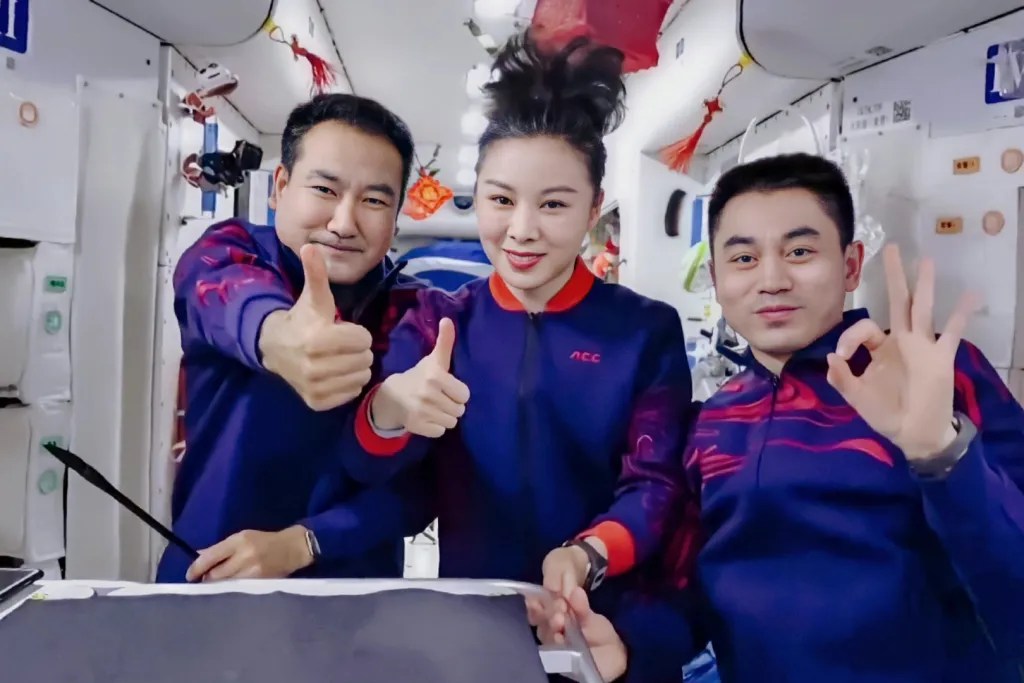
On the week of the 9th August 2022 the Takionaut Crew of the Shenzhou 14 vlogging Panoramic experience of the beauty outside the cabin from the Wentian experimental module….. module docking with the Tianhe core module, there are several more “viewing spots” outside the Chinese space station. Today, let’s take a look at the scene of Wentian’s sun wing slowly rotating against the background of the earth from the perspective of Tianhe and the beautiful view of the earth from the first perspective of Wentian….

The Wentian experimental module is equipped with the same Taikonauts’ living facilities as the core module, including 3 sleeping areas, 1 sanitary area, kitchen and other facilities, which can guarantee the astronauts’ life. It can also work with the core module to support the life of 6 astronauts during the rotation of the two manned spacecraft; in addition, a small robotic arm is also configured, which can be used alone or in combination with the large robotic arm of the core module. , to jointly complete the tasks of Taikonauts leaving the cabin, caring for extravehicular facilities, and patrolling. In addition, the Wentian experimental cabin is also equipped with an astronaut exit airlock. After the space station is completed, the airlock of the Wentian experimental cabin will be As the main airlock cabin for Takionauts to leave the cabin, the node cabin of the core cabin is used for other functions at this time, just as a backup; the Wentian experimental cabin also has a backup section for the core cabin to manage and control the assembly. That is to say, when the function of the core module platform fails, it can be switched to the Wentian experimental module to exercise the combined control and management functions, which can improve the reliability of the space station as a whole.

Images and Visuals are from their Respectives ..

#CNSA #ChinaNationalSpaceAdministration #国家航天局 |#BeltAndRoadinitiative #July2022 | #嫦娥五号#CLEP The #Moon #Change5 #LunarMission #MonsRumker #LunaExploration the Magical Chang’e 5″ #PopularScienceDocumentary Officially Released in #Beijing…

More than One year ago on 24th November 2020, the Chang Zheng – Long March Five Carrier Rocket Launched away  in CNSA – China National Space Administration China Wenchang spaceport launch, Change Five  Lunar probe into orbit, opened up towards China – People’s Republic of China’s first celestial bodies sample return trip from Mons Rumker on the Lunar Surface of the moon in which now on the week of 12th July a new series Popular Science Documentary named the “The Magical Chang’e 5” Popular Science Documentary Officially Released in Beijing- China – People’s Republic of China…  

 .……  

On July 12th 2022, the popular science documentary “The Magical Chang’e 5” jointly produced by the National Space Administration and the China Association for Science and Technology was officially released in Beijing. Shu Wei, secretary of the Secretariat of the China Association for Science and Technology, and Dong Baotong, deputy director of the National Space Administration, attended the press conference and delivered speeches. Hu Hao, the chief designer of the third phase of the lunar exploration project, and relevant comrades from the China Association for Science and Technology, the National Space Administration, the Space Foundation, and the engineering research and development units attended the conference- press conference.

On December 17, 2020, the Chang’e 5 mission, the third phase of the lunar exploration project, obtained 1,731 grams of lunar samples and returned to Earth, realizing the millennium dream of the Chinese nation “to embrace the moon in nine days”, and promoting human lunar sample research into the “Chang’e Era”. Chang’e 5 is not only a historical achievement of scientific and technological innovation, but also has a very high value for popular science. Show the lunar exploration journey of Chang’e 5 in the way of popular science, and tell the technological breakthrough of Chang’e 5 in the language of popular science, give full play to the social efficiency of major projects, and promote the process of popularization of scientific and technological resources.

Scientific and technological innovation and scientific popularization are the two wings to realize innovation and development. The popular science documentary “The Magical Chang’e 5” focuses on the key links of the Chang’e 5 mission from launch to home. It reproduces the magical journey of Chang’e’s lunar exploration in the form of records + popular science, and uses the form of documentary + animation It describes the scientific principles of Chang’e’s lunar exploration, which is a beneficial exploration of the combination of scientific and technological innovation and scientific popularization.
 

At the press conference, three senior consultants of the lunar exploration project sent messages via video. Academician Luan Enjie, the first commander-in-chief of the lunar exploration project, said that our lunar exploration project has embarked on a lunar exploration road with Chinese characteristics. Academician Ouyang Ziyuan, chief scientist of the Chang’e-1 lunar application system, said that “The Magical Chang’e-5” is China’s first all-round, multi-dimensional and three-dimensional science popularization work based on the lunar exploration project. Academician Ye Peijian, chief designer and commander of the Chang’e-1 probe, said that the core technology can only rely on self-reliance. They believe that “The Magical Chang’e 5” will surely plant spiritual seeds in the hearts of young people and take our exploration to a deeper space.

Via CNSA China Space Administration –CLEP China Lunar Exploration project management office

#CNSA #ChinaNationalSpaceAdministration #国家航天局 |#BeltAndRoadinitiative #酒泉衛星發射中心 #JiuquanSatelliteLaunchCenter #July2022| Preparing for the#中科院之声 #ChineseAcademyOfSciences #ChinaSolarProbe #ASOS #AdvanceSpaceSolarObservatory for the #October2022 launch calendar.

酒泉衛星發射中心On the launch calendar October 2022 Hong Kong SAR – Beijing Time  morning, CNSA –China National Space Administration  Jiuquan Satellite Launch Center – Inner Mongolia – China – People’s Republic of China is preparing to launch China- People’s Republic of China’s first comprehensive solar exploration satellite named [Advanced Space-based Solar Observatory (ASO-S) call for centralized nicknames and plans to launch in October this year] According to the latest news from the Chinese Academy of Sciences, my country’s first comprehensive solar exploration satellite – Advanced Space The base Solar Observatory (ASO-S) will launch from the Jiuquan Satellite Launch Center in October 2022 to start a journey of exploration of the sun.

The satellite is equipped with payloads such as the All-Solar Vector Magnetic Imager, the Lyman Alpha Solar Telescope, and the Solar Hard X-ray Imager. It weighs 888KG and will operate in a 720-kilometer sun-synchronous orbit with a design life of more than 4 years. It will reveal the solar magnetic field. , the formation and interrelation of solar flares and coronal mass ejections (“one magnetic and two storms”).

The Purple Mountain Observatory of the Chinese Academy of Sciences sincerely invites everyone to give a Chinese nickname to the upcoming Advanced Space-Based Solar Observatory (ASO-S), and the call for naming selection for the ASO-S probe  will be held from July 11 to 24, 2022..

Operating in a sun-synchronous orbit of 720 kilometers.  With many instrumentations of  Using Solar hard X-ray imager, equipped with 3 payloads, designed for a life span of more than 4 years and development time of more than 5 years, will reveal the formation and interrelationship of the solar magnetic field, solar flares and coronal mass ejections (“one magnetic and two storms….

After the successful launch of ASO-S, the “solar storm” of the 25th solar cycle will be recorded in detail. After the satellite is in orbit, it will generate about 500GB of detection data every day. All scientific data and analysis software of the satellite will be open and shared to users around the world to jointly achieve the ASO-S scientific goals.

Images and visuals are from Weibo also their respectives..

#CNSA #ChinaNationalSpaceAdministration #国家航天局 |#BeltAndRoadinitiative #July2022 | #CMS #ChinaMannedSpace the crew #Shenzhou13 #Takionauts #CSS #ChinaSpaceStation #王亞平#WangYaping celebrates the 25th year anniversary of return of #HongKong to the Motherland #China #PeoplesRepublicOfChina..

中国空间站 On currently on December 2021, the Belt and Road Initiative CNSA –China National Space Administration  CSS China Space Station in which on a three to six months setting up a new home of the first three Shenzhou 13 in which spending up to on for the further construction and verifications of the systems of the CSS –China Space Station 2021 launch calendar in which currently the three Takionauts current Shenzhou 13 ……  Preparations for the six months of extension of the China Space Station  In which the currently it remains awaiting for the crew of setting up home in conducting fun scientifically onboard中国空间站..  China Space station …..

王亚平 Wang Yaping, Senior Colonel PLASSF  became a Takionaut at the age of 29 Born in 1980, Wang Yaping became a Takionaut at the age of 29 years…  . At the youth report meeting of “My Motherland and Me” to celebrate the 25th anniversary of Hong Kong’s return to the motherland on the 1st July 1997 celebrated on 2022 with China –People’s Republic of China’s President Xi Jinping  .. She also jointly launched by the All-China Youth Federation, the Hong Kong Liaison Office, the provincial youth federations and major youth associations in Hong Kong, Wang Yaping gave her speech “Our journey is a sea of ​​stars and stars”. ”, shared her growth story, and listened her story..

In which during the 15th March 2022 Tuesday CNSA –CMS-China Manned Space Engineering Office the “Tiangong Classroom” of China’s space station will choose an opportunity to conduct the second space teaching activity coming soon with Takionaut Space Teacher Wang Yaping and her Teachers Assistants Zhai Zhigang Ye Guangfu …..

The content of the second space lecture was widely selected from the opinions and suggestions collected, and were carefully designed according to the facilities conditions of China’s space station. The lectures will be live-streamed throughout on multi various platforms on traditional to social live streaming mediums in which featuring Wang Yaping’s Daughter. In which Cities from the last Space Teachers Lesson was from Beijing –Hong Kong SAR – Macau SAR China – People’s Republic of China

Images and visuals are from their respectives.

#MadeInChina #中國製造 #中國 |#西藏 #西藏天文馆 #TibetPlanetarium #June2022 |#Lhasa The world’s highest-altitude planetarium Observatory telescope – world’s largest refracting optical astronomical telescope ready year  2024,  – under construction, which will provide space early warning services for space activities…#TibetAutonomousRegion #China #PeoplesRepublicOfChina ….

西藏天文馆 Currently at the moment in Lhasa the region capital of Tibet Autonomous Region of China- People’s Republic of China the Construction of the world’s highest – The world’s highest-altitude planetarium, the西藏天文馆Tibet Planetarium, started construction in Lhasa on June 12. It is reported that the roof of the planetarium will be equipped with a refracting optical astronomical telescope with a diameter of 1.06 meters, which will also be the largest refracting optical astronomical telescope in the world. The planetarium has a total construction area of ​​11,571.9 square meters and is expected to be completed in June 2024. The roof of the planetarium will be equipped with a refracting optical telescope with a diameter of about 1.06 meters. This astronomical telescope will also surpass the 1.02-meter-diameter refractor telescope of the Yerkes Observatory in the United States and become the world’s largest refracting astronomical telescope. …


This one-meter-class refractor telescope can monitor variable stars, poor photometry of binary stars, and supernova monitoring. The scope of monitoring includes celestial bodies in the solar system, stars in the Milky Way, and even some nearby galaxies in the outer reaches of the Milky Way can also be observed.
In addition, in scientific research work, this one-meter-class refracting telescope will be used for space target observation, providing space early warning services for my country’s space launch activities and the on-orbit operation of spacecraft.


“Space debris and space junk are being monitored on a global scale, and this monitoring network requires a large number of space observation facilities such as telescopes to work together. The scientific goals of our one-meter-class refractor telescope also involve near-Earth detection in space. The monitoring activities of small celestial bodies and space debris are part of the entire monitoring network.” Wang Junjie said that there is no professional large-scale astronomical observation telescope in the vast Tibet area, and the space monitoring network needs to deploy monitoring equipment closely. The high-level refractor telescope is equivalent to filling the “blind area” of China’s space monitoring network. It will become an important part of the entire monitoring system. The monitoring data obtained will also be used together with the data of other monitoring facilities to calculate the space flight. The construction of the Tibet Planetarium in the orbit of the object 

The special geographical and climatic advantages of Tibet can also facilitate astronomical observations. In order to reduce the influence of atmospheric, weather and other factors on astronomical observation activities, astronomical observation facilities should preferably be located in places with higher altitudes, more sunshine and less rain, and less light pollution. The characteristics of high altitude, sunny days, low population density and high atmospheric visibility in Lhasa will be conducive to astronomical observations.

  In addition, the Tibet Planetarium after its completion will also undertake a special mission, that is, to carry out astronomical science popularization activities that are easy for the public, especially young people to participate in and accept, and popularize astronomical science knowledge through exhibitions, training, experiments, video broadcasts, lectures, etc. , to spread scientific ideas.

 ”The world’s highest-altitude planetarium, coupled with the world’s largest refracting optical astronomical telescope, will have a huge appeal to local people, domestic and foreign tourists, and astronomy enthusiasts. The scientific and cultural literacy of the public plays a unique and important role.” Wang Junjie said that he believed that the Tibet Planetarium would become a new local Internet celebrity landmark, attracting local people and global tourists to visit.

  According to the operation data of the Tibet Natural Science Museum over the years, the annual reception of the Tibet Planetarium is expected to reach more than 100,000 people, and more than 100,000 people can receive astronomical science popularization education every year.

  Wang Junjie said that in recent years, the astronomical undertakings in Tibet have been developing continuously, from the Tibet Yangbajing Observatory, the first professional observatory in Tibet, the National Astronomical Observatory, to the Ali Observatory of the National Astronomical Observatory in western Tibet. The former has a submillimeter-wave telescope in cooperation with Germany, which mainly explores star formation, organic molecules, etc. The latter is still under further construction, including gravitational wave telescopes, optical telescopes and other equipment.

Images and visuals are from their Respectives