On the 15 March 2024 Hour Hong- Kong SAR – Beijing time CNSA –China National Space Administration ….. the “Chang Zheng -Long March 5” Yao-8 carrier rocket which will carry out the Chang’e-6 mission of the fourth phase of the lunar exploration project, safely arrived at the Wenchang Space Launch Site in China. Subsequently, the rocket will be assembled and tested at the launch site together with the Chang’e-6 probe that arrived in advance. Currently, all participating systems in the launch site area are preparing for the Chang’e-6 mission as planned…..
“Chang Zheng -Long March 5” Yao-8 carrier rocket which will carry out the fourth phase of the lunar exploration project嫦娥六号was safely transported to the Wenchang Space Launch Site in China. Subsequently, the rocket will be assembled and tested at the launch site together with the Chang’e-6 probe that arrived in advance. Currently, all participating systems in the launch site area….
【Complete vertical transfer! Choose the right moment to launch! 】
On April 27th 2024, after the Chang’e-6 probe and the Long March-5 Yao-8 carrier rocket completed relevant work in the technical area at the Wenchang Space Launch Site in China, the vehicle-rocket assembly was transported vertically to the launch area. It is planned to select an opportunity for launch in early May.
After the Chang’e-6 probe and the Long March-5 Yao-8 carrier rocket arrived at the launch site in January and March respectively, they successively completed various preparations such as final assembly and testing. On April 27, the movable launch platform carrying the Long March 5 Yao-8 carrier rocket slowly and safely transferred the rocket assembly from the vertical test factory to the launch area. Subsequent functional inspections, joint tests, propellant filling and other work will be carried out as planned
Mission planning
嫦娥六号 Chang’e-6 plans to conduct systematic and long-term research on samples from the far side of the moon, analyze the structure, physical properties, and material composition of the lunar soil, and strive to obtain updated lunar scientific data [42].
The first scientific goal of Chang’e-6 is to carry out mapping detection and geological background survey of the landing site area, obtain on-site analysis data related to lunar samples , and establish a relationship between on-site detection data and laboratory analysis data. Mainly includes: topography detection of the landing area : description and structural characteristics around the sampling point ; description, size and distribution of impact craters , etc. Material composition detection: material composition characteristics at sampling points; physical characteristics and structure of lunar soil ; temperature gradient detection in the shallow layers of the lunar crust , etc. The second scientific goal is to conduct systematic and long-term laboratory research on the lunar samples returned to high altitudes, to analyze the physical characteristics and structural structure of lunar soil and lunar rocks , mineral and chemical composition, trace elements and isotope composition, and lunar rock formation and evolution. Through the isotope age determination of the process, the interaction between cosmic radiation and solar wind ions and the moon, the space weathering process and environmental evolution process, etc., we will conduct in-depth research on the formation and evolution history of the moon.
The second scientific goal is to conduct systematic and long-term laboratory research on the lunar samples returned to the ground , and analyze the physical properties and structural structure of the lunar soil and lunar rocks, mineral and chemical composition, trace elements and isotope composition , and the formation and evolution of lunar rocks. Isotopes of the process, the interaction between cosmic radiation and solar wind ions and the moon, space weathering processes and environmental evolution processes, etc., to deepen the study of the formation and evolution history of the moon.
To achieve lunar sample return, many technological breakthroughs are needed, such as sample collection technology, lunar surface ascent and takeoff technology, lunar orbit rendezvous and docking technology, etc. Because it is a high-speed return, breakthroughs in re-entry technology are also needed. In terms of sampling, it is not only necessary to collect lunar soil from the lunar surface , but also to drill holes to remove materials of different depths from the lunar soil layer 2 meters below and bring them back to the earth. Therefore, Chang’e 6 will also carry a drilling rig …
At 0651 Hours Hong Kong SAR- Beijing Time 27th March 2024 , China- People’s Republic of China- CNSA –China National Space Administration Successfully launched rocket ignited and took off at the Taiyuan Satellite Launch Center Shanxi Province.. , and then sent the Yunhai-3 02 satellite into the predetermined orbit. The launch mission was a complete success launched with the Chang Zheng- Long March 6A Yao 3 Carrier Rocket.
Yunhai-302 satellite and Chang Zheng- Long March 6A Yao 3 Carrier Rocket. Were both developed by the Eighth Academy of China Aerospace Science and Technology Corporation. Satellites are mainly used for tasks such as atmospheric and marine environment detection, space environment detection, disaster prevention and reduction, and scientific experiments. The Chang Zheng- Long March 6A rocket is my country’s new generation of solid-liquid bundled medium-sized launch vehicle, which adopts a two-stage and semi-configuration design. The rocket has a total length of about 50 meters, a take-off weight of about 530 tons, and a carrying capacity of more than 4.5 tons in a 700-kilometer sun-synchronous orbit.
This mission is the first launch mission of the Chang Zheng- Long March 6A in 2024, and it also kicked off the high-density launch of the Changliu rocket this year….
On the 1210 Noon 4th December 2023 Monday Hours Hong- Kong SAR – Beijing time CNSA –China National Space Administration , China, People’s Republic of China. Successfully launched the Yonggan 33 Remote Sensing satellite with the Chang Zheng- Long March 2C Jiuquan Satellite Launch Center, Inner Mongolia, China, People’s Republic of China, and then successfully launched a new Egypt on the Egypt-2 satellite project
[The Long March 2C carrier rocket successfully launched the Egypt Satellite 2]
At 12:10 Beijing time today, my country successfully launched the Egypt Satellite 2 using the Long March 2C carrier rocket at the Jiuquan Satellite Launch Center. According to the agreement between China and Egypt on the Egypt-2 satellite project, China has developed and launched for Egypt a small optical remote sensing satellite with a resolution of 2 meters (panchromatic)/8 meters (multispectral);
Using satellites aided by the Chinese government The final assembly and integration test center conducts final assembly and testing of the satellite; after on-orbit delivery, it will serve Egypt’s land and resource utilization, water conservancy, agriculture and other fields. This launch is the 499th launch of the Long March series of launch vehicles…
Entering the predetermined orbit, the launch mission was a complete success. This mission also carried and launched the second group of Xingchi-1 satellites A and B. The Egypt-2 satellite is mainly used for Egypt’s land and resources census and meets the needs of Egyptian users in the fields of agriculture, forestry, urban construction, environment and disaster monitoring. The two satellites launched are mainly used to provide commercial remote sensing services to users.
The Egypt-2 satellite uses the CAST1000 platform independently developed by the Aerospace Dongfanghong Satellite Co., Ltd. of the Fifth Academy of Aerospace Science and Technology as the satellite platform. It strictly controls the key links to improve image quality and selects high-performance technology that has been verified in orbit. The quality-independent and reliable core detector strengthens the high-quality control of the satellite-ground integrated indicator system in the entire process of satellite design, analysis, testing, and testing.
On November 2nd , 2023, the factory review meeting of the Egypt-aided Satellite 2 was held at the China Academy of Space Technology and passed the factory review as planned. Leaders of the International Economic Cooperation Affairs Bureau of the Ministry of Commerce and leaders of the Earth Observation and Data Center of the National Space Administration, the project management unit, attended the meeting and delivered speeches.
Experts attending the meeting watched a documentary report on satellite development, listened to the “Summary Report on the Development and Quality of the Egypt-2 Satellite Aid” made by the satellite chief engineer, and conducted discussions and questions. The review expert group believed that the Egypt-aided Satellite 2 had successfully completed all development and testing work, met relevant quality supervision requirements, and agreed to pass the factory review.
The meeting pointed out that the Egypt-2 satellite project is a landmark project for pragmatic cooperation between China and Egypt, the transformation and upgrading of China-Africa cooperation, and the promotion of high-quality development of the joint construction of the “Belt and Road”. A concrete manifestation of joint action. Since the start of the project, the general contractor and the management unit have cooperated sincerely to overcome the impact of the epidemic and overcome difficulties, and the work results have been hard-won. The successful implementation of the project has achieved many “firsts” in the history of China-Egypt cooperation and is of milestone significance.
As a satellite project that adopts a foreign aid management model, the Egypt-2 satellite project has written a new chapter in international cooperation in my country’s satellite projects. As a project management unit, on the basis of strict quality management and project management, the center will continue to manage the follow-up satellite launch, on-orbit testing and delivery stages, continue to expand the breadth and depth of China-Egypt aerospace cooperation, and build a new era for the new era. The China-Egypt community with a shared future continues to contribute its space capabilities.
It is on the morning of October 26, 2023, the “Shenzhou 17” manned spacecraft carrying three Takionauts will be launched from the 921 station of the Jiuquan Satellite launch Center, Inner Mongolia, China, People’s Republic of China by the “Long March 2F” Yao 17 carrier rocket to joining up with the Crew of the Shenzhou 16 Takionaut Crew onboard the Tiangong –China Space Station, On the 25th October 2023 CNSA- China National Space Administration According to the China Manned Space Engineering Office, the Takionaut Shenzhou 17 Crew is aiming to be launched at 11:14 on October 26th 2023.
The crew for the Shenzhou 17 manned mission will consist of three Takionauts: Tang Hongbo, Tang Shengjie, and Jiang Xinlin, with Tang Hongbo serving as the commander. The crew includes 1 second-batch astronaut and 2 third-batch Takionauts. It is the youngest average age of the Takionaut crew since the launch of the space station construction mission…..
On the morning of October 26 2023, the Shenzhou 17 manned spacecraft was launched from the Jiuquan Satellite Launch Center. Three Takionauts, Tang Hongbo, Tang Shengjie, and Jiang Xinlin, and the “Shenzhou 17 manned mission logo” carried the spacecraft to space. As the designer of the Shenzhou 17 manned mission logo, Tan Haoyu, a student at Sichuan Fine Arts Institute, was also invited to the launch site to observe and witness.
At 11:13:59 in the morning, the Shenzhou 17 spacecraft was ignited and launched. There was a special audience at the scene. She was the designer of the Shenzhou 17 mission logo—Tan Haoyu, a first-year postgraduate student majoring in cultural and creative design at the Sichuan Academy of Fine Arts.
At noon on the 26th, a cover news reporter contacted Tan Haoyu. She said that watching the logo she personally designed fly into space, she felt like she was still “in a dream.” “I arrived at the scene two days before the launch. In fact, before I came, I expected that I would be very excited, but when I went to the scene and watched it with the surrounding audience, it was a different feeling. That is the word ‘excited’ Two words can’t describe it.”
Due to a tight schedule, Tan Haoyu can only communicate with reporters by phone. She said that although the sunlight at the Jiuquan launch site was very strong, it still could not stop the enthusiasm of the audience in anticipating the launch of the “Shenzhou 17”.
“Especially the moment the rocket ignited, I could hear the roar of the rocket taking off and the cheers of the surrounding audience.” Tan Haoyu said that at that moment, he felt more deeply the pride of participating in the design, “It was like a huge wave facing us. It rushed forward and instantly drowned out all my thoughts, leaving only the spacecraft at the scene in my mind.”
According to previous reports, on February 15, 2023, the China Manned Space Engineering Office solicited from the public the logos of the three missions of Tianzhou 6, Shenzhou 16, and Shenzhou 17. After Tan Haoyu learned the news, he actively participated in the creative team of Sichuan Fine Arts Institute and designed the Shenzhou 17 mission logo using “symmetrical” composition, highlighting the central focus, and combining the number “17” with the spacecraft tail flame.
In May of this year, Tan Haoyu accepted an exclusive interview with cover news and introduced in detail how she used just 11 days to design the “winning” work.
“Although the whole creation process only lasted 11 days, I used every bit of the creative feeling I accumulated in my life. Therefore, for me, the meaning of ‘ Shenzou 17- ‘ is even more special.” Tan Haoyu said this .
At the end of the call, Tan Haoyu told the cover news that experiencing this design has strengthened his belief in being an excellent designer. “I hope there will be more opportunities in the future to participate in design projects that serve the country.”
The Shenzhou 17 manned mission logo is the first mission logo publicly solicited from the whole society for the manned space project. It is the only work designed and selected by college students. As the mission is approaching, Tan Haoyu, the designer of the mission logo and a graduate student at Sichuan Fine Arts Institute, is invited to share the design concept and mental journey of the mission logo.
Some feelings Exploring the vast universe has always been the millennium dream of our Chinese nation. I clearly remember the excitement and excitement every time I sat in front of the TV to count down and watch the launch of the spacecraft.
The mission logos of the Shenzhou 16, Shenzhou 17 manned spacecraft and Tianzhou 6 cargo spacecraft launched this year are the first mission logos in the history of China’s manned space project to be publicly solicited from the whole society. When I saw this solicitation , as a student, I have both expectations and some apprehensions about being able to participate in this activity. At that time, I submitted the manuscript with a learning attitude and asked myself to do my best. The School of Design of Sichuan Academy of Fine Arts gave us great support for our creative submissions and organized a team of instructors to provide in-depth guidance.
When I learned that the logo I designed was selected, I was very excited and surprised. I felt that my design was recognized. This greatly encouraged me and made me more confident on the road of learning and work hard. Come up with more meaningful designs. I hope my example can encourage more students to actively participate and contribute to the people, society and country!
Logo design concept
During the design and research phase, I conducted in-depth research on the logos of previous domestic manned space missions and related foreign space mission logos. I gained a systematic understanding of the design style, information transmission, and use of elements of aerospace logos, and clarified the concept of “solemn, vigorous, and vigorous” “Upward” is the main design direction of the Shenzhou 17 manned mission logo.
In the process of designing the logo of the Shenzhou 17 manned mission, I used “starry sky”, “earth”, “space station” and “spacecraft tail flame” as the main elements in the logo. In order to express the mission and space station configuration characteristics more accurately, with the help of a team of instructors, I systematically sorted out the configuration changes of the space station from construction to completion, and gradually became familiar with the docking relationship between the spacecraft and the space station. In the end, I It can use intuitive graphic language to show the state of the Shenzhou 17 manned spacecraft docking with the forward port of the Tianhe core module of the space station after launch, and forming a three-cabin and three-ship combination.
I think the biggest design highlight of the Shenzhou 17 manned mission logo is the mission number “17”. After many attempts at expressing the mission number, I finally came up with the design idea of combining the shape of the tail flame of Shenzhou 17 with the mission number “17”. The tail flame of this eruption makes the whole picture show a surging upward trend, which symbolizes the momentum of our country’s aerospace industry being prosperous and vigorously developing.
In my original design of the logo, the number “17” was not in the tail flame of the spacecraft. Instead, “17” is pressed behind the entire space station. Later, my instructor gave me some advice. If “17” was placed at the back, the hierarchy would look confusing and the space station and spacecraft would not be highlighted. So, I adjusted it to make the hierarchy clearer. During the process of many adjustments, I suddenly discovered that this tail flame part seems to be used to highlight the “17”, which will make the layers appear clearer. At the same time, there will also be a visual center point, so that “17” will be more conspicuous.
In addition, during the preliminary research, I also found that the previous task logo designs were not symmetrical, so I came up with the idea of creating based on “symmetry”. The design of “17” and the spacecraft can be combined to present a state of “soaring into the sky”, and some of the stars I drew on both sides of “17” also have the overall effect of “rising up into the sky”. This kind of design is our best blessing to China’s aerospace industry, and also reflects the booming trend of our country’s aerospace industry.
In terms of the color matching of the logo, I will use dark blue representing “space” as the background color, with red representing “China” as the center. The significant color contrast makes the digital tail flame as eye-catching as a torch. Through the combination of blue and red These two colors pay tribute to what I consider the great spirit of manned spaceflight.
How the Shenzhou Seventeen logo was born
Let me share with you its evolution based on the works I drew.
This picture is my attempt at the logo of the Shenzhou 17 manned mission in the early draft stage. first Draft
process draft
During the revision stage, I further refined the configuration of the space station and spacecraft, and also made different attempts at composition, color matching, etc. After receiving feedback from the teacher, I was not satisfied with the colors, so I continued to adjust.
process draft
Entering the late revision stage, I recolored the logo, readjusted the composition, and came up with the idea of using numbers as tail flames. I also appropriately shrunk the space station to highlight the main spacecraft of the current mission. At this time, I still felt that the overall tail flame digital combination was not satisfactory, so I continued to adjust.
Task ID final submission version
After repeated attempts, I chose to highlight the mission spacecraft and tail flame 17. I adjusted the stars in the background to match the dynamics of the spacecraft to give the feeling of rising. I modified the stars surrounding the outer ring of the logo and added changes in thickness to the lines to make them more dynamic. Done, submit!
On the eve of the launch mission, the China Manned Space Engineering Office will invite Tan Haoyu, the designer of the Shenzhou 17 manned mission logo, to the Jiuquan Satellite Launch Center to watch the launch. At the same time, we welcome more aerospace enthusiasts from all walks of life to actively participate in the subsequent mission logo collection activities. The exciting launch moment is waiting for you to witness!
國泰航空公司Cathay PacificThis year on the year 2023中秋節 Mid-Autumn Festival falls on the Friday 29th September 2023 in which also it known as the Moon Festival which is adjacent to China’s National Day on October 1st. An 8-day public holiday in which is a Public National Holiday of eight days enjoyed from September 29th to October 6th….. The Chinese –Asian community festival is held on the 15th day of the 8th month of the Chinese lunisolar calendar with a full moon at night, corresponding to mid-September to early October of the Gregorian calendar.
The Mid-Autumn Festival, also known as the Moon Festival or Mooncake Festival, is a traditional festival celebrated in Chinese culture. Similar holidays are celebrated in Japan, Korea, Vietnam, and other countries in East and Southeast Asia
Mooncakes Symbolize Family Reunion
In Chinese culture, roundness symbolizes completeness and togetherness. A full moon symbolizes prosperity and reunion for the whole family. Round mooncakes complement the harvest moon in the night sky at the Mid-Autumn Festival
A mooncake (simplified Chinese: 月饼; traditional Chinese: 月餅) is a Chinese bakery product traditionally eaten during the Mid-Autumn Festival (中秋節). The festival is primarily about the harvest while a legend connects it to moon watching, and mooncakes are regarded as a delicacy.
Is it good luck to eat mooncakes?
The mooncakes are the sweet and round delicacies associated with the feast: thought to bring good luck and prosperity, they are usually given as a present to their loved ones and served with tea
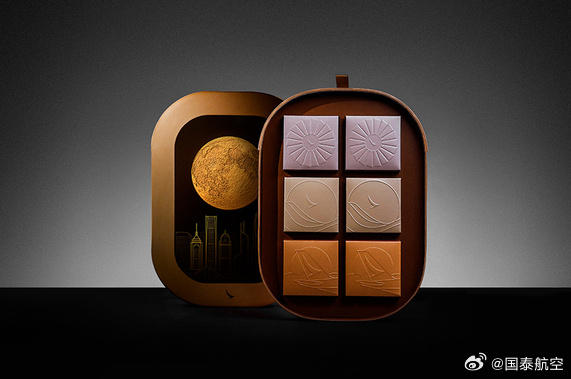
Put all the good things and blessings in the square gift box, and let the warmth of reunion be condensed in the small mooncake~ As the Mid-Autumn Festival is approaching, Cathay has specially prepared a mixed mini mooncake gift box for everyone. I hope this Holiday blessings can accompany the moonlight, travel across thousands of mountains and rivers, and reach you.
The carefully crafted limited edition mooncake gift box brings you a double enjoyment of sight and taste! The design is inspired by aircraft portholes, with unique ingenuity and simplicity. There are three classic Hong Kong-style mooncakes with egg yolk and white lotus paste, red bean paste, and custard. Each one uses a low-oil and low-fat formula, taking into accounts both deliciousness and health. Whether you are rushing to a reunion and enjoying the happiness of family gathering together; Or set sail for the stars and explore the unknown world together. As always, Cathay Pacific will accompany you every step of the way also the design are from Cathay international iconic elements!