中国空间站 On the 7th June 2023CNSA –China National Space Administrationat the Grounds of the Hong Kong SAR, China, People’s Republic of China, at Hong Kong SAR Government house in Central the 李家超 John Lee Ka-chiu-Chief Executive of the Hong Kong Special Administrative Region China, People’s Republic of China. Held a hosting meeting with the Hong Kong SAR Civilian Takionaut selection of the Role of Payload Specialist candidates.. His meeting is described as Meeting with payload expert- Specialists candidates…… as李家超 John Lee Ka-chiu-Chief Executive of the Hong Kong Special Administrative Region Quote below..
[Hong Kong SAR candidates have entered the selection stage of the national manned space engineering payload expert- Specialist]
Sun Dong, director of the Hong Kong Innovation, Technology and Industry Bureau, said on September 20th 2023 that more than one Hong Kong SAR candidate has entered the national manned space engineering payload expert selection stage. The country, China, People’s Republic of China. will send personnel to Hong Kong in early October to learn more about the candidates. Expect good news to be announced within this year.
After the SAR government selects candidates and recommends them to the country, more than one candidate from Hong Kong enters the final selection stage after primary and secondary elections. The candidates include both men and women. “I think we have achieved good results.
IT House reported on September 20 that my country launched the fourth batch of preliminary Takionaut selection last year, selecting payload experts in Hong Kong and Macau for the first time .
According to Hong Kong News Network, Hong Kong Secretary for Innovation, Technology and Industry Sun Dong said today (20th) that there are currently more than one candidate from Hong Kong who went to Beijing to participate in the “re-selection” of load experts for the national manned space project earlier . Entering the third stage of “selection”, there are men and women .
Sun Dong revealed that the country will send personnel to Hong Kong in October to learn more about the candidates, and he looks forward to good news this year.
IT Home inquired and learned that a total of 12 to 14 reserve Takionaut were selected this time, including 7 to 8 space pilots, 5 to 6 aerospace flight engineers and payload experts, including about 2 payload experts.
Aerospace pilots are selected from active pilots in the army, navy and air force, aerospace flight engineers are selected from scientific research and engineering technicians engaged in aerospace engineering and related fields, and payload experts are selected from scientific researchers engaged in space scientific research and application-related fields.
In May this year, my country’s space station welcomed the first payload expert into space—Gui Haichao. Gui Haichao is a professor at Beihang University . He is mainly responsible for the on-orbit operation of space science experimental payloads. He has professional training in science, aerospace engineering and other fields and has rich operational experience. He was selected as the Shenzhou 16 flight crew.
天问一号飞運騎遊達达3亿CNSA – China National Space Administration – ESA – European Space agency Belt and road initiative mars mission…first Mars exploration mission, Tianwen- Martian Probe OneAs of September 15, 2022, the Tianwen-1 orbiter has been in orbit for more than 780 days, and the rover has travelled a total of 1,921 meters, completed the established scientific exploration tasks, and obtained 1,480 GB of original scientific exploration data. The scientific research team has obtained rich scientific results through the research on the first-hand scientific data obtained independently by my country. Through a comprehensive study of typical landforms such as concave cones, barrier craters, and trenches distributed in the landing area, the important connection between the formation of the above-mentioned landforms and water activities has been revealed.
朱融号 The photos taken by the Mars rover before hibernation for one month (April 2022), maybe this is the posthumous work….
Currently as to date of the Zhurong Mars Rover is currently at sleep safe mode due to the Martian Sandstorms….. The location of Zhurong taken by the Tianwen-1 orbiter after it hibernated in Zhurong last year. The rut marks left by Zhurong after traveling 1921 meters are clearly visible….. The local dust on Mars captured by the Tianwen-1 orbiter is much layered. This photo was taken by the medium-resolution camera of the Tianwen-1 orbiter on January 6, 2022, and Zhurong went into a dormant state more than three months after this time point.
Last year, he appeared in the documentary “Hello! The photo of Arsia Mons in the opening title of “Mars” was synthesized from multiple photos taken by the medium-resolution camera of the Tianwen-1 orbiter on February 7, 2022.
On the basis of the previously released version, a post- processing….
The south pole of Mars taken by the medium-resolution camera of the Tianwen-1 orbiter is stitched together from three images. Image processing: SegerYu/CAS/NAOC/GRAS
A photo of the northwest corner of the Tempe Terra in the northern hemisphere of Mars. The coordinates are about 82° west longitude and 45° north latitude. It was taken by the Tianwen-1 medium-resolution camera on February 14, 2022, at 50% of the original size.
Original data source: China Planetary Exploration Engineering Ground Application System
The medium-resolution camera of Tianwen-1 were basically unprocessed. However, after trying to do post-production recently, it is still really fragrant, and I can get a lot of good pictures that feel completely different. For example, after processing the wind-eroded landform photos on the surface of Mars at 65.4° east longitude and 5.1° north latitude previously posted, Figure 1 is obtained . After comparing with the previous version (text of Weibo) (Figure 2), we can see that the overall effect is very high . A level of original data source: China Planetary Exploration Engineering Ground Application System….
Orson Welles crater (Orson Welles) near the equator, located in the Western Hemisphere Coprates quadrangle (MC-18), on the north side of the east end of Sailors Valley. The researchers believe that the pit was covered by sediment long ago, and that the collapse of an underground aquifer created a complex chaotic topography in the pit, releasing flash floods that formed vast lakes in the pit. The northeast side of the crater was damaged by multiple current events, and the flood water overflowed the rim of the crater, forming the downstream Shalbatana Vallis (Shalbatana Vallis). This is a key to the turbulent past of Mars… This picture is made by mosaicing 4 of the 26 Orbiter Medium Resolution Camera (MoRIC) images obtained by searching for the Sharbatana Canyon as the area of interest. Taken on February 22, 2022-detection cycle 914, using OpenCV, SKImage, Lr for processing. [CAS/GRAS, CNSA/PEC; export production:
Aram Chaos (left side) and Ares Canyon part (Ares Vallis, center right), in the Oxia Palus, MC-11, on the northeast side of Valles Mariners. The former is a circular chaotic terrain with a width of about 280 km, which is considered to be an impact crater highly eroded by water flow; the latter is an obvious overflow channel, which was landed by the Mars Pathfinder mission MESUR Pathfinder in 1997 The Sojourner rover landed here. This picture is made by searching a medium-resolution camera (MoRIC) image in an area with (2.6N, 21.5W) as the center and a search radius of 160 km. It was taken on February 9, 2022- Detection period 872, processed by OpenCV, SKImage, Lr. [CAS/GRAS, CNSA/PEC; export production
Gale Crater (the largest one in the picture above) and its surroundings taken by the medium-resolution camera of the Tianwen-1 Mars orbiter on March 3, 2022. Gale Crater is the place where the Curiosity rover landed on August 6, 2012. It has been nearly ten years since Curiosity landed when this photo was taken, and the Curiosity rover is still working tirelessly in Gale Crater Exploring, climbing Aeolis Mons (also known as Mount Sharp) located in the center of the pit from the northwest.
Several unnamed impact craters and some wind-eroded landforms near 7°N, 138.7°W of Mars were taken by the medium-resolution camera of the Tianwen-1 Mars orbiter on March 11, 2022, at 50% of the original size. Original data source: China Planetary Exploration Engineering Ground Application System
“Part of the Sacra Sulci at 18°N, 74.53°W on Mars, taken on March 6, 2022 by the Tianwen-1 Mars orbiter medium resolution camera, 50% of the original size. The several drop-shaped sand dunes in the picture look very interesting. Source of original data: China Planetary Exploration Engineering Ground Application System”
The mid-section of the Valles Marineris at around 70°W, taken by the medium-resolution camera of the Tianwen-1 Mars orbiter on February 8, 2022, is 50% of the original size and processed with contrast enhancement.
The area in the picture is mainly composed of four canyons: the smaller one in the upper left is Ophir Chasma, the one in the middle of the picture to the south is Candor Chasma, and the larger one in the lower left. The area is Melas Chasma (Melas Chasma), and the bottom right stretches all the way to the southeast is Coprates Chasma (Coprates Chasma).
Source of original data: China Planetary Exploration Engineering Ground Application System
The Martian dust storm taken by the medium-resolution camera of the Tianwen-1 Mars orbiter on February 3, 2022, 50% of the original size, processed with contrast enhancement. The center of the picture is about 3°W, 56°N, about 360 kilometers wide from east to west, and about 560 kilometers long from north to south, with a total area of about 200,000 square kilometers, which is larger than the area of most provincial-level administrative regions in eastern China. Original data source: China Planetary Exploration Engineering Ground Application System
The Phlegethon Catena (the one in the northeast-southwest direction) is located in the east of Alba Mons on Mars, at about 38°N, 103.5°W, as determined by the Tianwen-1 Mars Orbiter Rate camera taken on February 1, 2022.
Original data source: China Planetary Exploration Engineering Ground Application System
天文一号Curie Crater (the larger one in the middle and lower part) located at 28.78°N, 4.6°W on Mars and several unnamed craters around it were captured by the medium-resolution camera of the Tianwen-1 Mars Orbiter in 2022 Filmed on February 3.
Original data source: China Planetary Exploration Engineering Ground Application System
The Barabashov Crater (the largest one in the middle) is located at 47.3°N, 68.8°W on Mars. The upper right corner is the Perepelkin Crater, as shown by the Tianwen-1 spacecraft. Image taken by the Mars Orbiter Medium Resolution Camera on February 8, 2022, 50% original size.
Original data source: China Planetary Exploration Engineering Ground Application System
The Claritas Fossae group (Claritas Fossae) near 28.5°S and 103°W on Mars is full of rugged landforms and impact craters of different sizes. A long cliff extending from the upper left to the lower right is Claritas Fossae. Claritas Rupes. The photo was taken by the Tianwen-1 Mars Orbiter Medium Resolution Camera on March 18, 2022, 50% of the original size.
Original data source: China Planetary Exploration Engineering Ground Application System
The picture shows several impact craters in the Coracis Fossae group (Coracis Fossae) in the southern hemisphere of Mars, located at 33°S 78°W. The photo was taken by the Tianwen-1 Mars Orbiter Medium Resolution Camera on June 30, 2022, 50% of the original size.
Mount Askra, the second highest mountain on Mars, captured by the medium-resolution camera of the Tianwen-1 orbiter on February 1, 2022.
Data: CAS/NAOC/GRAS
Original data source: China Planetary Exploration Engineering Ground Application System
Valles Marineris taken by the Tianwen-1 Mars probe. This is the largest canyon in the solar system, 4,000 kilometers long, 200 kilometers wide at its widest point, and 7 kilometers deep. This photo was taken on February 8, 2022, when Tianwen-1 was at an altitude of 762 kilometers. Image source: CNSA/CLEP/PEC/MoRIC/
The Tianwen-1 Mars photo taken two years ago today shows the scene of a sandstorm approaching Olympus Mons. Image source: CNSA/CLEP/PEC/MoRIC/
东方空间 OrienSpace is one of sixty plus Carrier Rocket Companies in Made In China, People’s Republic of China.. Located in headquartered in Beijing, B3, Digital Manor, No. 1 Disheng West Road, Yizhuang Economic and Technological Development Zone, Daxing District, Beijing………Shandong Address: No. 30, Nanjing Street, Economic Development Zone, Haiyang City, Yantai City, Shandong Province………Shaanxi Address: 4th Floor, Northwest Building, Eleven Science and Technology, National Civil Aerospace Industry Base, Xi’an, Shaanxi Province…….Hainan Address: Room 125, 1st Floor, Building 20, No. 169, Wenwei Road, Wencheng Town, Wenchang City, Hainan Province…
Established in 2020, Dongfang Space is mainly engaged in space transportation. It is a design and manufacturing service company for launch vehicles and new aerospace vehicles. Through the research and development of the “Gravity” series of launch vehicles, the company has created serialized, diversified, and flight-based aerospace transportation products such as one-time use, recyclable reuse, and manned flight, and quickly formed low-cost, large-scale, and convenient launches. Service capability, committed to becoming the world’s most respected provider of commercial aerospace products and launch services, so that everyone can realize the dream of spaceflight…….
As of August 2023引力一号 #GravityOne Yao 1 Carrier Rocket ….passed the final assembly start review of the Yaoyi rocket…. Dongfang Space held the evaluation work for the start of the final assembly of the “Gravity-1” Yaoyi rocket. Plans, etc. were reviewed. The participating experts unanimously agreed that the “Gravity-1” Yaoyi rocket has the conditions to start the final assembly, marking the official departure of the “Gravity-1” Yaoyi rocket. The work of Dongfang Space’s first carrier rocket “Gravity-1” is progressing smoothly as planned, ensuring a complete success in the first sea flight in December.
“Gravity-1” is a three-and-a-half-stage rocket. The booster stage is bundled with 4 solid motors. A single unit is more than 10 meters high, 2.65 meters in diameter, and has a thrust of 155 tons. It will provide 600 tons for the rocket to take off. The thrust can achieve a low-Earth orbit carrying capacity of up to 6.5 tons …
[“Gravity-1” rocket has passed the review of the final assembly of the Yaoyi rocket]
Recently, with the completion of key tests and the complete set of first-flight products, Dongfang Space held a review for the start-up of the final assembly of the “Gravity-1” rocket. The preparation of the design and process documents, the completeness of the final assembly and ground products, and the final assembly plan were reviewed. The participating experts unanimously agreed that the “Gravity-1” Yaoyi rocket has the conditions to start the final assembly, marking the official departure of the “Gravity-1” Yaoyi rocket.
The work of Dongfang Space’s first carrier rocket “Gravity-1” is progressing smoothly as planned, ensuring a complete success in the first sea flight in December…
In recent years, China’s aerospace industry has developed rapidly. At the China Aerospace Conference on April 23rd 2023, Dongfang Space joined hands with strategic partner to release the world’s largest solid launch vehicle [Gravity-1], which is scheduled to launch its first flight in the second half of the year. The large carrying capacity of “Gravity-1” can not only achieve economies of scale and reduce the unit cost of rocket launches, but also meet the “one arrow and multiple satellites” satellite constellation networking work, and develop satellite networking more quickly. Dongfang Space innovates to create the “Gravity” series of large and medium-sized commercial launch vehicles, and maintains rapid development in accordance with the general idea of ”coexistence of solid and liquid, step-by-step, effective iteration, and system innovation…
[“Gravity-1” rocket booster separation test was a complete success]
Recently on the 2nd August 2023 , Dongfang Space independently designed, organized and implemented two “Gravity-1” carrier rocket booster separation tests at the Eastern Space Port. This test is the first commercial aerospace boost separation test in China. The test has fully assessed the timing of boost separation, the compatibility of the work of multiple sets of separation devices, the reliability of the binding structure, and the coordination of the separation process. A complete success. “Gravity-1” is the first domestic commercial space rocket with bundled design, and the world’s first all-solid bundled rocket. The rocket has a three-and-a-half-stage configuration. The booster stage is bundled by 4 solid motors. A single unit is more than 10 meters high, 2.65 meters in diameter, and has a thrust of 155 tons. It will provide 600 tons of thrust for the rocket to take off, making the “gravity -1” can achieve a low-earth orbit carrying capacity of up to 6.5 tons. The complete success of this test marks that the key booster separation technology and booster vertical assembly technology of the “Gravity-1” launch vehicle have been verified, and the established goal of “good, fast, and economical” has been achieved, laying the foundation for the rocket’s first flight at the end of the year. solid foundation.
[Changguang Satellite and Dongfang Space officially signed a contract for the “High Score 05” batch-production satellite launch service project, which will be launched into orbit on the first rocket of “Gravity-1” this year! 】
On April 17th 2023, Chang Guang Satellite Technology Co., Ltd. (hereinafter referred to as “Chang Guang Satellite”) and Dongfang Space held a signing ceremony for the “Jilin-1” high-resolution 05 satellite launch service project in Beijing.
Dongfang Space will use the “Gravity-1” carrier rocket to launch the “Jilin-1” high-resolution 05 satellite, providing batch and rapid network launch services for the new generation of high-resolution remote sensing constellations of Chang Guang Satellite.
At the signing ceremony, Xu Kai, deputy general manager of Changguang Satellite, expressed his expectation that the launch vehicle, satellite, data application and other industries will form a joint force to jointly promote the development of China’s commercial spaceflight. At the same time, we highly affirm the efforts made by Dongfang Space in the joint development of the star and rocket, and wish the first flight of “Gravity One” a complete success this year. Yao Song of Dongfang Space said that Changguang Satellite is the pioneer and leader of China’s commercial aerospace, and will continue to learn from Changguang Satellite, and the two sides will make progress and develop together. Dongfang Space Bu Xiangwei said that the “Jilin-1” satellite launch mission has posed new challenges to the company, and has also created a large application of large rockets. The company is confident in successfully completing the mission.
The “Jilin-1” constellation is the core project under construction of Changguang Satellite. It has built the world’s largest sub-meter commercial remote sensing satellite constellation, occupies a dominant position in remote sensing information services, and has gradually become an important source of space remote sensing information in the world. “Jilin No. 1” high-scoring 05-batch production star is the fourth-generation technology satellite of Chang Guang Satellite. It adopts a new generation of high-integration electronic control system, advanced technologies such as ultra-high-speed data transmission and electric propulsion, and adopts mass production and mass launch. , batch networking and the business model of rapidly providing remote sensing information services. It will provide higher-quality remote sensing information and product services in various fields such as homeland security, geographic surveying and mapping, land planning, agricultural and forestry production, ecological environmental protection, and smart cities, and provide customers with more abundant remote sensing data products.
“Gravity-1” is the first medium-sized solid launch vehicle for my country’s commercial spaceflight. The LEO carrying capacity reaches 6.5 tons, which triples the existing domestic solid capacity and meets the needs of low-orbit constellations and rapid launch services for medium and large satellites. The “Jilin-1” high-scoring 05-batch satellite launch mission is the first time that the “Gravity-1” rocket has been fully customized to support the construction of large-scale constellations. Through the joint design of the two parties for nearly half a year, the advantages of the large capacity and large space of the “Gravity-1” rocket will be “full and fully utilized”, which will help the construction of the “Jilin-1” constellation to greatly improve efficiency and reduce launch costs.
[“Gravity No. 1” has completed a number of static tests such as the inclined nose cone of the booster]
On the week of 30th July 2023…. The static test is also called the static strength test. By simulating the actual force and boundary conditions of the structure in actual work, the axial Force, bending moment and shear force are used to assess the structural strength, and the accuracy of the simulation results is verified to ensure the safety and reliability of the actual work. “Gravity One” adopts many low-cost and new forms that are conducive to mass production. During the development process, a large number of finite element simulations and serial static tests were carried out, which effectively verified the design results.
Since the beginning of this year, “Gravity-1” has successively completed a series of static tests including the combination of the instrument cabin, the second-level tail section of the core, the inclined nose cone, the first-level tail section of the core, and the booster tail section. Reliability of working under complex load conditions during flight. In order to speed up the progress, many trials are designed and carried out by the company itself.
In addition, the test adopted a method of multi-channel and multi-site parallel implementation. After full investigation, domestic units that meet the test capabilities were selected to ensure that multiple static tests were completed quickly within a short period of time. In the design of working conditions, through finite element simulation, the test team simplified more than ten working conditions into 3 to 5 working conditions (slightly different at each level), taking into account both efficiency and cost. The test adopts a staged loading method, and various working conditions are fully assessed, and the remaining strength coefficients of each section meet the service requirements.
Take the booster bevel cone as an example. Gravitation No. 1 adopts the design of uploading force, and the use of the inclined cone scheme can not only reduce the height of the section, but also provide a streamlined aerodynamic shape, but it requires high design and manufacturing capabilities. Yang Shuang, the person in charge of the oblique head cone, said that the structure is the most difficult project since the work: the oblique head cone is a special-shaped structure with a height of 4 meters. Constrained by small space and difficult force transmission and diffusion, it faces many difficulties such as bearing a concentrated load of 200 tons within a diameter of 250mm. In order to deliver on schedule, in less than half a year, the team fully practiced the concept of carrying out design and production to the end, and solved many technical problems after comparing multiple plans. In terms of testing, the team proposed an integrated loading scheme that simulated the flight state, which resolved related restrictions such as the site and loading conditions, and finally completed the delivery task on time.
At the same time as the series of static tests were completed, more than 20 flight rocket structures of “Gravity One” were produced and delivered simultaneously. This model also helps the company organize and carry out more innovative work in the future, and has accumulated valuable practical experience in “design-trial-manufacture-test-mass production”. The work of “Gravity One” is progressing smoothly as planned to ensure the complete success of the first flight in the fourth quarter. First flight test article | “Gravity One” completed….
.On the 2nd August 2023 Dongfang Space’s first carrier rocket “Gravity-1” will make its maiden flight at Dongfang Aerospace Port in December 2023. In order to ensure the success of the first flight, Dongfang Space has carried out various research and development work in a rigorous and meticulous manner. The structural system has recently completed the vibration test of the first-level core section and achieved complete success.
[Officially signed! Orient Space Aerospace Power Headquarters landed in Wuxi, and liquid rockets were launched at full speed]
On August 7, Orient Space and the People’s Government of Liangxi District, Wuxi City formally signed a contract for the Aerospace Power Headquarters Project in Wuxi. The project is expected to invest about 3 billion yuan. It will focus on the “Original Force” series of liquid rocket engines in Orient Space, develop core industries such as research and development, production, and testing of recyclable and reusable aerospace engines, and realize the ability to support an annual output of 300 liquid rocket engines. A first-class aerospace power comprehensive industrial base.
The world’s strongest solid launch vehicle “Gravity-1” will make its first flight at the Eastern Aerospace Port at the end of this year; the large-scale recyclable liquid oxygen kerosene rocket “Gravity-2” has been developed. The main feature is high-orbit launch, which will further increase the carrying capacity to 15 tons, which can meet the needs of large-scale satellite networking and medium-high orbit launches, and achieve first-class commercial space launch capabilities. It will make its first flight in 2025.
In the development of rockets, power comes first, and the capabilities of rocket engines determine the capabilities of rockets in space exploration to a certain extent. The “Gravity-2” rocket core first + core second stage will use the “Force-85” engine self-developed by “9+1” Dongfang Space. The “Original Force-85” 100-ton liquid oxygen kerosene engine adopts a gas generator cycle and a pintle injector, which has the characteristics of high reliability, high thrust, reusability, non-toxic environmental protection, and good economy. The scheme design and product production have been completed, and the test run of the gas generator has been successfully completed in March this year. The half-system and full-system test runs will be completed in the fourth quarter, and further development, testing and production work will be carried out at the Wuxi Aerospace Power Headquarters project. In 2025 it was applied to the “Gravitation-2” rocket for flight tests in 2010…
Images and visuals are from their respectives also 东方空间 OrienSpace
Currently at the moment中國製造 Expace Technology Corporation- a CASIC -China aerospace science and industry corporation has been very busy in building a New Carrier Rocket Factory in Wuhan National Aerospace Industrial Base in which the base will be in operations in May 2020 Kuaizhou Rocket Industrial Park that forms the manufacturing of twenty plus more Kuaizhou Rockets also its other sister larger carrier rockets in process of The assembly test capability of 20 solid launch vehicles……in which is now in operation……
快舟一号A Rocket Successfully Launches “Longjiang III” Test Satellite
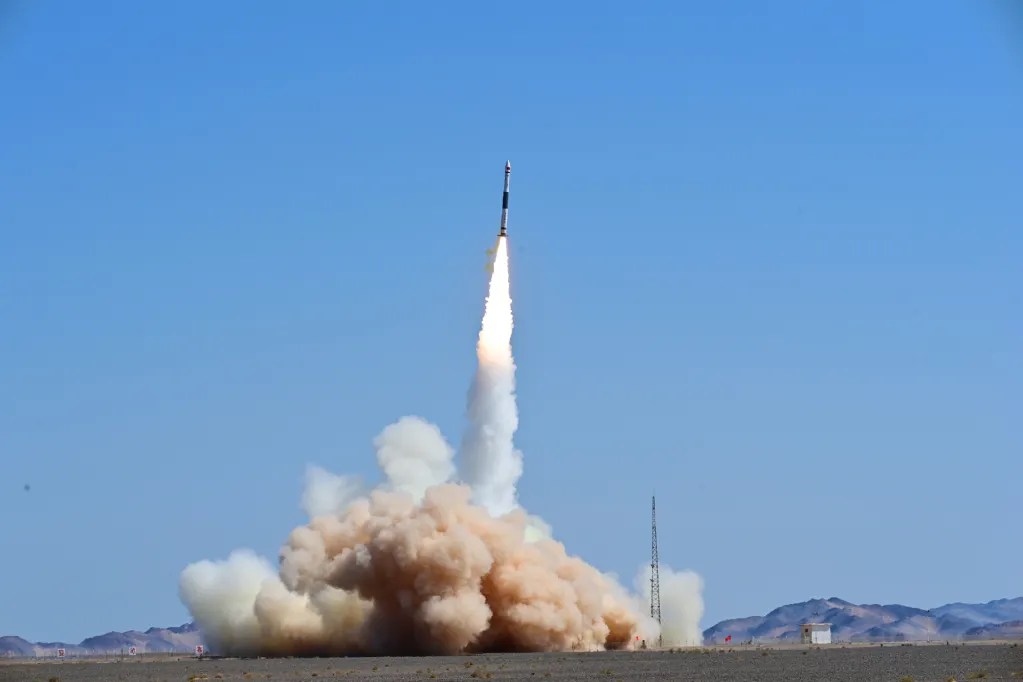
On a Clear blue Skies Day on Jiuquan Satellite launch Centre, Inner Mongolia, China, People’s Republic of China…. At 10:35 Hong Kong SAR- Beijing Time on June 9, 2023, the Kuaizhou-1A solid carrier named “Kuaizhou Ruike Laser” The rocket was ignited at the Jiuquan Satellite Launch Center, and sent China’s first flat-panel new system communication test satellite “Longjiang-3” into the predetermined orbit by means of “one rocket, one satellite”. The launch mission was a complete success.
The Kuaizhou-1A rocket that carried out this launch mission is a small solid launch vehicle launched by Aerospace Science and Industry Rocket Technology Co., Ltd. under the Aerospace Sanjiang subsidiary of China Aerospace Science and Industry Corporation. It mainly provides launch for 300 kg low-orbit small satellites It has the characteristics of high flight reliability, high orbital accuracy, short preparation period, less support requirements, and low launch cost.
The “Longjiang-3” experimental satellite was jointly developed by Harbin Institute of Technology and Harbin Institute of Technology Satellite Technology Co., Ltd. It is mainly used to verify key technologies such as satellite-ground high-speed communication and flat-panel satellite platform.
This mission is the 20th launch of the Kuaizhou-1A solid carrier rocket….
On the week on the 30th March 2023 CMS China Manned SpaceCNSA-China National Space Administration the crew of the Shenzhou 15 of the Tiangong-China Space Station Takionauts carried out the third out-of-vehicle activity. With the close cooperation of the ground staff and the Takionaut Deng Qingming in the cabin, the two out-of-vehicle Takionauts Fei Junlong and Zhang Lu successfully completed all the scheduled tasks and returned safely to the Wentian experimental cabin.
From the China Manned Space Office, on March 30, 2023, Beijing time, the crew of Shenzhou 15 Takionauts performed the third out of the cabin activity. With the close cooperation of the ground staff and the astronaut Deng Qingming in the cabin, the two out-of-vehicle astronauts Fei Junlong and Zhang Lu successfully completed all the scheduled tasks and returned safely to the Wentian experimental cabin. Since the manned mission of Shenzhou 12 in 2021, four astronauts have carried out a total of 10 out-of-vehicle activities, making breakthroughs and mastering a series of key technologies. At present, out-of-vehicle activities have become a routine work for astronauts in orbit. The follow-up will continue to be carried out on a normal basis according to the needs of the task. In addition, the Tianzhou-6 cargo spacecraft has safely arrived at the Wenchang Space Launch Site in the early stage, and the final assembly and testing work in the launch site area is being carried out as planned. It will be launched in early and mid-May…
Takionauts on-orbit work busy The three-chamber module combination of the Chinese space station not only means more space for the Takionauts, but also means more on-orbit work. The achievements of quasi-scientific experiments continue to flow, and extravehicular activities have become routine tasks for on-orbit astronauts. The current status of astronauts is just one word: “busy”
During this footage on the Tiangong TV Season four episode 20, containing the Taikonauts contains during the EVA it was over the Caspian Sea where the continental shelf is the coast of the Caspian Sea in Turkmenistan, and …. The footage was taken by the Takionauts when they were crawling on the Wentian-Tianhe and the cabin connection device, except for most of the ocean on the ground, the overexposed clouds, there are also blue-green features that appear to be coastal continental shelves. In addition, another key piece of information is the shadow projected on the Tianhe-Shenzhou interface……
The Shenzhou 15 mission is the sixth mission of China’s manned space program in 2022, and it is also the last mission during the construction phase of China’s space station. The crew will work and live in orbit for 6 months. The main purpose of the mission is to verify The space station supports crew rotation capabilities, realizing the first on-orbit rotation of Takionaut crews; carrying out the installation and commissioning of equipment inside and outside the space station and space application mission-related facilities and equipment, conducting space science experiments and technical tests; performing daily maintenance and repair of the space station; The normalized operation mode of the cabin assembly… . The Shenzhou 15 flight crew consisted of Takionauts Fei Junlong , Deng Qingming and Zhang Lu , with Fei Junlong serving as the commander…