On the months of January 2022 1st January 2022 on New Years Day 天问一号飞運騎遊達达3亿CNSA – China National Space Administration – ESA – European Space agency Belt and road initiative mars mission…first Mars exploration mission, Tianwen- Martian Probe One sent back stunning images of the Half Earth Mass size of the Rustic Planet Mars in which show stunning Martian landscape with its iconic polar caps of either southern or northern .. with its timeless Stunning Mars Photography.
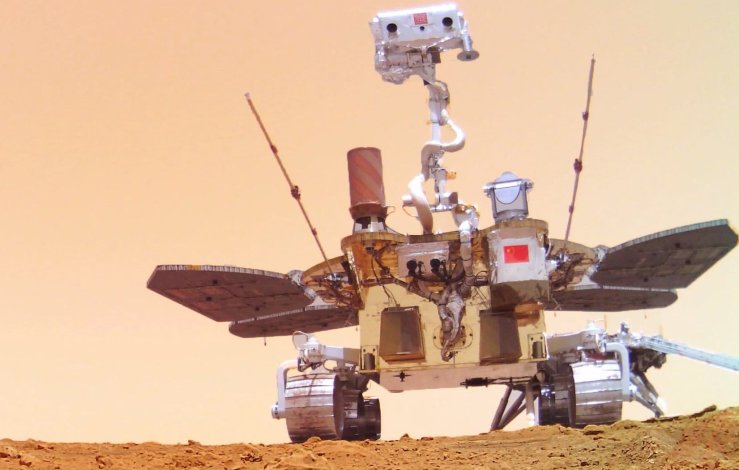
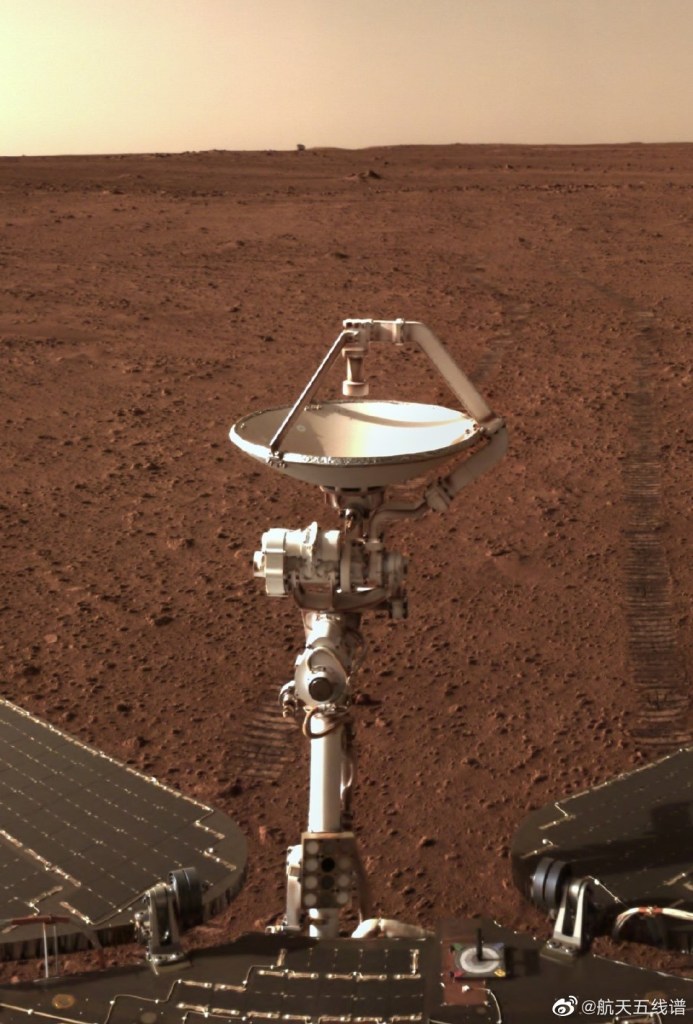
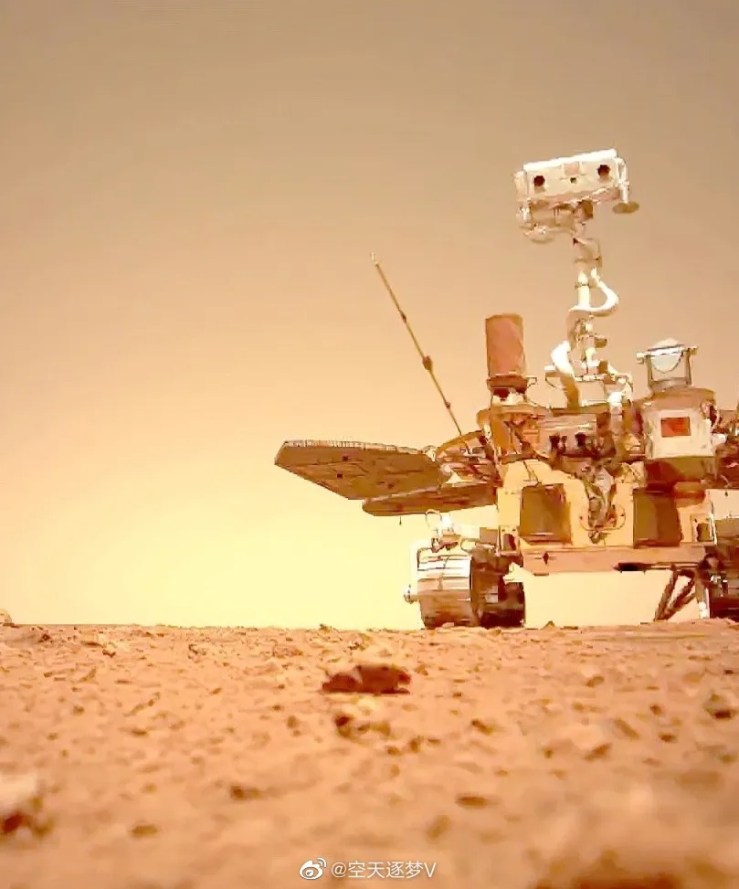
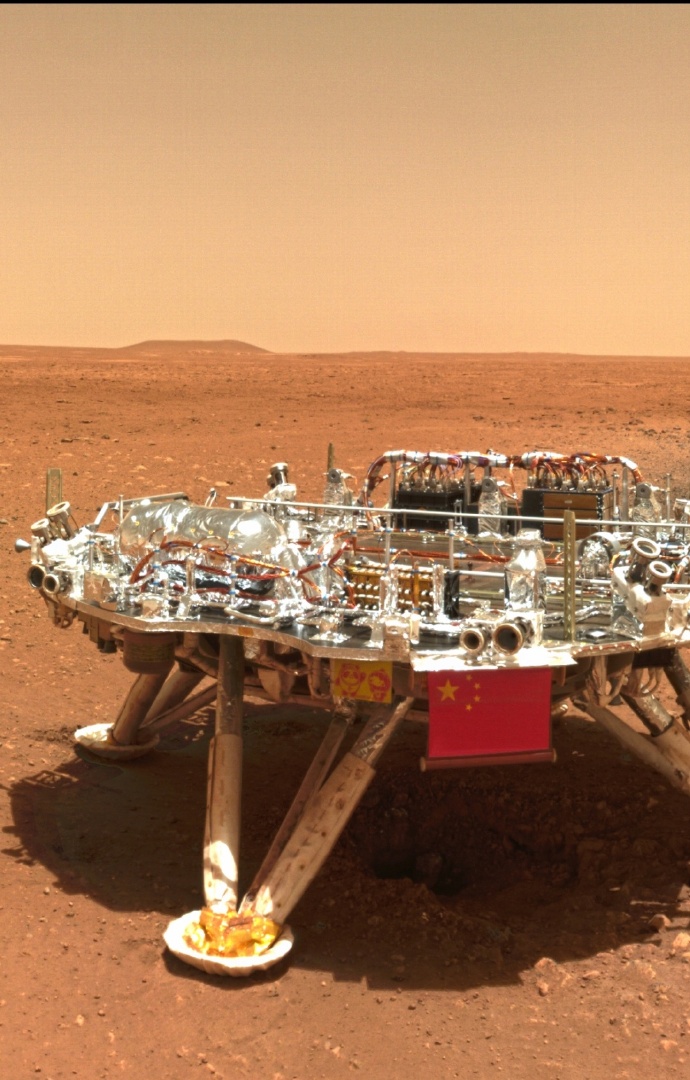
This set of images includes a photo of the orbiter and Mars, a close-up of the orbiter, the North Pole ice cap of Mars, and the “Zhurong” rover shooting fire landforms, etc., showing the operating status of the orbiter, the “Zhurong” rover, and the acquired surface of Mars form.
In Figure 1, the orbiter is flying over the north pole of Mars. The orbiter body is golden, the directional antenna for high-speed data communication with the ground is silver (under the orbiter body), and the solar wing is in good condition. The white area on Mars is the “ice” sheet covering the North Pole. Unlike the ice at the two poles of the Earth, the “ice” of Mars is composed of dry ice (solid carbon dioxide) and water ice. The dark area below Mars is the Olympia Shabo of Mars, the bright circular crater in the upper left corner is named Korolev Pit, and the remaining red and dark areas are bare ground.
Partial close-up of the orbiter
In Figure 2, the solar wing on the side of the orbiter is fully deployed and the attitude is stable. An unfolded subsurface detection radar antenna is parallel to the solar wing, and the magnetometer extension rod extends to the upper left of the surround.
Mars Arctic Ice Sheet
Figure 3 shows the Martian North Pole ice cap, the bedding is clearly visible. After years of deposition and ablation, it presents a spiral landform composed of a white ice layer centered on the pole and bare ground.
Figure 4 is a mosaic of 3 images acquired by the “Zhurong” Mars rover recently using a navigation terrain camera. In the figure, we can see typical Martian topography such as ring craters and rocks. As of December 31, 2021, the Tianwen-1 orbiter has been in orbit for 526 days, and is currently about 350 million kilometers away from the Earth. The communication delay is about 19.5 minutes. 1400 meters. At present, the Tianwen No. 1 mission is carrying out detection and related tests as planned, and a total of about 560GB of raw scientific data has been returned. The two devices are in good condition and operating normally.
Images and visuals are from CNSA- China National Space Administration also from there respectives..
On the months of November 2021 天问一号飞運騎遊達达3亿CNSA – China National Space Administration – ESA – European Space agency Belt and road initiative mars mission…first Mars exploration mission, Tianwen- Martian Probe One …….祝融号Zhu Rong” , China’s “Tianwen One” in cooperation with the European Space Agency “Mars Express” mission team, launched the “Vulcan No.” rover and “Mars Express” orbiter orbit relay communications test and achieved a complete success. Before the test, the respective detectors in both directions must be instructed to make preparations for the test. At the appointed time, the “Zhurong” will send the test data to the “Mars Express”, the communication distance is about 4000 kilometers, and the communication time is 10 minutes. The “Mars Express” receives the data and forwards it to the deep space monitoring and control station of ESA. After receiving the data, the monitoring and control station sends it to the European Space Operations Center (ESOC). The ESOC is then forwarded to the Beijing Aerospace Flight Control Center. After interpretation by the Chinese technical team, Interpret the correctness of the data. The test process is shown in the figure.
Constrained by weight and size, the Mars rover has weak direct-to-ground communication capabilities and cannot meet the demand for large amounts of data transmission. Therefore, the data needs to be sent to the Mars orbiter that is closer, and the orbiter with stronger communication capability is forwarded to the ground receiving system. , This process is called relay communication.
Under normal circumstances, before establishing relay communication, the orbiter will first send an “initiate” signal to the rover, and then the rover will reply with an “confirmation” signal, and then the two parties will establish a stable two-way relay communication link, just like a friend calling The phone needs to be dialled first. Since the launch frequency of the “Mars Express” does not match the receiving frequency of the “Zhurong”, the communication link cannot be established by “dialling a phone”. The transmission frequency of “Zhurong” matches the receiving frequency of “Mars Express”. Therefore, both parties need to agree on a communication time in advance. The “Zhurong” sends data directly and “Mars Express” performs “blind reception”, which is a bit similar to the communication method of WeChat. . The “Mars Express” orbiter has a “blind harvest” function, but there has been no chance to actually use this function for more than a decade.
ESA stated that this test is a good opportunity for the “Mars Express” to verify the “blind harvest” model in orbit. According to the results of data interpretation and analysis, the mission teams of both parties confirmed that the interfaces of the relay communication equipment configured on the “Zhurong” and the “Mars Express” match conform to international standards, and the content of the transmitted data is complete and correct, and the test is a success. In the future, the two parties will further carry out scientific data relay communication cooperation on the basis of this phase of experimentation. The “Zhurong” rover currently works on the surface of Mars for 196 Mars days, has travelled 1,297 meters in total, and obtained about 10GB of raw scientific data for inspections and explorations. It has sufficient energy and is in good condition.
On the 8TH November 2021 Friday 天问一号飞運騎遊達达3亿CNSA – China National Space Administration – ESA – European Space agency Belt and road initiative mars mission…first Mars exploration mission, Tianwen- Martian Probe One …….祝融号Zhu Rong” also have been exploration Roamingly1,253 meterson the Rustic half diameter planet size Red planet Mars… During that time Tianwen-1 orbiter enters remote sensing mission orbit…
November 8, 2021, “Heaven” successfully implemented around the fifth brake near the fire, into the exact orbit remote sensing mission, the Mars Global to carry out remote sensing. In the early stage, the “Zhurong” Mars rover has successfully completed the established inspection mission objectives, and is in good condition, and continues to carry out the detection mission. Considering the global remote sensing detection of the orbiter and the relay communication requirements of the Mars rover, the engineering development team optimized the orbit design and determined a remote sensing orbit plan with a near fire point of about 265 kilometers, a far fire point of about 10,700 kilometers, and a period of about 7.08 hours. While ensuring the development of orbiting scientific exploration, it will provide more relay communication support for the Mars rover to improve the efficiency of mission development.
n the remote sensing orbit, seven scientific payloads including mid-resolution cameras, high-resolution cameras, subsurface detection radars, mineral spectrum analyzers, magnetometers, ion and neutral particle analyzers, and energy particle analyzers will be acquired Scientific data such as fire star morphology and geological structure, surface material composition and soil type distribution, atmospheric ionosphere, Martian space environment, etc., focusing on typical landforms and geological units such as craters, volcanoes, canyons, and dry river beds, and implement high-resolution detection.
Up to now, the orbiter has been in orbit for 473 days, the ground fire distance is 384 million kilometers, and the light travel time is 21 minutes and 20 seconds; the rover has worked on the surface of Mars for 174 Mars days and travelled 1,253 meters in total. The two devices are in good condition. The working condition is normal.
On the 5th October 2021天问一号飞運騎遊達达3亿CNSA – China National Space Administration – ESA – European Space agency Belt and road initiative mars mission…first Mars exploration mission, Tianwen- Martian Probe One …….”祝融号Zhu Rong” previously on 30th August 2021 Mars Lander – Mars rover successfully exploring more than 1064 meters from its base lander camp.. Roamingly on the Rustic half diameter planet size Red planet Mars on Hong Kong SAR- Beijing Earth Wednesday time… In which new mileage: “Zhu Rong” Mars Rover ….Sailing in the galaxy, strolling through the glamorous rustic environment in talking it’s adventure with Tianwen 1 Martian communications probe orbiting the Red Planet… in which “Zhurong” Mars rover completes scheduled exploration mission
In which on 5th Tuesday October 2021 Tianwen-1 probe enters the solar transit stage since late September, the earth and Mars have gradually moved to both sides of the sun and the three are almost in a straight line. The solar electromagnetic radiation interference gradually increases, and the device-to-ground communication is disturbed. Instability or even interruption, this phenomenon is called “riling”.
The “lost connection” between the probe and the ground during the solar transit is the expected normal state, and the “lost connection” is not “missing”. In order to safely pass the solar transit period, the Mars rover and the orbiter have completed the relevant state settings recently, stopped the scientific exploration work and continued to monitor the state. riling will end in mid-October, and the probe will resume communication with the ground and continue scientific exploration.
In which during China’s National Day of the People’s Republic of China was told the Marian Lander Zhurong also its Base Camp Mars Lander to go on a well earn sleep hibernation in which Tianwen No.1 probe enters the solar transit stage Beginning in late September, the Earth and Mars have gradually moved to both sides of the sun and the three are almost in a straight line. Due to the electromagnetic radiation interference of the sun has gradually increased, and the communication between the device and the ground has been disturbed, and there has been instability or even interruption. This phenomenon is called “sun.” Ling”. The “lost connection” between the probe and the ground during the solar transit is the expected normal state, and the “lost connection” is not “missing”. In order to safely pass the solar transit period, the rover and the orbiter have completed the relevant status settings recently, stopped scientific exploration work and continued to monitor the status. Ri Ling will end in mid-October; the detector will resume communication with the ground and continue to carry out scientific exploration as the Planet Mars moves out from the Occultation going behind the Sun…
On the 30th Monday August 2021天问一号飞運騎遊達达3亿CNSA – China National Space Administration – ESA – European Space agency Belt and road initiative mars mission…first Mars exploration mission, Tianwen- Martian Probe One …….”祝融号Zhu Rong” Mars Lander – Mars rover successfully exploring more than 1064 meters from its base lander camp.. Roamingly on the Rustic half diameter planet size Red planet Mars on Hong Kong SAR- Beijing Earth Wednesday time… In which new mileage: “Zhu Rong” Mars Rover ….Sailing in the galaxy, strolling through the glamorous rustic environment in talking it’s adventure with Tianwen 1 Martian communications probe orbiting the Red Planet… in which “Zhurong” Mars rover completes scheduled exploration mission
The Zhurong Mars Rover had travelled a total of 1064 meters south of the landing site. Picture 1/2 is a panoramic view of the inspection area taken by 祝融号 recently. At present, the rover is in good condition and has sufficient energy. It will continue to follow the high-efficiency detection mode of “seven-day cycle, one-day planning, daily detection”, and drive to the ancient sea-land junction in the south to obtain richer scientific exploration Data.
The orbiter has been in orbit for 403 days and is about 392 million kilometers away from the earth. On August 24, a high-resolution camera was used to image the landing area, and a 1-meter resolution image was obtained. The rover’s trajectory is clear in the image…
At present, the distance of the ground fire gradually tends to be the furthest (about 395 million kilometers). In mid-to-late September, the Earth and Mars will travel to both sides of the sun. The three are almost in a straight line, and the probe will enter the solar transit phase ….. During the transit, due to the influence of solar electromagnetic radiation interference, the device-to-ground communication is interrupted, the orbiter and the rover will switch to safe mode and stop the detection work. After the solar transit, the orbiter will select the opportunity to enter the remote sensing mission orbit to carry out global remote sensing exploration of Mars, while taking into account the relay communication of the Mars rover’s expansion mission stage
On August 30th 2021, when China- People’s Republic of China first Mars exploration Tianwen-1 mission, “Zhurong”, the rover reached the surface of Mars for more than 100 days, the National Space Administration and the People’s Bank of China held China’s first Mars exploration mission in Beijing and successfully issued gold and silver commemorative coins. The ceremony is to commemorate an important step in our successful interstellar exploration journey, leaving China’s mark on Mars for the first time, becoming the world’s first country to achieve Mars circumnavigation, landing and patrol on a single mission. Wu Yanhua, deputy director of the National Space Administration, and Mou Shangang, chairman of China Gold Coin Corporation, delivered speeches.
At the ceremony, Chen Jianxin, deputy director of the People’s Bank of China Currency and Gold and Silver Bureau, announced the release announcement. Zhang Rongqiao, chief designer of China’s first Mars exploration mission project, released information on the progress of the Mars exploration mission. The leading experts at the meeting jointly presented gold and silver commemorative coins for China’s first Mars exploration mission. Coin unveiled.
Wu Yanhua said that this year marks the 100th anniversary of the founding of the Communist Party of China and the 65th anniversary of the founding of China’s aerospace industry. At this important historical moment and at this important project node, the National Space Administration, in conjunction with the Central Bank and the Gold Coin Corporation, issued “China’s First Mars Exploration Mission Successful” The commemorative coin is an organic fusion of science and technology and culture, aerospace and art. It is conducive to engraving historical achievements, is conducive to inspiring the whole line of aerospace to take the lead, and is conducive to setting off a national upsurge of innovation and creation.
Mou Shangang said that the success of my country’s first Mars exploration mission is an important achievement of the party and the country in advancing the building of a space power and a full demonstration of China’s aerospace spirit. It is worth recording and commemorating in the form of national legal tender. The issuance of commemorative coins can play an active role in inheriting the splendid and long-standing Chinese currency culture and patriotism, striving to achieve high-quality development of the aerospace industry, and demonstrating my country’s responsibility as a major country in advancing the progress and sustainable development of human civilization. The commemorative coin is the legal tender of the People’s Republic of China and is issued by the People’s Bank of China. There are 3 coins in total, including 2 gold coins and 1 silver coin. The logos on the front are the Chinese planetary exploration logo, and the country name and year number “2021” are published, and the patterns on the back are themed on the first Mars exploration mission “Orbit, Landing, and Patrol”, and the publication “China’s First Mars Exploration Mission Success · Tianwen Yi Number” and denomination. The commemorative coin condenses the vast space in a square inch, allowing the spacecraft to rise above the gold and silver coins. It uses a design method that combines realism and freehand brushwork. It adopts classic coinage techniques such as mirror surface, sandblasting, and multi-level sandblasting. It is scientific and The combination of aesthetics has important commemorative significance and artistic value.
The commemorative coin issued this time is China’s seventh set of aerospace-themed gold and silver commemorative coins. Prior to this, the 40th anniversary of the founding of China’s aerospace, the successful first manned space flight, the first lunar exploration flight, the first space walk, and the opening of the Beidou satellite navigation system Important aerospace events such as the operation and the success of the first moon landing have issued precious metal commemorative coins, bearing in mind China’s aerospace exploration achievements in climbing the technological summit, expressing the astronauts’ scientific dreams and forge ahead attitude, and demonstrating the Chinese people’s cultural confidence and romantic feelings. As of August 30, the rover had traveled a total of 1064 meters south of the landing site. At present, the rover is in good condition and has sufficient energy. It will continue to follow the high-efficiency detection mode of “seven-day cycle, one-day planning, and daily detection”, and drive to the ancient land-sea junction in the south to obtain richer scientific exploration. data. The orbiter has been in orbit for 403 days and is about 392 million kilometers away from the earth. On August 24, a high-resolution camera was used to image the landing area, and a 1-meter resolution image was obtained. The image shows a clear track of the rover.
At present, the distance of the earth fire is gradually approaching the farthest (about 395 million kilometers). In mid-to-late September, the earth and Mars will travel to both sides of the sun, and the three will be almost in a straight line, and the probe will enter the solar transit phase. During the transit, due to the influence of solar electromagnetic radiation interference, the device-to-ground communication is interrupted, the orbiter and the rover will switch to safe mode and stop the detection work. After the solar transit, the orbiter will select the opportunity to enter the remote sensing mission orbit to carry out global remote sensing exploration of Mars, while taking into account the relay communication of the Mars rover’s expansion mission stage.
Images and visuals are from CNSA- China National Space Administration also from there respectives..