深蓝航天 Deep Blue Limited – Deep Blue Aerospace One of sixty Chinese private space Carrier Rocket Companies in China-People’s Republic of China… As many of sixty plus Private Rocket Deep Blue Aerospace Co., Ltd. was established in 2017. The company is mainly a high-tech aerospace enterprise that focuses on the direction of liquid recovery and reusable launch vehicles and provides users with commercial launch services. Deep Blue Aerospace Co., Ltd. is headquartered in Nantong City, Jiangsu Province. At the same time, the company has rocket general and liquid engine R&D centers in Yizhuang, Beijing and Xi’an, Shaanxi, respectively, and a rocket power system test base in Tongchuan, Shaanxi…..
Development Progress | Deep Blue Aerospace completed the first fairing separation test in China using a non-pyrotechnic connection unlocking mechanism…
On the 2nd September 2023….. Recently, the separation test of the fairing of the “Xingyun-1” liquid recyclable and reusable launch vehicle of Shenlan Aerospace was a complete success. This is the first test in China to use a non-pyrotechnic connection unlocking mechanism to separate the fairing. In order to fully verify the separation state of the fairing under different deviations, Deep Blue Aerospace has carried out many experiments on this round, all of which use the self-developed non-pyrotechnic connection unlocking mechanism. The separation timing of the test is correct, which is basically consistent with the simulation results. No damage occurred.
This round of separation tests was completed at the Deep Blue Aerospace Nantong Rocket Assembly Base, and the fairing was completely recovered after multiple tests.
This round of separation tests was completed at the Deep Blue Aerospace Nantong Rocket Assembly Base, and the fairing was completely recovered after multiple tests.
This round of testing used the same set of connection and unlocking mechanisms to complete multiple separation tests within three days, verifying the reusability and rapid response capabilities of the self-developed non-pyrotechnical connection and unlocking mechanism. This is the first time in domestic fairing separation tests. This round of fairing separation test is one of the phased tests before the first flight of the “Nebula-1” liquid recyclable launch vehicle. The success of this round of test will lay the foundation for the successful first flight of the “Nebula-1” rocket in 2024. Solid foundation.
Why do rockets need to separate their Fairings?
The launch vehicle will encounter harsh environments during flight. The fairing protects the satellite payload from the aerodynamic forces and aerodynamic heat and also reduces the aerodynamic resistance of the launch vehicle during flight. After leaving the atmosphere, the launch vehicle is no longer affected by aerodynamics and throwing away the fairing helps to increase rockets capacity..
Beijing Zhongke Aerospace Exploration Technology Co., Ltd. is the first domestic aerospace enterprise with mixed ownership, and it is also the target enterprise that Oriental Aerospace Port focuses on introducing. Relying on the scientific research strength and resource advantages of the Institute of Mechanics of the Chinese Academy of Sciences and the Aerospace Flight Technology Center of the Chinese Academy of Sciences, China Aerospace Science and Technology has been committed to the research and development and integration of space technology and aerospace vehicles as a platform for the transformation of major national scientific research projects, as well as the transformation and provision of technological achievements. Aerospace launch service. The Lijian-1 rocket project also adds a brand-new name card to the Oriental Space Port, which will surely promote the construction of the Oriental Space Port to take a solid step forward.
Holding the torch of science and casting the heavy arrow of a great country | the ability of final assembly testing has been further improved! Lijian-1 Yaosan carrier rocket has completed the final assembly at the China Science and Technology Aerospace Industrialization Base and has entered the testing stage…
On August 19th 2023, the Lijian-1 Yao-3 launch vehicle successfully completed the final assembly work as planned at the China Aerospace Industrialization Base. During this period, each final assembly link achieved the “three noes”: no accidents, no hidden dangers, and no redundant objects. At present, the test conditions have been met, and the factory test is in progress. It is planned to leave the factory in October and carry out the third launch mission at the Jiuquan Satellite Launch Center. The Lijian-1 launch vehicle successfully launched twice in a row, successfully sending a total of 32 satellites into predetermined orbits. The total weight of the satellites was nearly 2 tons, further promoting a new chapter in the flight launch of China’s commercial launch vehicles. Based on the accumulated practical experience of previous multi-engine missions, the China Aerospace General Assembly team has continuously improved the technical details. Based on the pulsating production line of the industrial base, it has optimized the entire assembly production process, applied automatic intelligent tooling equipment, and strengthened personnel organization and management. etc., shortening the final assembly cycle of Lijian-1 Yaosan launch vehicle to 30 days .
In order to meet the refined design requirements and production needs of the rocket assembly process, Zhongke Aerospace technicians independently designed a variety of tooling products to assist in the final assembly , which can be used to improve measurement accuracy, simplify operation difficulty, and improve product reliability. For example, due to the existence of the rotating shaft, the zero position measurement of the servo system is difficult to locate and read with ordinary vernier calipers or steel rulers. In order to solve this problem, technicians designed special tooling according to actual needs, which effectively solved the difficulty of positioning and inaccurate readings. problem, greatly improving the accuracy and efficiency of measurement.
It is worth mentioning that, in order to improve the level of product launch services, the factory test project of the Lijian-1 Yaosan launch vehicle adopted a de-mission design , subverting the traditional process of waiting for the launch mission to be confirmed before carrying out test design, making the rocket production And the test cycle is greatly shortened, and the process is greatly simplified.
Zhongke Aerospace Technology Industrialization Base – a world-class serial launch vehicle production base built by Zhongke Aerospace. It is located in Nansha, the only sub-center of Guangzhou. It is mainly used for the development, production, and development of a series of solid and liquid launch vehicles. Testing, final assembly and testing have formed a complete manufacturing service system, marking the official entry into the stage of mass production, large-scale operation and serial development. The base has the final assembly and testing capabilities to produce 30 launch vehicles per year, the manufacturing and assembly capabilities of electronic equipment, and the production capabilities of launch vehicle structural compartments and storage tanks . At present, a semi-physical simulation laboratory, a comprehensive laboratory, etc. have been built, and have the capabilities of semi-physical simulation test and comprehensive test .
Zhongke Aerospace is the first commercial aerospace enterprise in China to develop medium and large-scale launch vehicles . With innovative, advanced, and efficient design ideas, it develops innovative, advanced, and economical launch vehicles. It is capable of undertaking low-orbit satellite constellation construction and space station cargo transportation. Ability. The Lijian-1 carrier rocket has a series of outstanding advantages such as large carrying capacity, high orbital accuracy, high inherent reliability, fast response, high launch efficiency, low support requirements, low launch cost, flexible and convenient use, and good environmental adaptability. , is a medium-sized launch vehicle with core competitiveness in the current commercial rocket launch market, and can provide high-quality, low-cost, and fast-response customized launch services for domestic and foreign satellite users .
On the 30th May 2023 clear 0931 Hours Morning Hong Kong SAR- Beijing time , the Belt and Road InitiativeCNSA –China National Space Administration from Jiuquan Satellite Launch Center – Inner Mongolia –China – People’s Republic of China deployment of the Chang Zheng – The Chang Zheng – Long March 2F Yao 16 –Shenzhou 16 carrier rocket.. On which Takionauts Jing Haipeng, Zhu Yangzhu, and Gui Haichao took to the predetermined orbit. The first manned flight mission in the application and development stage was a complete success. The three astronauts will stay in the space station and “join up” with the crew of Shenzhou 15 to carry out on-orbit handover “face-to-face” meeting in which brings the total crew of six with a handover ceremony from Shenzhou 15 towards 16..
On the 1st September 2023 it is the first semester of Beginning of the School Calendar in which ….开学第一课#Shenzhou 16 Takionaut Crew Sends “Three Gifts” for the Beginning of School.. At the beginning of the new semester, the Shenzhou 16 Takionaut Crew brought “three gifts” to elementary and middle school students across the country: A self-motivated, curious and original heart. I hope that the students will start the new semester with their blessings and step into the ocean of knowledge with confidence! Towards primary and secondary school students across the country: A motivated spirit, a curiosity and an original intention. I hope that the students will start the new semester with their blessings and march towards the ocean of knowledge with determination!
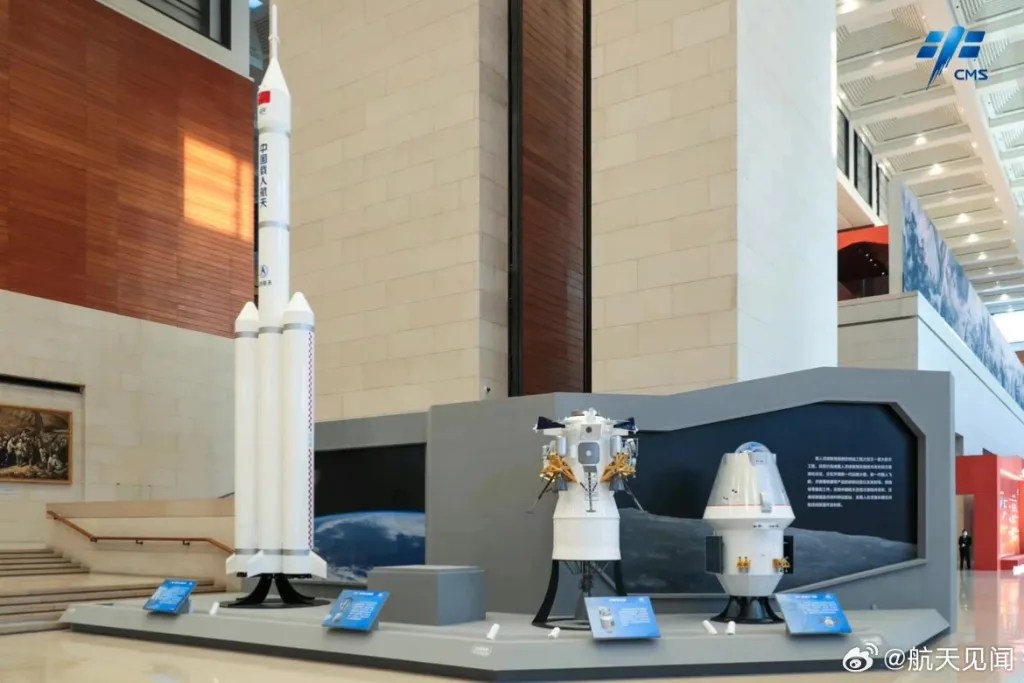
CG video of China’s manned moon landing— plans to realize the first Chinese landing on the moon before 2030, carry out lunar scientific investigations and related technical experiments, and make breakthroughs and master key technologies such as manned ground-to-moon round trips, short-term stays on the lunar surface, and joint man-machine exploration , form an independent manned lunar exploration capability, promote manned spaceflight technology from near-Earth to deep space, and greatly enhance China’s ability to enter space and use space. The main process of the manned mission to the moon is: first launch the lunar lander, the lunar lander is parked in the orbit around the moon, and then launch a new generation of manned spacecraft, and the spacecraft and the lander will rendezvous and dock in the orbit around the moon. Astronauts enter the lander from the spaceship, the lander separates from the spaceship and descends to the lunar surface, and the astronauts carry out activities on the lunar surface. After that, the Takionauts took off and ascended on the lander to dock with the spacecraft, and the astronauts entered the spacecraft. After the spacecraft separated from the lander’s lunar module, it returned to Earth….
Basic introduction of manned lunar exploration missions and aircraft— the new generation of manned spacecraft is a new type of space-to-earth round-trip transport aircraft that is fully upgraded and developed on the basis of Shenzhou spacecraft. It adopts a modular design and consists of a return module and a service module. It is mainly used for my country’s manned lunar exploration missions, taking into account the operation of near-Earth space stations. It has the characteristics of high safety, high reliability, multi-mission support, and reusability. The lunar landing mission can carry 3 Takionauts to and from the ground and orbit around the moon. Earth-orbit missions can carry seven astronauts to and from the ground and the space station.
The lunar lander is a newly developed extraterrestrial celestial body manned descent and ascent vehicle, which consists of a lunar module and a propulsion module. It is mainly used to transport astronauts between the lunar orbit and the lunar surface. It can carry 2 Takionauts back and forth, and can carry lunar rover and scientific payload. It has high safety, high reliability, high lunar landing accuracy, and strong ability to adapt to the lunar surface environment. With other characteristics, it is the lunar surface life center, energy center and data center for astronauts after landing on the moon, supporting lunar surface residency and lunar surface activities….
The lunar rover mounted on the lunar module The Chinese manned lunar rover weighs about 200 kilograms, and can take two astronauts to carry out lunar sampling and corresponding lunar surface experiments within a range of 10 kilometers.
On the 31st August 2023 in CNSA _China National Space Administration -China – People’s Republic of China 1536 hours Hong Kong –Beijing Time China- People’s Republic of China launch the Chang Zheng – Long march 2D Carrier Rocket launching from station form Xichang Satellite Launch Center Sichuan Province…..
On the 31st August 2023 in CNSA _China National Space Administration -China – People’s Republic of China 1536 hours Hong Kong –Beijing Time China- People’s Republic of China launch the Chang Zheng – Long march 2D Carrier Rocket launching from station form Xichang Satellite Launch Center Sichuan Province…..
The satellite then entered the predetermined orbit, and the launch mission was a complete success. Remote Sensing Satellite No. 39 was developed by the Fifth Academy and the Eighth Academy of China Aviation Academy. The Long March 2D carrier rocket is developed by the Eighth Academy of China Aviation Academy.
The Long March 2D launch vehicle is a normal-temperature liquid two-stage launch vehicle developed by the Eighth Academy of China Aerospace Science and Technology Corporation. It has the ability to launch single and multiple satellites with different orbital requirements. The corresponding carrying capacity for a 700-kilometer sun-synchronous orbit is 1.3 tons. The Remote Sensing No. 39 satellite launched this time was developed by the Fifth Academy and the Eighth Academy of China Aerospace Science and Technology Corporation Co., Ltd.! This launch is the 79th launch of the Long March-2D carrier rocket, the 193rd launch of the Long March series of launch vehicles developed by the Eighth Institute of Technology, and the 485th launch of the Long March series of launch vehicles.