天问一号飞運騎遊達达3亿CNSA – China National Space Administration – ESA – European Space agency Belt and road initiative mars mission…first Mars exploration mission, Tianwen- Martian Probe One on 23rd July 2022 On the second anniversary of the launch of Tianwen-1, high-definition images of Phobos were sent back
Phobos (Forbes) is one of the two natural satellites of Mars, with a size of about 27 kilometers × 22 kilometers × 18 kilometers. It runs in a near circular orbit at an altitude of about 6,000 kilometers from the surface of Mars, and orbits Mars every day. about 3 turns. The orbiter runs on a polar elliptical orbit with an altitude of about 220 kilometers near the fire point and an altitude of about 10,800 kilometers at the far fire point with a period of about 7 hours. Due to the orbital relationship between Phobos and the orbiter, as well as the lighting requirements during imaging, the operation team made precise calculations and precise control, and obtained a clear image with a resolution of about 50 meters when the two were about 5,100 kilometers apart.
The image shows that Phobos is a small celestial body with irregular shape, in the shape of a potato. The stripes on the surface can be seen in the upper left of the picture, which may be formed by the impact of the impact process. There is an obvious impact crater in the upper right of the picture, with a diameter of about 2 kilometer, named Öpik crater (Upik was an Estonian astronomer, known for his research on asteroids and meteorites).
Another satellite of Mars is Deimos (Deimos), with an average radius of only about 6.2 kilometers. The two satellites are named after the two sons of Ares, the god of war in ancient Greek mythology. The Greeks used to call Mars by Ares. Both moons are small irregular objects that many scientists believe were captured by Mars’ gravity into Mars’ orbit, but their origins remain controversial.
Image: National Astronomical Observatory…
Images and visuals are from CNSA- China National Space Administration also from there respectives- CLEP –China Lunar Exploration Project..
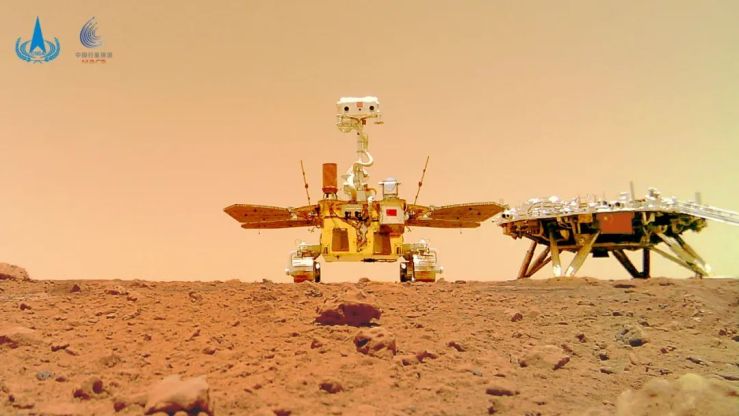
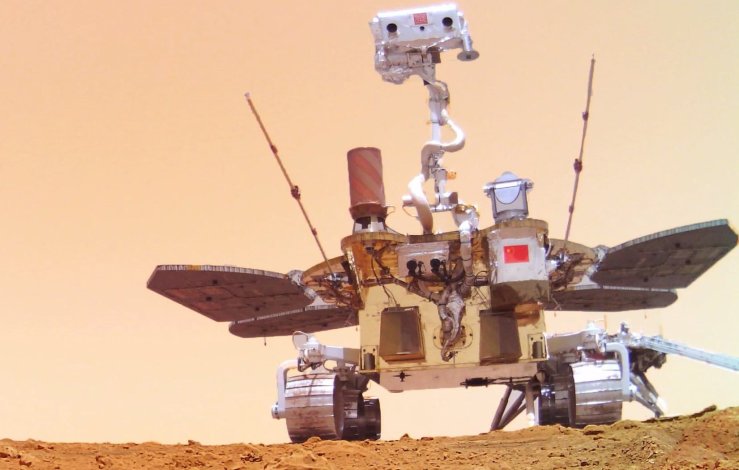
The Tianwen-1 mission was approved by the Party Central Committee in January 2016, and was successfully launched on July 23, 2020. After a deep space flight of 475 million kilometers for 202 days, the probe will rendezvous with Mars on February 10, 2021, and successfully implemented the capture and braking to enter the orbit around Mars. After 3 months of detailed inspection of the pre-selected landing area, the Mars landing was successfully carried out on May 15, 2021. On May 22, the “Zhurong” rover successfully landed on the surface of Mars and began to patrol and explore.
On August 15, 2021, the “Zhurong” rover successfully completed the 90 Martian scientific exploration missions, and continued to carry out extended exploration missions. It has traveled 1,921.5 meters on the surface of Mars. Affected by the severe winter cold and dusty weather in the landing area, the rover will enter the winter dormancy mode on May 18, 2022 as designed. Around December 2022, the “Zhurong” landing area will enter the early spring season. will resume normal work.
The orbiter has circled Mars 1,344 times, achieving global coverage and is currently in normal condition. In the follow-up, it will continue to carry out global remote sensing detection, and choose an opportunity to carry out expansion technology experiments to carry out preliminary technical verification for related tasks.
After nearly two years of flight and exploration for the Tianwen-1 mission, the 13 scientific payloads deployed by the rover and orbiter have obtained a total of about 1040GB of raw scientific data. After receiving and processing on the ground, the standard scientific data products formed are submitted to the rover on a monthly basis. A team of scientists has conducted analysis and interpretation, and relevant scientific results have been published in well-known academic journals at home and abroad. These scientific data will be open to scientists around the world at an appropriate time. Scientists around the world are welcome to actively apply for research and jointly promote the cause of human exploration of the universe.
In the spirit of open and shared cooperation, the National Space Administration actively promotes cooperation with the space agencies and scientific communities of various countries, and shares the orbital data of its Mars orbiter with the National Aeronautics and Space Administration (NASA) and the European Space Agency (ESA) to carry out collision warning. Cooperation; the “Zhurong” Mars rover and the European Space Agency’s “Mars Express” orbiter carry out data relay communication experiments to realize China-Europe Mars scientific data relay cooperation; Observatory stations in other countries use the Tianwen-1 orbiter and the “Mars Express” orbiter to jointly carry out occultation observations of the sun and conduct scientific research such as solar wind. These cooperation have achieved good results, enriched human knowledge, and made positive contributions to the construction of a community with a shared future for mankind in the scientific field.
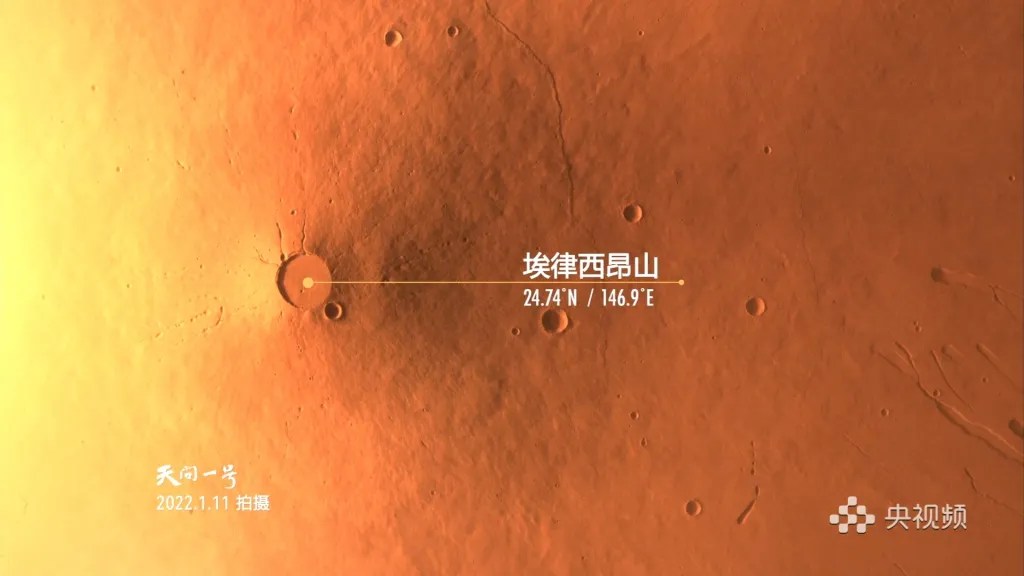
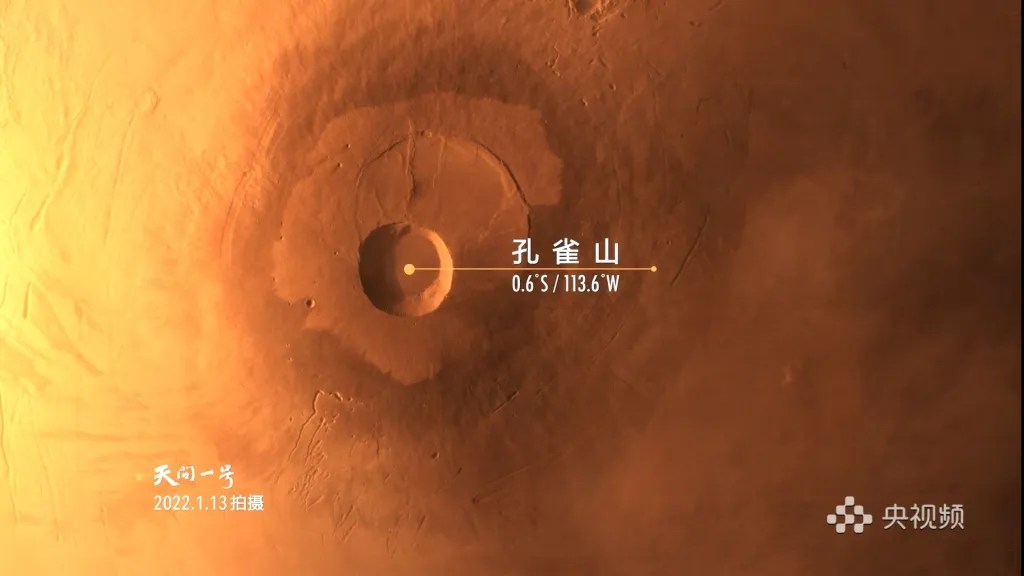
Below is a recent image of Mars taken by Tianwen-1.
Figure 1 The image of Mount Askela taken by the center camera, with a diameter of 456 kilometers and a height of 18 kilometers , shows the characteristics of the crater on the top of Mount Askela, and there are multiple crater collapse events.
Figure 2 An image of the Antarctic ice sheet taken by the center camera. The image shows the polar cap of the Martian South Pole. The study believes that the long-term and permanent polar cap of the Martian poles is mainly composed of dry ice (solid carbon dioxide) and water ice.
Figure 3 The central point camera captures the western landform image of the Sailor Grand Canyon. The Sailor Grand Canyon extends over 4,000 kilometers from east to west, 150 kilometers to 700 kilometers from north to south , and the deepest can reach 7 kilometers .
Figure 4. The image of the Arabian Highlands impact crater taken by the camera in the middle point. The image shows the geomorphological features of dozens of impact craters distributed in the area.
Figure 5 The image of the edge of the Mond ring crater captured by a high-resolution camera with a spatial resolution of about 0.5 meters and a diameter of about 91 kilometers . The image shows the geomorphological features of the edge of the Mond ring crater. The lower left part of the picture is the inside of the ring crater. The edge of the pit can be seen clearly collapsing into the pit.
Figure 6 The image of the inspection area taken by Zhurong. The image was taken before the rover entered the winter dormancy state, showing the local characteristics of a dune landform in the inspection area.
Images and visuals are from CNSA- China National Space Administration also from there respectives- CLEP –China Lunar Exploration Project..
“Hello! Mars” Episode 5 What skills do you need to learn to drive on Mars? See how the Zhurong rover visits Mars Hello Mars…….!
On the months week of 19th May 2022 天问一号飞運騎遊達达3亿CNSA – China National Space Administration – ESA – European Space agency Belt and road initiative mars mission…first Mars exploration mission, Tianwen- Martian Probe One sent back stunning images of the Half Earth Mass size of the Rustic Planet Mars in which show stunning Martian landscape with its iconic polar caps of either southern or northern … With its timeless Stunning Mars Photography. Tianwen-1″ returned high-resolution images of the Mars inspection area The “Zhurong” rover is preparing for winter, and the orbiter continues to carry out orbital exploration….. in which one year ago it was it’s first landing on Utopia Planitia region on the planet Mars .. in celebrating a CCTV five part Episode was produced..
《你好!火星》Hello Mars Episode five Two Driving on Earth pays attention to “there are thousands of roads, and safety is the first”, but on Mars, it becomes “there is no road, and safety is more important”. This place in the southern part of the Utopia Plain, although it is flat and open as far as the eye can see, is full of small pits and sand dunes. Driving in this place requires not only superb driving skills, but more importantly, a good car with eighteen martial arts skills. The rover’s design team finally designed this good car with experience and bold innovation.
Hello everyone, I would like to tell you some good news about the documentary “Hello!” about China’s first Mars exploration mission. “Mars” is finally on the air, friends who want to know more about Mars can stay in front of the TV tonight
“Hello! “Mars” is a large-scale scientific documentary jointly produced by the National Space Administration and China Central Radio and Television to commemorate the first anniversary of the Tianwen-1 Mars probe’s successful landing on Mars. It took three years to complete the filming and is divided into “Departure” and “Journey” “Surrounding”, “Landing” and “Patrol” have 5 episodes, each of which is 30 minutes long. They focus on the important stages of the Tianwen-1 mission, and describe a large number of astronomy, astrophysics, space applications, aerospace engineering and other disciplines in a simple way. Knowledge, in-depth analysis of Chinese wisdom and Chinese solutions in Mars exploration. Since May 2020, the co-production team has continued to track the key nodes of the Tianwen-1 mission, filmed many wonderful moments, and obtained a large number of first-hand precious materials. Many of the contents of the documentary were made public for the first time and were released authoritatively.
Broadcasting plan CCTV-1 CCTV integrated channel every night at 22:36, five days of continuous broadcast from May 18th to 22nd; CCTV-10 CCTV science and education channel every night at 20:10, from May 19th to 23rd five days of continuous broadcast
“Hello! Mars” Episode 4 Landing on Mars has many risks. How did Tianwen-1 complete a perfect landing?”
On the months week of 19th May 2022 天问一号飞運騎遊達达3亿CNSA – China National Space Administration – ESA – European Space agency Belt and road initiative mars mission…first Mars exploration mission, Tianwen- Martian Probe One sent back stunning images of the Half Earth Mass size of the Rustic Planet Mars in which show stunning Martian landscape with its iconic polar caps of either southern or northern … With its timeless Stunning Mars Photography. Tianwen-1″ returned high-resolution images of the Mars inspection area The “Zhurong” rover is preparing for winter, and the orbiter continues to carry out orbital exploration….. in which one year ago it was it’s first landing on Utopia Planitia region on the planet Mars .. in celebrating a CCTV five part Episode was produced..
《你好!火星》Hello Mars Episode Two The content of this issue At 7:18 on May 15, 2021, Beijing time, the Chinese probe successfully landed in the southern part of the Utopia Plain in the northern hemisphere of Mars. It can be said that this is a perfect landing, because the land chosen by the landing platform itself is really too flat. At 10:40 on May 22, 2021, the rover slowly drove away from the landing platform along the ramp, and travelled 0.522 meters on the Utopia Plain. This short distance marked China as the second to achieve Mars tour……
Hello everyone, I would like to tell you some good news about the documentary “Hello!” about China’s first Mars exploration mission. “Mars” is finally on the air, friends who want to know more about Mars can stay in front of the TV tonight
“Hello! “Mars” is a large-scale scientific documentary jointly produced by the National Space Administration and China Central Radio and Television to commemorate the first anniversary of the Tianwen-1 Mars probe’s successful landing on Mars. It took three years to complete the filming and is divided into “Departure” and “Journey” “Surrounding”, “Landing” and “Patrol” have 5 episodes, each of which is 30 minutes long. They focus on the important stages of the Tianwen-1 mission, and describe a large number of astronomy, astrophysics, space applications, aerospace engineering and other disciplines in a simple way. Knowledge, in-depth analysis of Chinese wisdom and Chinese solutions in Mars exploration. Since May 2020, the co-production team has continued to track the key nodes of the Tianwen-1 mission, filmed many wonderful moments, and obtained a large number of first-hand precious materials. Many of the contents of the documentary were made public for the first time and were released authoritatively.
Broadcasting plan CCTV-1 CCTV integrated channel every night at 22:36, five days of continuous broadcast from May 18th to 22nd; CCTV-10 CCTV science and education channel every night at 20:10, from May 19th to 23rd five days of continuous broadcast
“Hello! Mars Episode 3 What’s the Difference between Mars and Earth? What new discoveries have Tianwen-1 “circled” Mars? Hello Mars……!
On the months week of 19th May 2022 天问一号飞運騎遊達达3亿CNSA – China National Space Administration – ESA – European Space agency Belt and road initiative mars mission…first Mars exploration mission, Tianwen- Martian Probe One sent back stunning images of the Half Earth Mass size of the Rustic Planet Mars in which show stunning Martian landscape with its iconic polar caps of either southern or northern … With its timeless Stunning Mars Photography. Tianwen-1″ returned high-resolution images of the Mars inspection area The “Zhurong” rover is preparing for winter, and the orbiter continues to carry out orbital exploration….. in which one year ago it was it’s first landing on Utopia Planitia region on the planet Mars .. in celebrating a CCTV five part Episode was produced..
《你好!火星》Hello Mars Episode Three The content of this issue: On February 10, 2021, 202 days have passed since the launch of Tianwen-1. After a trek of 475 million kilometers, Mars is close at hand. At this time, the earth has circled the sun and has walked half a circle. Mars Falling behind, it is nearly 200 million kilometers away from the earth, and it takes 11 minutes for light to travel this distance. The main engine nozzle of the orbiter is facing forward, and it is about to ignite and brake. After a series of operation controls, Tianwen-1 has become an artificial Mars satellite.
Hello everyone, I would like to tell you some good news about the documentary “Hello!” about China’s first Mars exploration mission. “Mars” is finally on the air, friends who want to know more about Mars can stay in front of the TV tonight
“Hello! “Mars” is a large-scale scientific documentary jointly produced by the National Space Administration and China Central Radio and Television to commemorate the first anniversary of the Tianwen-1 Mars probe’s successful landing on Mars. It took three years to complete the filming and is divided into “Departure” and “Journey” “Surrounding”, “Landing” and “Patrol” have 5 episodes, each of which is 30 minutes long. They focus on the important stages of the Tianwen-1 mission, and describe a large number of astronomy, astrophysics, space applications, aerospace engineering and other disciplines in a simple way. Knowledge, in-depth analysis of Chinese wisdom and Chinese solutions in Mars exploration. Since May 2020, the co-production team has continued to track the key nodes of the Tianwen-1 mission, filmed many wonderful moments, and obtained a large number of first-hand precious materials. Many of the contents of the documentary were made public for the first time and were released authoritatively.
Broadcasting plan CCTV-1 CCTV integrated channel every night at 22:36, five days of continuous broadcast from May 18th to 22nd; CCTV-10 CCTV science and education channel every night at 20:10, from May 19th to 23rd five days of continuous broadcast