#CNSA #ChinaNationalSpaceAdministration #国家航天局 |#BRI #August2023 |#ChinaMannedLunarMission #ChangZheng10 #LongMarch10 #CarrierRocket CGI video of China’s manned moon landing before year 2030..

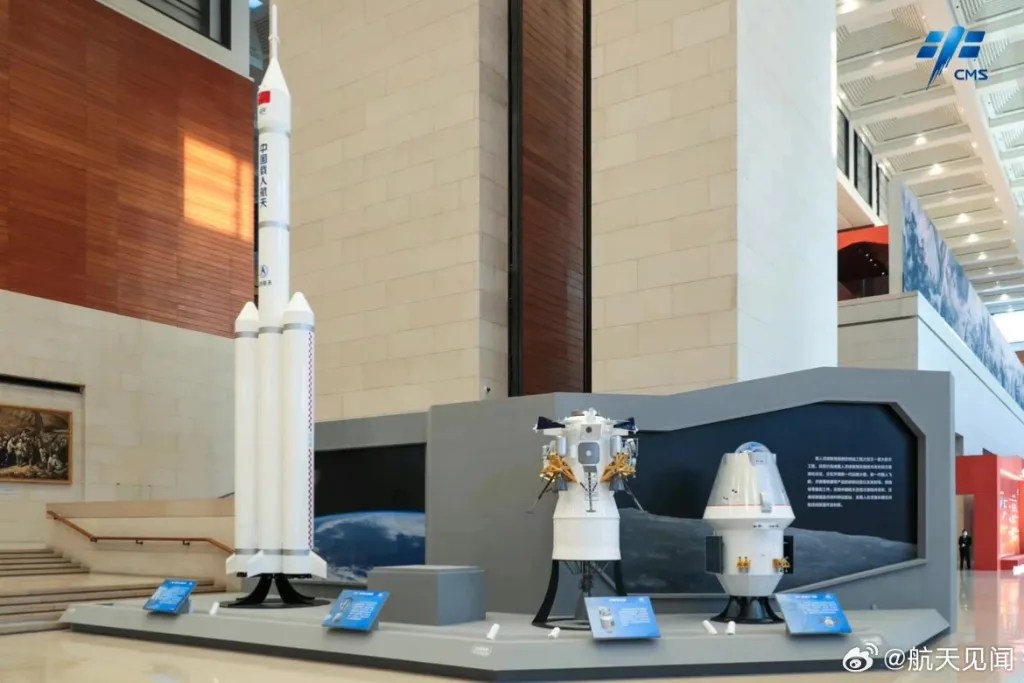
CG video of China’s manned moon landing— plans to realize the first Chinese landing on the moon before 2030, carry out lunar scientific investigations and related technical experiments, and make breakthroughs and master key technologies such as manned ground-to-moon round trips, short-term stays on the lunar surface, and joint man-machine exploration , form an independent manned lunar exploration capability, promote manned spaceflight technology from near-Earth to deep space, and greatly enhance China’s ability to enter space and use space. The main process of the manned mission to the moon is: first launch the lunar lander, the lunar lander is parked in the orbit around the moon, and then launch a new generation of manned spacecraft, and the spacecraft and the lander will rendezvous and dock in the orbit around the moon. Astronauts enter the lander from the spaceship, the lander separates from the spaceship and descends to the lunar surface, and the astronauts carry out activities on the lunar surface. After that, the Takionauts took off and ascended on the lander to dock with the spacecraft, and the astronauts entered the spacecraft. After the spacecraft separated from the lander’s lunar module, it returned to Earth….

Basic introduction of manned lunar exploration missions and aircraft—
the new generation of manned spacecraft is a new type of space-to-earth round-trip transport aircraft that is fully upgraded and developed on the basis of Shenzhou spacecraft. It adopts a modular design and consists of a return module and a service module. It is mainly used for my country’s manned lunar exploration missions, taking into account the operation of near-Earth space stations. It has the characteristics of high safety, high reliability, multi-mission support, and reusability. The lunar landing mission can carry 3 Takionauts to and from the ground and orbit around the moon. Earth-orbit missions can carry seven astronauts to and from the ground and the space station.

The lunar lander is a newly developed extraterrestrial celestial body manned descent and ascent vehicle, which consists of a lunar module and a propulsion module. It is mainly used to transport astronauts between the lunar orbit and the lunar surface. It can carry 2 Takionauts back and forth, and can carry lunar rover and scientific payload. It has high safety, high reliability, high lunar landing accuracy, and strong ability to adapt to the lunar surface environment. With other characteristics, it is the lunar surface life center, energy center and data center for astronauts after landing on the moon, supporting lunar surface residency and lunar surface activities….

The lunar rover mounted on the lunar module
The Chinese manned lunar rover weighs about 200 kilograms, and can take two astronauts to carry out lunar sampling and corresponding lunar surface experiments within a range of 10 kilometers.

Images and visuals are from their Respectives CMS China Manned SpaceCNSA-China National Space Administration

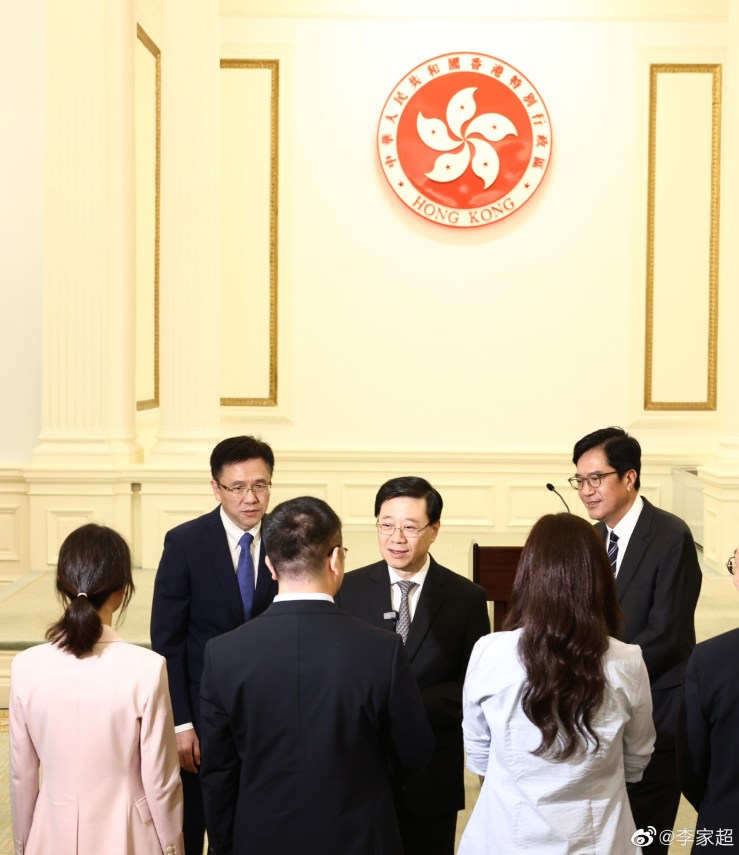
#CNSA #ChinaNationalSpaceAdministration #国家航天局 | #June2023 | #CMS #ChinaMannedSpace #Shenzhou Civilian  #Takionauts #HongKongSAR Selection for #PayloadSpecialist Candidates presented  hosted by # 李家超 John Lee Ka-chiu-Chief Executive of the Hong Kong Special Administrative Region China, People’s Republic of China.

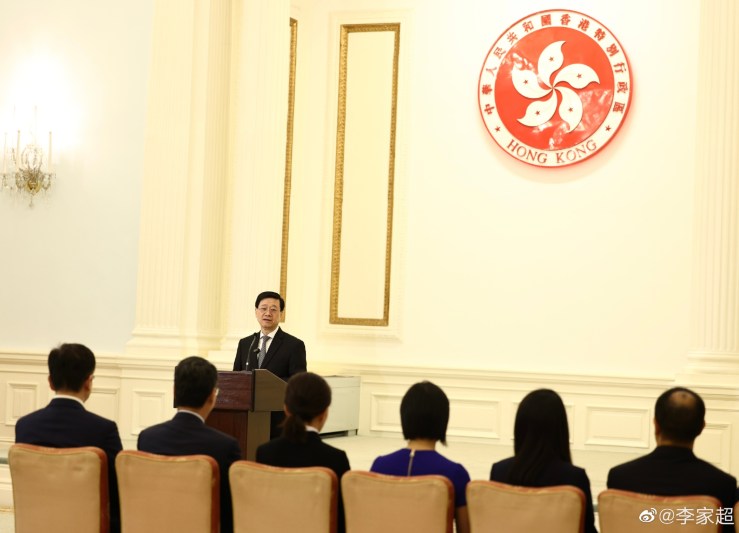
中国空间站 On the 7th June 2023 CNSA –China National Space Administration  at the Grounds of the Hong Kong SAR, China, People’s Republic of China, at Hong Kong SAR Government house in Central the 李家超 John Lee Ka-chiu-Chief Executive of the Hong Kong Special Administrative Region China, People’s Republic of China. Held a hosting meeting with the Hong Kong SAR Civilian Takionaut selection of the Role of Payload Specialist candidates..  His meeting is described as Meeting with payload expert- Specialists candidates…… as李家超 John Lee Ka-chiu-Chief Executive of the Hong Kong Special Administrative Region Quote below..

[Meeting with payload expert candidates]

I am very pleased to meet with Hong Kong payload expert candidates at the Government House this afternoon. They will go to Beijing this week to participate in the selection and re-election of payload experts for the National Manned Space Engineering Project. My team and I cheer for them.


It is the first time that the country selects payload experts in Hong Kong, which marks the country’s high attention and affirmation to Hong Kong’s scientific and technological circles, as well as its recognition of Hong Kong as an international innovation and technology center. This selection not only represents that the country encourages and welcomes Hong Kong compatriots to contribute to the country’s development, but also reflects the country’s concern for the development of Hong Kong youth.

These payload expert candidates are all elites in related fields, representing Hong Kong’s scientific research and innovation strength. We are proud that they can stand up at this historical moment, contribute to the country and shoulder the public’s expectations for Hong Kong people to participate in space exploration.

The following selection will be very rigorous. I hope that everyone will cherish and experience this process of struggle, experience and learning. I would like to take this opportunity to encourage you all to go all out and do your best to fight for the country, Hong Kong, and your aerospace dream!

Images and visuals are from their respectives.

#CNSA #ChinaNationalSpaceAdministration #国家航天局 | #BRI #March2023 #长征九号火箭 #ChangZheng9 #LongMarch9 #UltraHeavyCarrierRocket #ReusableUltraHeavyCarrierRocket in Construction taking shape to realization of the Ten Meter Diameter Tank….

During this year of 2023,   China People’s Republic of China’s CNSA – China National Space Administration Reusable Ultra Heavy Carrier Rocket长征九号火箭 Change Zheng –Long March Nine Reusable Carrier Rocket of it’s first heavy-duty rocket 10-meter-class rocket tank has been developed!……. The “waist circumference” of the rocket storage tank in front of me reaches 10 meters, and it is the largest rocket storage tank developed by our country so far. Compared with the “Fat Five” rocket’s tank with a diameter of 5 meters, its “waistline” has nearly doubled. At present, the storage tank has been developed, and the project has been completed recently.


Its successful development has realized the leap from a 5-meter-level diameter to a 10-meter-level launch vehicle storage tank in my country, and also marks that my country has become the third company in the world with the development capability of a 10-meter-level ultra-large-diameter storage tank after Russia and the United States. The country has laid a solid foundation for the development of my country’s heavy-duty launch vehicle engineering.


Hu Zhenggen, deputy chief designer of the heavy-duty launch vehicle of the Rocket Academy, introduced that expanding the diameter of the storage tank to the 10-meter level seems to be just the diameter multiplied by 2, but the actual development difficulty is not as simple as doubling, and the process almost challenges the limit of my country’s industrial basic capabilities , but it also fully drives the development of advanced materials, advanced technology, high-end manufacturing and other related basic industries, and plays a positive role in accelerating the transformation and upgrading of my country’s manufacturing industry, driving the development of high-end equipment in my country, and promoting the construction of a strong manufacturing country.

The project team innovated with the model of national large-scale cooperation and brainstorming, united more than 20 domestic superior units, and carried out collaborative research. It took more than 6 years to open up the entire development chain from materials, design, component forming, assembly and welding, and test assessment. The road has realized the upgrading of the design and manufacturing technology of large-diameter tanks for launch vehicles in my country. Previously, the team has successively completed the important components of the tank – the overall transition ring of the 10-meter tank (Figure 3), the melon petal sample of the 10-meter tank (Figure 4), the bottom ring of the 10-meter tank ( Figure 5) …

the overall transition ring of the 10-meter tank (Figure 3)
the melon petal sample of the 10-meter tank (Figure 4),


During this process, the team has overcome a series of key technologies:
preparation of super-large-sized plates, super-large
-diameter tank structure optimization design,
super-large-diameter components, precise shape, collaborative manufacturing technology,
super-large-diameter tank bottom, friction stir welding technology,
super-large-diameter tank Vertical assembly friction stir welding technology


The successful development of the 10-meter rocket body tank is an important achievement in the key technology research and program deepening demonstration stage of heavy-duty launch vehicles, which shows that China has the ability to develop heavy-duty launch vehicles….

Images and visuals are from their Respectives CMS China Manned SpaceCNSA-China National Space Administration
#CNSA #ChinaNationalSpaceAdministration #国家航天局 |#BRI #January2023 | # 北京航天飞行控制中心 #北京 #BeijingAerospaceFlightControlCenter #北京明白#BeijingUnderstands …..

北京明白””Beijing understands” is the CNSA China National Space Administration …. Beijing understands that there are hundreds of people behind it in the live broadcast of China’s aerospace launch, the “Beijing understands” that the Beijing Flight Control Center received a report and answered was impressive. In fact, behind every “Beijing understands”, there are hundreds of “understands”. Behind every sentence “understood”, it is the space workers Space Engineers who ensure that every plan and every instruction is in place. Chinese Space engineers and Takionauts 24 hours guarding the home of space, paying tribute to China Aerospace- space Industry..

Chinese Space Engineers – Space scientists with an average age of less than 35 years – a group of young talents who bravely climbed the peak of science and technology In the Beijing Aerospace Flight Control Center, there is a group of young people with an average age of less than 35 years old. If the spacecraft is compared to a kite, then they are kite flyer. Over the past ten years, they have firmly grasped the “kite string” and assisted my country’s space station construction, lunar exploration, Mars exploration and other major aerospace projects. Who are they?

The Beijing Aerospace Flight Control Center is the command, control and information exchange center for China’s manned spaceflight and deep space exploration, and is a key hub for the connection between heaven and earth. Here is a group of young people with an average age of less than 35 years old. With their excellent skills in precision measurement and control, they have won 22 consecutive major space missions and engraved “Chinese precision” at the forefront of the world’s aerospace flight control field. Take a look at the image promotional video of Beijing Aerospace Flight Control Center’s young scientific and technological talents group…

[Bao Shuo: I am young]

Her name is Bao Shuo, and she is a dispatcher at the Beijing Aerospace Flight Control Center. She is calm and confident in her work, and she is lively and laughs in her life, just like she holds in her hand in the dispatching position. Two pens, switch freely, use struggle to write the most beautiful youth….

The stars and the sea, they never stop………. In the Beijing Aerospace Flight Control Center, there is a group of young talents who have bravely climbed the peak of science and technology. In the past ten years, this group of young flight control youths with an average age of less than 35 have high aspirations, overcome difficulties, and bravely climbed to the top. Fill in more than 40 international and domestic gaps, and constantly refresh China’s heights in space. In this promotional video of the young scientific and technological talents of the Beijing Aerospace Flight Control Center, you can see the outstanding contributions made by young flight control youths to create space stations, landing on the back of the moon, sampling the lunar surface, and Mars exploration. When youth is in its prime, it is time to struggle. Stars and seas, they never stop.

[Who is “北京明明” | Jiang Ping:] Jiang Ping is the person responsible for sending instructions to spacecraft far away in space. She is not only a “ground Brilliant intelligent mother” who guards the stable operation of the spacecraft, but also a “busy mother” who cannot often accompany her 9-year-old child. With multiple identities, when facing the “children in the sky” and “children on the ground”, she said: “The word aerospace has always been very sacred to me, and it will always be ranked first.” Click on the video to show you the story of Jiang Ping and her children…

Images and visuals are from their Respectives CMS China Manned SpaceCNSA-China National Space Administration  

#CNSA #ChinaNationalSpaceAdministration #国家航天局 |#BRI #November2022 | #CASC #ChinaAerospaceScienceandTechnologyCorporation, #ReusableCarrierRocket #ReusableRocketEngine #北京 #Beijing Testing the 80-ton #RocketEngine successfully engine testing.

On the morning of November 10th 2022 Thursday, CNSA China National Space Admistraton,  CASC  China Aerospace Science and Technology Corporation  with the good news of success came from Beijing Yungang 101 test area. Just five days after the first complete machine test run on November 5th 2022 , the 80 Ton Reusable Carrier Rocket Engine developed by Beijing 11 Institute of the Sixth Academy of Aerospace Science and Technology Group. The second test run of the ton-level reusable liquid oxygen methane engine is good great news….!!!

The second test run of the 80-ton reusable liquid oxygen methane engine was a complete success….!  The latest news from the Beijing Institute of Aerospace Power of the Sixth Academy of Aerospace Science and Technology; this morning, good news of success came from the Yungang Experimental Zone in Beijing. Just five days after the first complete machine test on November 5, the Sixth Academy of Aerospace The 80-ton reusable liquid oxygen methane engine developed for the second test run of the whole machine was reported again, and it was a complete success!
This test is the second complete machine test based on the complete success of the first complete machine test. The test time is 50 seconds. The engine starts and shuts down according to the program. The working process is stable and the parameters are normal. The whole engine is further evaluated. Work coordination and matching; obtain the work performance of each component.


The complete success of this test marks that the engine has the conditions to be transferred from the prototype to the first prototype. In the follow-up, the engine performance and function test will be further carried out, and the reliability samples will be accumulated to lay an important technical foundation for the development and application of reusable vehicles….

Images and visuals are from their respectives- CNSA –China National Space Administration respectives