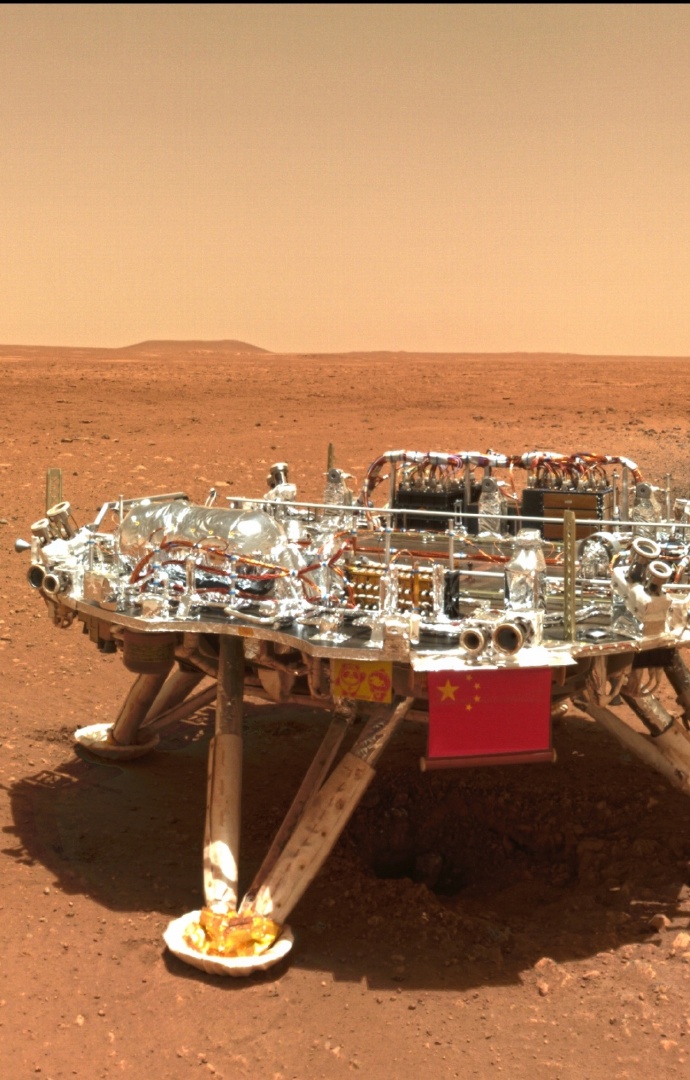
#CNSA #ChinaNationalSpaceAdministration #國家航天局 |#BeltAndRoadinitiative #June2021 |#火星 # 天問 #天问一号#TianwenOne #MarsMission #Marslander #MarsRover #Tianwen1 probe #祝融号 #ZhuRong Exploring from the #RedPlanet #Mars with more Ultimate #MarsSelfie …. #Selfies

On the Rustic half diameter planet size Red planet Mars  on Hong Kong SAR- Beijing  Earth Sunday time On June 27th  2021 , at the unveiling ceremony of the first batch of scientific visualizations  of the Tianwen-1 rover landing on Mars in Beijing, on the eve of the CPC- Communist Party of China 100 year Anniversary party’s centennial birthday of China- People’s Republic of China , the CNSA – China National Space Administration released a series of real shots of the Tianwen-1 Mars exploration mission landing and patrol exploration, including the parachute and descent process of the landing patrol, and the Zhurong rover leaving the landing platform Sound and video of Mars surface movement, Mars global environment perception image, Mars rustic ​​images on Utopia Planitia…..

 On the Same Notation of the panoramic view of the landing site, the topography of Mars, the “Chinese imprint” and the image taken by the “Zhurong” rover were announced. “Photographs with the tour” and other image maps. The release of the first batch of scientific image maps marked the complete success of my country’s first Mars exploration mission.

On June 1st 2021, the WIFI separation camera of the rover took a photo with the landing platform and the rover. The camera recorded the rover’s retreating movement and turning in place. According to the WIFI camera field of view, focal length and other parameters, the staff planned the location and travel path of the camera separation. After the rover reached the separation point, the WIFI camera was released and moved back to the photo spot. The camera took a photo of the landing platform and the front of the rover. The rover makes a turn, facing the camera sideways, and takes a photo of the landing platform and the rover sideways. 

On June 16, the rover carried out global environment perception, planned the path for the subsequent stage of scientific exploration, and used the rear obstacle avoidance camera to take pictures of the rover.

[Listening to the sound from the Mars rover for the first time] In my country’s previous deep space exploration missions, images and videos are often returned. In my country’s Tianwen-1 Mars exploration mission, the developers specially designed the “collection of sounds” Function. Just as the rover was leaving the landing platform, this precious sound clip was also recorded. This sound is the sound data of the departure process acquired by the recording device installed on the rover during the departure of the landing platform on May 22. The audio includes live sounds during the process of turning on the driving mechanism of the rover, driving on a ramp, and driving onto the surface of Mars.

Jia Yang, deputy chief designer of the Fifth Academy of Aerospace Science and Technology Group and Tianwen-1 probe: What are you hearing now? In fact, it is equivalent to the front grouser of the car. It is about 47 mm, and each small rack over there is 48 mm, so you can ensure that there is a little distance between the front rack and the front rack every time you come. . Then, after turning, it has a collision between the grouser and the rack caused by a microscopic upward and downward movement of one millimeter, which is equivalent to the sound of a metal collision. In addition to the collision sound between the rover gear and the landing platform ladder, there is also the sound of the motor working. The two sounds are mixed together to form the audio of the whole process of the rover leaving the platform.

During the interview, the reporter learned that the task of the sound collection device installed on the rover is not to collect the sound of the rover, but to hear the real sound from Mars…

天问一号飞運騎遊達达3亿…….As of 11th  June 2021Friday  CNSA – China National Space Administration – ESA – European Space agency Belt and road initiative mars mission…first Mars exploration mission, Tianwen- Martian Probe One …….”祝融号Zhu Rong” Mars Lander – Mars rover successfully sent back telemetry towards China National Space Administration released a high-resolution image of the landing area of ​China- People’s Republic of China’s first Mars exploration Tianwen-1 mission. The image of the Zhongtianwen-1 landing platform, the “Zhurong” rover and the surrounding area are clearly visible.   Also to of the ultimate Mars Selfie of itself also it’s Mars Landing platform in releasing a high definition patches of travelling least six meters of it landing platform 天问一号-1 landing on Mars first batch of scientific images revealingly… 

Images and visuals are from Weibo of CNSA – China National Space Administration – CLEP –China Lunar Exploration Program

#CNSA #ChinaNationalSpaceAdministration #国家航天局 |#BeltAndRoadinitiative #June2021 |#魏一凡 #PosterDesigner #WeiYifan created memorable #Chinesepoetry posters illustrated moments of China’s Successful Space Programme ….

Illustrating poster Designer 魏一凡 Wei Yifan creating Successfully Memorable moments of CNSA – China National Space Administration – China’s People’s Republic of China’s collaborative Space programme in which over the last half century more with that first flight of the long lines of series carrier rockets from the  Long March –Chang Zheng One with the Dongfeng shinny round hexagonal ball  communications Satellite .. To more now self -learning hardworking innovatively on various innovatively from towards the Far side of the moon with the CNSA –CLEP China Lunar Exploration program on the moon lunar surface, towards the most world’s number one advance navigation BeiDou Constellation system  towards first time landing on the rustic red planet Mars on Utopia Planitia.. Now it’s the construction of the Belt and Road Initiative CSS China Space Station for international partnership with furthering more international collaboration for more extremely challenging deep space missions manned and unmanned ..

[Romance is carved in the bones! 我们正把古人的传说一一 implementation】Shenzhou patrols the sky, harmony between heaven and earth, Zhu Rongluohuo, Chang’e flying to the moon, not reconciled to the mythology only exists in the yellowed scrolls, Chinese astronauts in the Geng Geng Xinghe will Chinese civilization The poems and the distance are fascinating. The poetic and pictorial meaning of the spaceman is to turn the myth into reality and continue to move forward and continue to climb. Come on, Chinese astronauts! (Poster design: Wei Yifan) 神舟十二号天地通信

Images and visuals are from Weibo and their respectives..

#CNSA #ChinaNationalSpaceAdministration #国家航天局 |#BeltAndRoadinitiative #June2021|#西昌衛星發射中心 # Xichang Satellite Launch Center – Successfully launching the iconic #LongMarch2C #ChangZheng2C #CarrierRocket to deploy the advance high velocity data #Communication #RemoteSensing #EarthSciences # ApoclypseSatellite …

On the 18th June 2021 in Friday afternoon CNSA _China National Space Administration -China – People’s Republic of China At 1430 hours Hong Kong –Beijing Time on an early morning past midnight…. China successfully launched the advance Earth Sciences – Remote sensing Communications Apocalypse Satellites using the Long March 2C Chang Zheng 2C carrier rocket at the Xichang Satellite Launch Center Sichuan Province Lift off. The satellite successfully entered the scheduled orbit satellite enters a predetermined orbit. The mission also carried and launched 14 stars in the constellation of Apocalypse. This mission is the 375th flight of the Long March series of carrier rockets.

In which it’s only yesterday that the successful launch of the Long March –Chang Zheng 2F carrier rocket three Taikonauts to the CNSA-CMS-BRI-  China National Space Admistraton – China Manned Space Agency- Belt and Road initiative CSS China Space Station .. from Jiuquan Satellite Launch Center on 17th June 2021..

China- People’s Republic of China successfully launched Remote Sensing No. 30 Group 09 satellites using the Long March- Chang Zheng 2C carrier rocket at the Xichang Satellite Launch Center The mission also carried and launched 14 stars in the constellation of Apocalypse. This is a micro-nano satellite loaded with a data acquisition payload, as a supplement to the ground network, which can realize data acquisition in blind areas of the ground network coverage. This is the 375th launch of the Long March series of carrier rockets and the 56th launch of the Long March 2C carrier rocket….

the Apocalypse Constellation are a component of the Apocalypse Internet of Things constellation and are mainly used to provide data collection and transmission services… this Launch marks the first launch after the spring festival in which the satellites in the deployed satellites from the launch mission was a complete success, the number of satellites in orbit increased to 24, and the network performance was further improved in which they were design manufactured  by the Institute of Microsatellite Innovation, Chinese Academy of Sciences…

This year, the Chang-2C rocket is expected to perform 7 more launch missions, which is also the year with the largest number of launches in the history of the Chang-2C rocket. In the follow-up launch missions this year, the Chang-2C rocket will also adopt a new configuration and increase its carrying capacity.


In order to cope with the situation of high-density launch of models, the Chang-2 C rocket team, under the leadership of the model two chiefs, carried out powerful measures such as launch site process optimization, personnel overall planning, and advance planning of ground equipment turnover. Effective shortening is expected to be implemented in 10 groups of remote sensing 30 satellites.

One interesting modification to the advance Long March –Chang Zheng 2C is the introduced that in this mission, the rocket fairing is equipped with an altimeter combination to measure the height change and partial attitude information during the separation of the fairing and re-entry into the atmosphere. The “parachute-based fairing debris landing zone control technology” research provides a reference for the design and improvement of subsequent rocket landing zone control schemes.

Images and visuals are from Weibo..

#CNSA #ChinaNationalSpaceAdministration #国家航天局 |#BeltAndRoadinitiative #June2021|#酒泉衛星發射中心 #JiuquanSatelliteLaunchCenter announcement the of the Launch crew the International Iconic #LongMarch2F #ChangZheng2F #CarrierRocket deploying #Shenzhou12 docking with #CSS #ChinaSpaceStation #TianheCoreModule….

On 16th  June 2021 Thursday Hong Kong SAR- Beijing Time-  CNSA –China National Space Administration  on which from Jiuquan Satellite launch Center – Inner Mongolia- China-People’s Republic of China… releases the full press coverage of the first three Takionaut –Chinese Astronaut to be launched on the 17th June 2021 Friday..

On previously  9th June 2021 Hong Kong SAR- Beijing Time-  CNSA –China National Space Administration  preparing to launching from one of its many launch Complexes from China used the Long March 2F – Chang Zheng 2F carrier rocket at the Jiuquan Satellite Launch Center – Inner Mongolia- China-People’s Republic of China…  in which Transfer of the Shenzhou 12 command module  and rocket assembly to the launch area According to the China Manned Space Engineering Office, on June 9, 2021, Beijing time, the Shenzhou 12 manned spacecraft was combined with the Long March 2 F Yao 12 carrier rocket The body has been transferred to the launch area launch complex station 921. At present, the facilities and equipment at the launch site are in good condition, and various functional inspections and joint tests before launch will be carried out as planned. ……

CGTN A press conference about the launch of Shenzhou-12 manned spacecraft is being held at Jiuquan Satellite Launch Center in northwest China’s Gansu Province. Shenzhou-12 is the first manned mission in China’s plan to complete the construction of its space station by the end of 2022. Three astronauts will board the Shenzhou-12 spacecraft and fly to the Tianhe core module in the space station and conduct a range of tasks in space for three months, according to China Manned Space Engineering Office (CMSEO) on last Wednesday.

CGTN A press conference about CGTN A press conference about Three astronauts from China’s manned spacecraft Shenzhou-12, Nie Haisheng, Liu Boming and Tang Hongbo, meet the press for the first time at Wentiange, the astronauts’ apartment compound in Jiuquan Satellite Launch Center in northwest China…

After the Shenzhou 12 manned spacecraft completes its launch, it will rendezvous and dock with the Tianhe core module of the CSS- China Space Station. Three Chinese astronauts will enter the Tianhe core module and begin a three-month stay in orbit.

It’s been after nearly 5 years, that China -People’s Republic of China the Chinese once again entered space and stationed in their own space station, looking forward to the day of launch 加油 After the Shenzhou 12 manned spacecraft completes its launch, it will rendezvous and dock with the Tianhe core module of the Chinese space station, 3 Chinese astronauts will enter the Tianhe core module and begin a three-month stay in orbit.

Under normal circumstances, the ship will use the fully autonomous rapid rendezvous and docking scheme as the Tianzhou-2 cargo spacecraft to dock with the forward docking interface of the core module of Tianhe.

Shenzhou 12 carries three astronauts. According to the plan, they will stay at the Tiangong space station for three months. This time will be three times that of the Shenzhou 11 crew at the Tiangong-2 space laboratory…..

Taking the Shenzhou 12 mission as a new starting point, we will maintain the mission frequency of launching two manned spacecraft each year. The Shenzhou series of manned spacecraft have already had mass production capacity as early as the Shenzhou 8 mission.

During the stay of Shenzhou 12 on the space station, a series of technical verification work will be implemented including astronauts walk out of space and verification of regenerative life support system.

This month, an in-line Tiangong space station configuration consisting of the Tianhe core cabin, the Tianzhou-2 cargo spacecraft, and the Shenzhou-12 manned spacecraft will be presented to the world. As the first hundred years are approaching anniversary of the CPC of modern China- People’s Republic of China, you can imagine what kind of blessings the three astronauts will send to our motherland in the vast space on July 1….

Takionaut -Astronaut crew to perform the Shenzhou 12 manned mission  According to the information from the China Manned Space Engineering Office, after the research and decision of the Space Station Phase Mission Command Headquarters, three astronauts Nie Haisheng, Liu Boming and Tang Hongbo will perform Shenzhou On the 12th manned mission, Nie Haisheng served as the commander. On the morning of June 16, 2021, Beijing time, three astronauts will meet with reporters from Chinese and foreign media at the Jiuquan Satellite Launch Center Wentian Pavilion and answer questions from reporters….

Resume of Captain Nie Haisheng Nie, male, Han nationality, native of Zaoyang, Hubei, member of the Communist Party of China, Ph.D. Born in September 1964, enlisted in the army in June 1983, joined the Communist Party of China in December 1986, and served as the captain of the Chinese People’s Liberation Army Astronaut Brigade in June 2014. He is now a special-class astronaut of the Astronaut Brigade, with the rank of major general in professional technology. He used to be the navigation director of the command of a certain division and regiment of the Air Force aviation, and he flew 1480 hours safely and was rated as a first-class air force pilot. In January 1998, he was selected as the first batch of astronauts in my country. In September 2003, he was selected as a backup astronaut for the Shenzhou V mission. In October 2005, he performed the Shenzhou VI flight mission. In November of the same year, he was awarded the honorary title of “Heroic Astronaut” by the Central Committee of the Communist Party of China, the State Council, and the Central Military Commission, and was awarded the “Aerospace Meritorious Medal.” In May 2008, he was selected as a backup astronaut for the Shenzhou VII mission. In March 2012, he was selected as a backup astronaut for the Shenzhou 9 flight mission. In June 2013, he performed the Shenzhou 10 flight mission and served as the commander. In July of the same year, he was awarded the “Secondary Aerospace Meritorious Medal” by the Central Committee of the Communist Party of China, the State Council, and the Central Military Commission. In December 2019, he was selected as the commander of the Shenzhou 12 mission crew…

Liu Boming, male, Han nationality, native of Yi’an, Heilongjiang, member of the Communist Party of China, master degree. Born in September 1966, enlisted in the army in June 1985, and joined the Communist Party of China in September 1990. He is currently a special-class astronaut of the Chinese People’s Liberation Army Astronaut Brigade, with the rank of major general. Served as a squadron leader of a certain division and regiment of the Air Force, and flew safely for 1,050 hours, and was rated as a first-class pilot of the Air Force. In January 1998, he was selected as the first batch of astronauts in my country. In June 2005, he was selected as the backup crew of the Shenzhou VI flight mission. In September 2008, he carried out the Shenzhou VII flight mission. In November of the same year, he was awarded the honorary title of “Heroic Astronaut” by the Central Committee of the Communist Party of China, the State Council, and the Central Military Commission, and was awarded the “Aerospace Meritorious Medal.” In December 2019, he was selected into the Shenzhou 12 mission crew…

Tang Hongbo, male, Han nationality, native of Xiangtan, Hunan, member of the Communist Party of China, master degree. Born in October 1975, enlisted in the army in September 1995, and joined the Communist Party of China in April 1997. He is now a second-level astronaut of the Chinese People’s Liberation Army Astronaut Brigade, with the rank of colonel. Served as the captain of a certain division and regiment of the Air Force, and flew 1159 hours safely, and was rated as a first-class pilot of the Air Force. In May 2010, he was selected as the second batch of astronauts in my country. In May 2016, he was selected as a backup astronaut for the Shenzhou 11 mission. In December 2019, he was selected into the Shenzhou 12 flight mission crew.

Images and visuals are from Weibo

#CNSA #ChinaNationalSpaceAdministration #國家航天局 |#BeltAndRoadinitiative #June2021 how did the China’s Astronauts #Takionauts from #神舟九号 #Shenzhou9 and #神舟十号 #Shenzhou10 Exploring celebrating sending #TuenNg #DragonBoatfestival wishers from Space orbiting the #Planet #Earth ..

During this month of 14th June 2021 it’s the start of an International – National Chinese Asian Bank Holiday in which massively celebrated as families members gathered back home throughout the China – People’s Republic of China also on globally throughout the Tuen Ng- Dragon Boat Festival during the previously manned missions of CSNA –China National Space Administration orbiting around the planet earth previously during the month of June orbiting around Earth on China’s second space station Tiangong one Takionauts – Chinese Astronauts  sending celebrative  blessings from space in those years..  During the manned flights of Shenzhou 9 and Shenzhou 10, it was the Dragon Boat Festival. Astronauts not only sent back their Dragon Boat Festival blessings from space, they also exposed “space fragrant rice dumplings” in space. It is the eight-treasure rice of Shenzhou 9 or the bean paste rice dumplings of Shenzhou 10, their taste is sweet #From space’s Dragon Boat Festival  Today is the Dragon Boat Festival again, review the classics, and wish everyone a happy holiday…..

神舟九号Shenzhou 9 was the fourth crewed spacecraft flight of China’s Shenzhou program, launched at 18:37:24 CST, 16 June 2012. Shenzhou 9 was the second spacecraft and first crewed spacecraft to dock with the Tiangong 1 space station, which took place on 18 June

神舟十号 Shenzhou 10 was a crewed spaceflight of China’s Shenzhou program that was launched on 11 June 2013. It was China’s fifth crewed space mission….

The Dragon Boat Festival, also known as the Dragon Boat Festival, the Dragon Boat Festival, and the Tianzhong Festival, was originally a festival originated  by ancient ancestors to worship the dragon ancestors, pray for blessings and ward off evil spirits. In the midsummer Dragon Boat Festival, the Canglong Qi Su soared in the middle of the sky in the south, and was in the most “center” position in the whole year, that is, as the line of the fifth line of “The Book of Changes•Qian Gua”: “Flying Dragon is in the Sky”. The Dragon Boat Festival is due to legend that Qu Yuan, a poet of Chu State during the Warring States Period, committed suicide by jumping on the Miluo River on May 5. Later, people also took the Dragon Boat Festival as a festival to commemorate Qu Yuan. The fragrance of dumplings and dragon boats became one of the four traditional festivals in China.

Images and visuals are from Weibo of CNSA – China National Space Administration – CLEP –China Lunar Exploration Program