#CNSA #ChinaNationalSpaceAdministration #国家航天局 |#BeltAndRoadinitiative #September2021 | #WenchangSpacecraftLaunchCenter #文昌航天發射場The newly advance variant #LongMarch7  #ChangZheng7 #CarrierRocket in Preparing for the #天舟三号  #CargoShip #Tianzhou3  towards the  #CSS #ChinaSpaceStation in preparing for #Shenzhou13  #AGallery….

On the week of 16th September 2021, Thursday Wenchang Spacecraft launch Center –Hainan Province –China – People’s Republic of China..  It was the preparations of CNSA – China National Space Administration– China’s Tianzhou-3 cargo spacecraft to be prepared for this later month or early next month launching of the Long March- Chang Zheng 7Carrier Rocket …长七遥四星星安全运到文昌机场航场 According to the China Manned Space Engineering Office, the Long March 7 Yaosi carrier rocket for the Tianzhou-3 mission has completed all the development work before it leaves the factory. It is in Beijing It will be safely transported to Wenchang Space Launch Site on August 16, 2021. The Long March 7 Yaosi carrier rocket and the Tianzhou-3 cargo spacecraft that have already arrived in advance will carry out the final assembly and testing of the launch site as planned

On September 16 – Thursday, 2021, Hong Kong SAR Beijing time, the combination of the Tianzhou-3 cargo spacecraft and the Chang Zheng Long March -7 Yao-4 carrier rockets was vertically transferred to the launch area. At present, the facilities and equipment of the Wenchang Aerospace Launch Site are in good condition, and various functional inspections and joint tests will be carried out before the launch as planned….  

According to the China Manned Space Engineering Office, at 8:56 on September 16, 2021, Beijing time, the Shenzhou 12 manned spacecraft and the space station Tianhe core module successfully implemented separation. Up to now, the Shenzhou 12 astronaut crew has worked and lived in the space station complex for 90 days, setting a record for Chinese astronauts’ space residence time in a single mission. Before separation, the astronaut crew, with the cooperation of ground scientific and technical personnel, completed various tasks before evacuation, such as setting the state of the space station assembly, sorting and downloading experimental data, and clearing and transferring materials on orbit…..Also During this morning, the Shenzhou 12 astronaut crew, with the cooperation of ground scientific and technical personnel, completed the withdrawal of relevant experimental devices and important items in the core module. Before leaving the space station complex, Nie Haisheng, Liu Boming, and Tang Hongbo expressed their gratitude and respect to ground-based scientific and technical personnel and people who care about and support the aerospace industry …..

Today, the combination of the天舟三号 cargo spacecraft and the Chang Zheng- Long March 7 Yaosi carrier rocket has been vertically transferred to the launch area. At present, the facilities and equipment of the Wenchang Aerospace Launch Site are in good condition, and various functional inspections and joint tests will be carried out before the launch as planned. China Aerospace, come on Add Oil ….!

神舟十二号回As of now, the Shenzhou 12 astronaut crew has been working and living in the space station complex for 90 days, refreshing the single flight of Chinese astronauts A record of the mission’s space residence time.
Before the separation, the astronaut crew, with the cooperation of ground scientific and technical personnel, completed the pre-evacuation tasks such as setting the state of the space station assembly, sorting and downloading experimental data, and clearing and transferring the orbiting material

The Chinese space station is named “Tiangong”. The basic configuration is composed of three sections: core cabin, experiment cabin, and experiment cabin, in a T-shaped configuration, with the core cabin in the middle, and the experiment cabin and experiment cabin 1 are connected to both sides.
The mass of the core cabin, the experimental cabin and the three-chamber combination of the experimental cabin 1 is about 68.5 tons, with a rated crew of 3, and a short-term crew rotation period of up to 6 people. It has the capacity to install and support more than 10 tons of load equipment. The design life is not less than 10 years, and it has the ability to extend the service life through maintenance and repair, and has a certain expansion capability.
The core module is named “Tianhe”. It is the management and control center of the space station and the main place for astronauts to live. It supports the development of a small number of space science and technology experiments.


The experiment module is named “Wen Tian”, and its main task is to carry out scientific experiments and technical experiments in the space inside and outside the cabin. It also has the management and control capabilities of the space station. It is also a working and living place for astronauts and an emergency shelter.


Experiment module 1 is named “Mengtian”, and its main task is to carry out scientific experiments and technical experiments in and out of the cabin. It is also a working and living place for astronauts and an emergency shelter. After the construction of the space station is completed, the optical capsule will be launched in common orbit with it

Images and visuals is from Weibo and their Respectives

#CNSA #ChinaNationalSpaceAdministration #国家航天局 |#BeltAndRoadinitiative #CLEP #September2021 | #VonKarmanCrater #LunarMission #Change4 #Yutu2 Lunar adventuring #LunaExploration 799 meters more Exploring working holiday #LunarPhotography #LunarSelifes.. #AGallery

As of 6th September 2021, The CNSA –China National Space Administration CLEP- China Lunar Exploration Program  Belt and Road Initiative Lunar Mission……Chang’e-4 with Yutu two the Lunar rover still working exploring more than 799 meters on the other side of the moon on the 103 Kilometers Diameter Von Karman Crater in which is least than two length by length fifty five Kilometers Hong Kong –Macau- Zhuhai Bridges …. Working Exploring the Crater on the other side of the Moon Chang’e Luna….

Having exploring more than 799 meters taking lunar photography with the ultimate Lunar Selfies in which gathering then Yutu two Lunar Rover team China Lunar and Deep Space Exploration Engineering Ground Application System also : Lunar and Planetary Data Publishing System​​​… After processing the eighteenth batch of scientific data just released by Chang’e-4, a part of it was selected to synthesize several large pictures to continue to show the desolation of the moon. The first three shots were taken in full color mode, and the fourth shot was a high-definition photo in color mode.

 Processing the eighteenth batch of scientific data of Chang’e 4 was released, and the mileage of Yutu 2 reached 799 meters On September 3, 2021, the ground application system of the lunar exploration project publicly released the 18th batch of scientific data of Chang’e 4. As of the end of August 2021, the Chang’e 4 lander and the Yutu 2 lunar rover have completed the 33rd month of scientific exploration, and the lunar rover has accumulated a mileage of 799 meters. The data released this time is provided by the ground application system, including the scientific data obtained by the four scientific payloads on the Chang’e 4 lander and the patrol vehicle (Yutu 2 lunar rover) during the second December day. There are a total of 603 data files, with a total data volume of 2.82GB……  

Images and visuals are from CNSA- China National Space Administration also from there respectives…!

#CNSA #ChinaNationalSpaceAdministration #國家航天局 |#BeltAndRoadinitiative #August2021 |#火星 # 天問 #天问一号#TianwenOne #MarsMission #Marslander #MarsRover #Tianwen1 probe #祝融号 #ZhuRong Exploring 1064 meters completes milestone exploring more #RedPlanet #Mars with more Ultimate #MarsSelfie …. #Selfies with more than 100 #Martian Days- ….

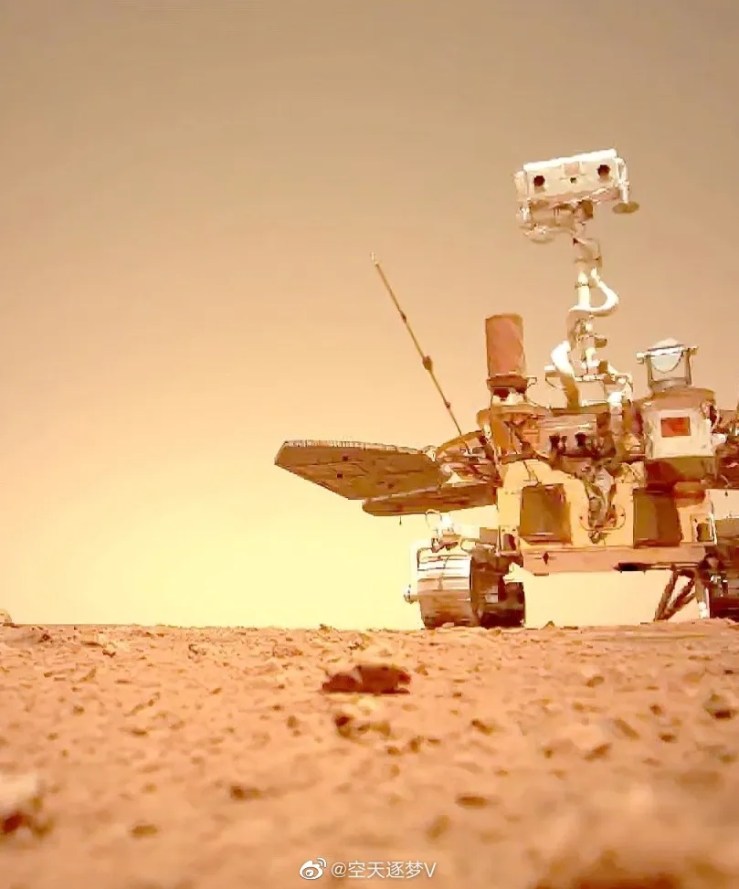
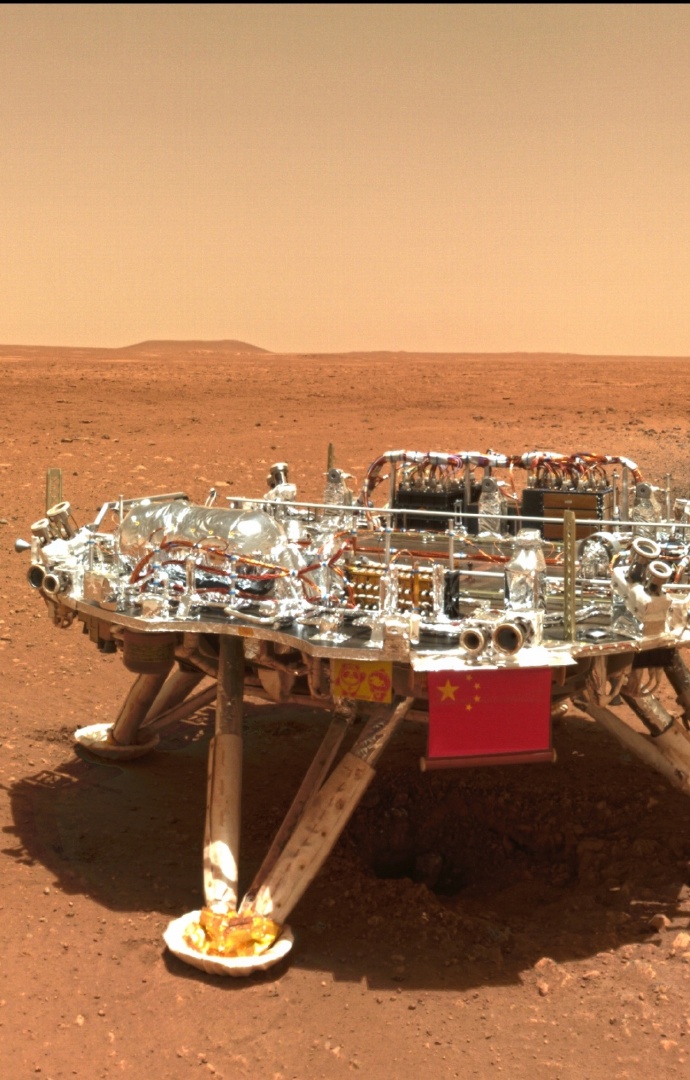
On the  30th Monday  August 2021天问一号飞運騎遊達达3亿CNSA – China National Space Administration – ESA – European Space agency Belt and road initiative mars mission…first Mars exploration mission, Tianwen- Martian Probe One …….”祝融号Zhu Rong” Mars Lander – Mars rover successfully exploring more than 1064 meters from its base lander camp.. Roamingly on the Rustic half diameter planet size Red planet Mars on Hong Kong SAR- Beijing Earth Wednesday time…  In which new mileage: “Zhu Rong” Mars Rover ….Sailing in the galaxy, strolling through the glamorous rustic environment in talking it’s adventure with Tianwen 1 Martian communications probe orbiting the Red Planet… in which “Zhurong” Mars rover completes scheduled exploration mission

 The Zhurong Mars Rover had travelled a total of 1064 meters south of the landing site. Picture 1/2 is a panoramic view of the inspection area taken by 祝融号 recently. At present, the rover is in good condition and has sufficient energy. It will continue to follow the high-efficiency detection mode of “seven-day cycle, one-day planning, daily detection”, and drive to the ancient sea-land junction in the south to obtain richer scientific exploration Data.

The orbiter has been in orbit for 403 days and is about 392 million kilometers away from the earth. On August 24, a high-resolution camera was used to image the landing area, and a 1-meter resolution image was obtained. The rover’s trajectory is clear in the image…

At present, the distance of the ground fire gradually tends to be the furthest (about 395 million kilometers). In mid-to-late September, the Earth and Mars will travel to both sides of the sun. The three are almost in a straight line, and the probe will enter the solar transit phase ….. During the transit, due to the influence of solar electromagnetic radiation interference, the device-to-ground communication is interrupted, the orbiter and the rover will switch to safe mode and stop the detection work. After the solar transit, the orbiter will select the opportunity to enter the remote sensing mission orbit to carry out global remote sensing exploration of Mars, while taking into account the relay communication of the Mars rover’s expansion mission stage

On August 30th 2021, when China- People’s Republic of China  first Mars exploration Tianwen-1 mission, “Zhurong”, the rover reached the surface of Mars for more than 100 days, the National Space Administration and the People’s Bank of China held China’s first Mars exploration mission in Beijing and successfully issued gold and silver commemorative coins. The ceremony is to commemorate an important step in our successful interstellar exploration journey, leaving China’s mark on Mars for the first time, becoming the world’s first country to achieve Mars circumnavigation, landing and patrol on a single mission. Wu Yanhua, deputy director of the National Space Administration, and Mou Shangang, chairman of China Gold Coin Corporation, delivered speeches.

At the ceremony, Chen Jianxin, deputy director of the People’s Bank of China Currency and Gold and Silver Bureau, announced the release announcement. Zhang Rongqiao, chief designer of China’s first Mars exploration mission project, released information on the progress of the Mars exploration mission. The leading experts at the meeting jointly presented gold and silver commemorative coins for China’s first Mars exploration mission. Coin unveiled.

Wu Yanhua said that this year marks the 100th anniversary of the founding of the Communist Party of China and the 65th anniversary of the founding of China’s aerospace industry. At this important historical moment and at this important project node, the National Space Administration, in conjunction with the Central Bank and the Gold Coin Corporation, issued “China’s First Mars Exploration Mission Successful” The commemorative coin is an organic fusion of science and technology and culture, aerospace and art. It is conducive to engraving historical achievements, is conducive to inspiring the whole line of aerospace to take the lead, and is conducive to setting off a national upsurge of innovation and creation.

Mou Shangang said that the success of my country’s first Mars exploration mission is an important achievement of the party and the country in advancing the building of a space power and a full demonstration of China’s aerospace spirit. It is worth recording and commemorating in the form of national legal tender. The issuance of commemorative coins can play an active role in inheriting the splendid and long-standing Chinese currency culture and patriotism, striving to achieve high-quality development of the aerospace industry, and demonstrating my country’s responsibility as a major country in advancing the progress and sustainable development of human civilization. The commemorative coin is the legal tender of the People’s Republic of China and is issued by the People’s Bank of China. There are 3 coins in total, including 2 gold coins and 1 silver coin. The logos on the front are the Chinese planetary exploration logo, and the country name and year number “2021” are published, and the patterns on the back are themed on the first Mars exploration mission “Orbit, Landing, and Patrol”, and the publication “China’s First Mars Exploration Mission Success · Tianwen Yi Number” and denomination. The commemorative coin condenses the vast space in a square inch, allowing the spacecraft to rise above the gold and silver coins. It uses a design method that combines realism and freehand brushwork. It adopts classic coinage techniques such as mirror surface, sandblasting, and multi-level sandblasting. It is scientific and The combination of aesthetics has important commemorative significance and artistic value.

The commemorative coin issued this time is China’s seventh set of aerospace-themed gold and silver commemorative coins. Prior to this, the 40th anniversary of the founding of China’s aerospace, the successful first manned space flight, the first lunar exploration flight, the first space walk, and the opening of the Beidou satellite navigation system Important aerospace events such as the operation and the success of the first moon landing have issued precious metal commemorative coins, bearing in mind China’s aerospace exploration achievements in climbing the technological summit, expressing the astronauts’ scientific dreams and forge ahead attitude, and demonstrating the Chinese people’s cultural confidence and romantic feelings. As of August 30, the rover had traveled a total of 1064 meters south of the landing site. At present, the rover is in good condition and has sufficient energy. It will continue to follow the high-efficiency detection mode of “seven-day cycle, one-day planning, and daily detection”, and drive to the ancient land-sea junction in the south to obtain richer scientific exploration. data. The orbiter has been in orbit for 403 days and is about 392 million kilometers away from the earth. On August 24, a high-resolution camera was used to image the landing area, and a 1-meter resolution image was obtained. The image shows a clear track of the rover.

At present, the distance of the earth fire is gradually approaching the farthest (about 395 million kilometers). In mid-to-late September, the earth and Mars will travel to both sides of the sun, and the three will be almost in a straight line, and the probe will enter the solar transit phase. During the transit, due to the influence of solar electromagnetic radiation interference, the device-to-ground communication is interrupted, the orbiter and the rover will switch to safe mode and stop the detection work. After the solar transit, the orbiter will select the opportunity to enter the remote sensing mission orbit to carry out global remote sensing exploration of Mars, while taking into account the relay communication of the Mars rover’s expansion mission stage.

Images and visuals are from CNSA- China National Space Administration also from there respectives..

#CNSA #ChinaNationalSpaceAdministration #國家航天局 |#BeltAndRoadinitiative #August2021 |#火星 # 天問 #天问一号#TianwenOne #MarsMission #Marslander #MarsRover #Tianwen1 probe #祝融号 #ZhuRong Exploring 1000 meters completes milestone exploring more #RedPlanet #Mars with more Ultimate #MarsSelfie …. #Selfies with 100 #Martian Days- ….

On the  23rd  August 2021天问一号飞運騎遊達达3亿CNSA – China National Space Administration – ESA – European Space agency Belt and road initiative mars mission…first Mars exploration mission, Tianwen- Martian Probe One …….”祝融号Zhu Rong” Mars Lander – Mars rover successfully exploring more than 889 meters from its base lander camp.. Roamingly on the Rustic half diameter planet size Red planet Mars on Hong Kong SAR- Beijing Earth Wednesday time…  In which new mileage: “Zhu Rong” Mars Rover ….Sailing in the galaxy, strolling through the glamorous rustic environment in talking it’s adventure with Tianwen 1 Martian communications probe orbiting the Red Planet… in which “Zhurong” Mars rover completes scheduled exploration mission

Travelling On 23rd August 2021 it’s the one thousand meters in one hundred days milestone for the is “Tianwen No. 1” traveling in space and chasing dreams on Mars for 13 months. It is also a crucial day for the “Zhurong” rover to spend 100 days on Mars safely, and its mileage exceeds 1,000 meter or One Hundred Meters in which travelling in spending one hundred days in which travelling more than its design parameters in which the awesome team from the Every step of Mars exploration is closely accompanied by the Mars team of Beijing Aerospace Flight Control Center. In the days to come, they will continue to accompany the Mars rover and survive in that distant place. On the red planet, new records are being set step by step, creating infinite possibilities…..

Previously 18TH  August Wednesday 2021  天问一号飞運騎遊達达3亿CNSA – China National Space Administration – ESA – European Space agency Belt and road initiative mars mission…first Mars exploration mission, Tianwen- Martian Probe One …….”祝融号Zhu Rong” Mars Lander – Mars rover successfully exploring more than 889 meters from its base lander camp.. Roamingly on the Rustic half diameter planet size Red planet Mars on Hong Kong SAR- Beijing Earth Wednesday time…  In which new mileage: “Zhu Rong” Mars Rover ….Sailing in the galaxy, strolling through the glamorous rustic environment in talking it’s adventure with Tianwen 1 Martian communications probe orbiting the Red Planet… in which “Zhurong” Mars rover completes scheduled exploration mission

China – People’s Republic of China’s first Mars exploration mission successfully landed on Mars on May 15, 2021. As of August 15, the “Zhurong” rover has been operating on the surface of Mars for 90 Martian days (approximately 92 Earth days), traveling a total of 889 meters. All scientific payloads were started for detection, and a total of about 10GB of raw data was obtained. The “Zhurong” rover successfully completed the scheduled inspection mission. At present, the rover is in good condition, stable on foot, and sufficient energy. In the future, it will continue to drive to the ancient land-sea junction in the southern Utopia Plain to implement expansion missions.

During the inspection and exploration period, the “Zhu Rong” rover operated in an efficient detection mode of “a cycle of seven days, a plan per day, and detection every day”. The navigation terrain camera acquires terrain and landform data along the way, supports the path planning of the rover and the selection of detection targets, and is used to carry out morphological features and geological structure research; subsurface detection radar acquires subsurface layered structure data for shallow surface structure analysis and exploration Possible ground water ice; meteorological measuring instrument obtains temperature, pressure, wind speed, wind direction and other meteorological data, which is used to carry out the research of atmospheric physical characteristics; surface magnetic field detector obtains local magnetic field data, and cooperates with the orbiter magnetometer to explore the Martian magnetic field Evolution process; surface composition detectors and multispectral cameras acquire spectral data of typical targets such as specific rocks and soils for analysis and research on elemental and mineral composition.

With 7 scientific load acquisitions including terrain camera, surface composition detector, subsurface detection radar, meteorological measuring instrument, orbiter high-resolution camera, subsurface detection radar (very low frequency mode), ion and neutral particle analyzer, etc. Related processing and quality verification of the data have been completed, and standard data products have been formed. The China Lunar and Deep Space Exploration Network has opened data applications to domestic scientific research teams a few days ago. In the future, scientific data will be released in batches on a monthly basis.

Images and visuals are from CNSA- China National Space Administration also from there respectives..

#CNSA #ChinaNationalSpaceAdministration #國家航天局 |#BeltAndRoadinitiative #August2021 |#火星 # 天問 #天问一号#TianwenOne #MarsMission #Marslander #MarsRover #Tianwen1 probe #祝融号 #ZhuRong Exploring 889 meters completes scheduled exploration mission #RedPlanet #Mars with more Ultimate #MarsSelfie …. #Selfies with 90 #Martian Days- ….

Today 18TH  August Wednesday 2021  天问一号飞運騎遊達达3亿CNSA – China National Space Administration – ESA – European Space agency Belt and road initiative mars mission…first Mars exploration mission, Tianwen- Martian Probe One …….”祝融号Zhu Rong” Mars Lander – Mars rover successfully exploring more than 889 meters from its base lander camp.. Roamingly on the Rustic half diameter planet size Red planet Mars on Hong Kong SAR- Beijing Earth Wednesday time…  In which new mileage: “Zhu Rong” Mars Rover ….Sailing in the galaxy, strolling through the glamorous rustic environment in talking it’s adventure with Tianwen 1 Martian communications probe orbiting the Red Planet… in which “Zhurong” Mars rover completes scheduled exploration mission

China – People’s Republic of China’s first Mars exploration mission successfully landed on Mars on May 15, 2021. As of August 15, the “Zhurong” rover has been operating on the surface of Mars for 90 Martian days (approximately 92 Earth days), traveling a total of 889 meters. All scientific payloads were started for detection, and a total of about 10GB of raw data was obtained. The “Zhurong” rover successfully completed the scheduled inspection mission. At present, the rover is in good condition, stable on foot, and sufficient energy. In the future, it will continue to drive to the ancient land-sea junction in the southern Utopia Plain to implement expansion missions.

During the inspection and exploration period, the “Zhu Rong” rover operated in an efficient detection mode of “a cycle of seven days, a plan per day, and detection every day”. The navigation terrain camera acquires terrain and landform data along the way, supports the path planning of the rover and the selection of detection targets, and is used to carry out morphological features and geological structure research; subsurface detection radar acquires subsurface layered structure data for shallow surface structure analysis and exploration Possible ground water ice; meteorological measuring instrument obtains temperature, pressure, wind speed, wind direction and other meteorological data, which is used to carry out the research of atmospheric physical characteristics; surface magnetic field detector obtains local magnetic field data, and cooperates with the orbiter magnetometer to explore the Martian magnetic field Evolution process; surface composition detectors and multispectral cameras acquire spectral data of typical targets such as specific rocks and soils for analysis and research on elemental and mineral composition.

7 scientific load acquisitions including terrain camera, surface composition detector, subsurface detection radar, meteorological measuring instrument, orbiter high-resolution camera, subsurface detection radar (very low frequency mode), ion and neutral particle analyzer, etc. Related processing and quality verification of the data have been completed, and standard data products have been formed. The China Lunar and Deep Space Exploration Network has opened data applications to domestic scientific research teams a few days ago. In the future, scientific data will be released in batches on a monthly basis.

祝融号”火星车完成既定探测任务​

​我国首次火星探测任务于2021年5月15日成功实现火星着陆,截至8月15日,“祝融号”火星车在火星表面运行90个火星日(约92个地球日),累计行驶889米,所有科学载荷开机探测,共获取约10GB原始数据,“祝融号”火星车圆满完成既定巡视探测任务。当前,火星车状态良好、步履稳健、能源充足,后续将继续向乌托邦平原南部的古海陆交界地带行驶,实施拓展任务。

在巡视探测期间,“祝融号”火星车按照“七日一周期,一日一规划,每日有探测”的高效探测模式运行。导航地形相机获取沿途地形地貌数据,支持火星车路径规划和探测目标选择,并用于开展形貌特征与地质构造研究;次表层探测雷达获取地表以下分层结构数据,用于浅表层结构分析,探寻可能存在的地下水冰;气象测量仪获取气温、气压、风速、风向等气象数据,用于开展大气物理特征的研究;表面磁场探测仪获取局部磁场数据,与环绕器磁强计配合,探索火星磁场演变过程;表面成分探测仪、多光谱相机获取特定岩石、土壤等典型目标的光谱数据,用于元素和矿物组成等分析研究。

火星车导航地形相机、表面成分探测仪、次表层探测雷达、气象测量仪,环绕器高分辨率相机、次表层探测雷达(甚低频模式)、离子与中性粒子分析仪等7台科学载荷获取的数据已经完成相关处理和质量验证工作,并形成标准的数据产品,中国月球与深空探测网日前已面向国内科学研究团队开放数据申请,后续将以月为周期组批发布科学数据。

Images and visuals are from CNSA- China National Space Administration also from there respectives..