#CNSA #ChinaNationalSpaceAdministration #国家航天局 | #BRI #June2023|#太原卫星发射中心  #TaiyuanSatelliteLaunchCenter  – International Iconic #ChangZheng6 #LongMarch6  yao 12 #CarrierRocket in launched to deploy #TestSatellite #Shiyan Number 25  Satellite  into orbit carry out new earth observation technology experiments #AGallery ..

At 1118 Hours Hong Kong SAR- Beijing Time  20th June 2023 , China- People’s Republic of China- CNSA –China National Space Administration   Successfully launched  the New Next Generation Long March – Chang Zheng 6 Y12 carrier rocket at the Taiyuan Satellite Launch Center Shanxi Province..  the Long March 6 carrier rocket carrying the test 25th satellite ignited and took off at the Taiyuan Satellite Launch Center, and then successfully put the satellite into the predetermined orbit, and the launch was a complete success.

The Long March-6 launch vehicle is a low-temperature liquid three-stage launch vehicle developed by the General Manager of the Eighth Academy of China Aerospace Science and Technology Corporation. Its sun-synchronous circular orbit has a carrying capacity of up to 1.0 tons (orbital height 700 kilometers). In this mission, the rocket test team carried out work in three aspects: optimizing the process, improving reliability and enhancing mission adaptability in response to satellite requirements, to improve the quality and efficiency of rocket launches. The test satellite No. 25 was developed by Aerospace Dongfanghong Satellite Co., Ltd. of the Fifth Academy of Aerospace Science and Technology Group, and is mainly used to carry out new-type earth observation technology experiments. This launch is the 11th launch of the Long March-6 carrier rocket and the 477th launch of the Long March series of carrier rockets

Long March 6 Yao 12 arrow adopts a new inverted cone-shaped frame-type satellite support…… The Long March 6 launch vehicle for this mission was developed by the Eighth Academy of China Aerospace Science and Technology Corporation, and it adopts the Sanping test launch mode A new generation of liquid oxygen kerosene launch vehicle. In this mission, the rocket test team carried out work in three aspects: optimizing the process, improving reliability and enhancing mission adaptability in response to satellite requirements, to improve the quality and efficiency of rocket launches.


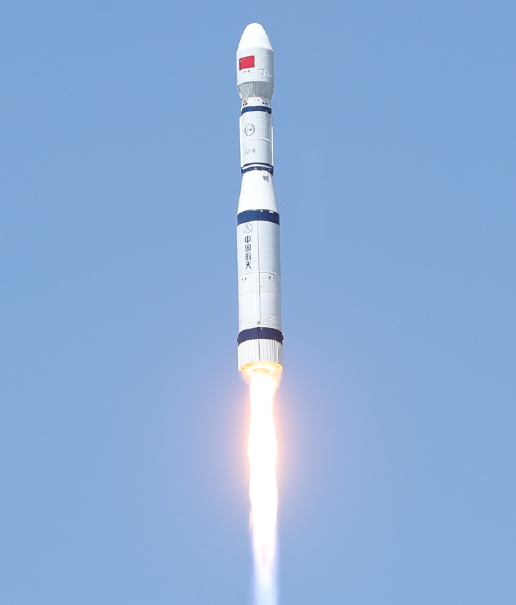
Following the launch of the mission, the model team sorted out a total of 36 improvement items, covering operational reliability and test coverage, which further improved the robustness and reliability of the rocket.

“The satellites launched this time are highly compatible with our Long March 6 rocket,” said Yu Yansheng, the overall chief designer of the Eight, Chang Zheng –Long March 6 test team. From the perspective of load weight, there are several types of rockets on the market that can perform this mission, but after an in-depth analysis of the satellite’s shape design and mission requirements, only the fairing envelope and carrying capacity of the Long March 6 are most suitable for the mission.

In view of the overall configuration of the mission satellite with a large aspect ratio, an inverted cone-shaped frame-type satellite support was designed for the model, and it is equipped with a 2.9-meter-diameter satellite fairing to adapt to the layout and interface of the satellite in the fairing. Requirements, provide effective “lifting + support” for satellites. In addition, the foam spraying technology is used on the outside of the satellite fairing to realize the insulation measures of the fairing without operation at the launch site and before launch.

At the same time, in terms of the separation method of the satellite, Chang Zheng –Long March 6 Y12 adopted a point-type connection and separation device composed of four components for the first time, which has the characteristics of light weight and intensive functions of Improved separation reliability.

In view of the fact that there are many satellite operation items after the rocket is transferred to the launch area, the design and operation personnel of the two sides of the model organization, the Star and Rocket, carried out special exchanges to confirm the timing, process, tools, precautions, etc. of the operation one by one; at the same time, arrange Specialized operation drills optimize the operation process to ensure that the time is controllable, safe and smooth in actual operation.

The Taiyuan Satellite Launch Center in June coincided with the season with more thunderstorms, and the model carried out re-identification, re-analysis, and re-confirmation of summer launch risks at the launch site. According to the characteristics of the Long March 6 carrier rocket’s “three-level” test launch mode and unsupported launch, a special review of rain and lightning protection was carried out, including the effectiveness of rain and lightning protection measures, the actual implementation of various measures, and the dismantling and rain protection before launch. Timing, etc., form a tabular inspection and confirmation document to ensure that the rocket meets the pre-launch operation and launch requirements during the thunderstorm season.

Images and visuals are from their Respectives CMS China Manned SpaceCNSA-China National Space Administration

#CNSA #ChinaNationalSpaceAdministration #国家航天局 |#BRI #Apirl2023 |#天宫#Tiangong #ChinaSpaceStation #CMS #ChinaMannedSpace #Shenzhou15 in readiness with the Advance #CargoSpaceCraft #Tianzhou6 with the #ChangZheng7 #LongMarch7 Yao7 arrives at #WenchangSpacecraftLaunchCenter #文昌航天發射場 #AGallery …..

On the 13th April 2023 Hour Hong- Kong SAR – Beijing time CNSA –China National Space Administration   The Chang Zheng – Long March 7 Y7 Carrier Rocket has safely arrived at the Wenchang Space Launch Site on April 13, and will carry out final assembly and testing at the launch site together with the #天舟六号# cargo spacecraft that arrived earlier work, which is currently expected to launch around May 10…….

From the arrival of the Chang Zheng – Long March 7  Carrier rocket to the launch of Tianzhou 6, the final assembly and testing work took 27 days, which is 5 times shorter than the 32 days of the last launch (Chang Zheng – Long March  6/Tianzhou 5). Days, the testing process is further optimized!

A new stage of space station application and development is about to start] The latest news from the First Academy of Aerospace Science and Technology Group; the Long March 7 Yao 7 carrier rocket that carried out the Tianzhou 6 mission was safely transported to the Wenchang Space Launch Site on April 13, and the follow-up will be in line with the previous stage The Tianzhou-6 cargo spacecraft that has arrived will carry out the final assembly and testing work in the launch site area together. The manned spaceflight project entered the application and development stage of the space station. All the participants of the project are stepping up their preparations and vowing to make the mission a complete success.

The Shenzhou 15 mission is the sixth mission of China’s manned space program in 2022, and it is also the last mission during the construction phase of China’s space station. The crew will work and live in orbit for 6 months. The main purpose of the mission is to verify The space station supports crew rotation capabilities, realizing the first on-orbit rotation of Takionaut crews; carrying out the installation and commissioning of equipment inside and outside the space station and space application mission-related facilities and equipment, conducting space science experiments and technical tests; performing daily maintenance and repair of the space station; The normalized operation mode of the cabin assembly… . The Shenzhou 15 flight crew consisted of Takionauts Fei Junlong , Deng Qingming and Zhang Lu , with Fei Junlong serving as the commander…

Images and visuals are from their Respectives CMS China Manned SpaceCNSA-China National Space Administration  

#CNSA #ChinaNationalSpaceAdministration #國家航天局|#BRI #March2023 |#ChineseAcademyofSciences #NationalAstronomicalObservatory #EinsteinProbe X-ray astronomical #Satellite – pinpoint the source of gravitational waves discovering the mysterious universe planned launch this year.  

國家航天局CNSA –China National Space Administration  China, People’s Republic of China plans to launch the Einstein probe at the end of this year China plans to launch a new X-ray astronomical satellite, the Einstein probe, at the end of 2023. It is expected to capture the first ray of light from a supernova explosion and help search and precise positioning the source of gravitational waves, discovering more distant, fainter celestial objects and fleeting mysterious phenomena in the universe. The satellite project has entered the final stage of positive development.

The X-ray Imaging Laboratory of the National Astronomical Observatory of the Chinese Academy of Sciences has been developing lobster eye X-ray imaging technology since 2010. After years of key technology research, it finally made a breakthrough, fully mastered the technology, and has completely independent intellectual property rights. The team carried out the test and verification of this technology on the space new technology test satellite launched in July 2022, and obtained and publicly released the wide-field X-ray focused imaging sky map for the first time in the world.

Yuan Weimin, the chief scientist of the Einstein Probe Satellite and a researcher at the National Astronomical Observatories of the Chinese Academy of Sciences, introduced at the recently held 35th National Space Exploration Symposium that the satellite project has entered the final development stage.

Inspired by the peculiar focusing imaging principle of lobster eyes, scientists have designed a special new type of X-ray telescope, which has a large observation field of view and higher detection sensitivity.

“That is to say, this kind of telescope can see the darker and farther universe while seeing a wide range. It is thanks to the lobster eye telescope technology that the Einstein Probe satellite can see the currently known universe.” There are very few soft X-ray bands for large-field, high-sensitivity, and fast time-domain survey monitoring.” Yuan Weimin said.

The X-ray Imaging Laboratory of the National Astronomical Observatory of the Chinese Academy of Sciences has been developing lobster eye X-ray imaging technology since 2010. After years of key technology research, it finally made a breakthrough, fully mastered the technology, and has completely independent intellectual property rights. The team carried out the test and verification of this technology on the space new technology test satellite launched in July 2022, and obtained and publicly released the wide-field X-ray focused imaging sky map for the first time in the world

Images and visuals are from their Respectives CMS China Manned SpaceCNSA-China National Space Administration

#CNSA #ChinaNationalSpaceAdministration #国家航天局 |#BRI #February2023 |  #JiuquanSatelliteLaunchCenter launched on the International Icon #长征二号丁火箭#ChangZheng2C  #LongMarch2C  #CarrierRocket successfully launch #Horus1  #RemoteSensing #Satellites .. 

On the 24th February 2023 Early clear 1201 Hours Hong Kong SAR- Beijing time , the Belt and Road Initiative CNSA –China National Space Administration  launching from Jiuquan Satellite Launch Center – Inner Mongolia –China – People’s Republic of China deployed launched the Chang Zheng – Long March 2C carrier rocket ….  The Chang Zheng – Long March 2Ccarrier rocket erected at station 603 of the Jiuquan Satellite Launch Center, and it is expected to perform a space launch mission at noon today….

Successfully launched the Horus 1 remote sensing satellite at 12:01 Beijing time today, China, People’s Republic of China successfully launched the Horus 1 remote sensing satellite into space using the Long March 2C carrier rocket at the Jiuquan Satellite Launch Center. The satellite successfully entered the predetermined orbit, and the launch mission was a complete success. This mission is the 464th flight of the Long March series of launch vehicles!

Images and visuals are from their Respectives…

#CNSA #ChinaNationalSpaceAdministration #国家航天局 |#BeltAndRoadinitiative #September2022 | #酒泉卫星发射中#JiuquanSatelliteLaunchCenter launched on the International Icon #ChangZheng4C  #LongMarch4C #CarrierRocket successfully launch #Yaogan  #RemoteSensing #EarthSciences #Satellite..  

On the 3rd September 2022 Early Morning clear 0744 Hours Hong Kong SAR- Beijing time , the Belt and Road Initiative CNSA –China National Space Administration  launching from Jiuquan Satellite Launch Center – Inner Mongolia –China – People’s Republic of China, Readiness rolled out    deployed the Chang Zheng – Long March 4C carrier rocket  launching a Yaogan- Remote Sensing 33 two satellites,  The satellite is mainly used for scientific experiments, land and resources census, agricultural production estimation, disaster prevention and mitigation and other fields.

Yaogan- Remote Sensing Satellite was developed by the Eighth Academy of China Aerospace Science and Technology Corporation, and is mainly used in scientific research, marine and terrestrial resources census, production estimation of agricultural products, and disaster prevention and mitigation

The Long March 4C carrier rocket for this launch mission is a normal temperature liquid three-stage carrier rocket with excellent performance and a wide range of uses. For different types of satellites, the Long March 4 series carrier rockets can adopt flexible launch plans, have the ability to launch satellites of various types and different orbit requirements, and can implement one rocket, one satellite or multiple satellites. Up to 3 tons (orbit height 700 km)

This launch is the 93rd launch of the Long March 4 series of launch vehicles, the 166th launch of the Long March series of launch vehicles developed by the Eighth Academy, and the 435th launch of the Long March series of launch vehicles.

The provisionments of the 遥感式; Yaogan satellites in which are design as remote sensing  earth sciences satellites in which have multiple installation equipment onboard, with scientific experiments, land surveying, agriculture , disaster monitoring ..  Also with electromagnetic environment detection… in which the Yaogan 33 satellites series  is place in at an attitude of in between 700 Kilometers above earth… at an inclination of ninety eight degrees…   Satellites are mainly used to carry out electromagnetic environment detection and related technical tests. …….

Images and visuals are from Weibo also are from their Respectives ..