中国空间站 On the 7th June 2023CNSA –China National Space Administrationat the Grounds of the Hong Kong SAR, China, People’s Republic of China, at Hong Kong SAR Government house in Central the 李家超 John Lee Ka-chiu-Chief Executive of the Hong Kong Special Administrative Region China, People’s Republic of China. Held a hosting meeting with the Hong Kong SAR Civilian Takionaut selection of the Role of Payload Specialist candidates.. His meeting is described as Meeting with payload expert- Specialists candidates…… as李家超 John Lee Ka-chiu-Chief Executive of the Hong Kong Special Administrative Region Quote below..
[Hong Kong SAR candidates have entered the selection stage of the national manned space engineering payload expert- Specialist]
Sun Dong, director of the Hong Kong Innovation, Technology and Industry Bureau, said on September 20th 2023 that more than one Hong Kong SAR candidate has entered the national manned space engineering payload expert selection stage. The country, China, People’s Republic of China. will send personnel to Hong Kong in early October to learn more about the candidates. Expect good news to be announced within this year.
After the SAR government selects candidates and recommends them to the country, more than one candidate from Hong Kong enters the final selection stage after primary and secondary elections. The candidates include both men and women. “I think we have achieved good results.
IT House reported on September 20 that my country launched the fourth batch of preliminary Takionaut selection last year, selecting payload experts in Hong Kong and Macau for the first time .
According to Hong Kong News Network, Hong Kong Secretary for Innovation, Technology and Industry Sun Dong said today (20th) that there are currently more than one candidate from Hong Kong who went to Beijing to participate in the “re-selection” of load experts for the national manned space project earlier . Entering the third stage of “selection”, there are men and women .
Sun Dong revealed that the country will send personnel to Hong Kong in October to learn more about the candidates, and he looks forward to good news this year.
IT Home inquired and learned that a total of 12 to 14 reserve Takionaut were selected this time, including 7 to 8 space pilots, 5 to 6 aerospace flight engineers and payload experts, including about 2 payload experts.
Aerospace pilots are selected from active pilots in the army, navy and air force, aerospace flight engineers are selected from scientific research and engineering technicians engaged in aerospace engineering and related fields, and payload experts are selected from scientific researchers engaged in space scientific research and application-related fields.
In May this year, my country’s space station welcomed the first payload expert into space—Gui Haichao. Gui Haichao is a professor at Beihang University . He is mainly responsible for the on-orbit operation of space science experimental payloads. He has professional training in science, aerospace engineering and other fields and has rich operational experience. He was selected as the Shenzhou 16 flight crew.
长征十号 At 22nd 23rd July 2023 Hong Kong SAR- Beijing time , China- People’s Republic of China- CNSA –China National Space Administration Successfully Carrier Rocket engine tested for the New Next Generation Chang Zheng – Long March 10 Manned Lunar mission landing Carrier rocket freighter The main engine of China’s manned lunar landing rocket Long March 10 completed another ignition test run yesterday, which verified all the requirements of the rocket mission for the engine, and provided strong support for the solidification of the engine’s technical status, the establishment of product technology baselines, and the improvement of reliability.
The engine used in this test run uses advanced liquid oxygen kerosene as fuel, which is improved and iterated from the high-thrust liquid oxygen kerosene engine used by the new generation of launch vehicles such as the active Long March 5, with a thrust of 130 tons. (The Sixth Academy of Aerospace Science and Technology Group)
Created with GIMP
The reporter learned from China Aerospace Science and Technology Group Co., Ltd. on July 23 that the main engine of my country’s manned moon landing rocket was tested in the Fengzhou Test Area of the Sixth Academy of Aerospace Science and Technology Corporation, and achieved continuous success. This test run verified the engine flight mission profile, and provided strong support for the solidification of the engine technical state, the establishment of the product technical baseline, and the improvement of reliability.
The engine is the power source of the rocket, and its development process is very complicated. Test run is an important link in the engine development process, and there are dozens of types. In layman’s terms, engine test run is the process of igniting the engine and verifying the rationality of its design scheme and process reliability. This is an indispensable and important part of the development and delivery of a type 1 engine. It will run through all stages before and after engine development. Each stage of test run has different meanings, and the ignition time varies from a few seconds to hundreds of seconds.
It is reported that the engine used in this test run uses advanced liquid oxygen kerosene as fuel, which is improved and iterated from the high-thrust liquid oxygen kerosene engine used by the new generation of launch vehicles such as the Long March 5. The thrust reaches 130 tons. The R&D team of the Sixth Academy of Aerospace Science and Technology Group adheres to the concept of digital design, and has successively overcome key technical problems such as engine start-up and shutdown sequence, engine wide-range continuously variable thrust, and engine long life and high reliability.
In addition, the continuous success of the test run has fully verified the reliability of a number of new carrying process technologies. The engine production of this test run adopts the concept of intelligent manufacturing, and actively applies new materials, new processes, and new technologies. The inner wall of the thrust chamber of the core component adopts a new protective coating, key assemblies adopt automatic welding technology, and a large number of components adopt 3D printing technology.
During the preparation of the engine test run, the participants in the research and test conducted tests and verifications on each subsystem of the test through comprehensive means such as digital modelling, simulation calculation, and system debugging. The successful test run shows that the test area has greatly improved the multi-station parallel test run capability and test efficiency by optimizing the workflow.
On July 12, 2023, the Ninth China (International) Commercial Aerospace Summit Forum opened in Wuhan. This forum is jointly directed by China National Space Administration, China Meteorological Administration, China Manned Space Engineering Office, Hubei Provincial People’s Government, Wuhan Municipal People’s Government, China Aerospace Science and Industry Corporation, China Aerospace Science and Technology Corporation, China Electronics Technology Co., Ltd. It is co-sponsored by Group Co., Ltd., China Aerospace Foundation and Chinese Society of Astronautics. Ji Qiming, Assistant Director of China Manned Space Engineering Office, Zhang Hailian, Deputy Chief Designer of China Manned Space Engineering and other leaders attended the forum.
Ji Qiming, assistant director of the China Manned Space Engineering Office, said in his opening speech that commercial aerospace is a new force in my country’s aerospace field and has become an indispensable force in my country’s aerospace industry. The Commercial Aerospace Summit Forum strives to bring together experts, scholars and relevant superior resources in the aerospace field at home and abroad, and actively builds a well-known platform for exchanges, cooperation and achievements in the industry. It is an important witness, companion and promoter of my country’s commercial aerospace development. All along, China’s manned space program has attached great importance to the cultivation, development and application of commercial space power.
Speech by Assistant Director Ji Qiming
Previously, the China Manned Space Engineering Office issued an announcement to the public on the solicitation of low-cost cargo transportation plans for the space station, and received many proposals from commercial aerospace companies. At present, the China Manned Space Engineering Office is soliciting from the whole society the manned lunar rover development plan and the space station space science and application project. In the future, the China Manned Space Engineering Office will continue to create more space for commercial aerospace forces to play a role in scientific payload carrying, on-orbit maintenance, space travel, and flight product development in accordance with the principles of openness, fairness and justice. Accumulate experience and lay the foundation for promoting the formation of a unified development pattern of manned spaceflight…commercialization with unified national management, active social participation, smooth transformation of achievements, and continuous improvement of benefits..
Deputy chief designer Zhang Hailian made a keynote speech
Zhang Hailian, deputy chief designer of China’s manned spaceflight project, made a keynote report on “Overall Considerations on the Development of my country’s Manned Lunar Exploration” in the main forum. The development steps of lunar exploration, expounding the preliminary flight plan of my country’s manned lunar exploration, and the main functions and performances of flight products such as a new generation of manned launch vehicles, a new generation of manned spacecraft, lunar landers, lunar rovers, and lunar landing suits. The main key technologies faced in the lunar scientific research and development stage, put forward the preliminary consideration of promoting the high-quality and high-efficiency development of the manned lunar exploration project with the help of commercial aerospace and social forces.
In addition, the crew of Shenzhou 16 Takionauts sent a video speech from the China Space Station, wishing the forum a complete success.
[Preliminary plan for manned moon landing announced]
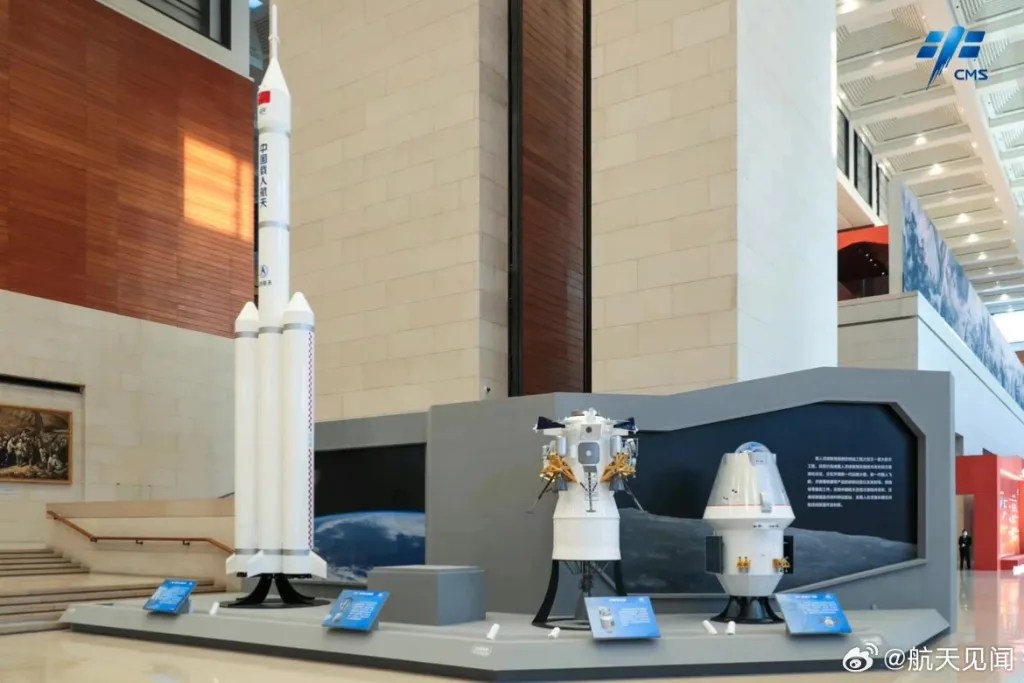
Zhang Hailian, deputy chief engineer of the China Manned Space Engineering Office, disclosed at the Ninth China (International) Commercial Space Summit Forum held in Wuhan that morning that my country plans to realize manned landing on the moon by 2030 Carry out scientific exploration, and then explore the construction of a lunar scientific research and experiment station, and carry out systematic and continuous lunar exploration and related technology test verification. At present, China’s preliminary plan for manned moon landing is:
🔷Use two carrier rockets to send the lunar lander and the manned spacecraft to the lunar orbit for rendezvous and docking in orbit, and the astronauts enter the lunar lander from the spacecraft. 🔷Afterwards, the lunar lander will descend and land on the predetermined area of the lunar surface alone, and the astronauts will land on the moon to carry out scientific investigation and sample collection.
🔷After completing the scheduled tasks, the astronauts will take the lander to ascend to the orbit around the moon to rendezvous and dock with the spacecraft, and carry samples back to Earth on the spacecraft. To accomplish this task, Chinese scientific researchers are developing equipment such as the Long March 10 carrier rocket, a new generation of manned spacecraft, a lunar lander, and a manned lunar rover..
China plans to realize manned landing on the moon to carry out scientific exploration before 2030, and then will explore the construction of a lunar scientific research and experimental station to carry out systematic and continuous lunar exploration and related technical test verification.
At present, China’s preliminary plan for manned landing on the moon is:
use two carrier rockets to send the lunar lander and the manned spacecraft to the lunar orbit for on-orbit rendezvous and docking, and the astronauts enter the lunar lander from the spacecraft.
Afterwards, the lunar lander will descend and land on the predetermined area of the lunar surface alone, and the astronauts will land on the moon to carry out scientific investigation and sample collection.
To accomplish this task, Chinese scientific researchers are developing equipment such as the Long March 10 carrier rocket, a new generation of manned spacecraft, a lunar lander, and a manned lunar rover. (China Manned Spaceflight Office🇨🇳The latest CG concept map of my country’s future manned lunar landing rover, lunar lander, and lunar scientific research and test station…
China Takionauts will land on the moon in this way
Zhang Hailian, deputy chief engineer of the China Manned Space Engineering Office, disclosed at the Ninth China (International) Commercial Aerospace Summit Forum held in Wuhan this morning that our country plans to Before 2030, realize manned landing on the moon to carry out scientific exploration, and then explore and build a lunar scientific research and test station to carry out systematic and continuous lunar exploration and related technology test verification.
At present, China, People’s Republic of China, preliminary plan for manned landing on the moon is: use two carrier rockets to send the lunar lander and the manned spacecraft to the Earth-Moon transfer orbit, the spacecraft and the lander will rendezvous and dock in the orbit around the moon, and the astronauts will enter from the spacecraft. Lunar lander. Afterwards, the lunar lander will descend and land on the predetermined area of the lunar surface, and the astronauts will land on the moon to carry out scientific investigation and sample collection. After completing the scheduled tasks, the astronauts will take the lander to ascend to orbit around the moon to rendezvous and dock with the spacecraft, and return to Earth with the spacecraft. To accomplish this task, Chinese researchers are developing equipment such as the Long March 10 carrier rocket, a new generation of manned spacecraft, a lunar lander, a lunar suit, and a manned lunar rover
Zhang Hailian, deputy chief engineer of the China Manned Space Engineering Office, disclosed at the Ninth China (International) Commercial Space Summit Forum held in Wuhan this morning that my country plans to realize manned landing on the moon to carry out scientific exploration before 2030, and then to explore and construct The Lunar Scientific Research and Experimental Station conducts systematic and continuous lunar exploration and related technology test verification.
On the 30th May 2023 clear 0931 Hours Morning Hong Kong SAR- Beijing time , the Belt and Road InitiativeCNSA –China National Space Administration from Jiuquan Satellite Launch Center – Inner Mongolia –China – People’s Republic of China deployment of the Chang Zheng – The Chang Zheng – Long March 2F Yao 16 –Shenzhou 16 carrier rocket.. On which Takionauts Jing Haipeng, Zhu Yangzhu, and Gui Haichao took to the predetermined orbit. The first manned flight mission in the application and development stage was a complete success. The three astronauts will stay in the space station and “join up” with the crew of Shenzhou 15 to carry out on-orbit handover “face-to-face” meeting in which brings the total crew of six with a handover ceremony from Shenzhou 15 towards 16..
[神舟六号Long March 2 F Yao 16 rocket test launch process shortened to 35 days, 20 technical status changes]
Liu Feng, deputy chief designer of the Chang Zheng –Long March Rocket 2F rocket, introduced that the remote launch of 神舟六号Sixteen rockets are far behind fifteen, and there are a total of 20 technical status changes. The research and development team focused on improving the redundancy and improving the process, and continued to improve the reliability of the rocket. At the same time, it continued to promote the localization of multiple electrical system components on the rocket, and continuously improved the independent and controllable level of the product.
The research and development team also empowered the rocket with digital and information technology, introducing “smart” changes for data interpretation. Relying on the continuous construction of the remote test and launch support system, real-time communication between the front and rear of the Chang-2F rocket test data has been realized, and the rear designers can more conveniently and comprehensively understand rocket-related data, carry out real-time monitoring, interpretation and data analysis, and simultaneously display the data on the large screen. On the visualization display. Not only that, but the powerful automatic data interpretation and analysis tools and a complete expert team will better ensure the coverage and reliability of data interpretation and improve work efficiency.
Starting from the construction mission of the space station, the Chang-2F rocket started a normal fast-paced launch. Especially since the launch of the Shenzhou 12 manned spacecraft, the Chang-2F rocket has adopted the launch mode of “one launch, one backup” and “rolling backup”.
In the face of the new normal, the development team has continuously optimized the launch site process through measures such as adjusting the test sequence, parallel work, and integrating test items on the premise of ensuring launch reliability. At present, the launch site process of the Chang-2F rocket has been compressed from 49 days in the initial stage of construction to 35 days. As the space station enters the application and development stage, the research and development team will further improve the efficiency of the launch site with a goal of 30 days, and send astronauts into space safely and accurately at a faster speed.
The Chang-2 F rocket is a two-and-a-half-stage carrier rocket specially used for manned launch missions. The reliability index of the whole rocket is 0.98, and the safety index is 0.997. On the premise of ensuring the reliability of the launch, the Chang-2F rocket team continued to sort out and optimize the launch site process to improve the efficiency of test and launch. At present, the launch site process of the Chang-2F rocket has been compressed from 49 days in the initial stage of construction to 35 days.
【神舟六号Shenzhou 16 is the first new batch of Shenzhou spacecraft, with hundreds of device changes, supporting the Beidou positioning system】
神舟六号 The manned spacecraft was developed by the Fifth Academy of Aerospace Science and Technology Group, and it is the first development in China The 11 manned spaceflight missions are also the first manned spacecraft in the application and development stage of China’s space station. At the same time, it is also the first manned spacecraft produced in batches from Shenzhou 16 to Shenzhou 21. The mission of “putting into production” has played a key role in connecting the past and the future.
As the “boat of life” for astronauts to go back and forth between heaven and earth, the Shenzhou series of manned spacecraft consists of an orbital module, a reentry module and a propulsion module, with a total of 14 subsystems. It is the spacecraft with the most stringent reliability and safety requirements in my country.
Among them, the propulsion module, as the “source of energy and power” of the whole ship, is equipped with the two most important energy and power systems of the spacecraft. For example, 80% of the equipment of the entire spacecraft energy system is installed in the propulsion module, including photovoltaic power supply equipment including two solar cell wings, which is the main energy source for the spacecraft’s in-orbit flight; all 40 engines of the power system are also installed. On the propulsion module, there are 4 high-thrust orbital engines at the bottom and 36 attitude control engines that allow the spacecraft to fly in various attitudes and directions.
Faced with the high-density mission requirements of launching two Shenzhou spacecraft each year during the mission phase of the space station, the Shenzhou spacecraft system adopts a batch development model and a rolling backup strategy of “one ship launched, one ship on standby” to ensure the smooth progress of the space station project. During the work at the launch site, the Shenzhou spacecraft test team needs to complete the Shenzhou 16 launch and Shenzhou 17 emergency rescue and standby preparations in parallel. The four fronts of development, launch, flight control and recovery are highly overlapping, and many aspects such as schedule arrangement, quality control, and resource guarantee are facing great challenges.
In order to meet the high-density and regular launch tasks of the space station, the Shenzhou 16 manned spacecraft has completed hundreds of verifications such as device changes and reliability improvements under the premise of ensuring reliability and safety, and has passed the national major project. Support the Beidou positioning system, further enhance the independent health management function, continuously improve the independent health management level of the spacecraft, and establish a data envelopment analysis mechanism, and fully promote the informationization of product data interconnection, digitalization of cable assembly layout, and intelligent detection of key parameters.
Badge design description: This badge cleverly forms the word “1” with a flexible and elegant silk ribbon and arrow body, indicating that this is the first manned mission of the Chinese space station after it officially entered the operation stage. The three vivid and realistic images of astronauts in the badge show that China ‘s special rocket for manned spaceflight sends astronauts into space, knocking on the door of the vast universe…
[神舟十六号 #Shenzhou16 manned spacecraft and space station assembly completed autonomous rapid rendezvous and docking]
The latest news from the China Manned Space Engineering Office, after the Shenzhou 16 manned spacecraft entered orbit, at 16:29 on May 30, 2023 Beijing time In 20 minutes, it successfully docked with the radial port of the space station’s sky and core module, and the entire docking process lasted about 6.5 hours.
According to the mission plan, the three Takionauts will then enter the sky and core module of the space station from the Shenzhou 16 manned spacecraft. The crew of Shenzhou 15 has made all preparations for the arrival of the crew of Shenzhou 16…
神舟十五号 Shenzhou 15 the crew hung up a couplet to welcome the arrival of the crew of 神舟十六 号 Shenzhou 16 in the Tiangong- China Space Station- Tianhe core cabin of the Chinese space station . Welcome comrades! Color! ! !
神舟六号 3 Shenzhou 16 Takionauts successfully stationed in China’s space station … After the manned spacecraft and space station combination successfully achieved independent rapid rendezvous and docking, the astronauts on Shenzhou 16 took The group enters the orbital module from the return module of the spacecraft. At 18:22 on May 30, 2023, Beijing time, the long-awaited Shenzhou 15 Takionaut crew successfully opened the “home” and welcomed the Shenzhou 16 astronaut crew who came from afar to settle in the “Tiangong”. Afterwards, the two Takionauts teamed up to take a “family portrait” and jointly reported safety to the people all over the country who cared about them.
Hope and hope! waiting! looking forward to! Finally, when the crew of Shenzhou 16 and the crew of Shenzhou 15 joined forces in China’s space homeland, seeing the moving scene of the six astronauts hugging and celebrating with joy when they met at the space station, this is China’s manned spaceflight ! How can you not love China’s manned spaceflight, how can you not burst into tears…. Subsequently, the two Takionaut crews will perform on-orbit rotations on the space station. During the period, the six Takionauts will work and live on the space station together for about 5 days to complete various scheduled tasks.
On the 2nd June 2023 the crew of Shenzhou 15 and Shenzhou 16 Takionaut Team Handover Ceremony The in-orbit handover ceremony is completed after three days of in-orbit communication between the crews of Shenzhou 15 and Shenzhou 16, the Takionauts of both crews agreed that they met the conditions for handover. Shenzhou Fifteen: It will be up to you later!
Shenzhou 15 and Shenzhou 16 crews have been working and living together in orbit for about 5 days, watching the wonderful scenes of the two crews’ “dream linkage” in orbit, and the touching moment of Yiyi saying goodbye, did you cry? !
On today on the 29TH May 2023 in according to the CMS China Manned SpaceCNSA-China National Space Administration China Manned Space Engineering Office At 11:00 on May 29, 2023, Beijing time, the three astronauts will meet with Chinese and foreign media reporters at the Wentian Pavilion of the Jiuquan Satellite Launch Center…… Official announcement! According to the research and decision of the Space Station Application and Development Stage Flight Mission Headquarters, the Shenzhou 16 astronaut crew consists of command commander Jing Haipeng, spaceflight engineer Zhu Yangzhu, payload expert Gui The tide is composed of 3 astronauts. This is the first time that my country’s third group of astronauts has performed a flight mission, and it is also the “first show” of the “new members” of my country’s astronaut team – aerospace flight engineers and payload experts.
Tomorrow, a brand-new crew composed of three types of astronauts will go to space to perform the first manned mission in the application and development phase of the space station. The Shenzhou-16 crewed spaceship is scheduled to be launched at 9:31 a.m. Tuesday 30th May 2023 Beijing Time from the Jiuquan Satellite Launch Center in northwest China, Inner Mongolia, China, People’s Republic of China. in which they will join with the Shenzhou 15 Crew together record breaking of six months. .
景海鹏 Jing HaiPeng
Jing Haipeng, male, Han nationality, was born in October 1966 in Yuncheng, Shanxi Province. He joined the army in June 1985 and joined the Communist Party of China in September 1987. He graduated with a doctorate from the School of Electronics and Information Engineering of Xi’an Jiaotong University in 2018, with the rank of major general. He is currently the captain of the Takionaut Brigade of the Chinese People’s Liberation Army and the deputy commander in chief of the astronaut system.
Jing Haipeng is a super Takionaut of the Chinese People’s Liberation Army Takionaut Brigade . He has successfully carried out the manned missions of Shenzhou 7, the manned rendezvous and docking missions of Tiangong 1 and Shenzhou 9 , and the manned missions of Tiangong 2 and Shenzhou 11. , achieved the Chinese miracle of three tours of the sky; was awarded the honorary title of ” Heroic Astronaut ” by the Central Committee of the Communist Party of China, the State Council, and the Central Military Commission, and was awarded the ” August 1st Medal ” in 2017; “Pioneer “, awarded the Reform Pioneer Medal; in January 2018, the Central Department awarded the honorary title of ” Model of the Times ” to the astronaut group. In 2021, he was selected as a national model of dedication and dedication. In December 2021, he was awarded the title of ice and snow sports promotion ambassador.
On May 29, 2023, after research and decision by the Space Station Application and Development Stage Flight Mission Headquarters, Shenzhou XVI will launch at 9:31 on the 30th. The Shenzhou 16 flight crew consisted of Takionauts Jing Haipeng, Zhu Yangzhu and Gui Haichao , with Jing Haipeng serving as the commander.
朱杨柱 Zhu Yangzhu
Zhu Yangzhu, male, an astronaut of the Astronaut Brigade of the Chinese People’s Liberation Army , an aerospace flight engineer, and an astronaut on the crew of Shenzhou 16 .
On May 29, 2023, after the study and decision of the Space Station Application and Development Stage Flight Mission Headquarters, the Shenzhou 16 Takionaut crew will consist of three astronauts: Jing Haipeng, Zhu Yangzhu, and Gui Haichao.
桂海潮Gui Haichao
Doctoral supervisor of School of Astronautics, Beihang University, astronaut of Shenzhou 16 crew Gui Haichao, male , Han nationality, born in November 1986, native of Shidian, Yunnan, joined the work in September 2017, joined the Communist Party of China in July 2020, doctorate in engineering, professor and doctoral supervisor of the School of Astronautics, Beihang University, in Professionally trained and experienced in fields such as science and aerospace engineering.
On May 30, 2023, Gui Haichao, as the crew member of Shenzhou 16, will carry out the manned mission of Shenzhou 16, mainly responsible for the on-orbit operation of the space science experiment load.