CNSA China National Space Admistraton –CMS China Manned Space Shenzhou ten and thirteen Senior Colonel Takionaut王亞平Wang Yaping family household is to be congratulate! In which Wang Yaping’s family was named “Shining Name – The Most Beautiful Family in 2023”! May 15th is International Family Day, and just last night, “Shining Names – 2023 Most Beautiful Family Release Ceremony” was broadcast on CCTV. In the release ceremony last night, a total of 10 outstanding representatives of the most beautiful families came to the scene; among them was the Wang Yaping family that we are most familiar with. 王亚平家庭was rated as the most beautiful family in 2023 on national Television on CCTV Science and Education Channel . … the behind the scenes shows her family life with her lovely daughter and her husband with their parents as equal to her Takionaut Space Career..
On today on the 12th March 2023 in according to the CMS China Manned SpaceCNSA-China National Space Administration China Manned Space Engineering Office, China’s space station has been fully completed, and the “three-step” development strategy of China’s manned spaceflight project has become a reality from conception. At present, the space station assembly is operating stably in orbit, and the crew of Shenzhou 15 is in good condition. It is planned to return to the ground in June this year. According to the mission arrangement, this year will organize the launch of Tianzhou-6 cargo spacecraft, Shenzhou-16, and Shenzhou-17 manned spacecraft. At present, the Tianzhou-6 cargo spacecraft has completed the work related to leaving the factory and has been transported to the Wenchang Space Launch Site. It is planned to launch in May this year…
China’s space station has been fully completed, and the “three-step” development strategy of China’s manned spaceflight project has become a reality from conception. At present, the space station assembly is operating stably in orbit, and the crew of Shenzhou 15 is in good condition. It is planned to return to the ground in June this year. At present, the project has entered a new stage of space station application and development.
2023 is the beginning year of the new stage of space station application and development. According to the task arrangement, this year will organize the launch of Tianzhou-6 cargo spacecraft, Shenzhou-16, and Shenzhou-17 manned spacecraft. The first missions after the new phase of application and development. At present, the Tianzhou-6 cargo spacecraft has completed the work related to leaving the factory and has been transported to the Wenchang Space Launch Site. It is planned to launch in May this year. The astronaut crew for the two manned flights has been selected and mission training is underway.
China, People’s Republic of China has always adhered to the principles of peaceful use, equality, mutual benefit, and common development, and is committed to building China’s space station into an open platform for scientific and technological cooperation and exchanges facing the international community. The first batch of experimental projects jointly selected by the China Manned Space Engineering Office and the United Nations Office for Outer Space Affairs are planned to start ascending successively this year and carry out experimental research on the Chinese space station.
While implementing the space station application and development stage tasks, the project is also fully promoting the manned lunar exploration mission. At present, the key technology research and program deepening demonstration of manned lunar exploration have been completed. This year, various development and construction work for the lunar landing stage will be fully carried out.
CNSA China National Space Admistraton –CMS China Manned Space Shenzhou ten and thirteen Senior Colonel Takionaut王亞平Wang Yaping also Colonel 刘洋 LiuYang spoke on 航空航刘洋王亚平 Send Women’s Day Blessings Today is the “March 8th” International Women’s Day. Chinese astronauts Wang Yaping and Liu Yang have joined hands to send festival blessings to all women. Liu Yang sent a message to the female compatriots to…..
“Strive to be the builders of the great cause, the advocates of civilized fashion…… the fighters who dare to pursue their dreams, and show the style of women in all walks of life in the new era.” Wang Yaping said: “May every female compatriot picks the brightest stars for the life and career they love in their own starry sky.”
No matter how grand and flying the imagination, there can always be traces in reality. When I sat in a movie theatre and felt the Chinese-style science fiction of “Take the Earth to Wander”, the value choices and wisdom presented there had a surprisingly similar core of thought to the space story told by China’s first Takionaut Yang Liwei. . I don’t know if you are as curious as I am, what has Yang Liwei been doing for the past 20 years after completing the mission of Shenzhou Five? During the 21 hours of his space roaming, what details we don’t know? In his eyes, what is the biggest change in the 30 years of manned spaceflight? Look for the answer in #张扬Dialogue
Yang Liwei, male, Han nationality, was born on June 21, 1965 in Suizhong County, Huludao City, Liaoning Province. He is a member of the Communist Party of China, a major general of the Chinese People’s Liberation Army, and a super Takionaut. In 1987, he graduated from the Air Force Aviation University of the Chinese People’s Liberation Army with a bachelor’s degree [39] ; in January 2009, he graduated from Tsinghua University with a doctorate in management [28] . He is currently a member of the 13th and 14th National Committee of the Chinese People’s Political Consultative Conference and deputy chief designer of China’s manned spaceflight project….
He has successively served as the deputy director of the China Takionaut Research and Training Center, the deputy commander-in-chief of the Takionaut system of the manned space engineering, the alternate member of the Central Committee, and the director of the China Manned Space Engineering Office. The first generation of astronauts trained by China is the first person in China to enter space. Yang Liwei flew safely for 1,350 hours in the former Air Force.
At 9 o’clock Beijing time on October 15, 2003, Yang Liwei entered space for the first time on the Shenzhou 5 spacecraft carried by the Long March 2F rocket, which symbolized a big step forward for China’s space industry and played a milestone role.
The awesome team at one of many CNSA –China National Space Administration that China National Space Administration After Wentian experimental module entered orbit, the status setting was successfully completed. At 3:13 on July 25, 2022, Beijing time, it was successfully connected to the forward port of 天和 Tianhe Core Module. The entire rendezvous and docking process lasted about 13 hours. . This is the first time that two 20-ton spacecraft in my country- China- People’s Republic of China have achieved rendezvous and docking in orbit. …According to the mission plan, the Shenzhou 14 Takionaut crew will then enter the Wentian experimental module….. In which finally docked in early morning time of the 25th July 2022 in with CNSA –Beijing Aerospace City in which co-ordinated the docking maneuverers have achieved rendezvous and docking in orbit.… in which the crew of the Shenzhou 14 staying for six months in construction of the stage one of the China Space station with the additional Mengtianexperimental module in which will be delivered on the October 2022 Launch Schedule calendar..
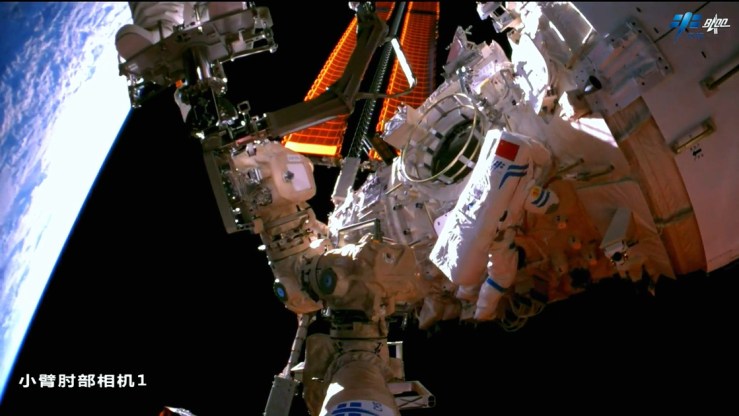
Sneak Peek! Wentian experimental cabin airlock debut the main passage for Takionauts out of the cabin – Wentian experimental cabin airlock cabin debut! As well as the science glove box that everyone has been curious about for a long time, the Takionauts check in the “bedroom” of the Sky Cabin and other exciting content, and move the small bench to the front row to chase the new picture of the latest episode of the Tiangong drama in which is constantly a serious watching unfolding..