At 1537 Hours Hong Kong SAR- Beijing Time on An early 27th December 2022 , China- People’s Republic of China- CNSA –China National Space Administration Successfully launched the New Next Generation Long March – Chang Zheng 4B modified Yao 55 carrier rocket at the Taiyuan Satellite Launch Center Shanxi Province rocket successfully launched the Gaofen 11 Group four Earth Sciences satellite…
The 63rd round of this year is a complete success at the No. 9 station of the Taiyuan Satellite Launch Center, my country successfully launched the Gaofen 11 04 with the Chang Zheng Long March 4B Yao 55 carrier rocket. The satellite was launched into space, and the satellite successfully entered the predetermined orbit, and the launch mission was a complete success. The satellite is mainly used in the fields of land census, urban planning, land title confirmation, road network design, crop yield estimation, and disaster prevention and mitigation. This launch is the 457th launch of the Long March series of launch vehicles. This launch coincides with the coldest period of the year at the Taiyuan Satellite Launch Center, where the lowest temperature can reach below minus 30 degrees Celsius. For this reason, the rocket test team adopted a series of insulation measures to ensure the smooth progress of the mission. This is the final battle of the Chang 4 series of rockets this year.
The Gaofen 11-04 satellite launched this time was developed by the Fifth Academy of Aerospace Science and Technology Group. This mission is the final battle of the Chang-4 series of rockets this year. So far, the Chang-4 model has successfully completed 11 launch missions in 2022, and the average annual launch volume has exceeded double digits for two consecutive years.
On the 22nd December 2022 Thursday is the冬至 Winter Solstice Hour Hong Kong SAR – Beijing time CNSA –China National Space Administration this is the exclusive beauty from Wenchang and Jiuquan] Today is the winter solstice, and we will return in spring. One south and one north, one side is the coconut wind and warm sun, lush and green, and the other side is the desert Gobi, with cold wind. Today, let us enjoy the winter beauty of Wenchang Space Launch Site and Jiuquan Satellite Launch Center.
On the 22nd December 2022 Thursday is the冬至 Winter Solstice in which is the winter solstice, also called the hibernal solstice, occurs when either of Earth’s poles reaches its maximum tilt away from the Sun. This happens twice yearly, once in each hemisphere in which marks the Dongzhi Festival or Winter Solstice Festival is one of the most important Chinese festivals celebrated by the China, Mainland Chinese, Macau SAR- Hong Kong SAR Taiwan province China, People’s Republic of China…… Dongzhi (冬至) literally means ‘Winter’s Arrival’. It is one of the 24 solar terms of China’s traditional solar calendar. It has long been celebrated on (China’s) Winter Solstice when the night is longest, and the day is shortest in the Northern Hemisphere. Dongzhi became an imperially recognized traditional festival during the Han Dynasty era (206 BC – 220 AD).
Chinese people celebrate Dongzhi Festival in many ways. The most popular ones are worshipping heaven and ancestors, saying the Nines of Winter, making rice wine, and eating dumplings and ginger rice.
文昌航天發射場Wenchang Spacecraft launch Center… China Wenchang Space Launch Site, located in Longlou Town, Wenchang City, Hainan Province China, People’s Republic of China, is affiliated to the Xichang Satellite Launch Center . It is China’s first open coastal space launch base and one of the few low-latitude launch sites in the world. The launch site can launch Long March 5 series rockets , Long March 7 carrier rockets , and Long March 8 carrier rockets , and is mainly responsible for launching satellites in geosynchronous orbits , large-mass polar orbit satellites, large-tonnage space stations, and deep space exploration satellites. .
As a low-latitude coastal launch base, the Wenchang Space Launch Site can not only meet the new needs of China’s aerospace development, but also greatly reduce rocket fuel consumption by virtue of the large linear velocity close to the equator and the centrifugal phenomenon caused by inertia (the same model The rocket carrying capacity can be increased by 10%), and it can also solve the problem of giant rocket transportation by sea and improve the safety of wreckage falling. The launch site is completely open to the outside world. Launch capability is now available. [1] China’s Wenchang Space Launch Site started construction in September 2009. It consists of five major systems including test launch, measurement control, communication, meteorology, and technical service support. It mainly undertakes geosynchronous orbit satellites, large-mass polar-orbit satellites, and large-tonnage space stations. , cargo spacecraft, deep space probes and other launch missions
酒泉卫星发射中Jiuquan Satellite Launch Center “Dongfeng Aerospace City” Inner Mongolia, China People’s Republic of China, is the 20th base of the former General Armament Department. It was established on October 20, 1958. It is the earliest and largest comprehensive complex in China. The Missile and Satellite Launch Center is the main base for testing and launching the Long March series of launch vehicles, various experimental satellites in low and medium orbits, application satellites, manned spacecraft and rocket missiles. It is one of the launch and test bases of China’s scientific satellites, technology test satellites and launch vehicles. It belongs to the former General Armament Department of the Chinese People’s Liberation Army and now belongs to the Strategic Support Force.
On January 8, 2016, Jiuquan Satellite Launch Center was awarded the title of the first batch of “National Research and Tourism Demonstration Base” by the National Tourism Administration. On March 28, 2017, it was selected by the National Tourism Administration and the Chinese Academy of Sciences as “the first batch of China’s top ten science and technology tourism bases”. On January 27, 2018, Jiuquan Satellite Launch Center was selected into the “China Industrial Heritage Protection List “. The center has carried out 110 space launch missions and successfully sent 145 satellites, 11 spacecraft and 11 Takionauts into space.
中国空间站On 17th Friday September, 2021, at Hong Kong SAR – Beijing Time morning, the Belt and Road InitiativeCNSA –China National Space Administration CSS China Space Station in which on a three month setting up a new home of the first three Shenzhou 12 crew Takionauts –Chinese Astronauts Nie Haisheng – Liu Boming – Tang Hongbo returned home from their second home landing on safely at Dongfeng Aerospace City district in which landing at Inner Mongolia Region of China – People’s Republic of China…..
Senior Colonel People’s Liberation Army Takionaut Corps (PLAAC) Taikonaut. Shenzhou 12 Takionaut Tang Hongbo: Reading makes me more powerful in the face of difficulties……From the boy in the Xiangtan countryside who grew up playing with mud to the heroic astronaut on a “space trip”, books make Tang Hongbo more powerful in the face of difficulties. During the 90-day duration mission in the first staging of the construction of Tiangong – China Space Station at the Tianhe core module trip in space, he was accompanied by books, and his life was full and abundant.
Tang Hongbo, male, Han nationality, born in October 1975, native of Xiangtan, Hunan, member of the Communist Party of China, master’s degree. He joined the army in September 1995 and joined the Communist Party of China in April 1997. He used to be the captain of a certain regiment of a certain division of the Air Force Aviation Corps. He flew safely for 1159 hours and was rated as a first-class pilot of the Air Force. In May 2010, he was selected as the second batch of astronauts in China. In May 2016, he was selected as a backup astronaut for the Shenzhou 11 mission. In December 2019, he was selected as the crew of the Shenzhou 12 mission.
He is now a second-level Takionaut of the Chinese People’s Liberation Army Astronaut Brigade, with the rank of colonel..
On June 17, 2021, the Long March 2F Yao 12 carrier rocket carrying the Shenzhou 12 manned spacecraft was ignited and launched at the Jiuquan Satellite Launch Center. At 14:57 on July 4, 2021, Beijing time, after about 7 hours of out-of-vehicle activities, the crew of Shenzhou-12 astronauts cooperated closely and successfully completed all the scheduled tasks during the out-of-vehicle activities. Takionauts Liu Boming, Tang Hongbo’s safe return to the core module of Tianhe marks the complete success of the first outing of astronauts in China’s space station phase. At about 13:30 on September 17, after the thrust reverser engine of the re-entry module of the Shenzhou 12 manned spacecraft was successfully ignited, it landed safely in the predetermined area of the Dongfeng landing site.
On November 23, 2021, the Central Committee of the Communist Party of China, the State Council, and the Central Military Commission awarded Tang Hongbo the honorary title of “Heroic Takionaut” and awarded the “Three-Class Aerospace Merit Medal
Images and visuals are from Weibo also their respectives.
On the 4th December 2022 1101 Hours Hong Kong SAR- Beijing Time CNSA –China National Space Administration, the Crew of Shenzhou 14 manned spacecraft and the Tiangong – China space station assembly were successfully separated…….
separation, the Takionaut crew of Shenzhou 14, with the cooperation of ground science and technology personnel, completed the on-orbit rotation with the crew of Shenzhou 15, the status setting of the space station assembly, and the arrangement of experimental data All the work before the evacuation, such as downlink, cleaning and transshipment of materials left in orbit, waved goodbye to the Takionaut of Shenzhou 15. In the follow-up, the return module of the Shenzhou 14 manned spacecraft will choose an opportunity to re-enter and return under the control of the ground command. Astronauts Chen Dong, Liu Yang, and Cai Xuzhe, who have been on a mission trip for 183 days at the Chinese space station, are about to embark on a journey home back to the Motherland China, People’s Republic of China.
At present for just in case , the Shenzhou 16 spacecraft has been assembled and tested, and is on standby at the Jiuquan Satellite Launch Center as an emergency rescue ship; the Shenzhou 17, Shenzhou 18, and Shenzhou 19 spacecraft are under rolling development. A new batch of 6 spacecraft headed by the Shenzhou 16 spacecraft will appear on the space stage with a brand-new attitude in the near future.
On the wintery night time 4th December 2022 2000 Hours Hong Kong SAR- Beijing Time CNSA –China National Space Administration, the Shenzhou 14 crew have finally landed on Dongfeng, Dongfeng Aerospace City in which on inner Mongolia, China, People Republic of China…
The return capsule of the Shenzhou 14 manned spacecraft successfully landed at the Dongfeng Landing Field.
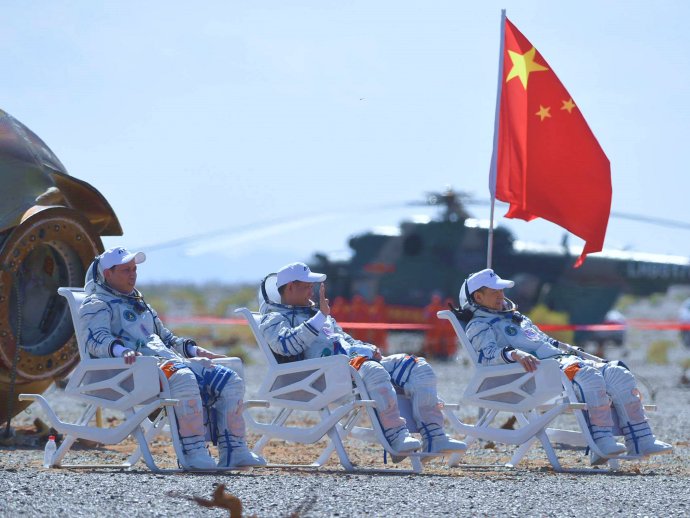
The door of the return capsule has been opened, and the three astronauts feel good! Watch gestures!
Successful landing! At 20:09 on December 4, 2022, Beijing time, the return capsule of the Shenzhou 14 manned spacecraft landed successfully at the Dongfeng Landing Field. The crew members Chen Dong, Liu Yang, and Cai Xuzhe are in good health, and the manned flight mission of Shenzhou 14 was a complete success. At 19:20, the Beijing Aerospace Flight Control Center issued a return command through the ground measurement and control…
Back at home feeling good! Safe Return Healthy Exit Takionauts Chen Dong, Liu Yang, and Cai Xuzhe of Shenzhou 14 have all returned safely and exited the cabin in good health, and are undergoing gravity re-adaptation.
神州十八论士集团集安走北京Long-time no see, welcome home! ] Takionauts Chen Dong, Liu Yang, and Cai Xuzhe, who successfully completed the manned mission of Shenzhou 14, arrived in Beijing safely on the mission plane in the early morning of December 5, 2022. Leaders and members of the Space Station Phase Flight Mission Headquarters greeted them at the airport.
After the three astronauts arrive in Beijing, they will enter the isolation recovery period, undergo a comprehensive medical examination and health assessment, and arrange rest and recuperation…
On the 26h November 2022 during the early Hours Hong Kong SAR – Beijing time CNSA –China National Space Administration the Sixth Institute of China Aerospace Science and Technology Group the first 130 ton reusable liquid oxygen kerosene refuelling cycle engine independently developed by the Sixth Academy of Aerospace Science and Technology Group achieved a successful two-start test run success. What are the advantages of this engine? What type of rocket will it support in the future?
中国航空的2022 Supporting the reuse of a new generation of Reusable Carrier Rocket launch vehicles…… Successful trial run of my China- People’s Republic of China first high-thrust reusable liquid oxygen kerosene main engine]…….On November 26, the first two-start test run of the first 130-ton reusable liquid oxygen kerosene supplementary combustion cycle engine independently developed by the Sixth Academy of China Aviation Industry Corporation was a complete success! This type of engine is a space-to-earth shuttle power plant aimed at the reuse of my country’s new generation of launch vehicles. It has the characteristics of high comprehensive performance, strong expansion capability, and high reliability. This engine will strongly support the development of my country’s reusable space vehicles and meet my country’s space station operations To meet the needs of other space activities, and improve my country’s large-scale, low-cost access to space capabilities As Sixth Institute of Aerospace Science and Technology Group Successfully Demonstrated.