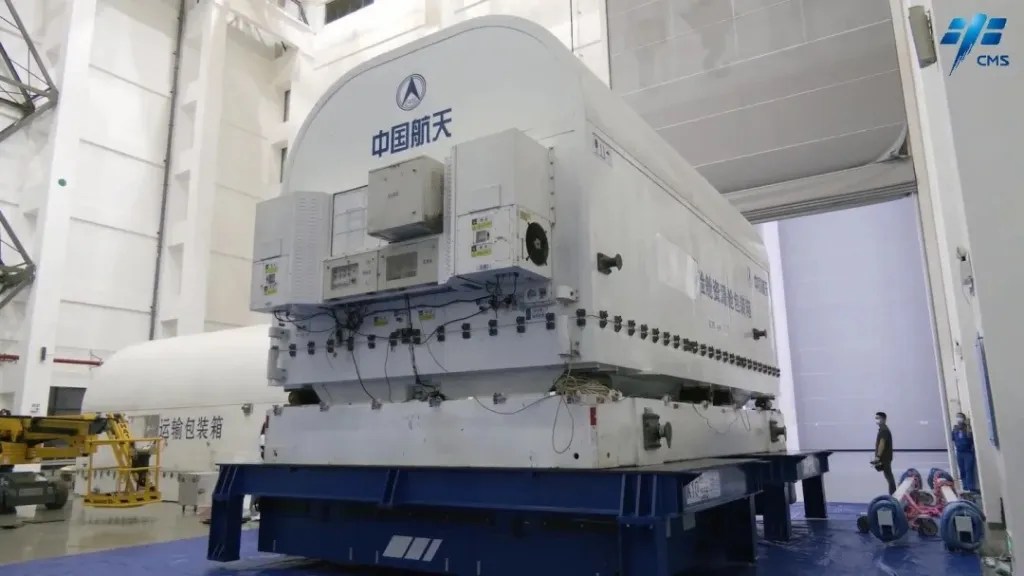
#CNSA #ChinaNationalSpaceAdministration #国家航天局 |#BeltAndRoadinitiative #July2022 | #CMS #ChinaMannedSpace #CLEP #ChinaLunarExplorationProgram the Advance Next Generation #LunaMannedLanding #ChangZheng #LongMarch #CZ-5DF #CarrierRockets #ReusableCarrierRocket The first flight is not far away …..

中国空间站 On currently on 29th July 2022 2022, the Belt and Road Initiative CNSA –China National Space Administration   on the currently developments of the  latest progress of China’s Chang Zheng – LongMarch manned lunar landing carrier  rockets Science and Technology Daily reporters learned from the First Academy of China Aerospace Science and Technology Corporation on July 28 2022 that the 702 Institute of the Academy recently successfully completed the multi-machine parallel static-motion joint test of my country’s new generation of manned launch vehicles. It strongly supported the smooth transition of the development of this type of rocket to the initial stage.

The first flight is not far away! China- People’s Republic of China’s first-generation moon landing Carrier rocket began to be prototyped, with a near-Earth capacity of 70 tons….  

China- People’s Republic of China’s moon landing rocket has completed the multi-engine parallel static and dynamic test and began to manufacture, and the first flight may not be far away

​​China’s new generation of manned rockets has made important progress! According to news from the First Academy of China Aerospace Science and Technology Corporation published by the “Science and Technology Daily” and other media on July 28th 2022, the 702 institutes affiliated to the academy have recently successfully completed the multi-machine parallel static-motion joint test of my country’s new generation of manned launch vehicles. The first step of this type of rocket will be transferred to the initial sample development stage.

At present, my country’s only manned rocket is the Long March 2F rocket, which is especially responsible for transporting China- People’s Republic of China’s Shenzhou spacecraft and Takionauts to the sky. My country’s new generation of manned rockets is a rocket with larger and more advanced capacity. It is also the “921 rocket” that netizens have often said over the years. In fact, its real code name is “CZ-5DF”, which means Chang Zheng- Long March 5. The series of lunar rockets are exactly the rockets prepared for my country’s manned lunar landing.

According to the published data, this rocket is about 100 meters high. After successful development, it will be the highest rocket before the appearance of the Long March 9. It is about the height of a 33-story building, which should be higher than the building you live in. Well, isn’t it shocking?

​And it will also be the largest rocket before the appearance of the Long March 9 carrier rocket, with a diameter of 5 meters, the same as the Long March 5, but its shape is very different from the Long March 5, because it adopts the CBC configuration, but It is not a “triple version of Chang 5”, it is not the configuration of the three core-stage rockets of the current Long March 5, because it is not composed of three core-stage rockets of the Long March 5. There are only two YF-77 liquid hydrogen-oxygen engines with a thrust of only 100 tons. The thrust of the Fat Five mainly relies on four bundled boosters. Each booster is equipped with two YF-100 engines with a thrust of 240 tons. , the thrust of the four boosters reached 960 tons, which together contributed to the 1060-ton thrust of the Long March-5 first-stage rocket.

​The new generation of manned rockets with  This type of rocket weighs about 2,200 tons and is a three-stage and a half configuration. The capacity of the Earth-Moon transfer orbit will not be less than 27 tons, which can meet the capacity requirements for launching China’s new generation of manned spacecraft (within 25 tons in weight). It can also meet the upward mission of large spacecraft in low-Earth orbit, because the orbital carrying capacity of low-Earth orbit will reach more than 70 tons.

​Take China’s space station as an example. After the Wentian experimental module was docked, the total weight of China’s space station assembly has now reached 66 tons, and China’s new generation of manned rockets can be sent into orbit with one launch mission. Zhu Xiquan, deputy chief designer of the 702 Institute, said: The successful completion of the parallel static-dynamic joint test of my country’s new generation of manned rockets marks the first time that my country has broken through the large-load static-dynamic joint test technology of launch vehicles. The test with the largest scale, the most technical difficulty and the most complex test process has laid a solid foundation for the new generation of manned launch vehicles to adopt the parallel technology of multiple high-thrust engines.

​According to the plan, this rocket will be the main launch vehicle for manned moon landing missions in China in the next 20 to 30 years, so it can also be called China’s first-generation “moon landing rocket”. It is significant, marking that China’s manned lunar landing rocket has entered a substantial manufacturing moment. After the manufacturing is completed, it will be a test flight. It was previously reported that the first flight will be completed before 2025. It can be seen that the first flight is not far away! Moreover, this type of rocket will also expand the recovery and reuse capabilities of the take-off stage in the future, that is, to create a reusable rocket like Musk’s Falcon rocket, which can also greatly reduce the launch cost. ​

References :”Science and Technology Daily” July 28 article “China’s new generation of manned rockets has made important progress “

Images and visuals are from their respectives.

#CNSA #ChinaNationalSpaceAdministration #国家航天局 |#BeltAndRoadinitiative #July2022 | #WenchangSpacecraftLaunchCenter #文昌航天發射場 | #ChinaSpaceStation #Shenzhou14 Crew Entering the #实验舱 #文天 #Wentian #ExperimentalCabinModule #ChinaSpaceStation  #2022July25th  a historic moment Recap…..

On Hainan Province –China –People’s Republic of China…. in the district area of the Wenchang – Wenchang Spacecraft launch center in which the awesome team at one of many CNSA –China National Space Administration  that China National Space Administration…………… On 24th July  2022 The Chang Zheng- Long March 5B Yao three carrier rocket successfully launch from the  Wenchang Space Launch Site complex  According to the China Manned Space Engineering Office, the Long March 5B Yao 3 carrier rocket that carried out the launch mission of the Wentian experimental module has completed all the research and development finalisation certification at the Factory also Wenchang Spacecraft Center…….  

After Wentian experimental module entered orbit, the status setting was successfully completed. At 3:13 on July 25, 2022, Beijing time, it was successfully connected to the forward port of 天和 Tianhe Core Module. The entire rendezvous and docking process lasted about 13 hours. . This is the first time that two 20-ton spacecraft in my country- China- People’s Republic of China have achieved rendezvous and docking in orbit. …According to the mission plan, the Shenzhou 14 Takionaut crew will then enter the Wentian experimental module….. in which finally docked in early morning time of the 25th July 2022 in with CNSA –Beijing Aerospace City in which co-ordinated the docking maneuverers have achieved rendezvous and docking in orbit.…  

On that day of the launch of the Chang Zheng –Long March 5B Y3文天Experimental Module Launch Successful Yesterday -July 24th 2022 on the eve of the Long March 5B launch of the Wentian Experimental Module (about 10 minutes before launch), the Tianhe core module transited over Hainan Island- Hainan Province- Hong Kong SAR, Macau SAR , Guangzhou also of Guangdong province of China- People’s Republic of China , and the Shenzhou 14 aerospace The crew took pictures of the beautiful Hainan Island. At this moment, on the Wenchang space launch site under the lens of the Takionauts, the Wentian experimental module is ready to go and is about to embark on the “Wentian” journey.

On a successful day of the 25th July 2022 the Shenzhou 14 Takionaut Crew LiuYang 陈冬 ChenDong、蔡旭CaiXuhe successfully entered the Wentian experimental module …According to the China Manned Space Engineering Office, the Shenzhou 14 Takionaut crew successfully opened the Wentian experimental module at 10:03 Morning Hong Kong SAR- Beijing Time on July 25th, 2022 The cabin door and smoothly entered the Wentian experimental cabin. This is the first time that a Chinese Takionaut has entered a scientific experimental cabin in orbit. In the follow-up, on-orbit work such as combined body attitude fusion control, small robotic arm crawling, and combined testing of large and small arms will be carried out as planned, and astronauts will be carried out by using the airlock cabin and small robotic arm for Takionaut exit activities…..

The Wentian experimental module is equipped with the same Taikonauts’ living facilities as the core module, including 3 sleeping areas, 1 sanitary area, kitchen and other facilities, which can guarantee the astronauts’ life. It can also work with the core module to support the life of 6 astronauts during the rotation of the two manned spacecraft; in addition, a small robotic arm is also configured, which can be used alone or in combination with the large robotic arm of the core module. , to jointly complete the tasks of Taikonauts leaving the cabin, caring for extravehicular facilities, and patrolling. In addition, the Wentian experimental cabin is also equipped with an astronaut exit airlock. After the space station is completed, the airlock of the Wentian experimental cabin will be As the main airlock cabin for Takionauts to leave the cabin, the node cabin of the core cabin is used for other functions at this time, just as a backup; the Wentian experimental cabin also has a backup section for the core cabin to manage and control the assembly. That is to say, when the function of the core module platform fails, it can be switched to the Wentian experimental module to exercise the combined control and management functions, which can improve the reliability of the space station as a whole.

Images and visuals are from their respectives.

#CNSA #ChinaNationalSpaceAdministration #国家航天局 |#BeltAndRoadinitiative #July2022 | #WenchangSpacecraftLaunchCenter #文昌航天發射場 | #ChinaSpaceStation #ChangZheng5B Longmarch5B Carrier Rocket #实验舱 #文天 #Wentian #ExperimentalCabinModule July 2022 launch calendar #AGallery ….

On Hainan Province –China –People’s Republic of China…. in the district area of the Wenchang – Wenchang Spacecraft launch center in which the awesome team at one of many CNSA –China National Space Administration  that China National Space Administration…………… On 23rd July  2022 The Chang Zheng- Long March 5B Yao three carrier rocket arrived at Wenchang Space Launch Site complex  According to the China Manned Space Engineering Office, the Long March 5B Yao 3 carrier rocket that carried out the launch mission of the Wentian experimental module has completed all the research and development finalisation certification at the Factory also Wenchang Spacecraft Center…….   

Look at the numbers of 文天Experimental Cabin – The Wentian Experimental Cabin will be launched soon Ask Tiangong Space Station- China Space Station, what is the Wentian Experimental Cabin? What are the characteristics? In these 165 seconds, let us take you close to the first experimental module of the Chinese space station with a set of numbers! Let you not only watch the fun

The axial length of the Wentian experimental cabin is 17.9 meters, and the maximum diameter of the cabin is 4.2 meters. After the solar wing was launched into orbit, the first deployment was about 6.5 meters, and the second deployment was about 23 meters in length. The Wentian experimental module is the largest single module in my country’s space station, with a launch mass of about 23 tons and a dry weight of 21.5 tons and a propellant of 1.5 tons.
The Wentian experimental module uses a rapid rendezvous and docking method to dock the space station assembly the Tiangong –China Space Station  of the small robotic arm (about 5 meters) of the Wentian experimental cabin…

The Expected Countdown towards the Launch of the Chang Zheng- Long March 5 Yao 3 Carrier Rocket in which is 28 Days in between late July 2022  until the Launch towards the China Space Station for the Wentian Experimental module in connecting Strengthen the mission and have the courage to innovate and make breakthroughs! Carefully prepare, organize, and implement carefully to ensure the complete success of the launch mission, and take practical actions to welcome the Party’s 20th National Congress of Victory….

Launch wise of the Chang Zheng –Long March 5 Yao 3 Carrier Rocket .

Location: China Wenchang Space Launch Site 101 Launch Station (WSLS LC101)
Mission Rocket: Long March 5 Yiyao-3 Rocket (CZ-5B Y3)
Mission Load: Space Station “Wentian” Experimental Module (WT)
Launch Window: 2022 estimated launch time in late July,
2022: Afternoon of July 24, 2022 (to be determined)

Previously As of May 2022 both The experimental cabin is progressing smoothly, waiting for the launch The Wentian experimental cabin to be launched in July is ready for finally and the Mengtian experimental cabin is also making corresponding preparations.


After the construction of the China Space Station is completed, the two experimental cabins will be the main working places for Takionauts in orbit. In both experimental cabins, space science experiments and technical experiments in the sealed cabin and outside the sealed cabin can be carried out. Both cabins are equipped with The load test cabinet inside the cabin and the load installation platform outside the cabin also provide support and guarantee measures such as information, power supply and heat dissipation, and can carry out experiments in various fields such as space science, space materials, space medicine and space exploration.


  The Wentian experimental module is equipped with the same Taikonauts’ living facilities as the core module, including 3 sleeping areas, 1 sanitary area, kitchen and other facilities, which can guarantee the astronauts’ life. It can also work with the core module to support the life of 6 astronauts during the rotation of the two manned spacecraft; in addition, a small robotic arm is also configured, which can be used alone or in combination with the large robotic arm of the core module. , to jointly complete the tasks of Taikonauts leaving the cabin, caring for extravehicular facilities, and patrolling. In addition, the Wentian experimental cabin is also equipped with an astronaut exit airlock. After the space station is completed, the airlock of the Wentian experimental cabin will be As the main airlock cabin for Takionauts to leave the cabin, the node cabin of the core cabin is used for other functions at this time, just as a backup; the Wentian experimental cabin also has a backup section for the core cabin to manage and control the assembly. That is to say, when the function of the core module platform fails, it can be switched to the Wentian experimental module to exercise the combined control and management functions, which can improve the reliability of the space station as a whole.

  The Mengtian experimental cabin is equipped with a cargo airlock and an outboard deployment test platform. In the future, the scientific test equipment that needs to be installed outside the cabin can be transported to the space station through a cargo spacecraft, and then the load will be sent to the outside of the cabin through the cargo airlock, and the robotic arm or Takionauts will install it on the platform outside the cabin. Realize the continuous update of the extravehicular test project.

Images and visuals are from their respectives.

#CNSA #ChinaNationalSpaceAdministration #国家航天局 |#BeltAndRoadinitiative #July2022 | #CMS #ChinaMannedSpace the #CSS #ChinaSpaceStation #TianheCoreModule #神舟十四号#Shenzhou14  Crew #陈冬 #ChenDong replying letters to students from#香港 #HongKongSAR…..  

中国空间站 On currently on June 5th 2022, the Belt and Road Initiative CNSA –China National Space Administration   CSS China Space Station in which on a six months setting up a new home of the third crew of Tiangong Space Station – China Space Station Shenzhou 14  in which spending up to on for the further construction and verifications of the systems of the CSS –China Space Station 2022 launch calendar in which currently the third China Space Station crew Takionauts current Shenzhou 14 ……  Preparations for the six months of extension of the China Space Station  In which the currently it remains awaiting for the crew of setting up home in conducting fun scientifically onboard中国空间站..  China Space station ….. The three Shenzhou 14 crewmates will spend around six months aboard Tianhe, the core module of the Tiangong space station. They will be aboard to receive two new modules, named Wentian and Mengtian, which are due to launch in late July and October, respectively…. crew is expected to conduct 2-3 extravehicular activities (EVA) from Wentian lab module and continue to livestream lectures from the Tiangong space station.

On the week 22nd July 2022 the Takionaut Crew of the Shenzhou 14 in which Commander陈冬 Chen Dong was sent lots of emails of the work and life onboard of the China Space Station, the first replies was replying back to the students of Hong Kong SAR – Take my dream to the palace of heaven: the first reply from the Chinese space station theme.. Do you still remember your dream of being mailed to “Heavenly Palace”? Your letter has been carefully read by the astronauts, and astronaut Chen Dong “replied” on the space station: sow seeds with sweat, the seeds of your dreams will surely take root and grow vigorously. In the future, more letters will be sent to Tiangong, whose letter will be answered next time? Maybe it’s you with your dream to go to heaven-space ..

Images and visuals are from their respectives.

#CNSA #ChinaNationalSpaceAdministration #国家航天局 |#BeltAndRoadinitiative #July2022 | #CMS #ChinaMannedSpace the newest detach- attachable #ChinaSpaceTelescope #SpaceTelescope of the #ChinaSpaceStation #Tiangong #SpaceStation Featuring the #SkySurveyOpticalModule #RemoteSensing #Satellite also helping to find #Exoplanets …

Currently中国空间站 Previously On 18th July 2022, the Belt and Road Initiative CNSA –China National Space Administration  Tiangong Space Station  CSS China Space Station in which on a six months setting up a new home of the first three Shenzhou 14 in which now readying for the newest module to be installed is the Wentian Experimental Module launching from a Chang Zheng – Long March 5B-Y3 Carrier Rocket at Wenchang Space Craft launch Center –Hainan Province – China – People’s Republic of China.. 

Currently one of the latest installations towards the Tiangong China Space Station –   the latest is the Sky Survey Space Telescope stands up to 3 stories high……. China’s Sky Survey Space Telescope is in the initial stage of development. The telescope will be launched after the completion of the China Space Station. It is expected to be put into scientific operation around 2024 and will become a flagship space astronomy facility for exploring the sea of ​​stars. It is about the size of a bus and stands 3 stories high, just like a mobile space observatory, which will fly independently with the space station in co-orbit….

The latest news of the Sky Survey Space Telescope, which is in the preliminary development stage……With the construction of the Chinese space station, the development of the Sky Survey Space Telescope for co-orbit flight with it is also progressing in an orderly manner. The reporter learned from the Changchun Institute of Optics, Fine Mechanics and Physics of the Chinese Academy of Sciences that at present, new progress has been made in the development of the first prototype of the sky survey optical facility. The telescope is expected to be launched after the completion of the Chinese space station, and will become a flagship space astronomy facility for exploring the sea of ​​stars.


As the optical module of the Chinese space station, the Sky Survey Space Telescope will be equipped with an optical system with a diameter of 2 meters and a series of state-of-the-art detectors. The size of the telescope is equivalent to a bus, standing three stories high and weighing more than ten tons.


On the Sky Survey Space Telescope, the first-generation instrument contains a total of 5 observation equipment, including a sky survey module, a terahertz module, a multi-channel imager, an integral field of view spectrometer, and an exoplanet imaging coronagraph. Among them, the most important observation time is the sky survey module, which is a camera with an extremely wide field of view.


Xu Shuyan, researcher at the Changchun Institute of Optics and Mechanics, Chinese Academy of Sciences, chief designer of the sky survey optical facility: We are currently in the initial prototype development stage. At present, all subsystems, components and units of the identified product have been basically developed and are ready for integration testing and testing. After the completion of these tasks , we will move to the prototype development stage, carry out the development of flying parts, carry out joint tests with the integration of the sky survey platform, carry out the launch site test, and then launch at the right time.


Zhan Hu, researcher of the National Astronomical Observatory of the Chinese Academy of Sciences, responsible scientist of the Sky Survey Optical Facility: It co-orbits away from the space station during normal observation. They are in the same orbital plane. When it needs to be replenished or repaired and upgraded, the Sky Survey Space Telescope will actively dock with the space station , and then resupply, or through the operation of the astronauts, the rear-end instruments and some components of the front main optical system can be replaced and upgraded, or some of them can be transported to the experimental cabin for maintenance.
According to China’s manned spaceflight project plan, the Sky Survey Space Telescope is expected to be put into scientific operation around 2024. The planned mission life is 10 years, and the life can be continuously extended through maintenance.

China’s Sky Survey Space Telescope  The Sky Survey Space Telescope will operate in a low-Earth orbit at a height of about 400 kilometers, with a primary mirror diameter of 2 meters. Xu Shuyan, a researcher at the Changchun Institute of Optics and Mechanics of the Chinese Academy of Sciences, the chief designer of the survey optics facility: The characteristics of this space survey telescope are that it can see deeply, see widely, and see finely. On the basis of the same depth and precision, it is more than 300 times wider than the Hubble telescope. Under the same conditions, Hubble can see 1 star, and our space survey telescope can see 300 stars.
According to reports, the detectors of the Hubble Telescope Camera are the size of a palm, while the main focal plane of the China Space Station Telescope Sky Survey Module is made up of 30 detectors, each of which is larger than the Hubble detector. Among them, 18 detectors are equipped with different filters, which can obtain color images of cosmic objects in different wavelength bands; the other 12 detectors are used for seamless spectral observation, and on average, at least thousands of celestial objects can be obtained per exposure. Spectral…

The Sky Survey Space Telescope (CSST) is expected to launch no earlier than the end of 2024, and is likely to be delayed until 2025.

Figure 1: CSST Optical Facilities Structure HD Rendering v1.1
Figure 2: Schematic diagram of CSST main optical system
Figure 4: Schematic diagram of CSST in Chang 5 B fairing
Figure 6: The overall structural model of the CSST sky survey module

Images and visuals are from their respectives.