#CNSA #ChinaNationalSpaceAdministration #国家航天局 |#BRI #July2023 | #天宫 #Tiangong #ChinaSpaceStation #神舟十六号 #Shenzhou16 #Takionaut #景海鹏 #JingHaPeng will rise to the 11th place in total flight time! Preparing to leave the cabin for the first time…

On the 30th  May 2023 clear 0931 Hours Morning Hong Kong SAR- Beijing time , the Belt and Road InitiativeCNSA –China National Space Administration from Jiuquan Satellite Launch Center – Inner Mongolia –China – People’s Republic of China deployment of  the Chang Zheng – The Chang Zheng – Long March 2F Yao 16 –Shenzhou 16  carrier rocket.. On which Takionauts Jing Haipeng, Zhu Yangzhu, and Gui Haichao took to the predetermined orbit. The first manned flight mission in the application and development stage was a complete success. The three astronauts will stay in the space station and “join up” with the crew of Shenzhou 15 to carry out on-orbit handover “face-to-face” meeting in which brings the total crew of six with a handover ceremony from Shenzhou 15 towards 16..

As of 09:31 on July 16, 2023, “Shenzhou 16” Takionauts Jing Haipeng, Zhu Yangzhu, and Gui Haichao have been flying for 47 days. The total flight time ranking is undergoing a new change.

Takionaut Jing Haipeng has carried out four manned missions including “Shenzhen 7”, “Shenzhen 9”, “Shenzhen 11” and “Shenzhen 16”. long Takionaut. The “Shenzhen VII” spacecraft ignited and took off at 21:10 on September 25, 2008, and landed at 17:37 on September 28. The flight time of the astronauts Zhai Zhigang, Liu Boming and Jing Haipeng was 2 days, 20 hours and 27 minutes. From 18:37 on June 16, 2012 to 10:05 on June 29, astronauts Jing Haipeng, Liu Wang, and Liu Yang carried out the “Shenzhen Nine” mission in 12 days, 15 hours and 28 minutes. From 07:30, October 17, 2016 to 13:59, November 18, 2016, Takionauts Jing Haipeng and Chen Dong partnered to carry out the “God 11” mission, with a flight time of 32 days, 6 hours and 29 minutes. Before the “God 16” mission, the total flight time of Jing Haipeng’s first three missions was 47 days, 18 hours and 24 minutes.
As of 16:07 on July 16, 2023, Jing Haipeng’s total flight time will reach 95 days and 1 hour, surpassing Liu Boming and ranking 11th among Chinese Takionauts. Liu Boming has carried out two missions including “Shenzhen 7” and “Shenzhen 12”. The total flight time was 95 days and 35 minutes.

During the period when the “Shenzhen XVI” crew was in orbit, large-scale space science experiments were carried out on a rolling basis, and the work of space application systems such as the out-of-cabin installation of the space radiation biology exposure experiment device in the “Mengtian” experimental cabin has been completed as planned. At the same time, the “Shenzhen XVI” crew is preparing for the first out of the cabin, which will be the first out of the third batch of astronauts, who will perform it? What extravehicular work will be done?

Images and visuals are from their Respectives CMS China Manned SpaceCNSA-China National Space Administration

#CNSA #ChinaNationalSpaceAdministration #国家航天局 |#BRI #July2023 | #天宫#Tiangong #ChinaSpaceStation #CMS #ChinaMannedSpace #神舟十六号 #Shenzhou16 Super space summer resort with freeform fun videography fly through the China Space Station..

On the 30th  May 2023 clear 0931 Hours Morning Hong Kong SAR- Beijing time , the Belt and Road Initiative CNSA –China National Space Administration  from Jiuquan Satellite Launch Center – Inner Mongolia –China – People’s Republic of China deployment of  the Chang Zheng –   The Chang Zheng – Long March 2F Yao 16 –Shenzhou 16  carrier rocket.. On which Takionauts Jing Haipeng, Zhu Yangzhu, and Gui Haichao took to the predetermined orbit. The first manned flight mission in the application and development stage was a complete success. The three astronauts will stay in the space station and “join up” with the crew of Shenzhou 15 to carry out on-orbit handover “face-to-face” meeting in which brings the total crew of six with a handover ceremony  from Shenzhou 15 towards 16..

Currently it’s hot Warm and humid summery time in China, People’s Republic of China July 2023.. In which to celebrate the coolness of summer is cool room temperature for the CNSA Tiangong –China Space Station Takionaut Shenzhou 16 Crew In the hot summer, welcome to the “space summer resort” that is like spring all the year round – China Space Station, come and experience the joy of passing through the cabin from the first perspective with us….

Images and visuals are from their Respectives CMS China Manned SpaceCNSA-China National Space Administration

#CNSA #ChinaNationalSpaceAdministration #国家航天局 |#BRI #July2023|#中国空间站 #Tiangong #ChinaSpaceStation #CMS #ChinaMannedSpace #Takionaut #Shenzhou14 crew featuring on the #开讲啦 #TheVoice -Build a dream! One hundred and eighty-three days… Mentoring the next generation!

During this Month of July 2023 the CNSA –China National Space Administration Shenzhou 16 Takionaut Crew of the Tiangong – China Space Station was featured on the CCTV youth channel  开讲啦 TheVoice or Known as Let’s Talk.. In mentoring in an open class youths… The Shenzhou 14 Takionaut crew share their inspirationally in the experiences during the finalisation of the One Year and a Half construction of stage Tiangong –China Space Station …..  

The “Let’s Talk” column was launched in September 2012. It is broadcast on the comprehensive channel of China Central Radio and Television every Saturday night. “The role model in the heart of Chinese youth” is invited as the speaker. Moisten things in a silent way to convey mainstream values. The column is positioned as China’s first TV youth open class, and has received widespread attention and praise for its “younger” and “all-media” communication characteristics.

22:30 on July 1, 2023, Shenzhou 14 crew 开话啦 After the “busiest crew” mission in space is completed, what are the three Takionauts doing? During the 183 days they spent together in space, what is the most impressive difference?

The “Let’s Talk” column was launched in September 2012. It is a Chinese youth TV open class program produced by CCTV Integrated Channel , with Sa Beining as the host of the program.

“Let’s Talk” invites “models in the hearts of Chinese youth” as the speaker, and through the sharing of cutting-edge new knowledge, the mainstream values ​​are conveyed from a plain perspective and in a silent way. The column is positioned as an open class for Chinese TV youth, and has received widespread attention and praise for its “younger” and “all-media” communication characteristics; each program invites a guest to tell his own story and share their perception of life and life. Give Chinese youth realistic discussions and spiritual nourishment. While discussing the life problems of young people, it is also discussing the social problems of Youth China.

Shenzhou 9 and Shenzhou 14 Takionaut LiuYang would be someone else’s role model As China’s first female astronaut, Liu Yang’s deeds have been written into essays by many students, and she is also the person many high school seniors dream of becoming. In this regard, Liu Yang said that in the future we will fly to deeper and farther space, “Today I appear in their compositions, and they are the materials for children’s compositions in the future.” The college entrance examination volunteer application is in progress,

Broad sea and sky! Shenzhou 11 and Shenzhou 14 Takionaut 陈冬 Chen Dong is speaking again! During the 183-day space mission, how did the Shensi Fourteen crew perform the first mission of the space station construction phase tacitly? What kind of special experience is the “broad sea and sky” that Chen Dong felt in space?

Shenzhou 14 Takionaut蔡旭Cai Xuhe Teacher on a business trip to space, can students still be “good”? Please Rest assured unknowingly, the crew of the Shenzhou 16 astronauts have been in space for a month. The mentor is “going to the sky”, is his research group still operating normally? Are the students taking the opportunity to “joy the sky”, or are they obediently writing their papers because of the “God’s perspective” of the tutor? Let’s see how the students of Teacher蔡旭哲Cai Xuhe deal with Xiaosa’s Question…

Images and visuals are from their Respectives CMS China Manned SpaceCNSA-China National Space Administration

#CNSA #ChinaNationalSpaceAdministration #国家航天局 |#BRI #June2023 |#北京 #中國 #中国科学技术馆 #Beijing #ChinaScienceAndTechnologyMuseum – Tiangong -#ChinaSpaceStation -The #天和; #TianheCoreModule structural parts…… #InternationalMuseum

The China Science and Technology Museum 中国科学技术馆, established in 1988 in Beijing, China, People’s Republic of China is “the only comprehensive museum of science and technology at national level in China” according to the official website of the Beijing government The museum at its current site houses both permanent and temporary exhibitions. It has many facilities for science popularization (classrooms, laboratories, lecture halls, etc.) including four special-effect theatres The museum is located in the Beijing Olympic Village, near the Olympic Green station of the Beijing Subway…  China, Bei Jing Shi, Chaoyang, 北辰东路5 邮政编码: 100101, Beijing, China, People’s Republic of China.

In preparation for Beijing’s 2008 Summer Olympics, construction of new buildings for the museum began at the Olympic site in 2006. The new museum opened in September, 2009, having been expanded from its previous 40,000 square meters to 48,000 square meters. The previous museum site was closed for several years before undergoing renovation and expansion beginning in 2016. On 15 September 2018, the old science museum reopened as Beijing Science Center…

The Tianhe core module structural parts in the China Science and Technology Museum may be the best spacecraft exhibit open to the public for close viewing in China. All the external details can be seen at a glance, and some sections are also displayed. Space fans absolutely hooked. What’s more interesting is that it is located outside the paid area of ​​the west entrance hall of the Science and Technology Museum, so you can actually visit it without making an appointment to buy tickets. It is very cost-effective and highly recommended.

However, when I went there last week, the docking device at the front of the node cabin was removed for some reason. The original appearance can be seen in here
detailed pictures are released here for those who cannot go to watch it in person. The main content is Yes:


Figure 1-3: Overview


Figure 4-9: Various rendezvous and docking equipment in the node cabin


Figure 10-11: Appearance of the second/fourth quadrant of the large column section

Figure 12: Structure of the rear fuel tank


Figure 13-15: Solar wing deployment Device


Figure 16: Target Adapter for Large Robotic Arm


Figure 17: Floodlight


Figure 18: Control Moment Gyro in the Fourth Quadrant and Panoramic Camera A on it (the one that the space station is lifted out of the space station for the first time)

In addition, the verification documents and the original version of this structure A little bit different

Images and visuals are from their respectives

#CNSA #ChinaNationalSpaceAdministration #国家航天局 |#BRI #June2023 | #天宫#Tiangong #ChinaSpaceStation #CMS #ChinaMannedSpace #神舟十六号 #Shenzhou16 – #Mengtian Module Capsule Space Radiation Biological Exposure Experimental Device successfully launched…

On the 30th  May 2023 clear 0931 Hours Morning Hong Kong SAR- Beijing time , the Belt and Road Initiative CNSA –China National Space Administration  from Jiuquan Satellite Launch Center – Inner Mongolia –China – People’s Republic of China deployment of  the Chang Zheng –   The Chang Zheng – Long March 2F Yao 16 –Shenzhou 16  carrier rocket.. On which Takionauts Jing Haipeng, Zhu Yangzhu, and Gui Haichao took to the predetermined orbit. The first manned flight mission in the application and development stage was a complete success. The three astronauts will stay in the space station and “join up” with the crew of Shenzhou 15 to carry out on-orbit handover “face-to-face” meeting in which brings the total crew of six with a handover ceremony  from Shenzhou 15 towards 16..

[Space Station Mengtian Capsule Space Radiation Biological Exposure Experimental Device successfully launched]
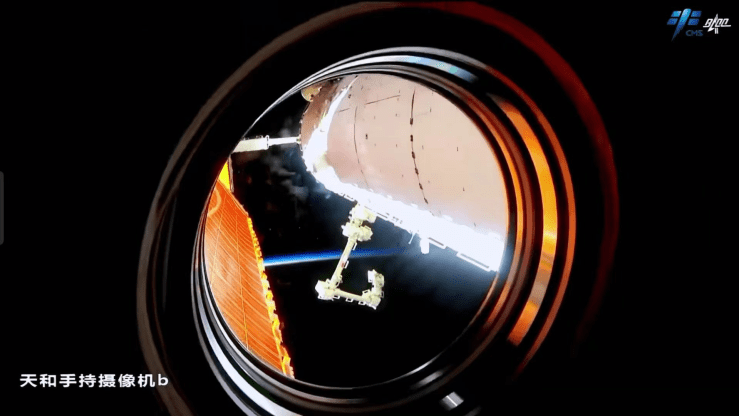
On the June 9-10, 2023 Beijing time, through the overall organization and coordination of space applications, with the support of the Takionaut system, China space station system, Beijing Flight Control Center and related systems, The space radiation biology exposure experiment device in the Mengtian experimental cabin of the space station (hereinafter referred to as the space radiation biology device) was grabbed by the robotic arm and left the cargo airlock.

Starting work! 空间Tiangong radiation device out of the cabin of the Mengtian module Shenzhou 16’s “doctoral crew” entered the space station for about two weeks, and quickly carried out a lot of work such as sorting out materials and loading out of the cabin. Come and take a look at three highly educated Takionauts working on the space radiation biology device out of the cabin in orbit, and quickly entered the working state!

The space radiation biology device is the first out-of-cabin load of the Mengtian Capsule. It is used to carry out research on the biological effects of environmental elements such as space particle radiation on sample materials. It can meet the timeliness, temperature, etc. Requirements to provide life support for scientific experiments on biological samples….

Images and visuals are from their Respectives CMS China Manned SpaceCNSA-China National Space Administration