The China Science and Technology Museum 中国科学技术馆, established in 1988 in Beijing, China, People’s Republic of China is “the only comprehensive museum of science and technology at national level in China” according to the official website of the Beijing government The museum at its current site houses both permanent and temporary exhibitions. It has many facilities for science popularization (classrooms, laboratories, lecture halls, etc.) including four special-effect theatres The museum is located in the Beijing Olympic Village, near the Olympic Green station of the Beijing Subway… China, Bei Jing Shi, Chaoyang, 北辰东路5号邮政编码: 100101, Beijing, China, People’s Republic of China.
In preparation for Beijing’s 2008 Summer Olympics, construction of new buildings for the museum began at the Olympic site in 2006. The new museum opened in September, 2009, having been expanded from its previous 40,000 square meters to 48,000 square meters. The previous museum site was closed for several years before undergoing renovation and expansion beginning in 2016. On 15 September 2018, the old science museum reopened as Beijing Science Center…
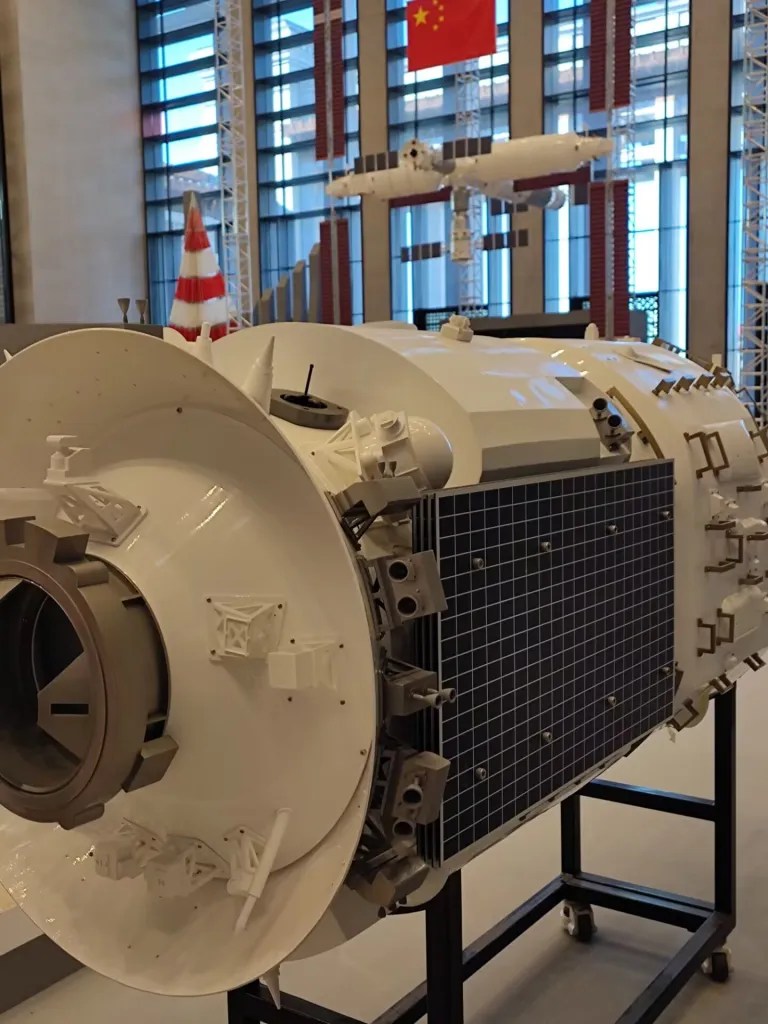
The Tianhe core module structural parts in the China Science and Technology Museum may be the best spacecraft exhibit open to the public for close viewing in China. All the external details can be seen at a glance, and some sections are also displayed. Space fans absolutely hooked. What’s more interesting is that it is located outside the paid area of the west entrance hall of the Science and Technology Museum, so you can actually visit it without making an appointment to buy tickets. It is very cost-effective and highly recommended.
However, when I went there last week, the docking device at the front of the node cabin was removed for some reason. The original appearance can be seen in here detailed pictures are released here for those who cannot go to watch it in person. The main content is Yes:
Figure 1-3: Overview
Figure 4-9: Various rendezvous and docking equipment in the node cabin
Figure 10-11: Appearance of the second/fourth quadrant of the large column section
Figure 12: Structure of the rear fuel tank
Figure 13-15: Solar wing deployment Device
Figure 16: Target Adapter for Large Robotic Arm
Figure 17: Floodlight
Figure 18: Control Moment Gyro in the Fourth Quadrant and Panoramic Camera A on it (the one that the space station is lifted out of the space station for the first time)
In addition, the verification documents and the original version of this structure A little bit different
成都科幻博物馆 Chengdu Science Fiction Museum …Set to opening in the later this year of year 2023 on the grand opening is the Chengdu Science Fiction Museum featuring two international iconic the structure is anticipated to stage the two most prestigious 81st annual events of the year….. The Hugo Awards and the Worldcon, presented by the World Science Fiction Society (WSFS)…..
Located in the Cheungdu is the capital of southwestern China’s Sichuan province China, People’s Republic of China… . Chengdu’s history dates back to at least the 4th century B.C., when it served as capital for the Shu Kingdom. Artifacts from that dynasty are the focus of the Jinsha Site Museum. The city is also home to the famous Chengdu Research Base of Giant Panda Breeding, a conservation center where visitors can view endangered giant pandas in a natural habitat.
The New Chengdu Science Fiction Museum is situated in on Jingrong lake within the Science and innovation New City of Chengdu’s Pidu District….. Integrating along the lakeshore the museum’s design designs defines nodes of activity connected by pedestrian routes and adjacent metro station through the surrounding parkland into the heart of the building, creating a journey of discovery that weaves between indoor and outdoor plazas at multiple levels to link the museum’s Exhibition galleries, education facilities, cafes and other amenities …
Both zodiac signs and architecture embody humanity’s romantic creations of space. When thoughts collide with the universe and creative architecture leaves its mark on the time, Aries architecture stands out with its powerful and unconstrained imagination. Join us as we explore the Chengdu Science Fiction Museum, a masterpiece built by CSCEC and designed by Zaha Hadid Architects. The fluid shape of the roof radiates outwards, simulating an expanding nebula centered on a star. With its high level of flexibility, the museum can host a variety of exhibitions, conferences, and events.
Chengdu Science Fiction Museum The floating nebula roof of the Chengdu Science Museum is made of metal. The overall area of the metal roof is 18,000 square meters, and the embedded lighting roof covers an area of about 1,382 square meters, implying the age of the universe. 13.82 billion years, called “the eye of science fiction
The 59,000-sq-m building will aim for three stars, the highest rating of China’s Green Building Programme. Digital modelling will help ZHA create natural ventilation and lighting. Solar panels and a rainwater capture system will add to the building’s sustainability.
Landscaped with plants native to the region, the museum also collects and stores rainwater for natural filtration and reuse, enabling Jingrong Lake to become an integral part of Chengdu’s sustainable drainage system that will mitigate flooding and increase biodiversity throughout the city.
The city is also the base for a massive 25-sq-km “Science City”, to be constructed along the Luxi River ecological belt, and is also the base for China Railways’ work on ultra-high speed maglev trains (see further reading).
The museum will be built on the shore of Jingrong Lake in Chengdu’s Technology Innovation Business District, begun in 2020 to house science-based industries such as intelligent manufacturing and IT.
Introduction: Uncover the high-tech behind the super project, tell the construction miracle built by the builders with sweat and wisdom, highlight the speed of China, convey the power of China, and witness the miracle of China! The second season of the CCTV-9 documentary “Strive for China”
Chengdu Science Fiction Museum Made by Zaha Hadid Architects The beautiful city of Chengdu, China is about to witness an architectural marvel of a Science Fiction Museum. While Zaha Hadid Architects have released the design and technical details, it is anticipated to open later this year. Upon completion, the structure is anticipated to stage the two most prestigious 81st annual events of the year. The Hugo Awards and the Worldcon, presented by the World Science Fiction Society (WSFS).
project team: Andrei Cojocaru, Berkin Islam, Chu Zhou, Hao Wen, Jillian Nishi, Lianyuan Ye, Meng Zhao, Shang Li, Stefan Manousof, Sven Torres, Yang Liu, Yuling Ma, Xiaoying Li
competition project directors: Satoshi Ohashi, Paulo Flores
competition associate: Yang Jingwen
competition project architects: Juan Liu, Magda Smolinska
competition team: Andrei Cojocaru, Enoch Kolo, Jillian Nishi, Juan Montiel, Lianyuan Ye, Meng Zhao, Nan Jiang, Nastasja Mitrovic, Stefan Manousof, Yanran Lu, Yimeng Zhao, Yuling Ma
competition sustainability team: Aleksander Mastalski, Carlos Bausa Martinez
— consultants —
local architect: China South West Architecture Design Institute
façade,M&E, MAP, and fire engineering: China South West Architecture Design Institute
site supervision: Sichuan Feihong Engineering Management Consulting Co., Ltd.
general contractor: China Construction Third Engineering Bureau Group
landscape consultant: Hangzhou Landscape Design Institute
Visible matter only accounts for a mere 5% of the vast universe, while the other 95% is made of dark energy and dark matter, which cannot be seen and detected directly. Despite the adage that “seeing is believing”, how do scientists find evidence for the existence of these mysterious and invisible components in the universe? To explore the most baffling mysteries in astronomy, we are honoured to invite Dr. Hakeem Oluseyi, an internationally renowned astrophysicist from the United States, to elucidate the properties of dark energy and dark matter in the Space Museum!
Beyond his notable scientific research achievements, Dr. Oluseyi is also a passionate science educator, appearing on various programmes to share knowledge and inspiring the audience to live their dreams with his personal story. If you are interested in dark energy and dark matter, and Dr. Oluseyi’s journey to becoming a preeminent scientist, this lecture is not to be missed!
Dr. Hakeem Oluseyi, author of the critically acclaimed memoir, A Quantum Life: My Unlikely Journey from the Streets to the Stars, is an internationally-recognized astrophysicist, science TV personality, and global education advocate who has had a long, distinguished career in academia and scientific research. Most recently, he was stationed at NASA Headquarters, where he served as an Astrophysicist and Space Science Education Lead for NASA’s Science Mission Directorate. In this talk, Dr. Oluseyi will talk about his work in “hacking stars,” explain dark energy and dark matter, and use his personal story to inspire the audience to chase their dreams no matter how unlikely they may seem.
Speaker: Dr. Hakeem Oluseyi Moderator: Mr. CHAN Chun-lam, Prince (Assistant Curator, Hong Kong Space Museum)
The lecture will be conducted in English.
Free admission on a first-come, first-served basis. Live streaming is also available on the Space Museum’s YouTube Channel.
Dark Energy and Dark Matter
Date: 13 March 2023 (Monday)
Time: 7:00 to 8:30 pm
Venue: Lecture Hall, Hong Kong Space Museum
Speaker: Dr. Hakeem Oluseyi (Astrophysicist)
Live Streaming Platform: Hong Kong Space Museum YouTube Channel
Dr. Oluseyi除咗有傑出嘅科研成就,佢更熱心於科學教育,喺多個節目上分享知識,更以自身經歷鼓勵觀眾勇於追夢。如果大家想對暗物質同暗能量有多些了解,並藉此認識Dr. Oluseyi成為頂尖科學家嘅歷程,記得唔好錯過今次嘅講座!
講座以英語講解,座位有限,先到先得;同時於太空館YouTube頻道直播。
暗藏玄機:暗物質與暗能量
日期:2023年3月13日(星期一)
時間:晚上7時至8時30分
地點:香港太空館演講廳
講者:Dr. Hakeem Oluseyi(天體物理學家)
直播網站:香港太空館YouTube頻道
語言:粵語
Located in the Heart of Hong Kong central of Victoria Harbour in which locate looking at the iconic Megatroplis HongKong Island city landscape from the opposite is the Hong Kong Space Museum 香港太空館 in which located at 10 Salisbury Road, Tsim Sha Tsui, Kowloon, Hong Kong SAR, China –People’s Republic of China.. in which is one of the most international iconic buildings architecturally due to its hemispheric round dome in which is iconic known as one of Hong Kong’s local most cherish bread pastries the Pineapple Bun – Bolo Bao due to the pineapple ceramic texturing tiles of the dome structure that resembles the delicious texturing of the Pineapple Bun .. In which on In June 2014, the Hong Kong Government listed the pineapple bun as a part of Hong Kong’s intangible cultural heritage. … Despite the name, it does not traditionally contain pineapple; rather, the name refers to the look of the characteristic topping (which resembles the texture of a pineapple)……
The National Museum of China中国国家博物馆; flanks the eastern side of Tiananmen Square in Beijing, China. The museum’s mission is to educate about the arts and history of China. It is directed by the Ministry of Culture and Tourism of the People’s Republic of China. 16 E Chang’an St, 前门 Dongcheng, China, 100051…. China, People’s Republic of China.
On the week of 20th January 2023 just before the Chinese Lunar New Year eve of the Year of the Rabbit The hall of the National Museum has recently exhibited a lot of aerospace exhibits. In addition to the Chang Zheng Long March 10 and the Sky Survey Telescope, there are also models of the Chinese space station assembly, the return capsule of the Shenzhou spacecraft and the actual parachute, the escape tower of the Chang-2 F, the Chang-2 F/Chang 7/Chang 5 B model, YF-20/100/77 engine, etc. These exhibits may not be permanent. Friends who are interested in Beijing or other places must seize the opportunity!
The China Space Station Sky Survey Space Telescope (CSST) model exhibited by the National Museum is quite high-precision, and its overall structural layout is clear at a glance. It is mainly composed of two parts: the optical cabin and the service cabin. The overall outer diameter is about 4.2 meters, and the diameter of the main mirror is about 2 meters. . In terms of the external structure of the cabin, it can be seen that there are a pair of solar wings on both sides of the service cabin, 5 control moment gyroscopes, a relay communication antenna, a mechanical arm docking port on the top, and a space station docking port and related equipment for rendezvous and docking at the rear; the optical cabin It is covered with handles for astronauts to go out of the cabin, and 4 star sensors.
In addition, CSST has a total of 3 types of 48 attitude control engines installed, including 16 forward 150N, reverse 4 150N, rotation 12 10N, pitch 8 25N, yaw 8 25N, visual judgment is not guaranteed to be completely correct
Images and visuals are of their Respectives – Photographed by 深蓝之日DBS
On the 16th December 2022厦门天文馆Xiamen Planetarium released the first batch of renderings, in which is great news for Good news for astronomy lovers: Xiamen Planetarium will be built next year to create a new landmark in Xiamen. In which Xiamen is a port city on China’s southeast coast, across a strait from Taiwan Province China, People’s Republic of China. .
厦门天文馆Xiamen Planetarium will be built next year to create a new landmark in Xiamen The project is planned to be started in early 2023 and be put into use in 2026.
In August this year 2022, the survey and design of the Planetarium located on the bank of the Sucuo River in Tong’an was called for public bidding Today, the planetarium released the renderings, and solicited from the public the planning plan for the text outline of the exhibition content.
According to the content of the announcement, the investment in the construction of the exhibition content is about 450 million yuan, and the venue is positioned as a comprehensive planetarium that integrates popular science exhibitions, astronomical observations, and astronomical education with “China’s first-class, distinctive regional characteristics”. The venue will be a new landmark in Tong’an District, and will make up for the gap in the construction of planetariums in southeast China.
Recently, Xiamen Science and Technology Museum Management Co., Ltd. organized a defense review meeting for the “Call for Planning Plans for the Exhibition Contents and Text Outline of Xiamen Planetarium Museum”. According to reports, the Xiamen Planetarium project is located in the core area of Xiamen Tongxiang High-tech City, with a total land area of about 27,000 square meters and a total construction area of about 55,000 square meters. The project is planned to start construction in early 2023 and be put into use in 2026
Xiamen Planetarium Here we come!
(1) Project location: East side of Sucuoxi River Basin, Tongxiang District, Xiamen
(2) Project scale: The project land area is about 27,043㎡, with a total construction area of about 55,350㎡, which can be used for planetarium exhibition halls (permanent and temporary exhibition halls) and public spaces The building area is about 24700㎡ (including about 4000 underground exhibition halls)㎡.
(3) Investment estimate: 450 million yuan will be invested in the construction of project exhibition contents.
(4) Project positioning: The function of Xiamen Planetarium is positioned as a comprehensive planetarium that integrates popular science exhibitions, astronomical observations, and astronomical education into a “first-class in China with distinctive regional characteristics”.
(5) Project value: The construction of Xiamen Planetarium will make up for the gap in the construction of planetariums in southeast China and promote the popularization of astronomical science; it will create a new landmark in Xiamen and provide Xiamen citizens and domestic and foreign tourists with an elegant environment to get in touch with new astronomical knowledge. Easily experience the beauty of the starry sky, understand the magnificence and subtlety of the universe, learn happily in personal experience, enhance the scientific connotation of the public, inspire creativity, and overall improve the level of social rational thinking and scientific cognition