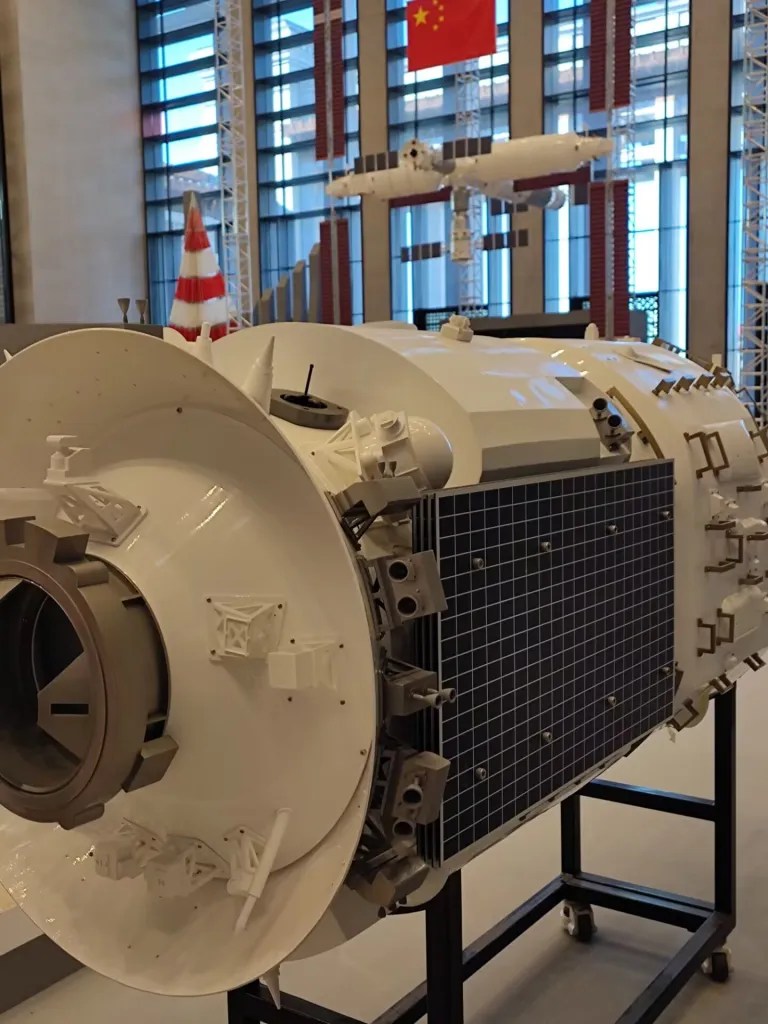
#CNSA #ChinaNationalSpaceAdministration #国家航天局 |#BRI #January2023 #Tiangong #ChinaSpaceStation – #中国国家博物馆; #NationalMuseumofChina #Beijing featuring new Aerospace Space exhibits of China space developments.  Featuring the China Space Station Sky Survey Space Telescope (CSST)

The National Museum of China中国国家博物馆; flanks the eastern side of Tiananmen Square in Beijing, China. The museum’s mission is to educate about the arts and history of China. It is directed by the Ministry of Culture and Tourism of the People’s Republic of China. 16 E Chang’an St, 前门 Dongcheng, China, 100051…. China, People’s Republic of China.

On the week of 20th January 2023 just before the Chinese Lunar New Year eve of the Year of the Rabbit The hall of the National Museum has recently exhibited a lot of aerospace exhibits. In addition to the Chang Zheng Long March 10 and the Sky Survey Telescope, there are also models of the Chinese space station assembly, the return capsule of the Shenzhou spacecraft and the actual parachute, the escape tower of the Chang-2 F, the Chang-2 F/Chang 7/Chang 5 B model, YF-20/100/77 engine, etc. These exhibits may not be permanent. Friends who are interested in Beijing or other places must seize the opportunity!

The China Space Station Sky Survey Space Telescope (CSST) model exhibited by the National Museum is quite high-precision, and its overall structural layout is clear at a glance. It is mainly composed of two parts: the optical cabin and the service cabin. The overall outer diameter is about 4.2 meters, and the diameter of the main mirror is about 2 meters. .
In terms of the external structure of the cabin, it can be seen that there are a pair of solar wings on both sides of the service cabin, 5 control moment gyroscopes, a relay communication antenna, a mechanical arm docking port on the top, and a space station docking port and related equipment for rendezvous and docking at the rear; the optical cabin It is covered with handles for astronauts to go out of the cabin, and 4 star sensors.


In addition, CSST has a total of 3 types of 48 attitude control engines installed, including 16 forward 150N, reverse 4 150N, rotation 12 10N, pitch 8 25N, yaw 8 25N, visual judgment is not guaranteed to be completely correct

Images and visuals are of their Respectives – Photographed by 深蓝之日DBS

#CNSA #ChinaNationalSpaceAdministration #國家航天局 |#BeltAndRoadinitiative #February2021 |#火星 # 天問 #天问一号#TianwenOne #MarsMission #Marslander #MarsRover #MarsProbe plane orbit adjustment towards #UtopiaPlanitia #Mars exploration for the #ChineseLunarNewYear festivals…… Before landing on Mars..


天问一号飞運騎遊達达3亿 ……. As of the afternoon Chinese Lunar New Year festival week holidays afternoon evening 15th February 2021, CNSA – China National Space Administration- ESA – European Space agency Belt and road initiative mars mission…first Mars exploration mission, Tianwen- Martian Probe One Tianwen-1 successfully implemented Mars plane orbit adjustment …. In congratulate…..! The Tianwen-1 probe completes the plane orbit adjustment of the distant fire point ………..  According to the CNSA China National Space Administration, at 17:00 Hong Kong –Beijing Time on February 15, 2021, the Tianwen-1 probe of the first Mars exploration mission successfully implemented the plane maneuver to capture the orbit of the distant fire point. The 3000N engine is ignited, and the orbit is adjusted to a circular fire orbit passing through the poles of Mars, and the height of the near-fire point is adjusted to about 265 kilometers. In the future, the probe will go through several orbit adjustments and enter the orbit of Mars.  Tianwen No. 1 detector completes the plane orbit adjustment of the far fire point……..

天问一号飞運騎遊達达3亿 …….As of the evening 10th February 2021, CNSA – China National Space Administration- ESA – European Space agency Belt and road initiative mars mission…first Mars exploration mission, Tianwen- Martian Probe One Tianwen-1 successfully implemented Mars capture, China’s first Mars exploration mission to circumnavigate Mars and succeeded] According to the China National Space Administration, at 19:52 on February 10, 2021, China’s first Mars exploration mission, Tianwen-1, was implemented Near-fire capture and braking, the orbiter 3000N orbital-controlled engine ignites for about 15 minutes, and the probe smoothly enters a large elliptical circular fire orbit with a near-fire height of about 400 kilometers, a period of about 10 Earth days, and an inclination of about 10º. The first man-made Mars satellite has achieved the goal of “orbiting, orbiting, and patrolling” the first step, and successfully orbiting Mars.

After the first Mars exploration mission entered the Mars capture phase from the ground fire transfer phase, the medium-resolution camera, high-resolution camera, magnetometer, mineral spectrum Analyzer, ion and neutral particles and energy particles carried by the Tianwen-1 orbiter the payloads such as sounding instruments will continue to work to carry out multi-dimensional exploration of Mars…..

Since its successful launch on July 23, 2020, the Tianwen-1 probe has accumulated 202 days of flight, completed 1 deep-space manoeuvre and 4 midway corrections, and had a flight mileage of approximately 475 million kilometers upon reaching Mars, and a distance of approximately 1.92 from Earth 100 million kilometers, the one-way delay of device-to-ground communication is about 10.7 minutes, and each system is in good condition. Subsequent Tianwen-1 will undergo multiple orbital adjustments, enter the Mars mooring orbit, and carry out pre-selected landing zone exploration. It is planned to choose an opportunity to land on Mars and carry out inspection exploration from May to June 2021.

Images and visuals are from Weibo

#CNSA #ChinaNationalSpaceAdministration #國家航天局 | along with its partner’s organisations Celebrating the #ChineseLunarNewYear #ChineseNewYear2020 #YearOfTheRat…….

Happy Chinese Lunar New Year’s Everyone..

Today it’s the 25th January 2020, in which it’s now the Year of the Rat, in which last year it was the year of the Pig… in which celebrating the Chinese New Year, it’s a family celebratory festivals in which all round the planet Earth it’s considered to be the largest migration movement on earth.. As the Asian Chinese communities returning home to their families…


In which people whom are born into the year of the Rat in which is the first Zodiac Chinese animal in which their personalities traits are which is the first seems to being with wealth and surpluses in also are reliable and live a steady life… with positive industrial diligence ….

On returning home the Crew of the CNSA- China National Space Administration also its partner organisations some decide to stay to maintain the operations of various networks of the CNSA space centers in which some of the staff of the Xian Satellite measurement and control center in which are still currently working on maintaining the operations ……

Taikonauts give you Chinese Lunar New Year blessings in which a few days ago, Taikonauts busily in the north and the south recorded the Chinese New Year blessings, and brought them to our space through the Internet, expressing their imagination for the future and wishes to the people across the country. This Spring Festival, some of them have returned home and reunited, and some still adhere to various parts of the motherland. When they bless us, we also bless them! The year of the rat is here. With the new dawn, let us move forward together!

【西安卫星测控中心新春献映:守护太空 守护你】#除夕# 有这样一群人,他们仰望星空、时刻准备,即便是在万家灯火、阖家团圆之时,也要坚守寂寞与孤独,时刻心系九天之上。他们来自五湖四海,守护着同一片星空。在这同一片星空下,是他们共同的家乡——祖国。为了守护这一片广袤的太空,他们身居斗室…..

[ 航天人给您拜年啦 ]前些天,忙碌在天南地北的航天人录制了新春祝福,并通过网络汇聚到了我们的太空,深情表达对未来的畅想和对全国人民的祝愿。这个春节,他们中有的已经回家团圆,有的还坚守在祖国各地,他们祝福我们的时候,我们也祝福他们!鼠年已到,迎着新的曙光,我们一起前进!


Images and visuals are from Weibo