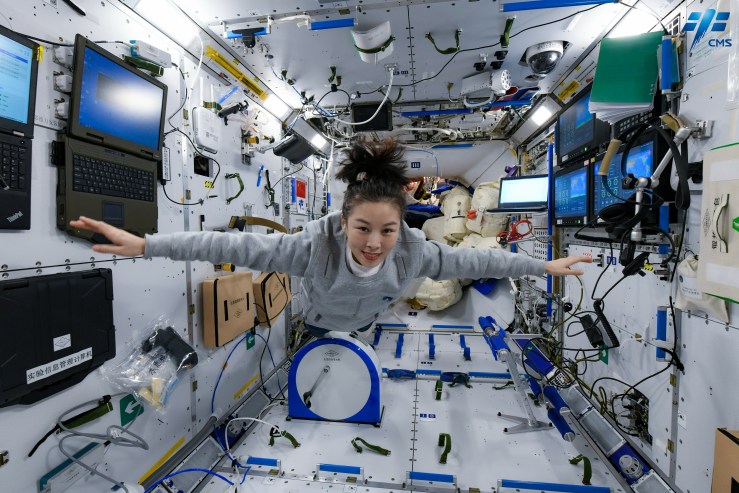
中国空间站 On currently on December 2021, the Belt and Road InitiativeCNSA –China National Space Administration CSS China Space Station in which on a three to six months setting up a new home of the first three Shenzhou 13 in which spending up to on for the further construction and verifications of the systems of the CSS –China Space Station 2021 launch calendar in which currently the three Takionauts current Shenzhou 13 …… Preparations for the six months of extension of the China Space Station In which the currently it remains awaiting for the crew of setting up home in conducting fun scientifically onboard中国空间站.. China Space station …..
On the 27th March 2022 According to the China Manned Space Engineering Office, the Tianzhou-2 cargo spacecraft completed all the scheduled tasks in the space station assembly stage, and evacuated the space station core module assembly at 15:59 on March 27th March 2022 Sunday, Hong Kong SAR Beijing time. At present, the Tianzhou-2 spacecraft is in good condition, and will re-enter the atmosphere at an opportune time under the guidance of Ground Mission control.
Tianzhou-2 is the first cargo spacecraft launched in the key technology verification phase of the Chinese space station. It was launched into orbit at the Wenchang launch site in Hainan on May 29, 2021, sending 6.8 tons of supplies to the space station. During the orbital operation of the Tianzhou-2 spacecraft, a series of extended application tests were carried out. At present, the Tianzhou-2 spacecraft is in good condition, and will re-enter the atmosphere at an opportune time under ground control
中国空间站 Previously On December 2021, the Belt and Road InitiativeCNSA –China National Space Administration CSS China Space Station in which on a three to six months setting up a new home of the first three Shenzhou 13 in which spending up to on for the further construction and verifications of the systems of the CSS –China Space Station 2021 launch calendar in which currently the three Takionauts current Shenzhou 13 …… Preparations for the six months of extension of the China Space Station In which the currently it remains awaiting for the crew of setting up home in conducting fun scientifically onboard中国空间站.. China Space station in which they’re expected to return to on mid April 2022…..
As from March 2022 this year China – People’s Republic of China – CNSA – China National Space Administration continues finish the China Space Station or named the Tiangong Space Station in which following with many onboard inter to Promotional video for the scientific experiment cabinet of the Space Application Engineering and Technology Center of the Chinese Academy of Sciences] This year, the Chinese space station will be completed soon. Thousands of scientific experimental projects in the field of university subjects.
What experiments can be carried out on the Chinese space station in the future? Click the video to find out…..For the scientific experiment cabinet of the Space Application Engineering and Technology Center of the Chinese Academy of Sciences] This year, the Chinese space station will be completed soon….. Thousands of scientific experimental projects in the field of university subjects. The Space Application Engineering and Technology Center of the Chinese Academy of Sciences is the overall unit of the manned space engineering space application system. On behalf of the Chinese Academy of Sciences, it is responsible for the planning, implementation, achievement output and promotion of manned space science and application tasks, on-orbit technical support, and payload. Operation control management, data acquisition and application results promotion services and other system technical support work. Among them, the 14 scientific experiment cabinets of Tiangong Space Station are developed by the Space Application Engineering and Technology Center of the Chinese Academy of Sciences.
According to the China Science News, the Space Application Engineering and Technology Center of the Chinese Academy of Sciences has completed the development of the scientific experiment cabinet, and is carrying out the integration and in-cabin testing work, which is progressing smoothly. Among them, the scientific experimental cabinet of the “Ask Sky” experimental cabin has been delivered to the platform, and the whole cabin test has been completed. The “Mengtian” experimental cabin has more scientific experimental cabinets, the whole cabinet test has been completed, and the whole cabin test is being carried out. , In the “Ask Sky” experimental cabin, a number of life science experiments such as plants, animals, and microbial cells will be carried out, and a small closed ecosystem composed of fish, microorganisms and algae will be built.
The world’s first set of space cold atomic clocks composed of hydrogen, rubidium, and optical clocks will be built in the “Mengtian” experimental cabin. If successful, it will become the most accurate time-frequency system in space, with an error of less than 1 in hundreds of millions of years. Second.
Images and visuals are from their respectives. from CNSA- China National Space Administration
On the months of March 2022 the week of 20th March 2022 天问一号飞運騎遊達达3亿CNSA – China National Space Administration – ESA – European Space agency Belt and road initiative mars mission…first Mars exploration mission, Tianwen- Martian Probe One sent back stunning images of the Half Earth Mass size of the Rustic Planet Mars in which show stunning Martian landscape with its iconic polar caps of either southern or northern .. With its timeless Stunning Mars Photography. Tianwen-1″ returned high-resolution images of the Mars inspection area
Figure 1 The image of the inspection area of ”Zhurong” taken by a high-resolution camera
A few days ago, the “Tianwen No. 1” orbiter passed over the inspection area of the Mars rover again, and took a 0.5-meter resolution image of the “Zhurong” inspection area. As of March 24, 2022, the “Zhurong” rover has been working on the surface of Mars for 306 Martian days and has traveled 1,784 meters in total. The “Tianwen-1” orbiter has been in orbit for 609 days and is 277 million kilometers away from the earth. Both are operating normally.
(a) Taken on May 19 , 2021 ( the 5th Martian day after landing ), the surface of the rover is not covered by sand and dust
(b) Taken on January 22 , 2022 (the 247th
Martian day after landing ), there is obvious dust coverage on the surface of the rover Figure 2 Comparison of images of the rover taken by the Navigation Terrain Camera in different periods
The “Zhurong” rover also sent back selfies from the surface of Mars. Compared with the photos taken just after landing, it can be seen that a thin layer of dust has accumulated on the surface of the rover. At the same time, according to the telemetry information of the rover, the power generation efficiency of the solar wing is affected to a certain extent, but the energy is still sufficient. In order to cope with the dust coverage, the solar wing of the Mars rover has been specially designed, and various measures can be taken to deal with the problem of the reduction of power generation efficiency caused by the sand and dust.
(a) Taken at the center of the image on January 22 , 2022 ( 30.7 °E, 74.0 ° N )
(b) Taken at the center of the image on February 10 , 2022 ( 37.8 ° east longitude , 7 2.9 ° north latitude), a local sandstorm occurred, and the ground objects were difficult to distinguish Fig. 3 Comparison of wind and sand activities in high latitude regions of the Northern Hemisphere captured by medium-resolution cameras
The Martian dust storm will directly affect the energy acquisition of the Mars rover, which has always attracted much attention. The engineering team continued to monitor the Martian sand and dust weather through images obtained by the medium-resolution camera of the “Tianwen-1” orbiter, and found that from late January this year, obvious wind and sand activities began to appear in the area north of 60 ° N latitude on Mars. It can be seen from the figure below that a local sandstorm occurred in this area in February this year, and typical features were covered by a large amount of sand and dust, making it difficult to distinguish.
At present, the northern hemisphere of Mars has begun to enter autumn. According to the analysis of previous detection data, autumn is the season of frequent occurrence of dusty weather on Mars, but no obvious dusty weather has been observed in the inspection area of ”Zhurong”.
(a) Taken on March 24 , 2021 , at the center of the image ( 110.2 ° E, 24.6 °N)
(b) Taken on January 30 , 2022 , at the center of the image ( 107.4 ° E longitude , 24.4 ° N latitude ) Figure 4. Medium resolution image of “Zhurong” landing inspection area
The “Tianwen-1” orbiter continues to carry out global remote sensing exploration of Mars, and focuses on typical landforms and geological units such as craters, volcanoes, canyons, and dry riverbeds, and obtains high-resolution images. On March 7 this year, the American “Perseverance” rover was photographed while imaging the “Jezero” crater, which is currently located about 200 meters southeast of its landing site.
Figure 5 The American “Perseverance” rover photographed by “Tianwen-1”
Source Cartography: National Astronomical Observatory -Author: Geng Yan Chen Gang
Images and visuals are from CNSA- China National Space Administration also from there respectives- CLEP –China Lunar Exploration Project..
中国空间站 Previously On December 2021, the Belt and Road InitiativeCNSA –China National Space Administration CSS China Space Station in which on a three to six months setting up a new home of the first three Shenzhou 13 in which spending up to on for the further construction and verifications of the systems of the CSS –China Space Station 2021 launch calendar in which currently the three Takionauts current Shenzhou 13 …… Preparations for the six months of extension of the China Space Station In which the currently it remains awaiting for the crew of setting up home in conducting fun scientifically onboard中国空间站.. China Space station …..
live stream CGTN..
In which during the 15th March 2022 Tuesday CNSA –CMS-China Manned Space Engineering Office announced, the “Tiangong Classroom” of China’s space station will choose an opportunity to conduct the second space teaching activity coming soon with Takionaut Space Teacher Wang Yaping and her Teachers Assistants Zhai Zhigang Ye Guangfu The second class from China Space Station by Shenzhou13 Takionauts will be held at 1540 Hong Kong SAR Beijing Time on 23rd March 2022. The live class is designed to demonstrate space technology and inspire young students’ passion for science….
via CGTN..
The second class from China’s Tiangong space station by Shenzhou-13 astronauts – Zhai Zhigang, Wang Yaping and Ye Guangfu – will be held at 3:40 pm BJT on March 23. The second episode of the “Tiangong Class” series will also be held as a space-Earth talk between the astronauts in space and the youth on Earth, aiming to ignite their interest in science and space. This time, astronauts will conduct various experiments, such as crystallization of saturated liquid, liquid bridge and water-oil separation. They will also demonstrate the difference between throwing objects in space and on Earth, and introduce space science facilities. The three Chinese astronauts went to space aboard the Shenzhou-13 spacecraft and entered China’s space station on October 16, 2021, embarking on the country’s longest-ever crewed space mission, of 6 months. The three astronauts will return to Earth in April as planned
The content of the second space lecture was widely selected from the opinions and suggestions collected, and were carefully designed according to the facilities conditions of China’s space station. The lectures will be live-streamed throughout on multi various platforms on traditional to social live streaming mediums in which featuring Wang Yaping’s Daughter. In which Cities from the last Space Teachers Lesson was from Beijing –Hong Kong SAR – Macau SAR China – People’s Republic of China
2021 12 On March 9th, “Tiangong Classroom” conducted the first space class. “Space teachers” Zhai Zhigang, Wang Yaping, Ye Guangfu interacted with teachers and students in the ground classroom. The first space class has further shortened the distance between young people and manned spaceflight, and there has been a continuous upsurge in exploring the mysteries of spaceflight and learning spaceflight knowledge.
After the first space class, all sectors of society participated in the “Tiangong Classroom” teaching content collection activity through news media and the Internet. The content of the second space lecture was widely selected from the opinions and suggestions collected, and were carefully designed according to the facilities conditions of China’s space station. Lectures will be broadcast
中国空间站 Previously On December 2021, the Belt and Road InitiativeCNSA –China National Space Administration CSS China Space Station in which on a three to six months setting up a new home of the first three Shenzhou 13 in which spending up to on for the further construction and verifications of the systems of the CSS –China Space Station 2021 launch calendar in which currently the three Takionauts current Shenzhou 13 …… Preparations for the six months of extension of the China Space Station In which the currently it remains awaiting for the crew of setting up home in conducting fun scientifically onboard中国空间站.. China Space station …..
[Shenzhou 13 Takionauts completed a number of on-orbit experiments] The gravity-free space environment of the space station provides convenient conditions for human beings to carry out life science research. Relying on the China Space Station, my country established a long-term cell culture system and cell model under space conditions for the first time during the Shenzhou 13 crew in orbit. Using such a system and culture model, scientific researchers have completed several world-leading life sciences. science experiment.
Li Yinghui, researcher of the China Takionaut Training Center and deputy chief designer of the manned space engineering astronaut system: We have completed the world’s first case of renal epithelial cells from human urine, and transformed them into vigorous epithelial cells through gene reprogramming. The stem cells with various functions are differentiated into cardiomyocytes. A fluorescent protein is edited by gene editing technology, then through the fluorescence of the fluorescent protein, we can see the blinking process of calcium signals during the contraction process. This is also the first time in the world to see the beautiful myocardial cells (in a weightless environment). shrinking process. Taking advantage of the sensitivity of cardiomyocytes to gravity, researchers compared the contraction process and contraction characteristics of cardiomyocytes under gravitational and weightless conditions based on the astronauts’ on-orbit experimental observations, in order to better interpret the effects of weightlessness on humans.
Li Yinghui, researcher of the China Takionaut Training Center and deputy chief designer of the manned space engineering astronaut system: On the one hand, this technology can be used to understand the characteristics of cardiovascular changes under our weightless conditions, and on the other hand, it is also important for public health, human regeneration and aging. , including human longevity and the occurrence of heart disease, provide very good experimental models. my country completed the world’s first weightless suspension culture experiment of skin stem cells In addition, relying on the Chinese space station and Shenzhou 13, Chinese researchers also completed the world’s first skin stem cell suspension culture experiment under long-term weightlessness conditions.
Li Yinghui, researcher of the China Takionaut Training Center and deputy chief designer of the manned space engineering astronaut system: The cell is in one of our small houses, so there are 4 channels, and this cell can be (completed) in our system for as long as One month (30 days) of survival and survival provides an important technical platform for us to conduct cell studies under long-term weightlessness conditions. According to experts, carrying out such cell space experiments will help humans better understand life and break through themselves. Li Yinghui, researcher at the China Takionaut Training Center and deputy chief designer of the manned space engineering astronaut system: We still have some issues, such as aging and differentiation. Why do we do stem cells, (that is) to provide very important basic scientific support for human health. If our astronauts want to fly farther and fly healthier, it is inseparable from the new gains and new understandings that our aerospace medicine keeps gaining. Only when these new harvests and new understandings become more and more, our supporting role for astronauts will become stronger and Stronger..