On 21st November 2022 Hong Kong SAR- Beijing time , the Belt and Road InitiativeCNSA –China National Space Administration launching from Jiuquan Satellite Launch Center – Inner Mongolia –China – People’s Republic of China, Readiness rolled out deployed the Chang Zheng – Long March 2F Yao 15 Manned carrier rocket in readiness for the 神舟十五号Shenzhou 15 Crew in which will be joining with the fellow Takionauts Comrades of Shenzhou 14 crew whom are presently up there in finalisation of the Construction of the Tiangong –China Space Station.
Deployed the Chang Zheng – Long March 2F Yao 15 Manned carrier rocket in readiness rolled out towards the launched complex from the VAB- Vertical Assembly Building . At present, the launch site facilities and equipment are in good condition, and various functional inspections and joint tests before launch will be carried out as planned…
According to Liu Feng, the deputy chief designer of the Chang Zheng – Long March 2F launch vehicle of the Aerospace First Division, compared with the Chang Zheng Long March 2F Yao 14 rocket, the Yao 15 rocket has increased the deviation of the rocket’s take-off time. Adaptability, after adopting this technology, the rocket can make relevant corrections in the orbital parameters, and automatically compensate for the time deviation during the take-off process to ensure the accuracy of orbiting. In addition, the rocket’s telemetry system transmitter and navigation receiver have been upgraded to enable it to receive more satellites, resulting in higher accuracy….
Our aviation test team members cheered for the rockets and spacecraft before they set off! Listen, they said: “Takionauts Arrow Asks the Sky”, “Shenzhou New Journey into the Heavenly Palace”, “I wish the 15th mission of Takionaut a complete success”!
On the November 15th Tuesday 2022 Early Morning clear 0938 morning Hours Hong Kong SAR- Beijing time , the Belt and Road InitiativeCNSA –China National Space Administration launching from Jiuquan Satellite Launch Center – Inner Mongolia –China – People’s Republic of China, successfully launching the International Icon Chang Zheng – Long March 4C Yao 48 Carrier Rocket ignited and took off at the Jiuquan Satellite Launch Center, and then sent the remote sensing 34-03 satellite into the predetermined orbit for launch. complete success.
The Yaogan Remote Sensing No. 34 03 satellite was developed by the Eighth Academy of China Aerospace Science and Technology Group Co., Ltd., and it forms a network operation status with the already in-orbit Yaogan No. 34 01, 02 and subsequent satellites. It is mainly used for national land censuses and urban planning. , Land ownership confirmation, road network design, crop yield estimation, disaster prevention and mitigation, etc., meet the needs of rapid revisiting of earth observation, and can provide information guarantee for the construction of the “Belt and Road”.
The Chang Zheng- Long March 4C carrier rocket is a room-temperature liquid three-stage carrier rocket developed by the Eighth Academy. It has the ability to launch various types of satellites with different orbital requirements. It can implement a single-satellite or multi-satellite launch Up to 3 tons.
This launch is the 450th launch of the Long March series of launch vehicles.
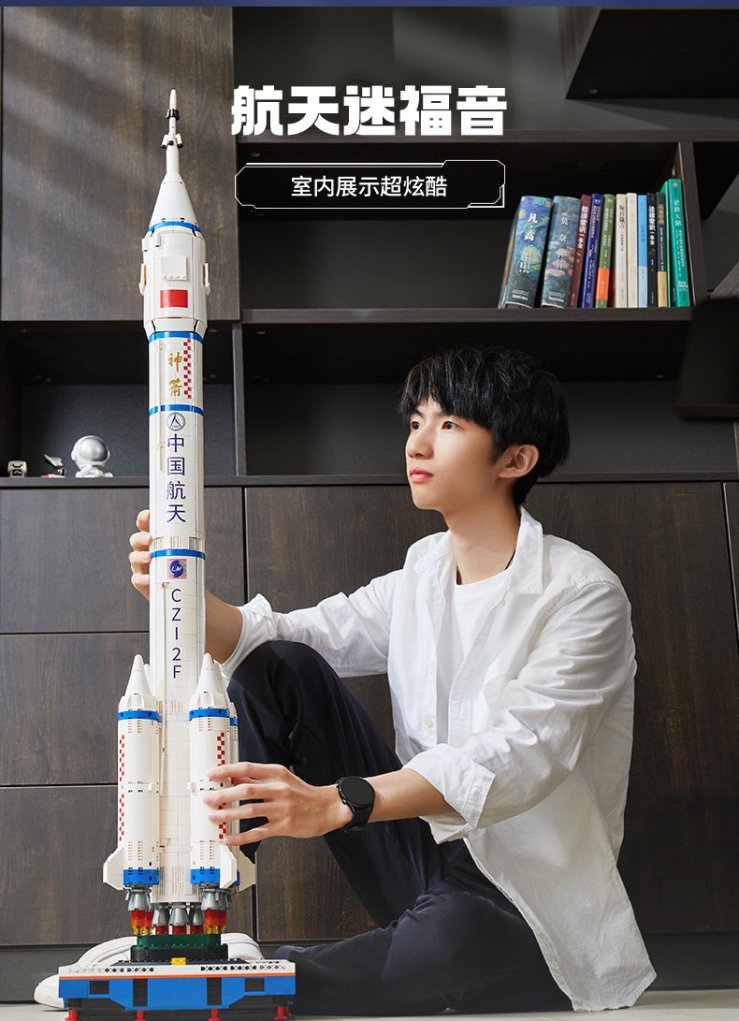
TOP TOY China Building Blocks and China Aerospace Shenzhou Media have jointly created a collection-level building block model of the Long March 2F carrier rocket with a height of 1.2m and a restored internal structure! Chang 2 F is the only manned carrier rocket in my country at present! It was the one that sent my country’s first Takionaut Yang Liwei into space! ….In order to let everyone know more about the structure of the country’s most important Chang Zheng- Carrier Rocket one of many the Long March rockets….
长征二号F Chang Zheng Long March 2F 58.34 meters (code name: CZ-2F, abbreviation: Chang 2F, nickname: Shenjian) is a large two-stage bundled booster launch vehicle developed by the China Academy of Launch Vehicle Technology affiliated to China Aerospace Science and Technology Corporation. , which is mainly used by China to launch Shenzhou manned spacecraft and large target vehicles to low-Earth orbit… it’s chief designer Liu Zhusheng, Zhang Zhi, Yiyi
The Long March 2F is a launch vehicle developed on the basis of the Long March 2E bundled rocket and in accordance with the requirements of launching manned spacecraft with the goal of improving reliability and ensuring safety. The rocket consists of four liquid boosters, a core first stage, a core second stage, a fairing and an escape tower. For the first time, the rocket adopts the “three vertical” test launch mode of vertical assembly, vertical testing and vertical transportation. The Long March-2F rocket has been developed since 1992. It was launched for the first time on November 19, 1999 and successfully sent China’s first experimental spacecraft “Shenzhou-1” into space. Long March 2F has successfully launched Shenzhou series spacecraft for many times, and has become the “star” rocket in China’s Long March series of launch vehicles…..
TOPTOY TOPTOY官方 is Located in Guangdong Province, China, People’s Republic of China, Top Toy hopes to spread the culture of toy combined with the trend to more players who love it, follow it, and believe in it, so that every player can become the “number one player” who is believed in.
On the October 9th 2022 Early Morning clear 0743 morning Hours Hong Kong SAR- Beijing time , the Belt and Road InitiativeCNSA –China National Space Administration launching from Jiuquan Satellite Launch Center – Inner Mongolia –China – People’s Republic of China, Readiness rolled out deployed the Chang Zheng – Long March 2D carrier rocket planned orbit from Jiuquan successfully launched the advanced space-based solar observatory “Kwafu-1” from the successfully launched at station 94 of the Jiuquan Satellite Launch Center.. . The Advanced Space-Based Solar Observatory (Kwafu-1/ASO-S) satellite was sent into the scheduled sun-synchronous orbit, and the launch mission was a complete success!
The Advanced Space-Based Solar Observatory (ASO-S) satellite was developed by the Institute of Microsatellite Innovation, Chinese Academy of Sciences. , which also provides support for severe space weather forecasting also the advanced space-based solar observatory satellite, the launch mission was a complete success. The satellite is mainly used for research on the causal relationship between solar flares and coronal mass ejections and the solar magnetic field, and provides data support for space weather forecasting…..
First comprehensive sun exploration satellite “Kuafu-1” was launched this morning] According to the official website of “Nature” magazine, at 7:43 am Beijing time on October 9, my country’s Advanced Space-based Solar Observatory (ASO-S) It will be launched by the Long March 2 Dingyao 55 rocket from the Jiuquan Satellite Launch Center. Advanced Space-based Solar Observatory (ASO-S) “Kuafu-1” is my country’s first comprehensive solar exploration dedicated satellite approved and implemented by the Space Science Pilot Project (Phase II) of the Chinese Academy of Sciences , its plan was first proposed independently by my country’s solar physics community in 2011, and was later established in 2017, with a total development cost of 900 million yuan.
The ASO-S satellite takes “one magnetic and two storms” as its scientific goal, and aims to take advantage of the opportunity of the 25th peak year of solar activity (2024-2025) to respond to the two most violent eruptions on the sun – flares and coronal matter Simultaneous observation of Ejection (CME) and all-solar vector magnetic field to study the origin, interaction and correlation of the solar magnetic field, solar flares and coronal mass ejections, and provide space for severe weather forecasts that seriously affect human high-tech activities support.
ASO-S has a total weight of 888kg and a design life of 4 years. It will run on a 720-kilometer sun-synchronous twilight orbit and conduct long-term continuous observations of the sun. The star carries three payloads: the Full-disc vector MagnetoGraph (FMG) to observe the vector magnetic field of the solar photosphere; the Hard X-ray Imager (HXI) It is used to observe the non-thermal physical process of solar flares; the Lyman-alpha Solar Telescope (LST) is mainly used to observe the formation and early evolution of coronal mass ejections.
After the successful launch of ASO-S, the “solar storm” of the 25th solar cycle will be recorded in detail. After the satellite is in orbit, it will generate about 500GB of detection data every day. After the completion of 4-6 months of on-orbit testing, all scientific data and analysis software of the satellite will be open and shared to users around the world to jointly achieve the scientific goals of ASO-S . By then, the research around ASO-S observations will become an international hotspot. While studying the natural law of “one magnetic and two storms”, scientists will also timely predict the impact of solar eruptions on human beings, benefiting all human beings…
On the 3rd September 2022 Early Morning clear 0744 Hours Hong Kong SAR- Beijing time , the Belt and Road InitiativeCNSA –China National Space Administration launching from Jiuquan Satellite Launch Center – Inner Mongolia –China – People’s Republic of China, Readiness rolled out deployed the Chang Zheng – Long March 4C carrier rocket launching a Yaogan- Remote Sensing 33 two satellites, The satellite is mainly used for scientific experiments, land and resources census, agricultural production estimation, disaster prevention and mitigation and other fields.
Yaogan- Remote Sensing Satellite was developed by the Eighth Academy of China Aerospace Science and Technology Corporation, and is mainly used in scientific research, marine and terrestrial resources census, production estimation of agricultural products, and disaster prevention and mitigation
The Long March 4C carrier rocket for this launch mission is a normal temperature liquid three-stage carrier rocket with excellent performance and a wide range of uses. For different types of satellites, the Long March 4 series carrier rockets can adopt flexible launch plans, have the ability to launch satellites of various types and different orbit requirements, and can implement one rocket, one satellite or multiple satellites. Up to 3 tons (orbit height 700 km)
This launch is the 93rd launch of the Long March 4 series of launch vehicles, the 166th launch of the Long March series of launch vehicles developed by the Eighth Academy, and the 435th launch of the Long March series of launch vehicles.
The provisionments of the 遥感式卫星; Yaogan satellites in which are design as remote sensing earth sciences satellites in which have multiple installation equipment onboard, with scientific experiments, land surveying, agriculture , disaster monitoring .. Also with electromagnetic environment detection… in which the Yaogan 33 satellites series is place in at an attitude of in between 700 Kilometers above earth… at an inclination of ninety eight degrees… Satellites are mainly used to carry out electromagnetic environment detection and related technical tests. …….
Images and visuals are from Weibo also are from their Respectives ..