#CNSA #ChinaNationalSpaceAdministration #國家航天局 |#BeltAndRoadinitiative #July2021 |#火星 # 天問 #天问一号#TianwenOne #MarsMission #Marslander #MarsRover #Tianwen1 probe #祝融号 #ZhuRong Exploring 400 meters more mileage milestone on the #RedPlanet #Mars with more Ultimate #MarsSelfie …. #Selfies

As of 20:00 Hong Kong SAR- Beijing Time on Sunday July 11th 2021, the Tianwen No. 1 circulator has been in orbit for 353 days, and the working conditions are normal. The distance of the ground fire was 370.7 million kilometers, and the light travel time was 20 minutes and 36 seconds. The “Zhu Rong” Mars rover travelled 410.025 meters in total, and the working conditions were normal. The rover worked hard and crossed 400 meters.

Previously  

天问一号飞運騎遊達达3亿CNSA – China National Space Administration – ESA – European Space agency Belt and road initiative mars mission…first Mars exploration mission, Tianwen- Martian Probe One …….”祝融号Zhu Rong” Mars Lander – Mars rover successfully sent back telemetry  On the Rustic half diameter planet size Red planet Mars  on Hong Kong SAR- Beijing  Earth Friday  time On July 8th  2021 , also previously during the 1st July 2021  at the unveiling ceremony of the first batch of scientific visualisations  of the Tianwen-1 rover landing on Mars in Beijing, on the eve of the CPC- Communist Party of China 100 year Anniversary party’s centennial birthday of China- People’s Republic of China , the CNSA – China National Space Administration released a series of real shots of the Tianwen-1 Mars exploration mission landing and patrol exploration, including the parachute and descent process of the landing patrol, and the Zhurong rover leaving the landing platform Sound and video of Mars surface movement, Mars global environment perception image, Mars rustic ​​images on Utopia Planitia…..

Form that day the Zhurong Mars Rover has travelled more than three hundred meters from its base station the Tianwen One mars Lander in exploring more with during the 54 Martian Days  …The latest scientific exploration progress-“Zhurong” takes you to see “Fire Rock”, “Fire Dust” and “Fire Sand”

As of July 8, the “Zhu Rong” rover has been working on the surface of Mars for 54 Martian days, with a mileage of more than 300 meters. Since the rover arrived on the surface of Mars, it has been traveling south to carry out patrol surveys. The navigation terrain camera images the landforms along the way daily. During the journey, the surface radar, weather measuring instrument, and Mars magnetometer are turned on for detection, and rocks, sand dunes, etc. are encountered on the way. For special geomorphology, use surface component detectors, multi-spectral cameras, etc. to carry out fixed-point detection. Figure 1 and Figure 2 are images of Martian rocks on the road, synthesized from multiple spectral data obtained by a multispectral camera. Figure 1 shows the texture features and rutting of Mars rocks, and Figure 2 shows the coverage of Martian dust on the rock surface. Happening.

As of July 8, the “Zhu Rong” rover has been working on the surface of Mars for 54 Martian days, with a mileage of more than 300 meters. Since the rover arrived on the surface of Mars, it has been traveling south to carry out patrol surveys. The navigation terrain camera images the landforms along the way daily. During the journey, the surface radar, weather measuring instrument, and Mars magnetometer are turned on for detection, and rocks, sand dunes, etc. are encountered on the way. For special geomorphology, use surface component detectors, multi-spectral cameras, etc. to carry out fixed-point detection. Figure 1 and Figure 2 are images of Martian rocks on the road, synthesized from multiple spectral data obtained by a multispectral camera. Figure 1 shows the texture features and rutting of Mars rocks, and Figure 2 shows the coverage of Martian dust on the rock surface. Happening….

On June 26 (42nd Mars Day), the rover arrived at a sand dune area and used the navigation terrain camera to take a high-resolution image of the red dune (Figure 3). The shooting point was about 6 meters away from the dune, and there were different sizes of sand dunes around. The stones, which are facing the rover, are about 0.34 meters wide.

On July 4 (50th Mars Day), the rover travelled to the south side of the sand dune to perceive and image the surrounding terrain. Figure 4 shows the overall view of the sand dune, which is about 40 meters in length, 8 meters in width and 0.6 meters in height. On the left side of Figure 5 is a cluster of rocks of various shapes. The back cover and parachute can be seen in the upper right corner. When imaging, the distance between the rover and the landing site is about 210 meters, and the distance between the back cover and the parachute is about 130 meters.

 Images and visuals are from Weibo also their respectives..

#CNSA #ChinaNationalSpaceAdministration #國家航天局 |#BeltAndRoadinitiative #July2021 |#火星 # 天問 #天问一号#TianwenOne #MarsMission #Marslander #MarsRover #Tianwen1 probe #祝融号 #ZhuRong Exploring 300 meters mileage on the #RedPlanet #Mars with more Ultimate #MarsSelfie …. #Selfies with 54 #Martian Days

天问一号飞運騎遊達达3亿CNSA – China National Space Administration – ESA – European Space agency Belt and road initiative mars mission…first Mars exploration mission, Tianwen- Martian Probe One …….”祝融号Zhu Rong” Mars Lander – Mars rover successfully sent back telemetry  On the Rustic half diameter planet size Red planet Mars  on Hong Kong SAR- Beijing  Earth Friday  time On July 8th  2021 , also previously during the 1st July 2021  at the unveiling ceremony of the first batch of scientific visualizations  of the Tianwen-1 rover landing on Mars in Beijing, on the eve of the CPC- Communist Party of China 100 year Anniversary party’s centennial birthday of China- People’s Republic of China , the CNSA – China National Space Administration released a series of real shots of the Tianwen-1 Mars exploration mission landing and patrol exploration, including the parachute and descent process of the landing patrol, and the Zhurong rover leaving the landing platform Sound and video of Mars surface movement, Mars global environment perception image, Mars rustic ​​images on Utopia Planitia…..

Form that day the Zhurong Mars Rover has travelled more than three hundred meters from its base station the Tianwen One mars Lander in exploring more with during the 54 Martian Days  …The latest scientific exploration progress-“Zhurong” takes you to see “Fire Rock”, “Fire Dust” and “Fire Sand”

As of July 8, the “Zhu Rong” rover has been working on the surface of Mars for 54 Martian days, with a mileage of more than 300 meters. Since the rover arrived on the surface of Mars, it has been traveling south to carry out patrol surveys. The navigation terrain camera images the landforms along the way daily. During the journey, the surface radar, weather measuring instrument, and Mars magnetometer are turned on for detection, and rocks, sand dunes, etc. are encountered on the way. For special geomorphology, use surface component detectors, multi-spectral cameras, etc. to carry out fixed-point detection. Figure 1 and Figure 2 are images of Martian rocks on the road, synthesized from multiple spectral data obtained by a multispectral camera. Figure 1 shows the texture features and rutting of Mars rocks, and Figure 2 shows the coverage of Martian dust on the rock surface. Happening.

As of July 8, the “Zhu Rong” rover has been working on the surface of Mars for 54 Martian days, with a mileage of more than 300 meters. Since the rover arrived on the surface of Mars, it has been traveling south to carry out patrol surveys. The navigation terrain camera images the landforms along the way daily. During the journey, the surface radar, weather measuring instrument, and Mars magnetometer are turned on for detection, and rocks, sand dunes, etc. are encountered on the way. For special geomorphology, use surface component detectors, multi-spectral cameras, etc. to carry out fixed-point detection. Figure 1 and Figure 2 are images of Martian rocks on the road, synthesized from multiple spectral data obtained by a multispectral camera. Figure 1 shows the texture features and rutting of Mars rocks, and Figure 2 shows the coverage of Martian dust on the rock surface. Happening….

On June 26 (42nd Mars Day), the rover arrived at a sand dune area and used the navigation terrain camera to take a high-resolution image of the red dune (Figure 3). The shooting point was about 6 meters away from the dune, and there were different sizes of sand dunes around. The stones, which are facing the rover, are about 0.34 meters wide.

On July 4 (50th Mars Day), the rover travelled to the south side of the sand dune to perceive and image the surrounding terrain. Figure 4 shows the overall view of the sand dune, which is about 40 meters in length, 8 meters in width and 0.6 meters in height. On the left side of Figure 5 is a cluster of rocks of various shapes. The back cover and parachute can be seen in the upper right corner. When imaging, the distance between the rover and the landing site is about 210 meters, and the distance between the back cover and the parachute is about 130 meters.

 Images and visuals are from Weibo also their respectives..

#CNSA #ChinaNationalSpaceAdministration #國家航天局 |#BeltAndRoadinitiative #June2021 |#火星 # 天問 #天问一号#TianwenOne #MarsMission #Marslander #MarsRover #Tianwen1 probe #祝融号 #ZhuRong Exploring celebrating sending #DragonBoatfestival wishers from the #RedPlanet #Mars ….

On the Rustic half diameter planet size Red planet Mars  on Hong Kong SAR- Beijing  Earth Friday  time On June 11th  2021 , at the unveiling ceremony of the first batch of scientific image maps of the Tianwen-1 rover landing on Mars in Beijing, the panoramic view of the landing site, the topography of Mars, the “Chinese imprint” and the image taken by the “Zhurong” rover were announced. “Photographs with the tour” and other image maps. The release of the first batch of scientific image maps marked the complete success of my country’s first Mars exploration mission.

The Dragon Boat Festival, also known as the Dragon Boat Festival, the Dragon Boat Festival, and the Tianzhong Festival, was originally a festival originated  by ancient ancestors to worship the dragon ancestors, pray for blessings and ward off evil spirits. In the midsummer Dragon Boat Festival, the Canglong Qi Su soared in the middle of the sky in the south, and was in the most “center” position in the whole year, that is, as the line of the fifth line of “The Book of Changes•Qian Gua”: “Flying Dragon is in the Sky”. The Dragon Boat Festival is due to legend that Qu Yuan, a poet of Chu State during the Warring States Period, committed suicide by jumping on the Miluo River on May 5. Later, people also took the Dragon Boat Festival as a festival to commemorate Qu Yuan. The fragrance of dumplings and dragon boats became one of the four traditional festivals in China.

The two most primitive beliefs of the Chinese people: one is belief in heaven and earth, and the other is belief in ancestors. Most of the ancient festivals were formed when the ancients chose auspicious days to make sacrifices to thank the gods and ancestors. The early festival culture reflected the humanistic spirit of the ancients such as natural worship and consolidating the roots. Sacrificial activities contain profound cultural connotations of respectful virtue, ritual and music civilization. The word “Dragon Boat Festival” first appeared in “Feng Tu Ji” of the Jin Dynasty. The original meaning of the word “duan” is “zheng”, and “wu” is “zhong”. “Dragon Boat Festival”, “Zhengzhong” also. The ancients used the heavenly stems and earthly branches to record the years, the heavenly stems carried the way of the sky, and the earth supported the way of carrying the earth. The heavenly stems and the earth’s branches were set up to coordinate the luck of the heavens and the earth. On the midsummer noon day, the Canglong Seven Suspension is in the middle of the south of the sky, which is the most “centered” position for daily operations throughout the year, and it is a sign of good fortune.

Qu Yuan was not an emperor or a general, but a poet. Few people can understand his poems, but for more than two thousand years, Chinese children have expressed their memory of him on the Dragon Boat Festival. This is not only in China, but there is no second example in the history of the world. Different from the “The Great Avenue is in my heart” of the philosophers, what Qu Yuan wants to present is the interaction between heaven and man. At the same time, he feels that he has many doubts that he can’t answer, “Sun and the moon, Lie Xing, Chen?”, “圜 is nine layers, who is the camp?”. More than two thousand years ago, Qu Yuan issued more than 170 questions, asking about the circulation of stars, studying the Taoist school of heaven and earth, exploring the evolution of all things, and seeking the principles of the world. Although he could not fully understand, Qu Yuan also expressed his attitude: “The road is long and long, and I will search up and down”, “I am more than good at heart, even if I die nine times, I still have no regrets.” This is China The simple expression of the ancients exploring the unknown and pursuing the truth.

This year’s Dragon Boat Festival has added a different kind of feelings. The name of China’s first Mars exploration mission, Tianwen-1, is derived from Qu Yuan’s long poem “Tianwen”. This year, China’s first Mars exploration mission was a complete success, and Tianwen-1 left a Chinese mark on the surface of Mars for the first time. The mission of the Chinese astronauts is to turn romantic myths into materialized reality, and to provide scientific answers to the millennial doubts. Tianwen-1’s journey to Mars will also be a question and answer to the ancients of China over a thousand years of time and space.

In addition, the commemoration of Qu Yuan also reflects the feelings of family and country and national characteristics in traditional Chinese culture. As we all know, the main civilization of the Chinese originated from the farming civilization, and the Chinese solar terms are mostly related to the farming time. Farming civilization is different from nomadic civilization and marine civilization. For nomadic civilization, horseback is home, tent is home, living by water and grass, and migrating with the seasons. Ocean civilization is always looking forward to the other shore, and where the other shore is may never be known, or it may never come back. China’s farming civilization advocates “intensive farming”, spring ploughing and autumn harvesting, which are stable and peaceful. Looking back at China’s aerospace industry from the perspective of civilization and history, it can be said that China’s aerospace industry is deeply rooted in the development sequence of the Chinese nation’s civilization and serves the sustainable progress of human civilization and the well-being of people’s lives. The development of China’s aerospace industry is shouldered The development of the mission is the development of open cooperation and the development of peace and win-win. It will also make more and greater contributions to building a community with a shared future for mankind.

Tianwen No.1 carries Zhurong No.1, I wish you all a good Dragon Boat Festival, Happiness goes well..

Images and visuals are from Weibo of CNSA – China National Space Administration – CLEP –China Lunar Exploration Program

#CNSA #ChinaNationalSpaceAdministration #國家航天局 |#BeltAndRoadinitiative #June2021 |#火星 # 天問 #天问一号#TianwenOne #MarsMission #Marslander #MarsRover #Tianwen1 probe #祝融号 #ZhuRong Exploring the #RedPlanet #Mars #UtopiaPlanitia released high-resolution images of The Zhurong ultimate #PlanetMarselfies #Selfies of the #MartainSurface …. #AGallery

天问一号飞運騎遊達达3亿 …….As of 11th  June 2021Friday  CNSA – China National Space Administration – ESA – European Space agency Belt and road initiative mars mission…first Mars exploration mission, Tianwen- Martian Probe One …….”祝融号Zhu Rong” Mars Lander – Mars rover successfully sent back telemetry towards China National Space Administration released a high-resolution image of the landing area of ​China- People’s Republic of China’s first Mars exploration Tianwen-1 mission. The image of the Zhongtianwen-1 landing platform, the “Zhurong” rover and the surrounding area are clearly visible.   Also to of the ultimate Mars Selfie of itself also it’s Mars Landing platform in releasing a high definition patches of travelling least six meters of it landing platform 天问一号-1 landing on Mars first batch of scientific images revealingly…  


That Mars  on Hong Kong SAR- Beijing  Earth Friday  time On June 11th  2021 , at the unveiling ceremony of the first batch of scientific image maps of the Tianwen-1 rover landing on Mars in Beijing, the panoramic view of the landing site, the topography of Mars, the “Chinese imprint” and the image taken by the “Zhurong” rover were announced. “Photographs with the tour” and other image maps. The release of the first batch of scientific image maps marked the complete success of my country’s first Mars exploration mission.


The panoramic view of the landing site is a 360-degree ring shot taken by the navigation terrain camera on the rover’s mast before the rover has left the landing platform, after correction and mosaic stitching. The image shows that the terrain near the landing site is flat, the Martian horizon can be seen in the distance, and the abundance and size of the rocks are consistent with expectations, indicating that the autonomous selection of the landing site and the implementation of hovering obstacle avoidance are effective.


The Mars topography map  is the first topography and geomorphology image map taken by the navigation terrain camera after the rover reaches the surface of Mars. The image shows that the nearby surface is relatively flat, with stones of different sizes distributed, with smooth edges, lighter colours, and semi-buried. There is an annular pit at the far end, and the edges of the annular pit are distributed with darker, angular stones. , And a few sand dunes farther away.
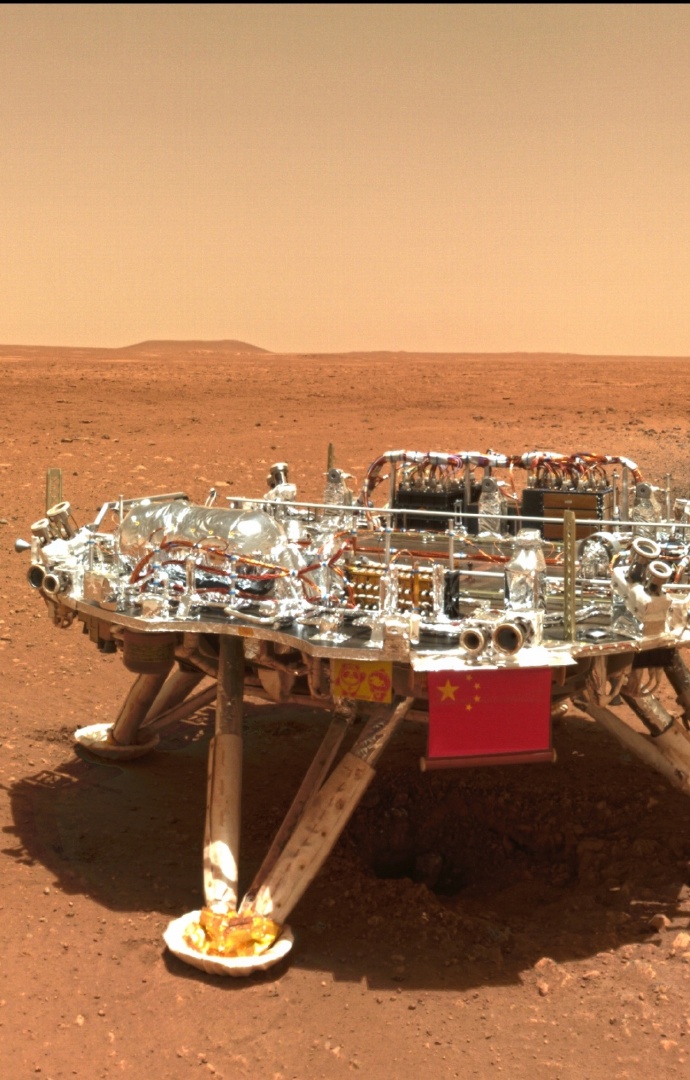
The “Chinese Imprint” map is an image of the landing platform taken when the Mars rover travels to about 6 meters southeast of the landing platform 60° southeast. The image shows that the landing platform is shining, the national flag is bright red and square, and the surface is rich in details.


The picture of the “touring group photo” shows the rover traveling about 10 meters south of the landing platform, releasing the separate camera installed at the bottom of the vehicle, and then retreating to the vicinity of the landing platform. The separate camera took pictures of the movement of the rover and the photo of the rover and the landing platform. The image is transmitted to the rover through wireless signals, and then relayed back to the ground by the rover through the orbiter

images of the mascots of the 2022 Winter Olympics “Bingdundun” and “Xuerongrong” on the landing platform

Mars surface Photography of Zhurong with the landing platform …. The picture of the “tourist group photo” shows the rover traveling about 10 meters south of the landing platform, releasing the separate camera installed at the bottom of the vehicle, and then retreating to the vicinity of the landing platform. The separate camera took pictures of the movement of the rover and the photo of the rover and the landing platform. The image is transmitted to the rover through wireless signals, and then relayed back to the ground by the rover through the orbiter. 

Chinese Imprint” image, the image of the landing platform taken by the Zhurong Mars rover driving to about 6 meters southeast of the landing platform 60° south. The image shows that the landing platform is shining, the national flag is bright red and square, and the surface is rich in details. 

Images and visuals are from Weibo of CNSA – China National Space Administration – CLEP –China Lunar Exploration Program

#CNSA #ChinaNationalSpaceAdministration #國家航天局 |#BeltAndRoadinitiative #June2021 |#火星 # 天問 #天问一号#TianwenOne #MarsMission #Marslander #MarsRover #Tianwen1 probe #祝融号 #ZhuRong Exploring the #RedPlanet #Mars #UtopiaPlanitia released high-resolution images of the landing area exploration mission #Tianwen1

天问一号飞運騎遊達达3亿 …….As of 7th June 2021 Monday CNSA – China National Space Administration – ESA – European Space agency Belt and road initiative mars mission…first Mars exploration mission, Tianwen- Martian Probe One …….”祝融号Zhu Rong” Mars Lander – Mars rover successfully sent back telemetry towards China National Space Administration released a high-resolution image of the landing area of ​China- People’s Republic of China’s first Mars exploration Tianwen-1 mission. The image of the Zhongtianwen-1 landing platform, the “Zhurong” rover and the surrounding area are clearly visible.

The image was taken at 18:00 on June 2 by the high-resolution camera of Tianwen-1 surround. After landing, there are two obvious bright spots in the upper right corner of the image. The upper bright spot is composed of two bright spots. The larger bright spot is the Tianwen-1 landing platform, and the smaller bright spot is the “Zhurong” rover. With the bright spot of the landing platform as the center, the surrounding area is darker. According to analysis, it may be caused by the engine plume during the landing. There are symmetrical jet-like bright stripes in the north-south direction of the landing platform, which may be formed by blowing off fine dust when the landing platform is passivated after landing. The bright spot in the middle of the image is the combination of the back cover and the parachute thrown away during the landing on Mars, in which the back cover is a round bright spot, and the parachute is a long strip of bright spot. In the lower left direction of the image, there is another obvious bright spot, which is a heat-proof outsole thrown away during the landing.

As of today, the “Zhu Rong” rover has been working on the surface of Mars for 24 Martian days, carrying out environmental perception, fire surface movement, and scientific exploration. All scientific load equipment has been activated to obtain scientific data. The orbiter runs in a relay orbit with a period of 8.2 hours and provides relay communication for the scientific exploration of the Mars rover.

国家航天局发布我国首次火星探测任务天问一号着陆区域高分影像图

2021年6月7日,国家航天局发布我国首次火星探测天问一号任务着陆区域高分影像图。图像中天问一号着陆平台、“祝融号”火星车及周边区域情况清晰可见。 

影像图由天问一号环绕器高分辨率相机于6月2日18时拍摄。着陆后图像右上角有两处明显亮斑,靠上的亮斑由两个亮点组成,较大亮点为天问一号着陆平台,较小亮点为“祝融号”火星车。以着陆平台亮点为中心,周围区域颜色较暗,据分析,可能是降落过程中受到发动机羽流影响造成。着陆平台南北方向,存在对称的喷射状亮条纹,可能是着陆后着陆平台钝化时吹除了较细的尘埃形成。图像中部亮斑为降落火星过程中抛离的背罩及降落伞组合体,其中背罩为圆形亮点,降落伞为长条状亮点。图像左下方向,存在另外一处明显的亮斑,为降落过程中抛离的防热大底。 

截至今天,“祝融号”火星车在火星表面已工作24个火星日,开展环境感知、火面移动、科学探测,所有科学载荷设备均已开机工作,获取科学数据。环绕器运行在周期8.2小时的中继轨道,为火星车科学探测提供中继通信。

Images and visuals are from Weibo of CNSA – China National Space Administration – CLEP –China Lunar Exploration Program