#CNSA #ChinaNationalSpaceAdministration #國家航天局 |#BeltAndRoadinitiative #June2021 |#火星 # 天問 #天问一号#TianwenOne #MarsMission #Marslander #MarsRover #Tianwen1 probe #祝融号 #ZhuRong Exploring the #RedPlanet #Mars #UtopiaPlanitia released high-resolution images of The Zhurong ultimate #PlanetMarselfies #Selfies of the #MartainSurface …. #AGallery

天问一号飞運騎遊達达3亿 …….As of 11th  June 2021Friday  CNSA – China National Space Administration – ESA – European Space agency Belt and road initiative mars mission…first Mars exploration mission, Tianwen- Martian Probe One …….”祝融号Zhu Rong” Mars Lander – Mars rover successfully sent back telemetry towards China National Space Administration released a high-resolution image of the landing area of ​China- People’s Republic of China’s first Mars exploration Tianwen-1 mission. The image of the Zhongtianwen-1 landing platform, the “Zhurong” rover and the surrounding area are clearly visible.   Also to of the ultimate Mars Selfie of itself also it’s Mars Landing platform in releasing a high definition patches of travelling least six meters of it landing platform 天问一号-1 landing on Mars first batch of scientific images revealingly…  


That Mars  on Hong Kong SAR- Beijing  Earth Friday  time On June 11th  2021 , at the unveiling ceremony of the first batch of scientific image maps of the Tianwen-1 rover landing on Mars in Beijing, the panoramic view of the landing site, the topography of Mars, the “Chinese imprint” and the image taken by the “Zhurong” rover were announced. “Photographs with the tour” and other image maps. The release of the first batch of scientific image maps marked the complete success of my country’s first Mars exploration mission.


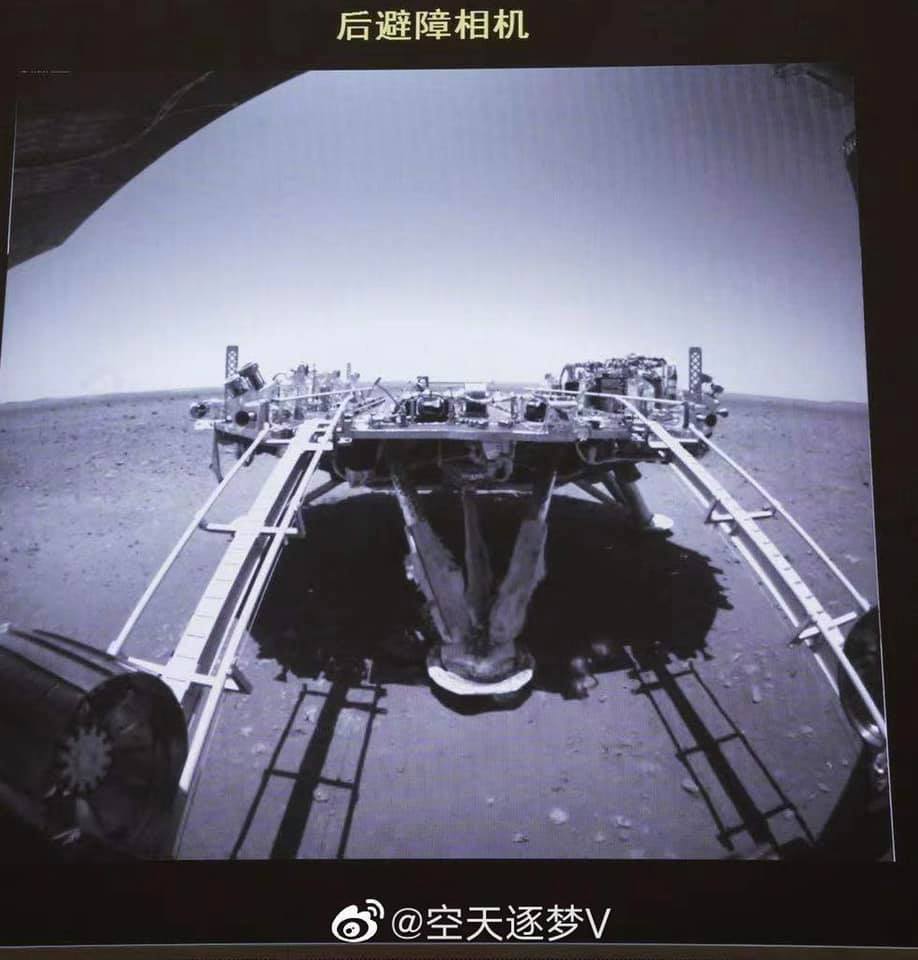
The panoramic view of the landing site is a 360-degree ring shot taken by the navigation terrain camera on the rover’s mast before the rover has left the landing platform, after correction and mosaic stitching. The image shows that the terrain near the landing site is flat, the Martian horizon can be seen in the distance, and the abundance and size of the rocks are consistent with expectations, indicating that the autonomous selection of the landing site and the implementation of hovering obstacle avoidance are effective.


The Mars topography map  is the first topography and geomorphology image map taken by the navigation terrain camera after the rover reaches the surface of Mars. The image shows that the nearby surface is relatively flat, with stones of different sizes distributed, with smooth edges, lighter colours, and semi-buried. There is an annular pit at the far end, and the edges of the annular pit are distributed with darker, angular stones. , And a few sand dunes farther away.
The “Chinese Imprint” map is an image of the landing platform taken when the Mars rover travels to about 6 meters southeast of the landing platform 60° southeast. The image shows that the landing platform is shining, the national flag is bright red and square, and the surface is rich in details.


The picture of the “touring group photo” shows the rover traveling about 10 meters south of the landing platform, releasing the separate camera installed at the bottom of the vehicle, and then retreating to the vicinity of the landing platform. The separate camera took pictures of the movement of the rover and the photo of the rover and the landing platform. The image is transmitted to the rover through wireless signals, and then relayed back to the ground by the rover through the orbiter

images of the mascots of the 2022 Winter Olympics “Bingdundun” and “Xuerongrong” on the landing platform

Mars surface Photography of Zhurong with the landing platform …. The picture of the “tourist group photo” shows the rover traveling about 10 meters south of the landing platform, releasing the separate camera installed at the bottom of the vehicle, and then retreating to the vicinity of the landing platform. The separate camera took pictures of the movement of the rover and the photo of the rover and the landing platform. The image is transmitted to the rover through wireless signals, and then relayed back to the ground by the rover through the orbiter. 

Chinese Imprint” image, the image of the landing platform taken by the Zhurong Mars rover driving to about 6 meters southeast of the landing platform 60° south. The image shows that the landing platform is shining, the national flag is bright red and square, and the surface is rich in details. 

Images and visuals are from Weibo of CNSA – China National Space Administration – CLEP –China Lunar Exploration Program

#CNSA #ChinaNationalSpaceAdministration #國家航天局 |#BeltAndRoadinitiative #June2021 |#火星 # 天問 #天问一号#TianwenOne #MarsMission #Marslander #MarsRover #Tianwen1 probe #祝融号 #ZhuRong Exploring the #RedPlanet #Mars #UtopiaPlanitia released high-resolution images of the landing area exploration mission #Tianwen1

天问一号飞運騎遊達达3亿 …….As of 7th June 2021 Monday CNSA – China National Space Administration – ESA – European Space agency Belt and road initiative mars mission…first Mars exploration mission, Tianwen- Martian Probe One …….”祝融号Zhu Rong” Mars Lander – Mars rover successfully sent back telemetry towards China National Space Administration released a high-resolution image of the landing area of ​China- People’s Republic of China’s first Mars exploration Tianwen-1 mission. The image of the Zhongtianwen-1 landing platform, the “Zhurong” rover and the surrounding area are clearly visible.

The image was taken at 18:00 on June 2 by the high-resolution camera of Tianwen-1 surround. After landing, there are two obvious bright spots in the upper right corner of the image. The upper bright spot is composed of two bright spots. The larger bright spot is the Tianwen-1 landing platform, and the smaller bright spot is the “Zhurong” rover. With the bright spot of the landing platform as the center, the surrounding area is darker. According to analysis, it may be caused by the engine plume during the landing. There are symmetrical jet-like bright stripes in the north-south direction of the landing platform, which may be formed by blowing off fine dust when the landing platform is passivated after landing. The bright spot in the middle of the image is the combination of the back cover and the parachute thrown away during the landing on Mars, in which the back cover is a round bright spot, and the parachute is a long strip of bright spot. In the lower left direction of the image, there is another obvious bright spot, which is a heat-proof outsole thrown away during the landing.

As of today, the “Zhu Rong” rover has been working on the surface of Mars for 24 Martian days, carrying out environmental perception, fire surface movement, and scientific exploration. All scientific load equipment has been activated to obtain scientific data. The orbiter runs in a relay orbit with a period of 8.2 hours and provides relay communication for the scientific exploration of the Mars rover.

国家航天局发布我国首次火星探测任务天问一号着陆区域高分影像图

2021年6月7日,国家航天局发布我国首次火星探测天问一号任务着陆区域高分影像图。图像中天问一号着陆平台、“祝融号”火星车及周边区域情况清晰可见。 

影像图由天问一号环绕器高分辨率相机于6月2日18时拍摄。着陆后图像右上角有两处明显亮斑,靠上的亮斑由两个亮点组成,较大亮点为天问一号着陆平台,较小亮点为“祝融号”火星车。以着陆平台亮点为中心,周围区域颜色较暗,据分析,可能是降落过程中受到发动机羽流影响造成。着陆平台南北方向,存在对称的喷射状亮条纹,可能是着陆后着陆平台钝化时吹除了较细的尘埃形成。图像中部亮斑为降落火星过程中抛离的背罩及降落伞组合体,其中背罩为圆形亮点,降落伞为长条状亮点。图像左下方向,存在另外一处明显的亮斑,为降落过程中抛离的防热大底。 

截至今天,“祝融号”火星车在火星表面已工作24个火星日,开展环境感知、火面移动、科学探测,所有科学载荷设备均已开机工作,获取科学数据。环绕器运行在周期8.2小时的中继轨道,为火星车科学探测提供中继通信。

Images and visuals are from Weibo of CNSA – China National Space Administration – CLEP –China Lunar Exploration Program

#CNSA #ChinaNationalSpaceAdministration #國家航天局 |#BeltAndRoadinitiative #May2021 |#火星 # 天問 #天问一号#TianwenOne #MarsMission #Marslander #MarsRover #Tianwen1 probe finally #祝融号 #ZhuRong Started Rover exploring #Planet #Mars #UtopiaPlanitia #MartainSurface …….

天问一号飞運騎遊達达3亿 …….As of 22nd  May 2021 CNSA – China National Space Administration– ESA – European Space agency Belt and road initiative mars mission…first Mars exploration mission, Tianwen- Martian Probe One …….”祝融号Zhu Rong” Mars Lander – Mars rover successfully sent back telemetry signals and landed on Mars with a complete success in which confirmed it’s now left the Mars Lander Platform National Space Administration that according to the telemetry data, at 10:40 on May 22, the “Zhu Rong” rover safely left the landing platform, reached the surface of Mars, and began to patrol and explore…….

The scientific goal of the Tianwen-1 mission is to study the morphology and geological structure characteristics of Mars, the characteristics of the soil on the surface of Mars and the distribution of water ice, the composition of the surface material on Mars, the ionosphere of Mars and the characteristics of the surface climate and environment, the physical field and internal structure of Mars… also any other scientifically explorations..

Since the probe was launched on July 23, 2020, during the ground-fire transfer flight and the ring-fire orbit operation, the orbiter is equipped with a medium-resolution camera, a high-resolution camera, a mineral spectrum Analyzer, a magnetometer and other 7 scientific instruments. The payload was started to detect and obtain scientific data. During the fire surface work, the rover will carry out environmental perception, fire surface movement and scientific detection in the patrol area as planned. Through the configuration of the terrain camera, multi-spectral camera, subsurface detection radar, surface composition detector and other 6 payloads, the inspection area Carry out detailed detection. At the same time, the orbiter will operate in the relay orbit to provide stable relay communication for the Mars rover patrol and detection, and take into account the development of surround detection.​​​​

At During  7:18 Hong Kong SAR – Beijing Time  on May 15th 2021 , the scientific research team confirmed according to the telemetry signal sent by the “Zhurong” Mars rover that the Tianwen 1 Landing Patrol successfully landed in the pre-selected landing zone in the southern Utopia Plain of Mars, and my country’s first Mars exploration mission landing on Mars was achieved. A complete success…..

At about 1 am, the Tianwen-1 probe was de-orbited in its parked orbit, maneuvering to Mars and entering orbit. At about 4 o’clock, the landing patrol was separated from the orbiter. After about 3 hours of flight, it entered the Martian atmosphere. After about 9 minutes of deceleration, hovering, obstacle avoidance and buffering, it successfully landed on the pre-selected landing zone. About 30 minutes after the two devices are separated; the orbiter will ascend and return to the parking orbit to provide relay communication for the landing patrol device. In the follow-up, the “Zhurong” rover will successively carry out global imaging of the landing site, self-check, leave the landing platform and carry out inspections.

images and visuals are from Weibo

#CNSA #ChinaNationalSpaceAdministration #國家航天局 |#BeltAndRoadinitiative #May2021 |#火星 # 天問 #天问一号#TianwenOne #MarsMission #Marslander #MarsRover #Tianwen1 probe #祝融号 #ZhuRong landing on #Planet #Mars #UtopiaPlanitia with another ultimate #MarsSelfie #Selfies …….

天问一号飞運騎遊達达3亿 …….As of 15th May 2021 CNSA – China National Space Administration – ESA – European Space agency Belt and road initiative mars mission…first Mars exploration mission, Tianwen- Martian Probe One …….”祝融号Zhu Rong” Mars Lander – Mars rover successfully sent back telemetry signals and landed on Mars with a complete success

At 7:18 Hong Kong SAR – Beijing Time  on May 15th 2021 , the scientific research team confirmed according to the telemetry signal sent by the “Zhurong” Mars rover that the Tianwen 1 Landing Patrol successfully landed in the pre-selected landing zone in the southern Utopia Plain of Mars, and my country’s first Mars exploration mission landing on Mars was achieved. A complete success.

At about 1 am, the Tianwen-1 probe was de-orbited in its parked orbit, maneuvering to Mars and entering orbit. At about 4 o’clock, the landing patrol was separated from the orbiter. After about 3 hours of flight, it entered the Martian atmosphere. After about 9 minutes of deceleration, hovering, obstacle avoidance and buffering, it successfully landed on the pre-selected landing zone. About 30 minutes after the two devices are separated; the orbiter will ascend and return to the parking orbit to provide relay communication for the landing patrol device. In the follow-up, the “Zhurong” rover will successively carry out global imaging of the landing site, self-check, leave the landing platform and carry out inspections.

Hello, everyone, I am the “Zhu Rong” rover. Since I landed on Mars on the 15th, my friends on Earth have moved their benches and have been looking forward to seeing the pictures. I also asked anxiously, what am I up to?

No, today I have provided 2 pictures taken after landing, and a video of the separation of the two devices (the surround device and the landing patrol device) was added for a good value, so that everyone can feast their eyes on it.

Why have you waited so long?

As we all know, the farthest distance between Mars and the Earth is about 400 million kilometers, and radio waves travel at the speed of light, and the attenuation of signal energy is proportional to the square of the propagation distance.

I have configured two communication methods, one is to communicate directly with the earth, and the other is to communicate with the earth through the Tianwen-1 orbiter relay. Why do we need relay to communicate directly? That’s because I am about 320 million kilometers away from the earth, which is too far away. Even if I keep shouting with my throat, the earth can only receive very little data, which is too slow and can only send back the most important information. As soon as I landed on the 15th, I directly reported “I have landed and feel good” to my family, and my friends started cheering for me!

After landing, I took some photos with the camera I carried, and I can’t wait to share them with you. However, if it is sent directly back to the earth, even if it is a photo like Figure 1, it would theoretically take more than eight hours. And because of the rotation of Mars, I can communicate directly with the earth for less than half an hour every day, so I abandoned the function of directly transmitting images to the earth. Therefore, I have to wait for the repeater of the surround device. He is big and has a loud voice, and transmits data to the earth much faster than me.

On the 17th, the orbiter entered the relay orbit, and we first established a communication link. Because he orbits Mars for 8.2 hours, we are often blocked by the big guy Mars, so I have to pay close attention to the precious time of relaying, first send back some important data of my own state, and then send it back Image…..

Currently, I am preparing to leave the landing platform. In the follow-up, I will work closely with the orbiter, not only to take pictures of the Martian landscape, but also to use the six scientific payloads I carry to conduct in-depth exploration of Mars and send more scientific data back to the scientists for research. It’s more important than taking pictures……. !!!!!

images and visuals are from Weibo

#CNSA #ChinaNationalSpaceAdministration #國家航天局 |#BeltAndRoadinitiative #March2021 |#火星 # 天問 #天问一号#TianwenOne #MarsMission #Marslander #MarsRover #Tianwen1 probe does more Mars Selfies orbiting #Planet #Mars …….

天问一号飞運騎遊達达3亿 …….As of 26th   March 2021, CNSA – China National Space Administration– ESA – European Space agency Belt and road initiative mars mission…first Mars exploration mission, Tianwen- Martian Probe One ……. With the China National Space Administration released two sideways images of Mars in the southern and northern hemispheres taken by my country’s first Mars exploration mission, Tianwen-1. In the image, Mars has a “crescent” shape with clear surface texture. The Tianwen-1 probe flew to a distance of 11,000 kilometers from Mars and used a medium-resolution camera to take a panoramic view of Mars. At this time, because the probe is in the sky behind the Mars side (to face the sun as the front), two “sideways” images are obtained. At present, the Tianwen-1 probe has been in orbit for a month, and the high-resolution camera, medium-resolution camera, mineral spectrometer, Mars energy particle Analyzer, ion and neutral particle Analyzer, magnetometer and other loads have been turned on one after another. , Carry out exploration of Mars and obtain scientific data.

The southern hemisphere image was taken by the Tianwen-1 medium-resolution camera on March 16, 2021, Beijing time. At this time, the orbital height of the orbiter was about 11,200 kilometers.

The northern hemisphere image was taken by the Tianwen-1 medium-resolution camera on March 18, 2021 Beijing time. At this time, the orbital height of the orbiter was about 11,500 kilometers.

Previously…..  天问一号飞運騎遊達达3亿 …….As of 17th  March 2021, CNSA – China National Space Administration- ESA – European Space agency Belt and road initiative mars mission…first Mars exploration mission, Tianwen- Martian Probe One ……. Tianwen-1 is currently in the mooring orbital phase, and all seven orbiter payloads have been powered on for preliminary scientific exploration, to achieve stable communication between the Earth and Mars, and to provide signal relay services for future patrols landing on Mars. Every two days, it arrives at a near-fire point, only about 280 kilometers away from Mars………

 The medium-resolution camera, high-resolution camera, and spectrometer in the payload will pre-select the topography and landforms of the low-latitude landing area such as the southern Utopia Plain. , Sand and dust weather, etc. to conduct detailed investigations to assess the feasibility of the Martian environment and landing timing……


After 3 months of detailed surveys, the orbiter will undergo a certain orbit adjustment and be separated from the lander/patrol unit. The latter will start an independent Mars landing process of about 7 minutes. Due to the long distance between Mars and the Earth, which leads to a communication delay of tens of minutes, it is impossible for the CNSA crew to control the landing process, and must let the lander complete this “black seven-minute” journey fully autonomously…..

Images and visuals are from Weibo.