CNSA China National Space Admistraton –CMS China Manned Space Shenzhou ten and thirteen Senior Colonel Takionaut王亞平Wang Yaping who switched back to Earth mode after a six months on the Tiangong China Space Station, it is normal for Takionauts to experience lost weight From “weightless mode” back to “Earth mode”, Wang Yaping lost weight. Is it too good to eat in space? This is actually “swelling” at the frequency of weightlessness. “Swelling” is a normal physiological response, and there is no traction in the case of weightlessness. Little popular science knowledge: This is a normal phenomenon of body fluid redistribution, not pathological, and it is fundamentally different from ground edema “Edema is the medical term for swelling caused by fluid trapped in your body’s tissues. Edema happens most often in your feet, ankles and legs, but can affect other parts of your body, such as your face, hands and abdomen.”. Shandong Satellite TV….
On the 9th October 2022 clear sunny day at CNSA –China National Space Administration At Wenchang Space Launch Centre – Hainan Province China, People’s Republic of China….. Space Station Mengtian Experiment Module completes propellant refilling According to the China Manned Space Engineering Office, on October 9th 2022, the space station Mengtian Experiment Module completed propellant refilling as planned. Since the Mengtian experimental module arrived at the Wenchang space launch site, it has completed the final assembly and testing of the technical area, and will carry out a joint inspection of system functions together with the Chang Zheng Long March 5B Yao-4 Carrier Rocket launch vehicle. At present, the facilities and equipment of the Wenchang Space Launch Site are in good condition, and the systems participating in the test are undergoing mission preparations in an orderly manner
The Mengtian experimental cabin is equipped with a cargo airlock and an outboard deployment test platform. In the future, the scientific test equipment that needs to be installed outside the cabin can be transported to the space station through a cargo spacecraft, and then the load will be sent to the outside of the cabin through the cargo airlock, and the robotic arm or astronaut will install it on the platform outside the cabin. Realize the continuous update of the extravehicular test project.
On the 25th October 2022 Morning Hong Kong SAR – Beijing Time the Mengtian capsule and the Chang Zheng – Long March 5b Yao 4 Carrier Rocket combination is being transported vertically….This morning, the Mengtian experimental module and the Long March 5B Yao-4 carrier rocket combination were vertically transported at the Wenchang Space Launch Site in Hainan province. The assembly starts from the vertical test workshop, and under the support of the movable platform, it moves steadily toward the launch tower along the nearly 3-kilometer-long dedicated track. The vertical transfer is expected to last more than 2 hours…. the Mengtian experimental module of the Chinese space station will be launched at the Wenchang space launch site in Hainan this month of October 2022..
According to the China Manned Space Engineering Office, today, the Mengtian Experiment Cabin and the Long March 5B Yao-4 carrier rocket assembly have been transferred to the launch area. In the follow-up, various functional inspections and joint tests before launch will be carried out as planned, and the launch is planned to be carried out in the near future on the October 2022 launch calendar.. in which following to the transfer to the launch complex it’ll In the follow-up, various functional inspections and joint tests before launch will be carried out as planned, and the launch is planned launching At present, the facilities and equipment of the Wenchang Space Launch Site are in good condition, and all participating units are stepping up their mission preparations and go all out to ensure a decisive victory in the construction of the Tiangong China Space station
More than One year ago on 24th November 2020, the Chang Zheng – Long March Five Carrier Rocket Launched away in CNSA – China National Space Administration China Wenchang spaceport launch, Change Five Lunar probe into orbit, opened up towards China – People’s Republic of China’s first celestial bodies sample return trip from Mons Rumker on the Lunar Surface of the moon New research achievements – Chinese scientists reveal the composition of lunar soil minerals and space wind at the landing site of Chang’e 5
This is a schematic diagram of the magma and thermal evolution of the moon in different periods (drawn on October 20, 2022). Published by Xinhua News Agency (Photo courtesy of Institute of Geology and Geophysics, Chinese Academy of Sciences)
Chinese scientists have proposed a new model of lunar thermal evolution based on the study of the Chang’e 5 lunar soil, revealing a mystery that has plagued academia: why the moon still had volcanic activity 2 billion years ago.
According to Chen Yi, a researcher at the Institute of Geology and Geophysics of the Chinese Academy of Sciences, the moon was formed about 4.5 billion years ago, and its mass is only about 1% of that of the earth. For such a small celestial body, in theory, it should cool rapidly and stop volcanoes very early. Activity and become a “dead” planet. The return of Chang’e-5 lunar soil samples has triggered a new round of lunar research upsurge. In October 2021, Chinese scientists published three articles in the journal “Nature”, revealing that lunar volcanic activity could last until 2 billion years ago, refreshing human understanding of the history of lunar magma activity and thermal evolution. According to experts, lunar basalt is a rock formed by the partial melting of the lunar mantle (equivalent to the earth’s mantle) through volcanic eruptions to the lunar surface to cool and crystallize. International scholars have put forward two hypotheses about the partial melting of the continuously cooling lunar mantle: one is that the heat generated by radioactive elements causes the lunar mantle to heat up; the other hypothesis is that if the water content is high, the melting point of the lunar mantle will be lowered. However, Chinese scientists’ research on the Chang’e-5 basalt revealed that the lunar mantle source region is not rich in radioactive heat-generating elements and is very “dry”, ruling out the above two hypotheses. Therefore, why the lunar volcanism has continued for so long has become an unsolved mystery in a new round of lunar research.
Yuan Jiangyan, an engineer at the Scanning Electron Microscopy and Electron Probe Laboratory of the Institute of Geology and Geophysics, Chinese Academy of Sciences, analyzes the composition of the Chang’e-5 lunar soil (photo taken on October 14, 2022). Published by Xinhua News Agency (Photo courtesy of Institute of Geology and Geophysics, Chinese Academy of Sciences)
In response to this problem, Chen Yi led the scientific research team to select 27 representative Chang’e 5 basalt cuttings, and used the newly developed scanning electron microscope energy spectrum quantitative scanning technology to analyze the main components of the whole rock cuttings, combined with a series of The petrological and thermodynamic simulation calculations have successfully recovered the initial magma composition of the Chang’e-5 basalt, and compared it with the initial magma of the Apollo samples to deduce their origin depth and temperature. The study found that the initial magma of the young Chang’e-5 basalt contained more calcium and titanium than the Apollo samples, suggesting that the mantle source region of the Chang’e-5 basalt had more additions of calcium-rich and titanium-rich materials. This part of the material is precisely the product of the late crystallization of the lunar magma ocean, and has the characteristics of being fusible. Its addition will significantly reduce the melting point of the lunar mantle and induce partial melting of the lunar mantle to form young lunar basalts. Further simulation results show that the moon’s interior has experienced continuous cooling for more than a billion years, and the temperature has only dropped by about 80 degrees Celsius.
Chen Yi said that this study shows that although the interior of the moon continues to cool slowly, the fusible components crystallized in the late lunar magma ocean are continuously added to the deep lunar mantle, which not only “supplements calcium and titanium” for the lunar mantle, but also lowers the lunar mantle. the melting point, thereby overcoming the slow cooling lunar interior environment and triggering long-lasting lunar volcanism.
On the week of 16th October 2022CNSA –China National Space Administration China’s Tiangong China Space Station 神舟十四号Shenzhou 14 Takionaut crew of Month 16TH October 2022 the Crew刘洋 LiuYang陈冬 ChenDong蔡旭哲 CaiXuhe …. The furthest audience, Takionauts watch 20th Session of the CPC National Congress on the China space station At 10:00 Morning Hong Kong SAR Beijing Time on October 16, 2022, the 20th National Congress of the Communist Party of China opened. General Secretary Xi Jinping, on behalf of the 19th Central Committee, told the conference make a report. The Shenzhou 14 astronaut crew watched the grand opening of the 20th National Congress of the Communist Party of China at the Chinese Space Station. Under the leadership of the party and the country, China’s manned spaceflight will not forget its original intention, keep its mission in mind, and make unremitting efforts to build a strong country in science and technology and achieve high-level scientific and technological self-reliance and self-reliance! Hello Twenty……
In which during that week celebrating the CPC 20th National Congress…… A set of milestone figures look at the development of China- People’s Republic of China’s aerospace Space exploration industry in ten years 400 kilometers is the distance from the earth to the low-Earth orbit in space. In 10 years, 11 astronauts entered space; 380,000 kilometers is the distance from the earth to the moon, in 10 years , the lunar exploration project has successfully completed the three-step strategy of “circling, falling, and returning”; 400 million kilometers is the distance from the earth to Mars, and the “Zhurong” rover has travelled nearly 2,000 meters… This set of figures records China The journey of spaceflight ……
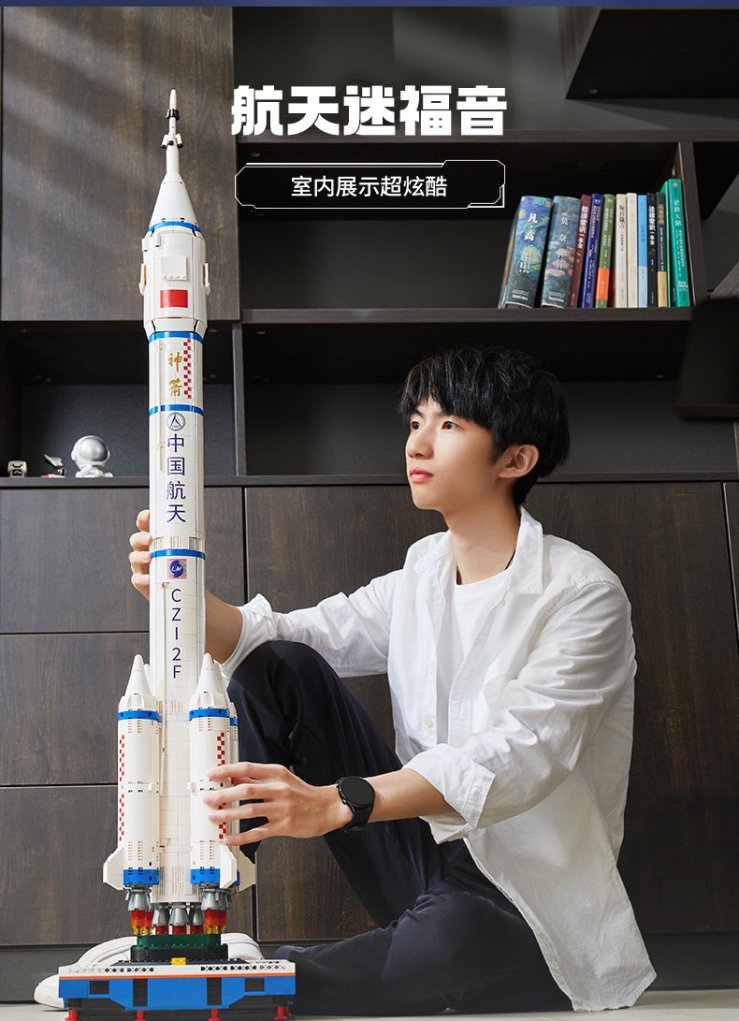
TOP TOY China Building Blocks and China Aerospace Shenzhou Media have jointly created a collection-level building block model of the Long March 2F carrier rocket with a height of 1.2m and a restored internal structure! Chang 2 F is the only manned carrier rocket in my country at present! It was the one that sent my country’s first Takionaut Yang Liwei into space! ….In order to let everyone know more about the structure of the country’s most important Chang Zheng- Carrier Rocket one of many the Long March rockets….
长征二号F Chang Zheng Long March 2F 58.34 meters (code name: CZ-2F, abbreviation: Chang 2F, nickname: Shenjian) is a large two-stage bundled booster launch vehicle developed by the China Academy of Launch Vehicle Technology affiliated to China Aerospace Science and Technology Corporation. , which is mainly used by China to launch Shenzhou manned spacecraft and large target vehicles to low-Earth orbit… it’s chief designer Liu Zhusheng, Zhang Zhi, Yiyi
The Long March 2F is a launch vehicle developed on the basis of the Long March 2E bundled rocket and in accordance with the requirements of launching manned spacecraft with the goal of improving reliability and ensuring safety. The rocket consists of four liquid boosters, a core first stage, a core second stage, a fairing and an escape tower. For the first time, the rocket adopts the “three vertical” test launch mode of vertical assembly, vertical testing and vertical transportation. The Long March-2F rocket has been developed since 1992. It was launched for the first time on November 19, 1999 and successfully sent China’s first experimental spacecraft “Shenzhou-1” into space. Long March 2F has successfully launched Shenzhou series spacecraft for many times, and has become the “star” rocket in China’s Long March series of launch vehicles…..
TOPTOY TOPTOY官方 is Located in Guangdong Province, China, People’s Republic of China, Top Toy hopes to spread the culture of toy combined with the trend to more players who love it, follow it, and believe in it, so that every player can become the “number one player” who is believed in.