#CNSA #ChinaNationalSpaceAdministration #国家航天局 | #BRI #July2023 |#CASC #ChinaAerospaceScienceAndTechnologyCorporation – #长征十号 #MannedCarrierRocket #CarrierRocketFreighter  #3DPrinting #CarrierRocketEngine Testing the #ChangZheng10 #LongMarch10 engine at Thrust of 130 Tons Successfully …..

长征十号 At 22nd  23rd July  2023 Hong Kong SAR- Beijing time , China- People’s Republic of China- CNSA –China National Space Administration   Successfully Carrier Rocket  engine tested for the New Next Generation Chang Zheng – Long March 10 Manned Lunar mission landing Carrier rocket freighter The main engine of China’s manned lunar landing rocket Long March 10 completed another ignition test run yesterday, which verified all the requirements of the rocket mission for the engine, and provided strong support for the solidification of the engine’s technical status, the establishment of product technology baselines, and the improvement of reliability.


The engine used in this test run uses advanced liquid oxygen kerosene as fuel, which is improved and iterated from the high-thrust liquid oxygen kerosene engine used by the new generation of launch vehicles such as the active Long March 5, with a thrust of 130 tons. (The Sixth Academy of Aerospace Science and Technology Group)

Created with GIMP

The reporter learned from China Aerospace Science and Technology Group Co., Ltd. on July 23 that the main engine of my country’s manned moon landing rocket was tested in the Fengzhou Test Area of ​​the Sixth Academy of Aerospace Science and Technology Corporation, and achieved continuous success. This test run verified the engine flight mission profile, and provided strong support for the solidification of the engine technical state, the establishment of the product technical baseline, and the improvement of reliability.

The engine is the power source of the rocket, and its development process is very complicated. Test run is an important link in the engine development process, and there are dozens of types. In layman’s terms, engine test run is the process of igniting the engine and verifying the rationality of its design scheme and process reliability. This is an indispensable and important part of the development and delivery of a type 1 engine. It will run through all stages before and after engine development. Each stage of test run has different meanings, and the ignition time varies from a few seconds to hundreds of seconds.

It is reported that the engine used in this test run uses advanced liquid oxygen kerosene as fuel, which is improved and iterated from the high-thrust liquid oxygen kerosene engine used by the new generation of launch vehicles such as the Long March 5. The thrust reaches 130 tons. The R&D team of the Sixth Academy of Aerospace Science and Technology Group adheres to the concept of digital design, and has successively overcome key technical problems such as engine start-up and shutdown sequence, engine wide-range continuously variable thrust, and engine long life and high reliability.

In addition, the continuous success of the test run has fully verified the reliability of a number of new carrying process technologies. The engine production of this test run adopts the concept of intelligent manufacturing, and actively applies new materials, new processes, and new technologies. The inner wall of the thrust chamber of the core component adopts a new protective coating, key assemblies adopt automatic welding technology, and a large number of components adopt 3D printing technology.

During the preparation of the engine test run, the participants in the research and test conducted tests and verifications on each subsystem of the test through comprehensive means such as digital modelling, simulation calculation, and system debugging. The successful test run shows that the test area has greatly improved the multi-station parallel test run capability and test efficiency by optimizing the workflow.

Images and visuals are from their Respectives CMS China Manned SpaceCNSA-China National Space Administration  the Sixth Academy of Aerospace Science and Technology Group

#CNSA #ChinaNationalSpaceAdministration #国家航天局 |#BRI #July2023 | #天宫 #Tiangong #ChinaSpaceStation #CMS #ChinaMannedSpace #神舟十六号 #Shenzhou16 #桂海潮 #GuiHaichao- Space Science and Application Project Solicitation Officially Starts Application

[China Space Station Space Science and Application Project Solicitation Officially Starts Application 航人贵海涛From天宫发来听听 ]

CNSA –China National Space Administration … The China Space Station space science and application project declaration system was officially opened on the morning of July 20, 2023, Hong Kong SAR- Beijing time.  Taikonaut  桂海潮 Gui Haichao, China’s first payload expert who is performing missions on the space station, sent an invitation to colleagues from the scientific and technological community to do experiments at the “Tiangong”.


In order to promote the overall development of China, People’s Republic of China space science, space application, and space technology, in mid-June, the China Manned Space Engineering Office released the “Guidelines for Space Station Application and Development Engineering Space Science and Application Projects (V1.0)” to openly solicit space science and application projects from the whole society. This solicitation covers four major fields: space science and human body research, microgravity physical science, space astronomy and earth science, and new space technologies and applications. Each field has several themes and directions. The application system will be officially opened at 9 am on July 20 and will end at 16:00 on August 10. For details of the “Project Guide” and the application methods and requirements, please refer to the China Manned Space Engineering Network (www.cmse.gov.cn).

According to reports, the space station, as my country’s “national space laboratory” covering the most complete fields of space science-related disciplines, has the strongest on-orbit support capability, and has unique advantages such as manned participation and uplink and downlink transportation, has deployed world-class scientific research and technology testing facilities on orbit, and has the ability to carry out large-scale space science research. The scientific experiment cabinet, technical test cabinet and support system equipped inside the cabin, and the exposure experiment platform, standard load interface and large load hanging point outside the cabin can support scientific research, technical tests and applications in many fields. In addition, in order to give full play to the comprehensive benefits of engineering services for economic and social development, the China Manned Space Engineering Office will continue to use Tianzhou cargo spacecraft to provide opportunities for the whole society to carry scientific experiments (experiments)…

Images and visuals are from their Respectives CMS China Manned SpaceCNSA-China National Space Administration

#CNSA #ChinaNationalSpaceAdministration #国家航天局 |#BRI #July2023 | #天宫 #Tiangong #ChinaSpaceStation #CMS #ChinaMannedSpace #神舟十六号 #Shenzhou16 #Takionauts first time for successfully performed  #EVA #ExtravehicularActivity #Spacewalk…… #AGallery

On the 30th  May 2023 clear 0931 Hours Morning Hong Kong SAR- Beijing time , the Belt and Road InitiativeCNSA –China National Space Administration from Jiuquan Satellite Launch Center – Inner Mongolia –China – People’s Republic of China deployment of  the Chang Zheng – The Chang Zheng – Long March 2F Yao 16 –Shenzhou 16  carrier rocket.. On which Takionauts Jing Haipeng, Zhu Yangzhu, and Gui Haichao took to the predetermined orbit. The first manned flight mission in the application and development stage was a complete success. The three astronauts will stay in the space station and “join up” with the crew of Shenzhou 15 to carry out on-orbit handover “face-to-face” meeting in which brings the total crew of six with a handover ceremony from Shenzhou 15 towards 16..

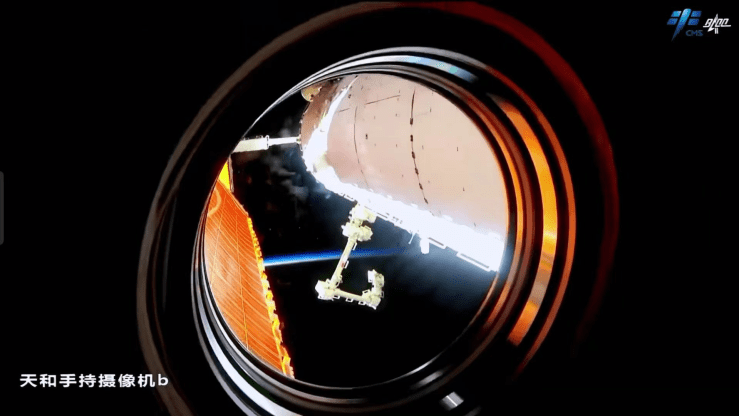
At 21:40 on July 20, 2023, Shenzhou 16 Takionauts Jing Haipeng, Zhu Yangzhu, and Gui Haichao worked closely together to successfully complete all the scheduled tasks for the out-of-vehicle activities. The three astronauts interacted frequently during the whole process of leaving the cabin, and easily completed the work of raising the three panoramic cameras outside the cabin.

​[The crew of Shenzhou 16 Takionauts successfully completed all the scheduled tasks for the out-of-vehicle activities]

According to the CNSA – China National Space Administration – China Manned Space Engineering Office, at 21:40 on July 20, 2023, Hong Kong SAR Beijing time, after about 8 hours of out-of-vehicle activities, Shenzhou 16 Takionauts Jing Haipeng, Zhu Yangzhu, and Gui Haichao worked closely together, and with the support of the space station’s robotic arm, they successfully completed all the scheduled tasks for extravehicular activities. Takionauts Jing Haipeng and Zhu Yangzhu have safely returned to the space station. The experiment cabin and out-of-cabin activities were a complete success.

During the Takionauts ‘ out-of-vehicle activities, the installation and lifting of the in-orbit support for the panoramic camera B of the core module, and the unlocking and lifting of the panoramic cameras A and B of the dream capsule were completed. The whole process went smoothly and successfully. Takionauts Jing Haipeng, who has flown for four times, cooperated with the out-of-vehicle activity from the cabin of Shenzhou-7. With 15 years of perseverance, he realized the dream of “spacewalking”; astronaut Zhu Yangzhu became my country’s first out-of-vehicle activity Active Spaceflight Engineer.

According to the plan, in the future, the Takionauts crew will also carry out a large number of space science experiments (tests), and participate in the completion of multiple application load out-of-cabin installation tasks…

Shenzhou 16 Takionauts Jing Haipeng, Zhu Yangzhu, and Gui Haichao worked closely together, and with the support of the space station’s robotic arm, they successfully completed all the scheduled tasks for the out-of-vehicle activities. Astronauts Jing Haipeng and Zhu Yangzhu have safely returned to the Wentian experimental module of the space station.
During the Takionauts ‘ out-of-vehicle activities, the installation and lifting of the in-orbit support for the panoramic camera B of the core module, and the unlocking and lifting of the panoramic cameras A and B of the dream capsule were completed. The whole process went smoothly and successfully.Takionauts Jing Haipeng, who has flown four times, cooperated from the Shenzhou 7 capsule to this extravehicular activity. With 15 years of perseverance, he realized the dream of “spacewalking”.
According to the plan, in the future, the astronaut crew will also carry out a large number of space science experiments (tests), and participate in the completion of multiple application load out-of-cabin installation tasks…..

The activity area of ​​this extravehicular activity covers multiple quadrants of the third cabin of the space station. The panoramic camera of the Tianhe cabin is different from the two experimental cabins. The panoramic camera of the experimental cabin has been optimized to simplify the lifting steps and save effort; the panoramic camera of the Tianhe cabin needs more steps to complete the lifting (for details, please refer to God The four out-of-vehicle activities of Twelve and God Thirteen, the process of raising the panoramic camera is introduced).

The long path between the operating areas and many quadrants involved also means that the Takionauts need to spend more time for transfer, which may be one of the reasons why the time spent on this extravehicular activity is close to the critical value of the extravehicular suit.

Images and visuals are from their Respectives CMS China Manned SpaceCNSA-China National Space Administration

#CNSA #ChinaNationalSpaceAdministration #国家航天局 |#BRI #July2023 | #天宫 #Tiangong #ChinaSpaceStation #神舟十六号 #Shenzhou16 #Takionaut #景海鹏 #JingHaPeng will rise to the 11th place in total flight time! Preparing to leave the cabin for the first time…

On the 30th  May 2023 clear 0931 Hours Morning Hong Kong SAR- Beijing time , the Belt and Road InitiativeCNSA –China National Space Administration from Jiuquan Satellite Launch Center – Inner Mongolia –China – People’s Republic of China deployment of  the Chang Zheng – The Chang Zheng – Long March 2F Yao 16 –Shenzhou 16  carrier rocket.. On which Takionauts Jing Haipeng, Zhu Yangzhu, and Gui Haichao took to the predetermined orbit. The first manned flight mission in the application and development stage was a complete success. The three astronauts will stay in the space station and “join up” with the crew of Shenzhou 15 to carry out on-orbit handover “face-to-face” meeting in which brings the total crew of six with a handover ceremony from Shenzhou 15 towards 16..

As of 09:31 on July 16, 2023, “Shenzhou 16” Takionauts Jing Haipeng, Zhu Yangzhu, and Gui Haichao have been flying for 47 days. The total flight time ranking is undergoing a new change.

Takionaut Jing Haipeng has carried out four manned missions including “Shenzhen 7”, “Shenzhen 9”, “Shenzhen 11” and “Shenzhen 16”. long Takionaut. The “Shenzhen VII” spacecraft ignited and took off at 21:10 on September 25, 2008, and landed at 17:37 on September 28. The flight time of the astronauts Zhai Zhigang, Liu Boming and Jing Haipeng was 2 days, 20 hours and 27 minutes. From 18:37 on June 16, 2012 to 10:05 on June 29, astronauts Jing Haipeng, Liu Wang, and Liu Yang carried out the “Shenzhen Nine” mission in 12 days, 15 hours and 28 minutes. From 07:30, October 17, 2016 to 13:59, November 18, 2016, Takionauts Jing Haipeng and Chen Dong partnered to carry out the “God 11” mission, with a flight time of 32 days, 6 hours and 29 minutes. Before the “God 16” mission, the total flight time of Jing Haipeng’s first three missions was 47 days, 18 hours and 24 minutes.

As of 16:07 on July 16, 2023, Jing Haipeng’s total flight time will reach 95 days and 1 hour, surpassing Liu Boming and ranking 11th among Chinese Takionauts. Liu Boming has carried out two missions including “Shenzhen 7” and “Shenzhen 12”. The total flight time was 95 days and 35 minutes.

During the period when the “Shenzhen XVI” crew was in orbit, large-scale space science experiments were carried out on a rolling basis, and the work of space application systems such as the out-of-cabin installation of the space radiation biology exposure experiment device in the “Mengtian” experimental cabin has been completed as planned. At the same time, the “Shenzhen XVI” crew is preparing for the first out of the cabin, which will be the first out of the third batch of astronauts, who will perform it? What extravehicular work will be done?

Images and visuals are from their Respectives CMS China Manned SpaceCNSA-China National Space Administration

#MadeInChina #中國製造|#COMAC #C919 #July2023 | # 中國東方航空公司 #ChinaEasternAirlines officially received the second domestically-made Adorable cute  C919 – first aircraft to fly the #上海 #Shanghai- #成都 #Chengdu Express Line….

On July 16, 中國東方航空公司China Eastern Airlines officially received the second domestically produced C919 large passenger aircraft in Shanghai. Afterwards, the plane was transferred from Shanghai Pudong International Airport to Shanghai Hongqiao International Airport, officially “listed” in the fleet of China Eastern Airlines. The second C919 will be “partnered” with the first aircraft, and will first be put into the “Shanghai Hongqiao-Chengdu Tianfu” air express line of China Eastern Airlines, and more routes will be gradually expanded in the future. In addition, China Eastern Airlines has “introduced new” meals on C919 flights, adding Shanghai-style aviation meals such as Benbang smoked fish and Benbang butterfly cakes to enhance passengers’ flight experience.

C919 aircraft, the full name of  COMAC C919, is a large jet civil aircraft independently developed by China in accordance with international civil aviation regulations and has independent intellectual property rights. The project establishment demonstration, feasibility demonstration, and pre-development stage work have been completed, and the project has entered the project development stage. On November 2, 2015, the final assembly was completed. The performance is equivalent to the international new generation mainstream single-aisle airliner. It successfully made its maiden flight on May 5, 2017……

The second: China Eastern Airlines will receive the second domestic large aircraft C919 in mid-June 2023 at the earliest. 

On July 14, 2023, the East China Regional Administration of Civil Aviation issued the nationality registration certificate, airworthiness certificate, and radio station license of the second C919 aircraft to China Eastern Airlines, marking that the aircraft has qualified for commercial operation and is airworthy in compliance with civil aviation regulations. Require. According to the plan of China Eastern Airlines, the second C919 will be “partnered” with the first aircraft, and will first be put into the “Shanghai Hongqiao-Chengdu Tianfu” air express line of China Eastern Airlines, and more routes will be gradually expanded in the future. On July 16, China Eastern Airlines officially received the second domestically-made C919 large passenger aircraft in Shanghai. The C919 large passenger aircraft received by China Eastern Airlines this time is the second of the first five C919 passenger aircraft purchased by China Eastern Airlines, and the cabin layout is consistent with that of the first aircraft.

The second domestically-made C919 was “listed” and partnered with the first aircraft to fly the Shanghai-Chengdu Express Line

On the morning of July 16, China Eastern Airlines officially received the second domestically-made C919 large passenger aircraft in Shanghai. Afterwards, the plane was transferred from Shanghai Pudong International Airport to Shanghai Hongqiao International Airport, officially “listed” in the fleet of China Eastern Airlines. The arrival of a new C919 aircraft indicates that China Eastern Airlines’ commercial operation of the C919 large passenger aircraft is speeding up.

The C919 large passenger aircraft received by China Eastern Airlines this time is the second of the first five C919 passenger aircraft purchased by China Eastern Airlines, and the cabin layout is consistent with that of the first aircraft. On July 14, the East China Regional Administration of Civil Aviation issued the nationality registration certificate, airworthiness certificate, and radio station license of the second C919 aircraft to China Eastern Airlines, marking that the aircraft has qualified for commercial operation and meets the airworthiness requirements of civil aviation regulations. According to the plan of China Eastern Airlines, the second C919 will be “partnered” with the first aircraft, and will first be put into the “Shanghai Hongqiao-Chengdu Tianfu” air express line of China Eastern Airlines, and more routes will be gradually expanded in the future.

As the world’s first user of the domestically produced C919 large passenger aircraft, China Eastern Airlines officially received the world’s first C919 delivery aircraft on December 9, 2022; “The round-trip flight, after which this C919 served passengers on the Shanghai-Chengdu Express Line. As of July 12, the first C919 had operated a total of 87 commercial flights, including 2 Beijing-Shanghai flights and 85 Shanghai-Chengdu flights, with an average passenger load factor of nearly 80%, serving a total of 11,095 passengers, and a total of 250.10 hours of commercial operation.

After the first C919 delivery aircraft was put into operation, due to reasons such as local training and planned maintenance, it may not be able to make commercial flights every day and carry passengers who want to visit. After the second C919 is unveiled on the Shanghai-Chengdu Express Line, passengers will have more choices to experience China-made large aircraft on China Eastern Airlines flights.

From the beginning of the commercial operation of C919, China Eastern Airlines has deeply integrated the “Four Precisions” service concept of “accuracy, delicacy, delicacy-wonderful” in various service links: providing “Nine” series themed meals for C919 aircraft, customizing commemorative paper cups, cleaning bag, and is equipped with an exclusive aviation safety instruction video with national characteristics. Starting from July 1, China Eastern Airlines will “update” the meals on C919 flights, adding Shanghai-style aviation meals such as Benbang smoked fish and Benbang butterfly cakes to enhance passengers’ flight experience. Since the first delivery of the C919 aircraft was put into commercial operation, China Eastern Airlines has carefully organized the training, training of large aircraft talent teams and commercial operations. At present, China Eastern Airlines has 8 captains with qualifications for C919 models, 46 cabin crew members, and maintenance personnel. There are 16 personnel, and a logistics support team of more than 100 people has been established. There are also 21 pilots and a group of support personnel who are receiving qualification training, and continue to strengthen the talent team for the safe operation of C919 and passenger service.

Images and visuals are from their respectives.