#MadeInChina #中國製造 |#LandSpace #蓝箭航天 #December2022 #March2023 | #BlueArrowAerospace #Suzaku2 #CarrierRocket #Suzaku2 Yao 1 Rocket launched  Test Launched 14th December 2022 aborted mid-flight testing Reviewing  with lessons learnt for a future success..

LandSpace 蓝箭航天 One of sixty Chinese private space Carrier Rocket Companies in China-People’s Republic of China…   On the occasion of the centenary of the founding of the party, the first phase of the Jiaxing LandSpace Blue Arrow Aerospace Center,   located in VIC International Plaza, No. 13 Ronghua South Road, Yizhuang Economic and Technological Development Zone, Beijing China – People’s Republic of China…. The company located in a gathering place for the aerospace industry chain laid out in Zhejiang, was completed and will soon be put into use. Established mass production capacity for medium and large rockets, and completed the first phase of Jiaxing Blue Arrow Space Center…. Blue Arrow Aerospace Technology Co., Ltd. (Blue Arrow Aerospace) is a leading domestic commercial company for the creation and operation of aerospace transportation systems, established in June 2015, a national high-tech enterprise, Member of the International Astronautical Federation (IAF). Guided by the national strategy and guided by market demand, Blue Arrow Aerospace is committed to developing a series of medium and large launch vehicles with liquid oxygen methane as propellant, providing cost-effective and highly reliable launch services for the global market.

Suzaku-2 Yao-1 carrier rocket flight failure passed the zero-reset review On March 18, 2023, Blue Arrow Aerospace Science and Technology Co., Ltd. organized a zero-reset review meeting for the abnormal shutdown failure of the second-stage aircraft of the Suzaku-2 Yao-1 carrier rocket. After deliberation, the evaluation expert group unanimously believed that the abnormal shutdown fault problem of the second-stage engine of the Suzaku-2 remote-1 launch vehicle was accurately located and the mechanism was clear. The fault recurred in the ground test of the engine.


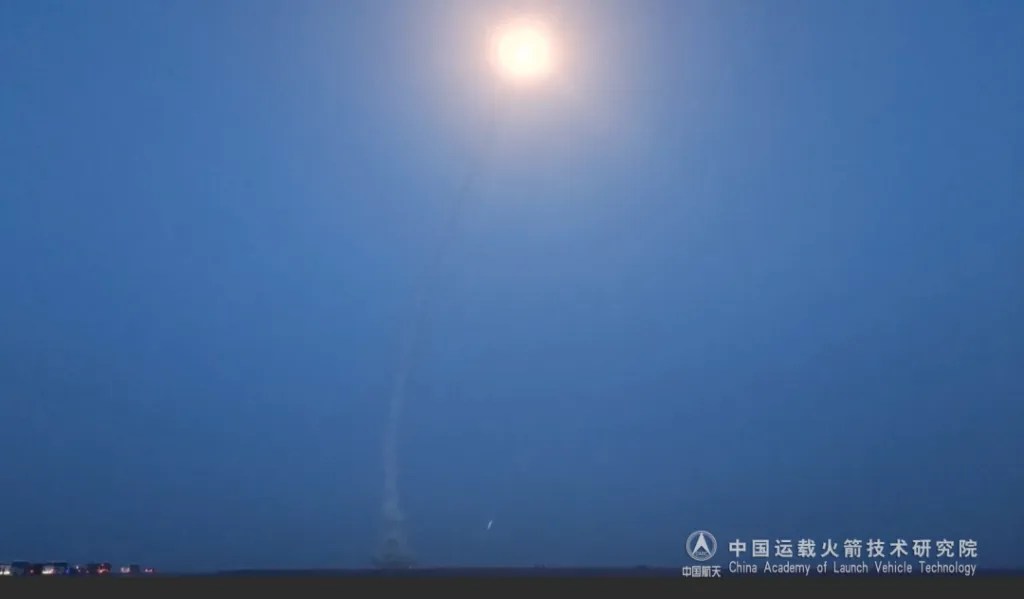
The Suzaku-2 Yao-1 carrier rocket ignited and took off at the Jiuquan Satellite Launch Center in China at 16:30 on December 14, 2022. The first-stage flight, first- and second-stage separation, second-stage ignition, and fairing separation were all normal. After the second-stage host was shut down The tour plane shut down abnormally, and the launch mission failed. After the failure of the mission, Blue Arrow Aerospace established a zero-return working group to organize failure analysis, locate the cause of the failure, and analyze the failure mode and mechanism. Through the detailed analysis of the flight telemetry data, a comprehensive simulation analysis calculation and a series of test verification and hot test work were planned to find out the cause and mechanism of the failure. The abnormal shutdown fault of the second-level swimming machine is located in the rigidity mismatch between the oxygen delivery pipe of the swimming machine and the low-pressure casing of the oxygen pump, and the low-pressure casing has insufficient strength margin. The game machine shuts down abnormally. In view of the cause and mechanism of the failure, Blue Arrow Aerospace has adopted a number of improvement measures to improve the structural safety factor and reduce the impact of water hammer. The improvement measures have been verified by simulation analysis and calculation and ground test vehicle assessment, and can meet the flight requirements.

We would like to thank the review expert group for their guidance and assistance to Blue Arrow Aerospace during the zeroing process, the customers for their trust and understanding, and all shareholders for their long-term companionship and support. In the follow-up, the company will fully launch the final assembly and general inspection of the Suzaku No. 2 launch vehicle, quickly implement fault improvement measures, continuously enhance the team’s quality awareness, awareness of urgency, and responsibility awareness, and strictly organize the go-around work of Suzaku No. 2. Ensuring the continued success of subsequent launch missions……

Images and visuals are from their Respectives. LandSpace Blue Arrow Aerospace Center,   

#CNSA #ChinaNationalSpaceAdministration #国家航天局 |#BRI  #March2023 |#西昌衛星發射中心 #XichangSatelliteLaunchCenter – Successfully launching the advance iconic #ChangZheng3B #LongMarch3B Y90  #CarrierRocket deploying advance Gaofen 13-02  #EarthSciences #RemoteSensing #EnivormentalSatellite  #Satellite The third launch within a week!

On the 17th March  2023  in  CNSA _China National Space Administration -China – People’s Republic of China At 1633 hours Hong Kong –Beijing Time China- People’s Republic of China launch the Chang Zheng – Long march 3B  Carrier Rocket launching from station form Xichang Satellite Launch Center Sichuan Province…..Deploying the Gaofen 13-02  Earth Sciences Environmental satellite….

Long March 3B successfully launched the Gaofen 13-02 satellite successfully launch the Gaofen 13-02 satellite into space, and the satellite went smoothly Entering the predetermined orbit, the launch mission was a complete success. The satellite is mainly used in the fields of land census, crop yield estimation, environmental governance, weather early warning and forecasting, and comprehensive disaster prevention and mitigation. This mission is the 468th flight of the Long March series of launch vehicles!

The 02 satellite is a high-orbit optical remote sensing satellite, which is mainly used in emergency disaster reduction, land census, ocean observation, environmental governance, meteorological observation and other fields, and can provide information services for national economic construction.

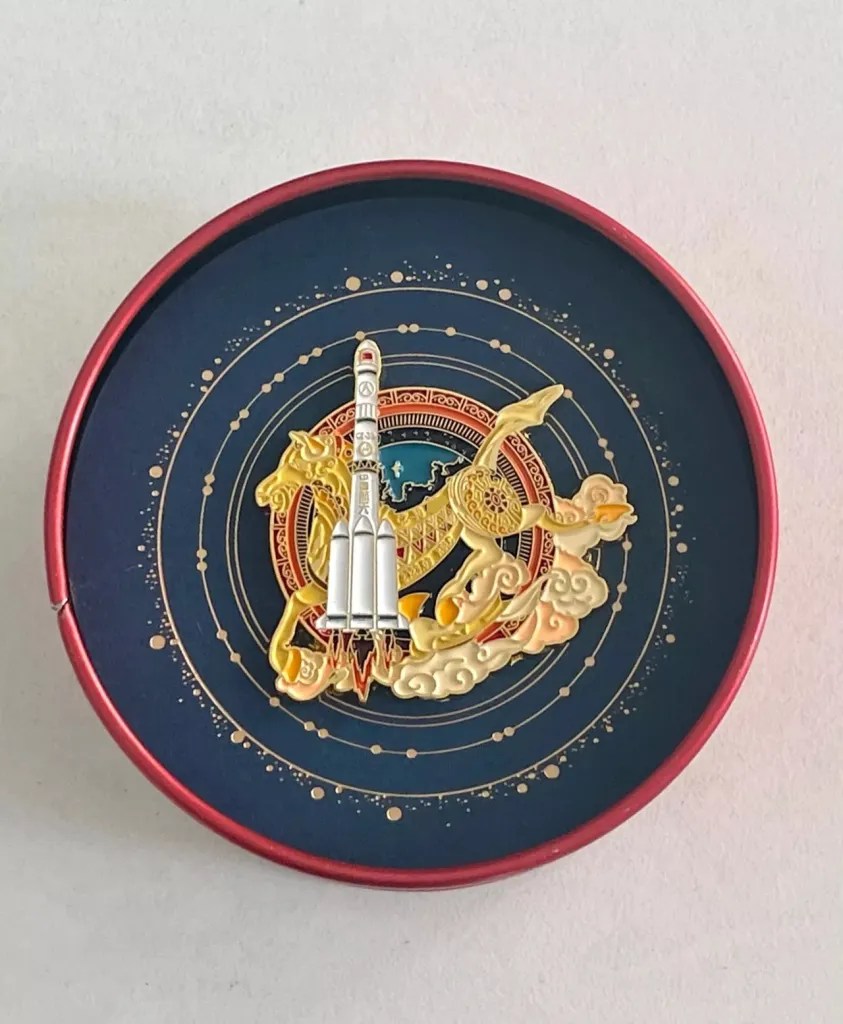
Chang Zheng – Long march 3B  Carrier Rocket yao 90 launches high score 13th No. 02 satellite mission badge: This badge is inspired by the historical allusion of a horse stepping on a flying swallow. Ma Ta Feiyan is a magical and rare treasure in the history of ancient sculpture art in my country. It is a landmark building in Xichang. As an emblem element, it implies the rapid development of China’s aerospace industry and the tenacious and indomitable spirit of astronauts.
The main body of the emblem is the Chang Zheng – Long march rocket, the earth is in the center of the picture, auspicious clouds surround the main body, and the stars mark the launch site, which means that one arrow and one star will be launched from here, and go forward bravely, just like astronauts bravely climbing the peak of science and technology, to write China’s aerospace industry The new chapter dares to overcome all difficulties and obstacles…..

Images and visuals are from their Respectives CMS China Manned SpaceCNSA-China National Space Administration

#CNSA #ChinaNationalSpaceAdministration #國家航天局|#BRI #March2023 |#ChineseAcademyofSciences #NationalAstronomicalObservatory #EinsteinProbe X-ray astronomical #Satellite – pinpoint the source of gravitational waves discovering the mysterious universe planned launch this year.  

國家航天局CNSA –China National Space Administration  China, People’s Republic of China plans to launch the Einstein probe at the end of this year China plans to launch a new X-ray astronomical satellite, the Einstein probe, at the end of 2023. It is expected to capture the first ray of light from a supernova explosion and help search and precise positioning the source of gravitational waves, discovering more distant, fainter celestial objects and fleeting mysterious phenomena in the universe. The satellite project has entered the final stage of positive development.

The X-ray Imaging Laboratory of the National Astronomical Observatory of the Chinese Academy of Sciences has been developing lobster eye X-ray imaging technology since 2010. After years of key technology research, it finally made a breakthrough, fully mastered the technology, and has completely independent intellectual property rights. The team carried out the test and verification of this technology on the space new technology test satellite launched in July 2022, and obtained and publicly released the wide-field X-ray focused imaging sky map for the first time in the world.

Yuan Weimin, the chief scientist of the Einstein Probe Satellite and a researcher at the National Astronomical Observatories of the Chinese Academy of Sciences, introduced at the recently held 35th National Space Exploration Symposium that the satellite project has entered the final development stage.

Inspired by the peculiar focusing imaging principle of lobster eyes, scientists have designed a special new type of X-ray telescope, which has a large observation field of view and higher detection sensitivity.

“That is to say, this kind of telescope can see the darker and farther universe while seeing a wide range. It is thanks to the lobster eye telescope technology that the Einstein Probe satellite can see the currently known universe.” There are very few soft X-ray bands for large-field, high-sensitivity, and fast time-domain survey monitoring.” Yuan Weimin said.

The X-ray Imaging Laboratory of the National Astronomical Observatory of the Chinese Academy of Sciences has been developing lobster eye X-ray imaging technology since 2010. After years of key technology research, it finally made a breakthrough, fully mastered the technology, and has completely independent intellectual property rights. The team carried out the test and verification of this technology on the space new technology test satellite launched in July 2022, and obtained and publicly released the wide-field X-ray focused imaging sky map for the first time in the world

Images and visuals are from their Respectives CMS China Manned SpaceCNSA-China National Space Administration

#MadeInChina #中國製造 #中國 | #北京 #Beijing#北京天兵科技有限公司 #天兵科技 #TianbingTechnology #SpacePioneer #March2023 |#CarrierRocketShopping #TianLongTwo #CarrierRocket preparing first flight March launch of two #RemoteSensing One Cute #Jinta #LoveSpaceScience #Satellite …. .

Founded in 2015 located in Beijing ….天兵科技 – 北京天兵科技有限公司Tianbing Technology is an Aerospace propulsion system supplier and spacecraft provider One of Sixty Plus Chinese carrier Rocket companies in China, People’s Republic of China ……. Tianbing Technology is an advanced aerospace propulsion system supplier and aerospace vehicle provider. Tianbing Technology independently develops the next-generation ambient temperature green HCP liquid propellant and minimalist aerospace propulsion system. As an upgraded product of traditional chemical propulsion system, it can meet cost-effective aerospace. Advance system supporting needs. The next-generation green HCP aerospace propulsion system, first tested by Tianbing Technology, can be used in the small-vehicle main power and launch vehicle upper-level propulsion system.

Space Pioneer – Tianlong-2’s first Carrier rocket launches two remote sensing satellites at the end of March with “one arrow and two satellites …..  Tianbing Technology Company’s Tianlong-2 is planning to launch the “Golden Tower” at the LC-1XX field of Jiuquan Satellite Launch Center at the end of March. …. Remote sensing cube star.

“Jinta” (“Love Space Science”) is a remote sensing satellite developed by Hunan Hangsheng Satellite Technology Co., Ltd. The cube star is about 40 centimetres high and weighs about 8 kilograms. It is mainly used to verify the key points of the spacecraft. Technology, and at the same time cooperate with popular science education to show the charm of spaceflight. The star is equipped with a star camera, which can provide a large amount of cosmic image materials for the science education of Chinese teenagers and send them back to the ground in real time. In addition, it will conduct the first space test of the feasibility of radio charging in the country.
It is understood that the Tianlong-2 carrier rocket that undertakes the delivery mission has arrived at the Jiuquan Satellite Launch Center, and will complete the flight test mission by the end of March, transporting two remote sensing satellites into a sun-synchronous orbit at an altitude of 500 kilometers, which will open up China’s commercial aerospace liquid delivery A new era of rocketry…

Images and visuals are from their respectives also天兵科技北京天兵科技有限公司Tianbing Technology- Space Pioneer..

#CNSA #ChinaNationalSpaceAdministration #国家航天局 |#BRI #March2023 |  #JiuquanSatelliteLaunchCenter launched on the International Icon #ChangZheng11  #LongMarch11  #CarrierRocket successfully launch #TestSatellite  #Satellites….

On the 15th  March 2023 clear 1941 Hours Hong Kong SAR- Beijing time , the Belt and Road Initiative CNSA –China National Space Administration  launching from Jiuquan Satellite Launch Center – Inner Mongolia –China – People’s Republic of China deployed launched the Chang Zheng – Long March 11 carrier rocket ….  The Chang Zheng – Long March 11 carrier rocket..

This is the first flight of the Chang Zheng Long March 11 Carrier rocket, known as the “fast and sharp arrow”, in 2023. It is also the 16 consecutive successful launches of this type of rocket since its first flight.

Chang Zheng -Long March 11 carrier rocket at the Jiuquan Satellite Launch Center to successfully launch the test satellite 19 into space, and the satellite successfully entered the predetermined orbit, the launch mission was a complete success. The satellite is mainly used in the fields of national land census, urban planning and disaster prevention and mitigation. This mission is the 467th flight of the Long March series of launch vehicles. ​​​….​

Images and visuals are from their Respectives CMS China Manned SpaceCNSA-China National Space Administration