On the week of coming on the 22nd January 2023 CMS China Manned SpaceCNSA-China National Space Administration the crew of the Shenzhou 15 of the Tiangong-China Space Station celebrating the Festive Chinese Lunar New Year in writing New Year good luck blessings in Chinese Traditional Couplets in Traditional Chinese calligraphy wondering what the crew of the Shenzhou 15….?
On the week of 30th January 2023 the Dream Crew Shenzhou 15 in which there is many surprise elements in this video. There is a relatively complete process of passing through the cabin, and for the first time, you can enjoy the forward docking Shenzhou spacecraft up close from the front porthole of the Mengtian experimental cabin! Review of the wonderful moments of the Spring Festival 神十五航人Vlog…..
During the Spring Festival, the Yuanmeng crew decorated the space station with joy, and spent this unforgettable “Space Spring Festival” with all Chinese people 400 kilometers away. Let’s take a look at the Takionauts eating New Year’s Eve dinner, watching the Spring Festival Gala, writing calligraphy and other Spring Festival activities, and even the astronauts will take you to experience the first-person experience of the space station through the cabin, come and see ! 开工大吉# (Music/”New Year”-EM-MUMU)
The National Museum of China中国国家博物馆; flanks the eastern side of Tiananmen Square in Beijing, China. The museum’s mission is to educate about the arts and history of China. It is directed by the Ministry of Culture and Tourism of the People’s Republic of China. 16 E Chang’an St, 前门 Dongcheng, China, 100051…. China, People’s Republic of China.
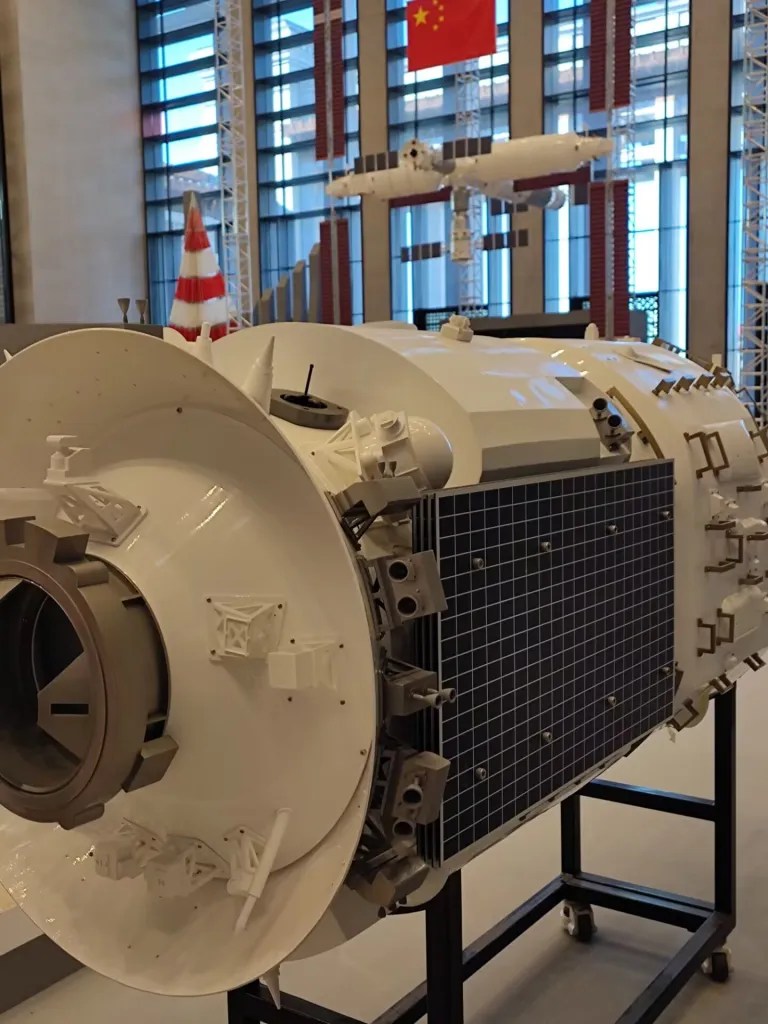
On the week of 20th January 2023 just before the Chinese Lunar New Year eve of the Year of the Rabbit The hall of the National Museum has recently exhibited a lot of aerospace exhibits. In addition to the Chang Zheng Long March 10 and the Sky Survey Telescope, there are also models of the Chinese space station assembly, the return capsule of the Shenzhou spacecraft and the actual parachute, the escape tower of the Chang-2 F, the Chang-2 F/Chang 7/Chang 5 B model, YF-20/100/77 engine, etc. These exhibits may not be permanent. Friends who are interested in Beijing or other places must seize the opportunity!
The China Space Station Sky Survey Space Telescope (CSST) model exhibited by the National Museum is quite high-precision, and its overall structural layout is clear at a glance. It is mainly composed of two parts: the optical cabin and the service cabin. The overall outer diameter is about 4.2 meters, and the diameter of the main mirror is about 2 meters. . In terms of the external structure of the cabin, it can be seen that there are a pair of solar wings on both sides of the service cabin, 5 control moment gyroscopes, a relay communication antenna, a mechanical arm docking port on the top, and a space station docking port and related equipment for rendezvous and docking at the rear; the optical cabin It is covered with handles for astronauts to go out of the cabin, and 4 star sensors.
In addition, CSST has a total of 3 types of 48 attitude control engines installed, including 16 forward 150N, reverse 4 150N, rotation 12 10N, pitch 8 25N, yaw 8 25N, visual judgment is not guaranteed to be completely correct
Images and visuals are of their Respectives – Photographed by 深蓝之日DBS
On the 22nd December 2022 Thursday is the冬至 Winter Solstice Hour Hong Kong SAR – Beijing time CNSA –China National Space Administration this is the exclusive beauty from Wenchang and Jiuquan] Today is the winter solstice, and we will return in spring. One south and one north, one side is the coconut wind and warm sun, lush and green, and the other side is the desert Gobi, with cold wind. Today, let us enjoy the winter beauty of Wenchang Space Launch Site and Jiuquan Satellite Launch Center.
On the 22nd December 2022 Thursday is the冬至 Winter Solstice in which is the winter solstice, also called the hibernal solstice, occurs when either of Earth’s poles reaches its maximum tilt away from the Sun. This happens twice yearly, once in each hemisphere in which marks the Dongzhi Festival or Winter Solstice Festival is one of the most important Chinese festivals celebrated by the China, Mainland Chinese, Macau SAR- Hong Kong SAR Taiwan province China, People’s Republic of China…… Dongzhi (冬至) literally means ‘Winter’s Arrival’. It is one of the 24 solar terms of China’s traditional solar calendar. It has long been celebrated on (China’s) Winter Solstice when the night is longest, and the day is shortest in the Northern Hemisphere. Dongzhi became an imperially recognized traditional festival during the Han Dynasty era (206 BC – 220 AD).
Chinese people celebrate Dongzhi Festival in many ways. The most popular ones are worshipping heaven and ancestors, saying the Nines of Winter, making rice wine, and eating dumplings and ginger rice.
文昌航天發射場Wenchang Spacecraft launch Center… China Wenchang Space Launch Site, located in Longlou Town, Wenchang City, Hainan Province China, People’s Republic of China, is affiliated to the Xichang Satellite Launch Center . It is China’s first open coastal space launch base and one of the few low-latitude launch sites in the world. The launch site can launch Long March 5 series rockets , Long March 7 carrier rockets , and Long March 8 carrier rockets , and is mainly responsible for launching satellites in geosynchronous orbits , large-mass polar orbit satellites, large-tonnage space stations, and deep space exploration satellites. .
As a low-latitude coastal launch base, the Wenchang Space Launch Site can not only meet the new needs of China’s aerospace development, but also greatly reduce rocket fuel consumption by virtue of the large linear velocity close to the equator and the centrifugal phenomenon caused by inertia (the same model The rocket carrying capacity can be increased by 10%), and it can also solve the problem of giant rocket transportation by sea and improve the safety of wreckage falling. The launch site is completely open to the outside world. Launch capability is now available. [1] China’s Wenchang Space Launch Site started construction in September 2009. It consists of five major systems including test launch, measurement control, communication, meteorology, and technical service support. It mainly undertakes geosynchronous orbit satellites, large-mass polar-orbit satellites, and large-tonnage space stations. , cargo spacecraft, deep space probes and other launch missions
酒泉卫星发射中Jiuquan Satellite Launch Center “Dongfeng Aerospace City” Inner Mongolia, China People’s Republic of China, is the 20th base of the former General Armament Department. It was established on October 20, 1958. It is the earliest and largest comprehensive complex in China. The Missile and Satellite Launch Center is the main base for testing and launching the Long March series of launch vehicles, various experimental satellites in low and medium orbits, application satellites, manned spacecraft and rocket missiles. It is one of the launch and test bases of China’s scientific satellites, technology test satellites and launch vehicles. It belongs to the former General Armament Department of the Chinese People’s Liberation Army and now belongs to the Strategic Support Force.
On January 8, 2016, Jiuquan Satellite Launch Center was awarded the title of the first batch of “National Research and Tourism Demonstration Base” by the National Tourism Administration. On March 28, 2017, it was selected by the National Tourism Administration and the Chinese Academy of Sciences as “the first batch of China’s top ten science and technology tourism bases”. On January 27, 2018, Jiuquan Satellite Launch Center was selected into the “China Industrial Heritage Protection List “. The center has carried out 110 space launch missions and successfully sent 145 satellites, 11 spacecraft and 11 Takionauts into space.
On the week of 20th December 2022CNSA –China National Space Administration–CASC of China Aerospace Science and Technology Corporation revision of what’s to come for China- People’s Republic of China’s Space Exploration from a series of New Next Generation of Chang Zheng Long March Carrier Rockets towards Tiangong-China Space Station, CLEP-China Lunar Exploration Programme, within that Programme that includes the Mars Programme return sample towards a series of Numerous Chang’e Lunar missions towards with Deep Space exploration with visitation of Jupiter, Uranus….
Manned moon landing, flight-based transportation, space “4S” shop, sound-finding plan… China is doing this to build a space power!……Wu Yansheng, chairman of China Aerospace Science and Technology Corporation, introduced my country’s heavy-duty launch vehicle, flight-based space transportation system, national space infrastructure system, the fourth phase of lunar exploration, manned moon landing, Shenzhen The latest progress and development plans in space exploration and other aspects. Wu Yansheng, Chairman of China Aerospace Science and Technology Corporation In the “New Space Journey – “China Space Station Waiting for You to Travel” Series of Ideological and Political Courses, the future plans of China’s spaceflight are introduced – a new generation of manned launch vehicles, heavy launch vehicles, flight-based space transportation systems, and national space infrastructure The latest progress and development plans of the system, the fourth phase of lunar exploration, manned lunar landing, and deep space exploration.
(1) China, People’s Republic of China is developing a new generation of manned carrier rockets, which mainly launch a new generation of manned spacecraft in my country to meet the long-term strategic needs of China’s manned spaceflight such as manned lunar exploration. Its low-earth orbit carrying capacity will reach 70 tons, and the earth-moon the carrying capacity of the transfer orbit will reach 25 tons, and the first flight is expected to be completed around 2027.
(2) The Long March 9, a heavy-duty carrier rocket being developed in my country, has a body diameter of 10m and a height of about 110m. After successful development, the carrying capacity of the low-orbit will reach 150 tons, and the carrying capacity of the earth-moon transfer orbit will reach more than 50 tons. Strive to complete the first flight around 2030.
(3) China, People’s Republic of China ‘s manned spaceflight will also land on the moon and go to deep space. At present, a new generation of manned spacecraft and lunar lander is being developed. The new generation of manned spacecraft can send 3 astronauts into orbit around the moon and return to Earth. The lunar lander can carry 2 astronauts to land on the moon and carry out scientific exploration. Activity.
(4) We will implement the fourth phase of the lunar exploration project. Chang’e-6 is scheduled to sample and return from the back of the moon around 2025. Chang’e-7 plans to carry out environmental and resource exploration at the south pole of the moon around 2026. Chang’e-8 is planned to be launched around 2028, and together with Chang’e-7, it will form the basic type of scientific research station at the south pole of the moon in my country.
(5) China, People’s Republic of China plans to launch a deep-space probe around 2025 to detect near-Earth asteroids and main-belt comets, and plans to implement Mars sampling and return missions in the next 10 to 15 years. It is planned to carry out interplanetary explorations such as Jupiter and Uranus, and to carry out solar exploration and detection of the edge of the solar system. It is planned to implement the “Sound-seeking Project” around 2030 to detect whether there are planets suitable for human habitation outside the solar system….
On the week of 20th December 2022 it is the 23rd Anniversary of the return Macau to the Motherland China, People’s Republic of China under the frame work of One Country two systems on that day it celebrated with the SAR- Special Administrative Region Macao’s first science and technology experimental satellite “Macau Science and Technology One” satellite will be launched in the first half of 2023…
天舟五号Tianzhou-5 successfully released the “Macao Student Science Popularization Satellite No. No. 1”, “Macau Student Science Popularization Satellite No. 1” is an 8U cube star, weighing 12kg, using an unfolded solar array. It was launched on November 12, 2022 on the Tianzhou-5 cargo spacecraft. The young students in Macao provide a satellite science popularization practice platform, and provide aerospace science popularization activities such as ground imaging and radio communication experience.
In addition to the “Macao Student Science Popularization Satellite No. 1” released this time, the Tianzhou-5 cargo spacecraft is also equipped with experimental projects such as hydrogen-oxygen fuel cells for aerospace and high-energy particle detection loads with a wide energy spectrum in space. In the future, it will also carry out in-orbit Scientific experiment (experimental) experiment; Tianzhou-4 cargo spacecraft carried Zhixing-3 A satellite, emergency data acquisition device and space heat pump verification system payload, which promoted the construction of aerospace science education demonstration area and effectively supported the innovation of space environment perception technology Research and verification of key technologies for space thermal management; the Tianzhou-3 cargo spacecraft carried a space debris detection payload, made breakthroughs and verified a number of key technologies in orbit, built a space-ground integrated data application system, and realized space debris space-based short-arc Orbit determination and correlation, the whole link has verified the detection, identification, orbit determination, correlation and application of space-based space debris.
After the completion of the construction of China’s space station, it will enter the stage of application and development. As the cargo and supply transportation platform of the space station, the Tianzhou cargo spacecraft will be launched at an average frequency of 1-2 ships per year. The China Manned Space Engineering Office will carry out the selection of declared projects in a planned and step-by-step manner, and will continue to open up the carrying resources of cargo spacecraft to the public. Units and organizations dedicated to space exploration and research are welcome to actively apply