On the 13th August 2023 in CNSA _China National Space Administration -China – People’s Republic of China 0126 Morning hours Hong Kong –Beijing Time China- People’s Republic of China launch the Chang Zheng – Long march 3B Carrier Rocket launching from station form Xichang Satellite Launch Center Sichuan Province……. The Chang Zheng Long March 3B carrier rocket ignited and blasted off at the Xichang Satellite Launch Center, and then successfully sent the Land Exploration No. 4 01 satellite into the predetermined orbit and launched The mission was a complete success.
The Land Exploration No. 4 01 satellite was developed by the Fifth Academy of China Aerospace Science and Technology Corporation to meet the application needs of disaster prevention and mitigation, earthquake monitoring, land and resources survey, ocean, water conservancy, meteorology, agriculture, environmental protection, forestry and other industries in my country and surrounding areas.
长征三号乙The Chang Zheng- Long March 3B carrier rocket was developed by the First Academy of Aerospace Science and Technology Corporation, which adopted the unified configuration design idea of the Chang Zheng -Long March series rockets, and the instrument cabin is in the state of double laser inertial component hoisting.
This launch is the 483rd launch of the Long March series of launch vehicles.
On the 27th July 2023 in CNSA _China National Space Administration -China – People’s Republic of China At 0402 Morning hours Hong Kong –Beijing Time China- People’s Republic of China launch the Chang Zheng – Long march 2D Carrier Rocket launching from station form Xichang Satellite Launch Center Sichuan Province…..successfully launched the Yaogan 36 satellite and successfully launched 150 consecutive Long March series rockets to set a record…. At 4:02 Beijing time 27th July 2023 today, the Long March 2D carrier rocket ignited and took off at the Xichang Satellite Launch Center, and then successfully sent the Yaogan 36 satellite into the predetermined orbit.
The Remote Sensing No. 36 satellite was developed by the Fifth Academy and the Eighth Academy of Aerospace Science and Technology Corporation. This launch is the 480th launch of the Long March series of launch vehicles. So far, the Long March series of launch vehicles has set a record of 150 consecutive successful launches…
On the 17th May 2023 in CNSA _China National Space Administration -China – People’s Republic of China At 1049 hours Hong Kong –Beijing Time China- People’s Republic of China launch the Chang Zheng – Long march 3B Carrier Rocket launching from station form Xichang Satellite Launch Center Sichuan Province…..Deploying Geo Stationary the World’s Number one leading Beidou3 Series 56th Navigation Satellite
The 56th Beidou navigation satellite was successfully sent into the predetermined orbit, and the launch mission was a complete success. This launch is the 473rd flight of the Long March series of launch vehicles. (China Academy of Launch Vehicle Technology)
[Launch vehicle landing zone control technology has made a further breakthrough! 】
On May 17th 2023, the mission of launching the 56th Beidou navigation satellite by the Long March 3B carrier rocket developed by the Rocket Academy was a complete success. Another highlight of this mission is the verification test of the landing area control technology – the rocket booster is equipped with a parachute landing area control system. Strategic maneuvering flight, accurately guiding the booster separation body to the predetermined “parachute landing area”, successfully reducing the separation body landing area by 80%. The carrying test was a complete success, which laid the foundation for the subsequent engineering application of booster parachute control technology.
The booster parachute landing area control technology is a technology independently developed by the Rocket Academy to improve the safety of the rocket sub-stage wreckage landing area at the inland launch site. When the booster separates and falls to the predetermined altitude, the parachute landing area control system installed in the nose cone of the booster will automatically start, and the manoeuvrable flight will be realized through the controllable parafoil, and the booster separation body will be guided to the predetermined area landing.
Zhang Yipu, chief designer of the rocket’s Long March 3A series of launch vehicles, introduced that during this flight, the main optimization of the booster parachute landing zone control system came from the electrical subsystem. On the one hand, it has carried out a unified design with the control system of the rocket fairing parachute landing zone, and on the other hand, it has also carried out system-level integration with the electrical equipment of the parachute subsystem, achieving a weight reduction of 30 kg and effectively improving the practical level of the product. Based on the development concept of “rapid iteration and combination of flight transformation”, the development team has carried out a series of research on the basis of the previous pre-research results. Overcome: the overall design technology of parachute landing area control, the overall design technology of large-area controllable parafoil, the integrated navigation and positioning technology under high dynamics, the separation technology of nose cone-parafoil combination, and a series of key technologies, combined with the control of the landing area The actual situation has formulated a reasonable and feasible “parachute landing zone” setting strategy and homing control strategy. After multiple rounds of iterative optimization and step-by-step loading verification, the controllable and accurate landing of the booster separation body is gradually realized…
After the analysis of the test data and the on-site survey of the wreckage, the control system of the parachute landing area maneuverer and flew according to the established homing strategy, and accurately guided the booster separation body to the predetermined “parachute landing area”, successfully reducing the area of the separation body landing area by 80% %. The carrying test was a complete success, which laid the foundation for the subsequent engineering application of booster parachute control technology.
In addition to the booster parachute landing zone control technology, the development team is also looking for countermeasures in multiple dimensions to reduce the impact of rocket separation on the landing zone. Active control of separation body return based on grid rudder, control of fairing landing zone based on parachute, etc..
On the 17th May 2023 in CNSA _China National Space Administration -China – People’s Republic of China At 1049 hours Hong Kong –Beijing Time China- People’s Republic of China launch the Chang Zheng – Long march 3B Carrier Rocket launching from station form Xichang Satellite Launch Center Sichuan Province…..Deploying Geo Stationary the World’s Number one leading Beidou3 Series 56th Navigation Satellite
The 56th Beidou navigation satellite was successfully sent into the predetermined orbit, and the launch mission was a complete success. This launch is the 473rd flight of the Long March series of launch vehicles. (China Academy of Launch Vehicle Technology)
长征三号乙火箭, During the Launch of The Chang Zheng Long March 3b Carrier Rocket Yao 87 , one of its boosters has two “blue” Color bar bar”, indicating that a booster parachute test was carried out again, which effectively narrowed the range of the booster’s landing zone! This is the third time that the Chang Zheng Long March 3b Carrier Rocket booster has undergone parachute recovery technology verification…..
国家组织发布56th Beidou Navigation Satellite and the first Beidou-3 backup star, this is the 90th launch of the Chang Zheng Long March 3b Carrier Rocket rocket….! The Beidou-3 GEO-4 Satellite is the first backup satellite of my country’s Beidou-3 project. After entering orbit and completing the in-orbit test, it will be connected to the Beidou satellite navigation system. This launch is the first mission in three years after the high-density networking of the Beidou-3 project.
First Beidou-3 backup star GEO-4 star mission badge description: “Containing red clover leaves, a city facing the wind and beauty.” In Xichang in May, the bougainvillea is in full bloom. Pianxiayun, leaning on or probing, is so beautiful. The outline of this badge adopts the shape of the city flower of Xichang – Bougainvillea. The flower language of bougainvillea is enthusiasm and perseverance, implying auspicious and festive blessings, and symbolizing a tenacious and progressive spirit. A Long March 3B carrier rocket went straight into the sky, splitting the badge pattern in two. The collision between night and day is very visually impactful, and it also bears the hard work and hard work of the astronauts behind each launch mission day and night. The Big Dipper shining in the cosmic sky symbolizes the breakthrough progress of this launch of the Beidou navigation satellite. The starry sky is vast, and the exploration is endless. We astronauts will take a steadier and farther step in our pursuit of dreams and stars!
The precise single-point positioning service of the first Beidou-3 backup satellite has the super capability to support four navigation system services…..The launch of the 31st Beidou-3 navigation satellite (GEO-4 star) will further enhance the system services It is of great significance to promote the characteristic services of the Beidou system and support the large-scale application of the Beidou system. The satellite realizes the on-orbit hot backup of the existing geostationary satellites, which will enhance the availability and robustness of the system, increase the short message communication capacity of the existing area of the system by one-third, and improve satellite-based enhancement and precise single-point positioning Service performance helps users achieve fast and high-precision positioning.
GEO satellites (geosynchronous orbit satellites) are stationed in space 36,000 kilometers above the earth. They are responsible for the important mission of providing enhanced services for the improvement of the technical indicators of the Beidou global navigation system. They are affectionately called “auspicious stars”. The fifty-six Beidou navigation satellites are the fourth “auspicious star” of the Beidou family.
Previously, the precise single-point positioning service in the Beidou-3 global satellite navigation system also supported the “GPS + Beidou” dual navigation system. In order to support the leap from dual systems to four systems for precision single-point positioning services, the research and development team of Xi’an Branch of the Fifth Academy of Sciences greatly improved the navigation performance of the fourth “auspicious star”, and upgraded the satellite’s downlink navigation task processing unit. The upgraded precision single point positioning service can have the super ability to support four kinds of navigation system services.
On the 17th March 2023 in CNSA _China National Space Administration -China – People’s Republic of China At 1633 hours Hong Kong –Beijing Time China- People’s Republic of China launch the Chang Zheng – Long march 3B Carrier Rocket launching from station form Xichang Satellite Launch Center Sichuan Province…..Deploying the Gaofen 13-02 Earth Sciences Environmental satellite….
Long March 3B successfully launched the Gaofen 13-02 satellite successfully launch the Gaofen 13-02 satellite into space, and the satellite went smoothly Entering the predetermined orbit, the launch mission was a complete success. The satellite is mainly used in the fields of land census, crop yield estimation, environmental governance, weather early warning and forecasting, and comprehensive disaster prevention and mitigation. This mission is the 468th flight of the Long March series of launch vehicles!
The 02 satellite is a high-orbit optical remote sensing satellite, which is mainly used in emergency disaster reduction, land census, ocean observation, environmental governance, meteorological observation and other fields, and can provide information services for national economic construction.
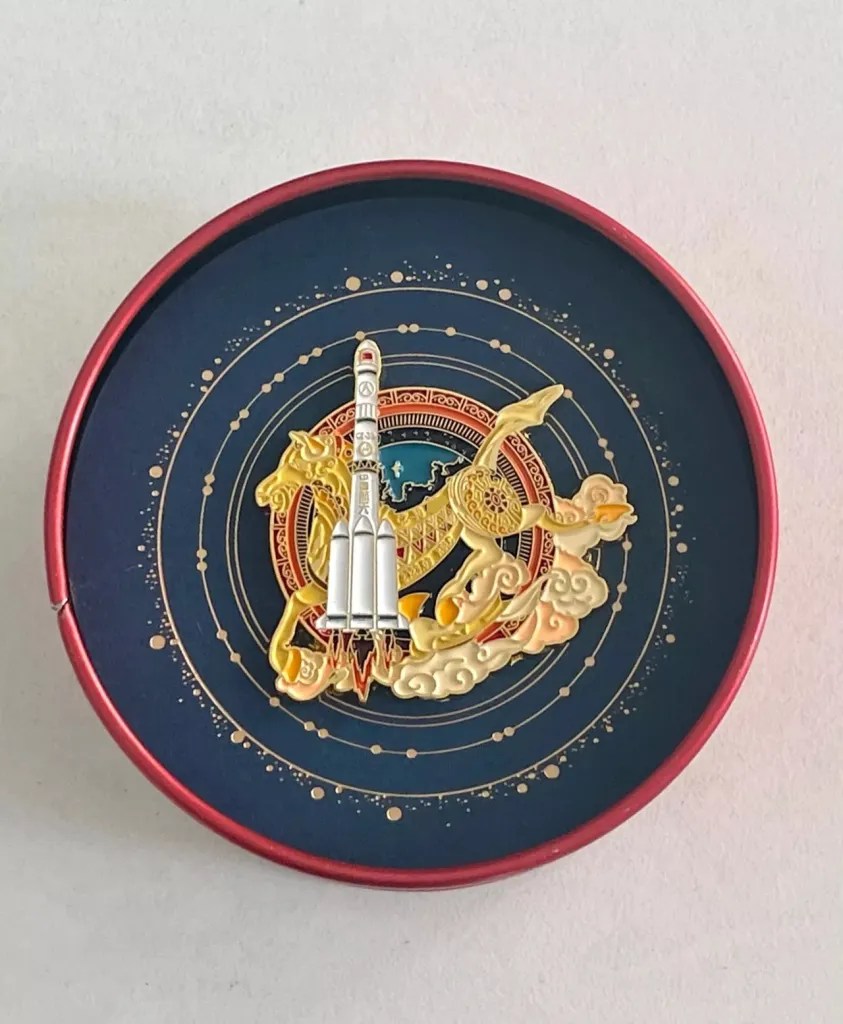
Chang Zheng – Long march 3B Carrier Rocket yao 90 launches high score 13th No. 02 satellite mission badge: This badge is inspired by the historical allusion of a horse stepping on a flying swallow. Ma Ta Feiyan is a magical and rare treasure in the history of ancient sculpture art in my country. It is a landmark building in Xichang. As an emblem element, it implies the rapid development of China’s aerospace industry and the tenacious and indomitable spirit of astronauts. The main body of the emblem is the Chang Zheng – Long march rocket, the earth is in the center of the picture, auspicious clouds surround the main body, and the stars mark the launch site, which means that one arrow and one star will be launched from here, and go forward bravely, just like astronauts bravely climbing the peak of science and technology, to write China’s aerospace industry The new chapter dares to overcome all difficulties and obstacles…..