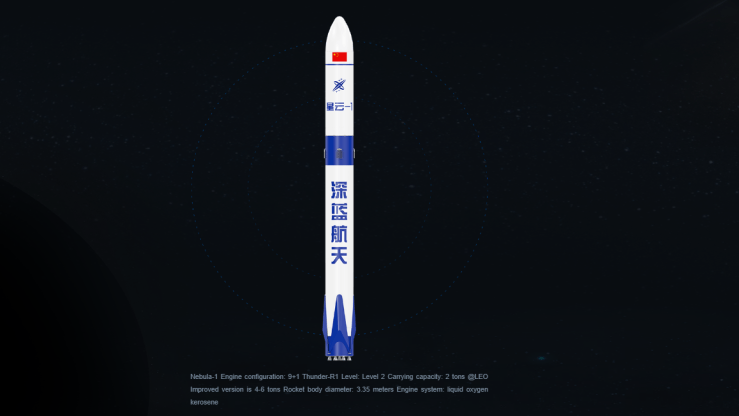
#MadeInChina #中國製造 |#深蓝航天#DeepBlueLimitedCompany  #January2024| Deep Blue Aerospace #ReusableCarrierRocket #ReusableCarrierRocketEngine Development Progress -The first long-distance test run of Deep Blue Aerospace’s #3DPrinted  #ThunderR1 #Flight preparation engine rocking test run was a complete success….

深蓝航天  Deep Blue Limited – Deep Blue Aerospace One of sixty Chinese private space Carrier Rocket Companies in China-People’s Republic of China…  As many of sixty plus Private Rocket Deep Blue Aerospace Co., Ltd. was established in 2017. The company is mainly a high-tech aerospace enterprise that focuses on the direction of liquid recovery and reusable launch vehicles and provides users with commercial launch services. Deep Blue Aerospace Co., Ltd. is headquartered in Nantong City, Jiangsu Province. At the same time, the company has rocket general and liquid engine R&D centers in Yizhuang, Beijing and Xi’an, Shaanxi, respectively, and a rocket power system test base in Tongchuan, Shaanxi…..

Recently on the 5th January 2024, DeepBlue Aerospace’s “Thunder-R1” engine rocking test run was a complete success. This test run included sine wave swing, square wave position, frequency sweep and triangle wave swing tests, covering the control requirements for subsequent flight missions and verifying the engine Compatibility with servo system operation. This engine test has accumulated a large amount of data and valuable experience for the power system test. It also laid the foundation for the high-altitude VTVL recovery test of the first sub-stage of the “Nebula-1” rocket that Deep Blue Aerospace will conduct this year, as well as the first flight of the “Nebula-1” rocket. Solid foundation…..

Recently, DeepBlue Aerospace’s “Thunder-R1” engine rocking test run was a complete success. This test run included sine wave swing, square wave position, frequency sweep and triangle wave swing tests, covering the control requirements for subsequent flight missions and verifying the engine Compatibility with servo system operation.

This test run achieved the following results:

1. Feasibility of the plan

The “Thunder-R1” engine adopts a pump backswing solution, which has a small weight in the swing part, greatly reduces the power demand on the servo mechanism, and improves the response characteristics of the small engine control loop; the pump backswing technology can achieve the same swing angle. Significantly reducing the swing envelope is a key technology to achieve a parallel layout of multiple rockets in a limited space. This test run verified the feasibility of this solution;

2 Reliability of flexible links

The maximum swing angle of the engine during the test was ±7°, which verified the reliability of the high-pressure swing hose;

3. Stability of electrical system

Through multiple complete machine tests of the “Thunder-R1” engine, the working stability and reliability of the engine’s electrical system have been fully verified.

This test run fully assessed the relevant performance indicators of the engine controller, servo system, battery, measurement system, ignition system and other parts to meet the overall requirements for the delivery of the rocket. In addition, the engine servo is the most important execution link of the rocket control system, and its working performance, stability and reliability were fully assessed and verified during this engine test run. The engine servo operates according to regulations and completes unidirectional swing and omnidirectional swing of various swing angles at multiple frequency points, with a maximum swing angle of 7 degrees. The engine servo is working normally and all performance indicators meet the requirements of the rocket control system.

This engine test has accumulated a large amount of data and valuable experience for the power system test. It also laid the foundation for the high-altitude VTVL recovery test of the first sub-stage of the “Nebula-1” rocket that Deep Blue Aerospace will conduct this year, as well as the first flight of the “Nebula-1” rocket. Solid foundation.

Knowledge Posts

The “Thunder-R1” engine thrust vector control adopts a pump backswing technical solution. As the name suggests, a swingable high-pressure hose is set between the engine’s thrust chamber and the turbine pump. When the engine is performing vector control during operation, the turbine The pump is stationary and the thrust chamber is oscillated by the servo actuator. The name pump backswing engine actually comes from the perspective of the overall engine layout. This layout is based on the engine frame, and the frame and the thrust chamber are connected through a gimbal. Since only the thrust chamber swings, the swing mass and inertia are small, and the power requirements for the servo actuator are lower; since the turbopump does not swing, the engine swing profile is more compact, and the saved space provides the possibility to connect more rocket engines in parallel. 

Images and visuals are from their Respectives.

#MadeInChina #中國製造 #ExPace | #December2023|#酒泉衛星發射中心#JiuquanSatelliteLaunchCenter #CASIC Rocket Technology Company #Expace #PrivateChineseSpaceCompany #Wuhan #CarrierRocketCompany #CarrierRocket #Kuaizhou 1A #KX1A Launches successfully to deploy of the a #Tianmu1 #meteorological constellation 11-14 #satellites #Satellite … on a #Christmas Morning.

During today on 25th December 2023  at 0900 Hong Kong SAR- Beijing Time  launching from one of many complexes酒泉衛星發射中心 Jiuquan Satellite Launch Center in Dongfeng Aerospace City – inner Mongolia –China – People’s Republic of China on中國製造 Expace Technology Corporation, , the Kuaizhou No. 1A solid carrier rocket ignited and lifted off at the Jiuquan Satellite Launch Center four Tianmu-1 meteorological constellation 11-14 satellites The satellite successfully entered the predetermined orbit, and the launch mission was a complete success. The satellite is mainly used to carry out experiments such as space environment detection….

中國製造 Expace Technology Corporation, , the Kuaizhou No. 1A solid carrier rocket

Successfully launched the four Tianmu-1 meteorological constellation 11-14 satellites from the Jiuquan Satellite Launch Center using the Kuaizhou-1A carrier rocket. This launch is the 215th space launch in the world in 2023, the 63rd for China, the 9th this month, and the 5th for the Kuaizhou-1A carrier rocket,,,,,,

Tianmu-1 meteorological constellation were launched into space. The satellites successfully entered the scheduled orbit, and the launch mission was a complete success. The satellite is mainly used to provide commercial weather data services is also mainly used to obtain information on global atmospheric environment elements. After the constellation is completed, it can realize three-dimensional and integrated business detection of the global all-weather ocean, atmosphere, and ionosphere.

Images and visuals are from a their respectives..

#CNSA #ChinaNationalSpaceAdministration #国家航天局 |#WenchangSpacecraftLaunchCenter #文昌航天發射場 #BRI #November2023 |#文昌国际航天城 #WenchangInternationalSpaceCity – 2023 Wenchang International Aerospace Forum opens… 

On November 25, the 2023 Wenchang International Aerospace Forum with the theme of “Accelerating the Application of BRICS Satellite Data to Promote International Cooperation in Space and Space Information” opened in Wenchang, Hainan Province, China, and People’s Republic of China.

2023 is a critical year for the vigorous development of the Hainan Free Trade Port. The holding of the 2023 Wenchang International Aerospace Forum is not only a concrete measure for Hainan to implement the spirit of the important speech on accelerating cooperation in remote sensing satellite data and applications, but also accelerating the construction of the satellite application industry. Circle and strengthen the chain, build a world-class aerospace city, and support the active exploration of the construction of Hainan Free Trade Port.

Li Guoping, chief engineer of the National Space Administration, said in his speech that the space information industry is a national strategic emerging industry that integrates aerospace technology and information technology. In recent years, China’s aerospace industry has entered a fast lane of innovation and development. With the implementation of a number of major aerospace projects such as the national space infrastructure and the Beidou satellite navigation system, my country currently has a complete range of satellites in orbit, with more than 200 remote sensing satellites alone. These have laid a solid foundation for promoting the development of the space information industry. Currently, our country is researching and planning a new generation of national space infrastructure, accelerating the cultivation of commercial aerospace to become a convenient new force, and promoting the construction of a more complete, open and integrated aerospace industry ecosystem.


Based on the theme of this forum, he proposed that first, we must strengthen satellite application services and achieve high-quality development of the space information industry. The second is to create a good business environment and encourage the development of commercial aerospace. The third is to deepen international exchanges and cooperation and build a community with a shared future for mankind in the space field. “Hainan Province’s unique advantages give it great potential for the development of the aerospace information industry. The construction of Hainan Wenchang Space City is now ready to go, and it is facing a good situation in building a powerful aerospace country.” He said.

Liu Xiaoming, deputy secretary of the Hainan Provincial Party Committee and governor of Hainan, pointed out in his speech that “small satellites have great potential in Hainan.” Hainan has China’s only low-latitude coastal space launch base and is about to build China’s first commercial space launch site. In November last year, Hainan and the National Space Administration jointly established the “National Space Administration Satellite Data and Application International Cooperation Center”, “BRICS Remote Sensing Satellite Constellation Data and Application Center (China)” and “Hainan Satellite Data and Application Research Center” , jointly build an international cooperation hub for the national remote sensing data and application service platform. It can be said that Hainan has both space launch capabilities and ground data reception capabilities. It also has the advantage of a free trade port policy endowed by the state, and has huge potential to develop the satellite application industry.

Hainan has focused on cultivating aerospace as one of the three future industries of “land, sea and air”, built Wenchang International Space City as a key free trade port park, launched an industrial layout around the “three chains” of rocket chain, satellite chain and data link, and actively carried out civil International cooperation in commercial satellite data and applications, strengthening data exchange and sharing at home and abroad, striving to build a world-class “aerospace +” innovation ecosystem, and creating an important node for China’s aerospace industry to “go global” and international aerospace cooperation and exchanges.

At the opening ceremony, the international version of the National Remote Sensing Data and Application Service Platform and the “Announcement on Opportunities for Global Sharing of China’s Remote Sensing Data” were released. The National Space Administration and the China Meteorological Administration awarded licenses to the first batch of international user units of the National Remote Sensing Data and Application Service Platform, including the National University of Laos, Jagannath University in Bangladesh, BioSense Institute in Serbia, and the National Space Research and Technology Center of Kazakhstan. “China’s Remote Sensing Satellite and Application Industry Development Blue Book (2022)” was released. At the same time, a major strategic cooperation agreement was signed.

Liu Chong, Mayor of Wenchang City and Director of the Wenchang International Space City Administration Bureau, delivered a keynote report titled “Sharing New Opportunities for Commercial Space Development.” He introduced that Hainan Satellite Data and Application Research Center actively promotes international cooperation in satellite data and applications and has undertaken two international satellite data and application projects of the National Space Administration. Among them, the “SCO Satellite Remote Sensing Data and Application Comprehensive Demonstration Project”, which was the lead application, has been approved for project approval. This project is the first overseas demonstration application project of my country’s high-scoring system and has achieved a major breakthrough in Hainan’s aerospace industry.

The Hainan Provincial Aerospace Technology Innovation Center has compiled the 2023 special guide for the “land, sea and air” space field, launched the first batch of “land, sea and air” science and technology projects, and promoted the implementation of 8 projects. We are planning to introduce an aerospace science and technology innovation team and jointly establish two laboratories to further enhance Hainan’s aerospace science and technology innovation capabilities and core competitiveness.

Cao Xiaozhong, Deputy Director of the China Meteorological Administration, Battelle, Member of the Standing Committee of the Hainan Provincial Committee and Executive Vice Governor, Academician Wu Weiren of the Lunar Exploration and Aerospace Engineering Center of the National Space Administration, Academician Wu Yirong of the Aerospace Information Innovation Institute of the Chinese Academy of Sciences, Academician Jin Yaqiu of Fudan University, China Aviation Industry Corporation Academician Fan Huitao of the Co., Ltd., as well as expert representatives from relevant national ministries, scientific research institutes, universities, representatives of well-known domestic and foreign institutions and well-known enterprises in the industry attended the opening ceremony and main forum activities.

From November 25th to 27th, the International Cooperation Council on Satellite Data and Applications, the Academician Expert Seminar on Satellite Remote Sensing Data Application and Cooperation, the Hainan Free Trade Port Low Altitude Economic Development Academician Expert Seminar, China (Wenchang) Commercial Aerospace Summit Forum, A series of activities such as Hainan provincial high-score data application promotion activities and cultural industry research will be held one after another.

The 2023 Wenchang International Aerospace Forum is hosted by the Hainan Provincial People’s Government, guided by the National Space Administration, Hainan Provincial Office of National Defense Science and Technology Industry, National Space Administration Earth Observation and Data Center, BRICS Remote Sensing Satellite Constellation Data and Application Center (China), Wenchang It is jointly organized by the Municipal People’s Government, Wenchang International Space City Administration Bureau, General Aviation Branch of China Information Association, Hainan Aerospace Information Research Institute, Hainan International Commercial Space Launch Co., Ltd.

Imagines and visuals are from their respectives..

#MadeInChina #中國製造 |#深蓝航天 #LANDSPACE #DeepBlueLimitedCompany #November2023| Deep Blue Aerospace #ReusableCarrierRocket # Zhuque-3 #Suzaku-3″ #CarrierRocket stainless steel launch vehicle announcement at Aerospace Information Industry International Ecosystem Event 2023.

深蓝航天  Deep Blue Limited – Deep Blue Aerospace One of sixty Chinese private space Carrier Rocket Companies in China-People’s Republic of China…  As many of sixty plus Private Rocket Deep Blue Aerospace Co., Ltd. was established in 2017. The company is mainly a high-tech aerospace enterprise that focuses on the direction of liquid recovery and reusable launch vehicles and provides users with commercial launch services. Deep Blue Aerospace Co., Ltd. is headquartered in Nantong City, Jiangsu Province. At the same time, the company has rocket general and liquid engine R&D centers in Yizhuang, Beijing and Xi’an, Shaanxi, respectively, and a rocket power system test base in Tongchuan, Shaanxi…..

On the Month of October- November 2023  Zhang Changwu, founder/CEO of Blue Arrow Aerospace As a guest speaker, attend this conference event of Aerospace Information Industry International Ecosystem Event 2023 It has finally been officially announced that Blue Arrow has developed the reusable Carrier Rocket  stainless steel Suzaku 3 rocket….  

Many people did not notice the details on. Blue Arrow disclosed for the first time its Suzaku 3, which will succeed Suzaku 2 Carrier Rocket – Reusable Carrier Rocket. Launch vehicle.


Judging from the picture, the one-time launch to low-Earth orbit has a transport capacity of 20 tons, the recovery area is 16.5 tons (not necessarily at sea), and the return transport capacity is 11 tons. Two-stage design, stainless steel storage tank, the diameter should be more than 4 meters by comparison, and it is suspected that 7 engines (maybe 9) are stuffed inside. First stage with grille rudder with deployable landing legs.


The railway transportation limit made by the Shanghai Institute is 3.8 meters. If it is 4 meters higher, it is equivalent to killing the possibility of inland launch? Or is there another way? After all, Landspace Blue Arrow spent a lot of effort on the launch pad in Jiuquan Satellite Launch Center, Inner Mongolia, China, and People’s Republic of China. , so it is unlikely that they will be abandoned. What do you think?


Blue Arrow originally wanted to go to IAC for a press conference, but it was later cancelled for some reason. This time in China, it was taken the opportunity to release. There is nothing unexpected about the overall design. Perhaps the only exception is the use of stainless steel. It is the first mainstream private aerospace company in China to officially announce the use of stainless steel.

General Manager Changwu of Blue Arrow shared that no matter what, I have always recognized Blue Arrow’s hard work and development in the field of China’s commercial space launch vehicles, and I am grateful for its efforts and contributions to the commercialization of China’s launch vehicles. I will always believe in it. , as long as you keep working hard like this, @LANDSPACE Blue Arrow Aerospace will be realized sooner or later.

Images and visuals are from their Respectives.

#MadeInChina #中國製造| #ISpace #星际荣耀#InterstellarGlory #November2023 | #ChinesePrivateSpaceCompany –#ReusableCarrierRocket #CarrierRocket #JiuquanSatelliteLaunchCenter  #Hyperbola 2 Successfully vertical take-off and landing test verification of rocket recovery and reusability ….

In which iSpace- Interstellar Glory in which it is the first Chinese Private Space Company to do so successfully commercially first out from sixty known private space companies in China People’s Republic of China…  Founded in Beijing 2016 located in Beijing Economic and Technological Development Zone or known for short as E-Town in Capital of China – People’s Republic of China …

Beijing Interstellar Glory Space Technology Co., Ltd. (referred to as “Interstellar Glory”) was established in October 2016, with Peng Xiaobo as the legal representative. The company is committed to developing excellent commercial launch vehicles and providing systematic launch solutions, providing global commercial aerospace customers with more efficient, higher-quality, and more cost-effective launch services, so as to greatly improve the ability of human beings to freely enter and exit space.

The company focuses on the research and development of intelligent launch vehicles, and provides integrated commercial launch services for global satellite and constellation customers.

Just now on the 2nd November 2023, my country China, People’s Republic of China has used an orbit-level engine for the first time to conduct a vertical take-off and landing test of a rocket, successfully conducting a key verification of rocket recovery and reuse.

At around 1400 Hours Hong Kong SAR- Beijing Time this afternoon 2nd November 2023, Beijing Interstellar Glory Space Technology Co., Ltd. successfully carried out the first vertical take-off and landing test of the Hyperbola-2 verification rocket at the Jiuquan Satellite Launch Center (official announcement: the first domestic use of full-scale reusable one-stage liquid oxygen Vertical take-off and landing flight test of methane liquid rocket).

The flight test mission of the liquid oxygen methane reusable verification rocket Hyperbola II (codenamed SQX-2Y) independently developed by Star Glory was a complete success

🔷The rocket adopts a full-size rocket body diameter of 3.35m and a total length of about 17m

🔷Assembled and independently developed by Star Glory The Focus-1 depth variable thrust liquid oxygen methane engine (codenamed JD-1)
🔷The test flight altitude is 178.42m, the flight time is 50.82s
🔷The landing position accuracy is about 1.68m, the landing speed is 0.025m/s, and the landing attitude angle is about 0.18°. The rolling angle is about 4°, and the flight test mission was successfully completed with high precision


The vertical takeoff and landing test is a key verification and iteration step for rocket recovery and reuse. The developers built a test platform with similar size, weight, power and control system to the first stage of the real rocket (or even directly modified it from the rocket body), and organized it in the atmosphere. Meters, hundreds of meters, and kilometers are gradually progressively tested (parts can be saved), thereby optimizing the software and hardware design, and finally realizing the recovery and reuse of the first stage of the rocket in orbit.

Today’s test rocket is equipped with a Focus-1 liquid oxygen methane engine. This is also the first time that my country has used an engine with the ability to enter orbit for such a test.

Images-visuals are from their respectives..