#CNSA #ChinaNationalSpaceAdministration #国家航天局 |#BRI #October2023 #Tiangong #ChinaSpaceStation #CMS #ChinaMannedSpace, #Takionauts #Shenzhou16 returns home to the Motherland #China #PeoplesRepublicOfChina …

It is on the morning of October 26, 2023, the “Shenzhou 17” manned spacecraft carrying three Takionauts will be launched from the 921 station of the Jiuquan Satellite launch Center, Inner Mongolia, China, People’s Republic of China  by the “Long March 2F” Yao 17 carrier rocket to joining up with the Crew of the Shenzhou 16 Takionaut Crew onboard the Tiangong –China Space Station, On the 25th October 2023 CNSA- China National Space Administration According to the China Manned Space Engineering Office, the Takionaut Shenzhou 17 Crew is aiming to be launched at 11:14 on October 26th 2023.

On 31st October 2023 CNSA – China National Space Administration China’s Shenzhou-16 Taikonauts Jing Haipeng, Zhu Yangzhu and Gui Haichao return to Earth on October 31st 2023 onto towards Dongfeng Aerospace City- Jiuquan Satellite Launch Center- Inner Mongolia China, People’s Republic of China….. Having completed all their scheduled tasks on China’s space station. The three Takionauts handed over the control of the space station to the Shenzhou-17 crew, completing the country’s third in-orbit crew rotation. They will touch down at Dongfeng landing site in north China’s Inner Mongolia Autonomous Region, which is ready for their return.

With the development of China’s aerospace technology, the timing and technology of each Shenzhou crew return are basically fixed. ….Now, the countdown to the Shenzhou16 return landing sequence is -1 hour, and the orbital module has been depressurized! What’s the next sequence?

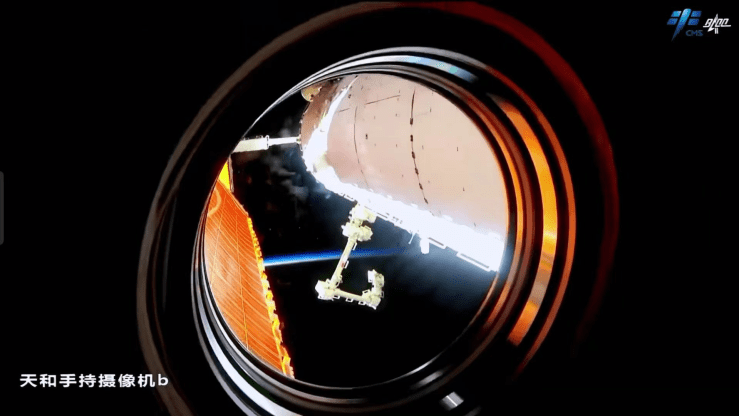
At 20:37 on October 30, 2023, Beijing time, the Shenzhou 16th manned spacecraft and the space station assembly were successfully separated. Before separation, the Takionaut crew of Shenzhou 16 and the astronaut crew of Shenzhou 17 carried out work handover and completed the exchange of on-orbit work experience, the transfer and installation of uplink materials and downlink samples. After separation, the Shenzhou 16 astronauts held high-definition cameras and flew around the spacecraft to complete a panoramic image of the space station assembly with the Earth as the background. Subsequently, the return capsule of the Shenzhou 16 manned spacecraft will choose an opportunity to return under the control of ground commands. The astronauts Jing Haipeng, Zhu Yangzhu, and Gui Haichao who are on a business trip to the China Space Station will soon embark on a journey home. I wish the astronauts and crew of Shenzhou 16 a safe journey! See you east wind! See you in Beijing!

The return capsule of the Shenzhou 16 manned spacecraft successfully landed. The first manned mission in the application and development stage of the space station was a complete success

At 8:11 on October 31, 2023, Beijing time, the return capsule of the Shenzhou 16 manned spacecraft successfully landed at the Dongfeng Landing Field. On-site medical supervision and medical insurance personnel confirmed the health status of astronauts Jing Haipeng, Zhu Yangzhu, and Gui Haichao Good, the Shenzhou 16 manned mission was a complete success.

At 7:21, the Beijing Aerospace Flight Control Center issued a return command through the ground measurement and control station, and the orbital module of the Shenzhou 16 manned spacecraft was successfully separated from the return module. After that, the spacecraft returned to brake and ignited the engine, and the return capsule separated from the propulsion module. The return capsule landed successfully. The search and rescue team responsible for the search, rescue and recovery mission found the target in time and arrived at the landing site.

The Shenzhou 16 manned spacecraft was launched from the Jiuquan Satellite Launch Center on May 30, 2023, and then docked with the Tianhe core module to form a combination. As the first batch of astronauts to carry out manned missions in the application and development stage of the space station, the three astronauts stayed in orbit for 154 days, during which they conducted one extravehicular activity and the fourth space teaching activity of the China Space Station. They cooperated to complete The space station’s multiple cargo missions have laid the foundation for the regular implementation of space station missions.

This mission is the first manned mission for China’s manned spaceflight project to enter the space station application and development stage. With the close cooperation of the astronaut crew and ground scientific researchers, human factors engineering, aerospace medicine, life ecology, biotechnology, Many space science experiments (experiments) such as materials science, fluid physics, and aerospace technology have made important progress in the fields of space life science and human body research, microgravity physics, and new space technologies, and have taken the manned space project from construction to Application, an important step in the transformation from input to output…

【feel good! 神州16 The Takionaut crew safely and smoothly exited the cabin]

At 9:10 on October 31, 2023, Beijing time, Shenzhou 16 Takionauts Jing Haipeng, Zhu Yangzhu, and Gui Haichao all safely and smoothly escaped from the cabin. Good health.

So far, astronaut Jing Haipeng has successfully completed his fourth space flight. His cumulative mission time in orbit has exceeded 200 days. He is the Chinese astronaut who has performed the most missions so far. my country’s first aerospace flight engineer Zhu Yangzhu and first payload expert Gui Haichao also successfully completed their first flight, marking that all three types of astronauts in my country have completed flight assessments and practical tests, laying the foundation for the subsequent development and large-scale implementation of the project. Laying a good foundation for space science experiments

神肖六肖 Shenzhou 16 “Doctoral Crew” arrived in Beijing safely on 1600 Beijing Time The astronaut crew that successfully completed the Shenzhou 16 manned mission arrived safely in Beijing on October 31, 2023 on the mission aircraft. Leaders of the Space Station Application and Development Stage Flight Mission Headquarters came to the airport to greet them. After arriving in Beijing, the three astronauts will enter an isolation and recovery period, undergo comprehensive medical examinations and health assessments, and arrange rest.

Images and visuals are from their Respectives CMS China Manned SpaceCNSA-China National Space Administration

#CNSA #ChinaNationalSpaceAdministration #国家航天局 |#BRI #July2023 #August2023 | #天宫 #Tiangong #ChinaSpaceStation #CMS #ChinaMannedSpace #神舟十六号 #Shenzhou16 Awesome #EarthViews with different angles with #SpaceGym #SpaceFitnessClass Action..

On the 30th  May 2023 clear 0931 Hours Morning Hong Kong SAR- Beijing time , the Belt and Road InitiativeCNSA –China National Space Administration from Jiuquan Satellite Launch Center – Inner Mongolia –China – People’s Republic of China deployment of  the Chang Zheng – The Chang Zheng – Long March 2F Yao 16 –Shenzhou 16  carrier rocket.. On which Takionauts Jing Haipeng, Zhu Yangzhu, and Gui Haichao took to the predetermined orbit. The first manned flight mission in the application and development stage was a complete success. The three astronauts will stay in the space station and “join up” with the crew of Shenzhou 15 to carry out on-orbit handover “face-to-face” meeting in which brings the total crew of six with a handover ceremony from Shenzhou 15 towards 16..

On the 28th July 2023 Beijing Time , The  Shenzhou 16 Takionaut crew raised up multiple camera angles to get different perspectives, different stories, backstories videography of  the hat does the earth and the space station look like after seeing it? The crew of Shenzhou 16 astronauts completed the lifting of three external panoramic cameras during the recent out-of-vehicle mission. Today, I will show you the Chinese space station and the A wonderful picture of the earth in the same frame…

On the week of 26th July 2023 awesome Shenzhou 16 A fitness video is out During this hot summer, have you “shut up and open your legs”? Today, our #神舟六号 “Space Coach” will take you to punch in the “golden action” of space fitness, and experience a space exercise in 4 minutes!

Images and visuals are from their Respectives CMS China Manned SpaceCNSA-China National Space Administration

#CNSA #ChinaNationalSpaceAdministration #国家航天局 |#BRI #July2023 | #天宫 #Tiangong #ChinaSpaceStation #CMS #ChinaMannedSpace #神舟十六号 #Shenzhou16 #桂海潮 #GuiHaichao- Space Science and Application Project Solicitation Officially Starts Application

[China Space Station Space Science and Application Project Solicitation Officially Starts Application 航人贵海涛From天宫发来听听 ]

CNSA –China National Space Administration The China Space Station space science and application project declaration system was officially opened on the morning of July 20, 2023, Hong Kong SAR- Beijing time.  Taikonaut  桂海潮 Gui Haichao, China’s first payload expert who is performing missions on the space station, sent an invitation to colleagues from the scientific and technological community to do experiments at the “Tiangong”.


In order to promote the overall development of China, People’s Republic of China space science, space application, and space technology, in mid-June, the China Manned Space Engineering Office released the “Guidelines for Space Station Application and Development Engineering Space Science and Application Projects (V1.0)” to openly solicit space science and application projects from the whole society. This solicitation covers four major fields: space science and human body research, microgravity physical science, space astronomy and earth science, and new space technologies and applications. Each field has several themes and directions. The application system will be officially opened at 9 am on July 20 and will end at 16:00 on August 10. For details of the “Project Guide” and the application methods and requirements, please refer to the China Manned Space Engineering Network (www.cmse.gov.cn).

According to reports, the space station, as my country’s “national space laboratory” covering the most complete fields of space science-related disciplines, has the strongest on-orbit support capability, and has unique advantages such as manned participation and uplink and downlink transportation, has deployed world-class scientific research and technology testing facilities on orbit, and has the ability to carry out large-scale space science research. The scientific experiment cabinet, technical test cabinet and support system equipped inside the cabin, and the exposure experiment platform, standard load interface and large load hanging point outside the cabin can support scientific research, technical tests and applications in many fields. In addition, in order to give full play to the comprehensive benefits of engineering services for economic and social development, the China Manned Space Engineering Office will continue to use Tianzhou cargo spacecraft to provide opportunities for the whole society to carry scientific experiments (experiments)…

Images and visuals are from their Respectives CMS China Manned SpaceCNSA-China National Space Administration

#CNSA #ChinaNationalSpaceAdministration #国家航天局 |#BRI #July2023 | #天宫 #Tiangong #ChinaSpaceStation #CMS #ChinaMannedSpace #神舟十六号 #Shenzhou16 #Takionauts planned prepares for a #EVA #ExtravehicularActivity #Spacewalk……

On the 30th  May 2023 clear 0931 Hours Morning Hong Kong SAR- Beijing time , the Belt and Road InitiativeCNSA –China National Space Administration from Jiuquan Satellite Launch Center – Inner Mongolia –China – People’s Republic of China deployment of  the Chang Zheng – The Chang Zheng – Long March 2F Yao 16 –Shenzhou 16  carrier rocket.. On which Takionauts Jing Haipeng, Zhu Yangzhu, and Gui Haichao took to the predetermined orbit. The first manned flight mission in the application and development stage was a complete success. The three astronauts will stay in the space station and “join up” with the crew of Shenzhou 15 to carry out on-orbit handover “face-to-face” meeting in which brings the total crew of six with a handover ceremony from Shenzhou 15 towards 16..

[Shenzhou 16 crew will choose an opportunity to launch out-of-cabin activities in the near future]

On the 20th July 2023 The latest news from the China Manned Space Office; since it successfully entered the space station complex on May 30, 2023, Beijing time, the crew of Shenzhou-16 astronauts have been working in orbit for 51 days, and nearly one-third of the five-month space scientific research journey has been completed.
At present, the Shenzhou 16 astronaut crew is in good condition, the space station assembly is running stably, and has the conditions to carry out extravehicular activities….

Images and visuals are from their Respectives CMS China Manned SpaceCNSA-China National Space Administration

#CNSA #ChinaNationalSpaceAdministration #国家航天局 |#BRI #July2023 | #天宫 #Tiangong #ChinaSpaceStation #神舟十六号 #Shenzhou16 #Takionaut #景海鹏 #JingHaPeng will rise to the 11th place in total flight time! Preparing to leave the cabin for the first time…

On the 30th  May 2023 clear 0931 Hours Morning Hong Kong SAR- Beijing time , the Belt and Road InitiativeCNSA –China National Space Administration from Jiuquan Satellite Launch Center – Inner Mongolia –China – People’s Republic of China deployment of  the Chang Zheng – The Chang Zheng – Long March 2F Yao 16 –Shenzhou 16  carrier rocket.. On which Takionauts Jing Haipeng, Zhu Yangzhu, and Gui Haichao took to the predetermined orbit. The first manned flight mission in the application and development stage was a complete success. The three astronauts will stay in the space station and “join up” with the crew of Shenzhou 15 to carry out on-orbit handover “face-to-face” meeting in which brings the total crew of six with a handover ceremony from Shenzhou 15 towards 16..

As of 09:31 on July 16, 2023, “Shenzhou 16” Takionauts Jing Haipeng, Zhu Yangzhu, and Gui Haichao have been flying for 47 days. The total flight time ranking is undergoing a new change.

Takionaut Jing Haipeng has carried out four manned missions including “Shenzhen 7”, “Shenzhen 9”, “Shenzhen 11” and “Shenzhen 16”. long Takionaut. The “Shenzhen VII” spacecraft ignited and took off at 21:10 on September 25, 2008, and landed at 17:37 on September 28. The flight time of the astronauts Zhai Zhigang, Liu Boming and Jing Haipeng was 2 days, 20 hours and 27 minutes. From 18:37 on June 16, 2012 to 10:05 on June 29, astronauts Jing Haipeng, Liu Wang, and Liu Yang carried out the “Shenzhen Nine” mission in 12 days, 15 hours and 28 minutes. From 07:30, October 17, 2016 to 13:59, November 18, 2016, Takionauts Jing Haipeng and Chen Dong partnered to carry out the “God 11” mission, with a flight time of 32 days, 6 hours and 29 minutes. Before the “God 16” mission, the total flight time of Jing Haipeng’s first three missions was 47 days, 18 hours and 24 minutes.

As of 16:07 on July 16, 2023, Jing Haipeng’s total flight time will reach 95 days and 1 hour, surpassing Liu Boming and ranking 11th among Chinese Takionauts. Liu Boming has carried out two missions including “Shenzhen 7” and “Shenzhen 12”. The total flight time was 95 days and 35 minutes.

During the period when the “Shenzhen XVI” crew was in orbit, large-scale space science experiments were carried out on a rolling basis, and the work of space application systems such as the out-of-cabin installation of the space radiation biology exposure experiment device in the “Mengtian” experimental cabin has been completed as planned. At the same time, the “Shenzhen XVI” crew is preparing for the first out of the cabin, which will be the first out of the third batch of astronauts, who will perform it? What extravehicular work will be done?

Images and visuals are from their Respectives CMS China Manned SpaceCNSA-China National Space Administration