#CNSA #ChinaNationalSpaceAdministration #国家航天局 |#BRI  #June2023 |#西昌衛星發射中心 #XichangSatelliteLaunchCenter  the advance iconic #长征三号乙火箭, #ChangZheng3B #LongMarch3B launch vehicle landing zone control technology has made a further breakthrough!

On the 17th May  2023  in  CNSA _China National Space Administration -China – People’s Republic of China At 1049 hours Hong Kong –Beijing Time China- People’s Republic of China launch the Chang Zheng – Long march 3B  Carrier Rocket launching from station form Xichang Satellite Launch Center Sichuan Province…..Deploying Geo Stationary  the World’s Number one leading Beidou3 Series  56th Navigation Satellite 

The 56th Beidou navigation satellite was successfully sent into the predetermined orbit, and the launch mission was a complete success. This launch is the 473rd flight of the Long March series of launch vehicles. (China Academy of Launch Vehicle Technology)​​​​

[Launch vehicle landing zone control technology has made a further breakthrough! 】

On May 17th 2023, the mission of launching the 56th Beidou navigation satellite by the Long March 3B carrier rocket developed by the Rocket Academy was a complete success. Another highlight of this mission is the verification test of the landing area control technology – the rocket booster is equipped with a parachute landing area control system. Strategic maneuvering flight, accurately guiding the booster separation body to the predetermined “parachute landing area”, successfully reducing the separation body landing area by 80%. The carrying test was a complete success, which laid the foundation for the subsequent engineering application of booster parachute control technology.

 
The booster parachute landing area control technology is a technology independently developed by the Rocket Academy to improve the safety of the rocket sub-stage wreckage landing area at the inland launch site.
When the booster separates and falls to the predetermined altitude, the parachute landing area control system installed in the nose cone of the booster will automatically start, and the manoeuvrable flight will be realized through the controllable parafoil, and the booster separation body will be guided to the predetermined area landing.


Zhang Yipu, chief designer of the rocket’s Long March 3A series of launch vehicles, introduced that during this flight, the main optimization of the booster parachute landing zone control system came from the electrical subsystem. On the one hand, it has carried out a unified design with the control system of the rocket fairing parachute landing zone, and on the other hand, it has also carried out system-level integration with the electrical equipment of the parachute subsystem, achieving a weight reduction of 30 kg and effectively improving the practical level of the product.
Based on the development concept of “rapid iteration and combination of flight transformation”, the development team has carried out a series of research on the basis of the previous pre-research results.
Overcome: the overall design technology of parachute landing area control, the overall design technology of large-area controllable parafoil, the integrated navigation and positioning technology under high dynamics, the separation technology of nose cone-parafoil combination, and a series of key technologies, combined with the control of the landing area The actual situation has formulated a reasonable and feasible “parachute landing zone” setting strategy and homing control strategy. After multiple rounds of iterative optimization and step-by-step loading verification, the controllable and accurate landing of the booster separation body is gradually realized…

After the analysis of the test data and the on-site survey of the wreckage, the control system of the parachute landing area maneuverer and flew according to the established homing strategy, and accurately guided the booster separation body to the predetermined “parachute landing area”, successfully reducing the area of ​​the separation body landing area by 80% %. The carrying test was a complete success, which laid the foundation for the subsequent engineering application of booster parachute control technology.

In addition to the booster parachute landing zone control technology, the development team is also looking for countermeasures in multiple dimensions to reduce the impact of rocket separation on the landing zone. Active control of separation body return based on grid rudder, control of fairing landing zone based on parachute, etc..

Images and visuals are from their Respectives CMS China Manned SpaceCNSA-China National Space Administration

#CNSA #ChinaNationalSpaceAdministration #国家航天局 |#BRI  #May2023 |#西昌衛星發射中心 #XichangSatelliteLaunchCenter – Successfully launching the advance iconic #长征三号乙火箭, #ChangZheng3B #LongMarch3B #CarrierRocket deploying the #BeiDou3 Series world’s Number One advance #NavigationSatellite System 56th  #Satellite  ….

On the 17th May  2023  in  CNSA _China National Space Administration -China – People’s Republic of China At 1049 hours Hong Kong –Beijing Time China- People’s Republic of China launch the Chang Zheng – Long march 3B  Carrier Rocket launching from station form Xichang Satellite Launch Center Sichuan Province…..Deploying Geo Stationary  the World’s Number one leading Beidou3 Series  56th Navigation Satellite  

The 56th Beidou navigation satellite was successfully sent into the predetermined orbit, and the launch mission was a complete success. This launch is the 473rd flight of the Long March series of launch vehicles. (China Academy of Launch Vehicle Technology)​​​​

长征三号乙火箭, During the Launch of The Chang Zheng Long March 3b Carrier Rocket Yao 87 , one of its boosters has two “blue” Color bar bar”, indicating that a booster parachute test was carried out again, which effectively narrowed the range of the booster’s landing zone! This is the third time that the Chang Zheng Long March 3b Carrier Rocket booster has undergone parachute recovery technology verification…..

国家组织发布56th Beidou Navigation Satellite and the first Beidou-3 backup star, this is the 90th launch of the Chang Zheng Long March 3b Carrier Rocket rocket….! The Beidou-3 GEO-4 Satellite is the first backup satellite of my country’s Beidou-3 project. After entering orbit and completing the in-orbit test, it will be connected to the Beidou satellite navigation system. This launch is the first mission in three years after the high-density networking of the Beidou-3 project.

First Beidou-3 backup star GEO-4 star mission badge description:
“Containing red clover leaves, a city facing the wind and beauty.” In Xichang in May, the bougainvillea is in full bloom. Pianxiayun, leaning on or probing, is so beautiful. The outline of this badge adopts the shape of the city flower of Xichang – Bougainvillea. The flower language of bougainvillea is enthusiasm and perseverance, implying auspicious and festive blessings, and symbolizing a tenacious and progressive spirit.
A Long March 3B carrier rocket went straight into the sky, splitting the badge pattern in two. The collision between night and day is very visually impactful, and it also bears the hard work and hard work of the astronauts behind each launch mission day and night. The Big Dipper shining in the cosmic sky symbolizes the breakthrough progress of this launch of the Beidou navigation satellite. The starry sky is vast, and the exploration is endless. We astronauts will take a steadier and farther step in our pursuit of dreams and stars!

The precise single-point positioning service of the first Beidou-3 backup satellite has the super capability to support four navigation system services…..The launch of the 31st Beidou-3 navigation satellite (GEO-4 star) will further enhance the system services It is of great significance to promote the characteristic services of the Beidou system and support the large-scale application of the Beidou system. The satellite realizes the on-orbit hot backup of the existing geostationary satellites, which will enhance the availability and robustness of the system, increase the short message communication capacity of the existing area of ​​the system by one-third, and improve satellite-based enhancement and precise single-point positioning Service performance helps users achieve fast and high-precision positioning.


GEO satellites (geosynchronous orbit satellites) are stationed in space 36,000 kilometers above the earth. They are responsible for the important mission of providing enhanced services for the improvement of the technical indicators of the Beidou global navigation system. They are affectionately called “auspicious stars”. The fifty-six Beidou navigation satellites are the fourth “auspicious star” of the Beidou family.

Previously, the precise single-point positioning service in the Beidou-3 global satellite navigation system also supported the “GPS + Beidou” dual navigation system. In order to support the leap from dual systems to four systems for precision single-point positioning services, the research and development team of Xi’an Branch of the Fifth Academy of Sciences greatly improved the navigation performance of the fourth “auspicious star”, and upgraded the satellite’s downlink navigation task processing unit. The upgraded precision single point positioning service can have the super ability to support four kinds of navigation system services.

Images and visuals are from their Respectives CMS China Manned SpaceCNSA-China National Space Administration

#CNSA #ChinaNationalSpaceAdministration #国家航天局 |#BRI  #March2023 |#西昌衛星發射中心 #XichangSatelliteLaunchCenter – Successfully launching the advance iconic #ChangZheng3B #LongMarch3B Y90  #CarrierRocket deploying advance Gaofen 13-02  #EarthSciences #RemoteSensing #EnivormentalSatellite  #Satellite The third launch within a week!

On the 17th March  2023  in  CNSA _China National Space Administration -China – People’s Republic of China At 1633 hours Hong Kong –Beijing Time China- People’s Republic of China launch the Chang Zheng – Long march 3B  Carrier Rocket launching from station form Xichang Satellite Launch Center Sichuan Province…..Deploying the Gaofen 13-02  Earth Sciences Environmental satellite….

Long March 3B successfully launched the Gaofen 13-02 satellite successfully launch the Gaofen 13-02 satellite into space, and the satellite went smoothly Entering the predetermined orbit, the launch mission was a complete success. The satellite is mainly used in the fields of land census, crop yield estimation, environmental governance, weather early warning and forecasting, and comprehensive disaster prevention and mitigation. This mission is the 468th flight of the Long March series of launch vehicles!

The 02 satellite is a high-orbit optical remote sensing satellite, which is mainly used in emergency disaster reduction, land census, ocean observation, environmental governance, meteorological observation and other fields, and can provide information services for national economic construction.

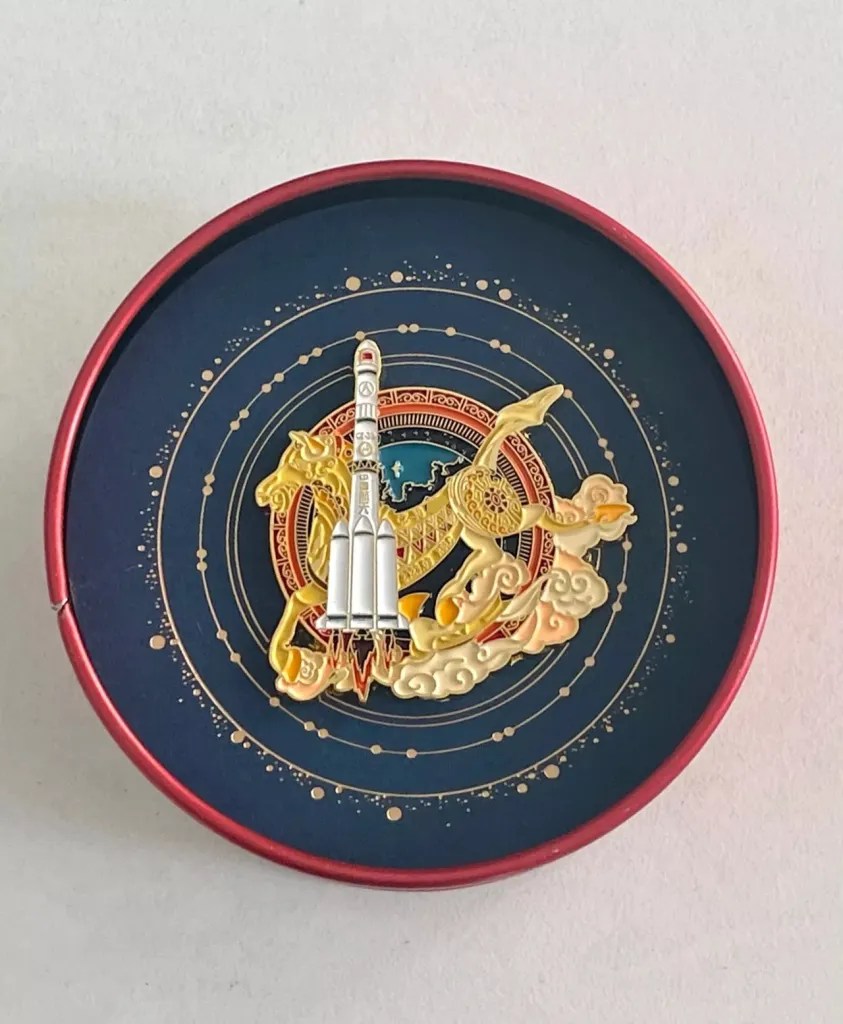
Chang Zheng – Long march 3B  Carrier Rocket yao 90 launches high score 13th No. 02 satellite mission badge: This badge is inspired by the historical allusion of a horse stepping on a flying swallow. Ma Ta Feiyan is a magical and rare treasure in the history of ancient sculpture art in my country. It is a landmark building in Xichang. As an emblem element, it implies the rapid development of China’s aerospace industry and the tenacious and indomitable spirit of astronauts.
The main body of the emblem is the Chang Zheng – Long march rocket, the earth is in the center of the picture, auspicious clouds surround the main body, and the stars mark the launch site, which means that one arrow and one star will be launched from here, and go forward bravely, just like astronauts bravely climbing the peak of science and technology, to write China’s aerospace industry The new chapter dares to overcome all difficulties and obstacles…..

Images and visuals are from their Respectives CMS China Manned SpaceCNSA-China National Space Administration

#CNSA #ChinaNationalSpaceAdministration #国家航天局 |#BRI  #February2023 |#西昌衛星發射中心 #XichangSatelliteLaunchCenter – Successfully launching the advance iconic #ChangZheng3B #LongMarch3B Y93  #CarrierRocket deploying advance # ChinaSat26 #CommunicationSatellite #TelecommunicationSatellite #Satellite  ….

On the 23rd February 2023  in  CNSA _China National Space Administration -China – People’s Republic of China At 1949 hours Hong Kong –Beijing Time China- People’s Republic of China launch the Chang Zheng – Long march 3B Y93  Carrier Rocket launching from station form Xichang Satellite Launch Center Sichuan Province…..Deploying the ChinaSat 26 communication satellite….

This marks the 6th launch of this year is a complete success At 19:49 Hong Kong SAR- Beijing Time  on February 23, 2023, at the No. 2 station of the Xichang Satellite Launch Center successfully launched the ChinaSat 26 communication satellite with the Chang Zheng- Long March 3 B Yao 93 carrier rocket. Launched into space, the satellite successfully entered the predetermined orbit, and the launch mission was a complete success. ChinaSat- Zhongxing 26 satellite is a high-throughput broadband communication satellite in geostationary orbit, using the Dongfanghong-4 enhanced satellite public platform independently developed by China- People’s Republic of China. The satellite is a full Ka-band high-throughput communication satellite with a satellite capacity exceeding 100Gbps. It is my country’s first high-throughput satellite with a capacity exceeding 100 Gbps. This launch is the 463rd launch of the Long March series of launch vehicles.

China- People’s Republic of China largest civil and commercial broadband satellite ChinaSat – Zhongxing 26 will help aircraft connect to the Internet] Zhongxing 26 is a high-throughput broadband communication satellite in full Ka-band geostationary orbit. No. Enhanced Satellite Public Platform. ChinaSat 26 satellite is currently the civil and commercial communication satellite with the largest communication capacity, the most beams, and the most complex in my country, and its communication capacity exceeds 100Gbps. The satellite is equipped with 94 user beams and 11 gateway beams, covering my country’s territory and surrounding areas, and will provide high-speed broadband access services for fixed terminals, vehicle terminals, ship terminals, and airborne terminals.


According to the development goal, ChinaSat-26 satellite can meet the needs of millions of user terminals at the same time, with a maximum communication rate of 450Mbps, and the overall performance of satellite-ground system design and operation services can match the international level. For the first time in China, the satellite fully uses the 27~30GHz frequency band, which is 500MHz wider than the previous communication satellite frequency.

According to Wei Qiang, commander-in-chief of ChinaSat 26 satellite, at the end of 2022, China Satcom and Sichuan Airlines will cooperate to install Viasat airborne Internet equipment on some Airbus A320 aircraft. The 16th satellite-based Ka-band satellite network provides passengers with in-flight Internet services. When passengers use mobile phones, tablet computers, etc. to connect to the Internet in the air, the network runs smoothly and the experience is good. “I believe that with the in-orbit application of the ChinaSat-26 satellite, the breadth and depth of satellite Internet business coverage will be enhanced to a greater extent, and a new era of satellite Internet services in my country will be fully opened.” Wei Qiang said.

Wang Fengchun, the chief engineer of the satellite, said: “With the widening of the frequency, the payload has brought a series of technical difficulties in the product design. This new technology has effectively reduced the load weight and greatly improved the satellite load performance.”

In addition, the development team took “independent controllability of core technology” as their own responsibility, independently innovated and pooled wisdom to tackle key problems, and realized the fourth-generation low-noise amplifier in the Ka-band The localization of various products such as frequency converters and sequential microwave switches has reached the international advanced level in performance and has been included in the payload product spectrum of the Fifth Academy, breaking the long-term dependence on imports and comprehensively improving the localization level of loads.

Images and visuals are from their Respectives…

#CNSA #ChinaNationalSpaceAdministration #国家航天局 |#BRI  #January2023 |#西昌衛星發射中心 #XichangSatelliteLaunchCenter – Successfully launching the advance iconic #ChangZheng2C  #LongMarch2C  #CarrierRocket deploying advance #AsiaPacific6E #APSTAR6E  #CommunicationSatellite #Satellite  ….

On the 13TH January 2023  in  CNSA _China National Space Administration -China – People’s Republic of China At 0210 hours Hong Kong –Beijing Time China- People’s Republic of China launch the Chang Zheng – Long march 2C Carrier Rocket launching from station form Xichang Satellite Launch Center Sichuan Province…..Deploying the  Asia Pacific 6E – APSTAR 6E Satellite ..

The Asia Pacific 6E – APSTAR 6E Satellite this is the first time that China, People’s Republic of China has launched an all-electric high-throughput communication satellite. First, the carrier rocket sends the combination of the satellite and the propulsion module into low-earth orbit, and then the satellite controls the DFH-3E propulsion module to send the satellite to the designated orbit. Then separate from the satellite. In the follow-up, the satellite will rely on its own LIPS-200 electric propulsion system, and after 10 months of orbital ascension, it will finally enter the GEO fixed point….implement the Asia-Pacific 6E communication satellite launch mission at the Xichang Satellite Launch Center at around 2:11 am on January 13 (the first star of the Dongfanghong-3 E platform APSTAR 6E satellite will provide high-speed and convenient high-throughput broadband communication services for Southeast Asia, effectively filling the gap in the broadband communication market in Southeast Asia. The rockets and satellites used in this launch were all developed by China Airlines. This is the 460th launch of the Long March series of launch vehicle

The first communication satellite launched by the Chang Zheng Long March 2C, with a launch weight of 4.3 tons The Asia Pacific 6E launch mission is the first time that the Chang Zheng Long March 2C Carrier rocket is used to launch a communication satellite, and the total weight of the launched payload reaches an unprecedented 4.3 tons (satellite + propulsion module)! This is the heaviest satellite ever launched into orbit by the Chang Zheng-Long March 2C rocket.


In order to meet the mission requirements, the development team specially developed an integrated satellite adapter, which achieved a weight reduction of more than 20%, and further improved the rocket’s existing carrying capacity. ….. At the same time, in this mission, the development team carried out multi-dimensional special research: narrowed the range of the rocket wreckage landing area; improved the rocket attitude stability and control accuracy.

Images and visuals are from their Respectives…