中国空间站On 17th Friday September, 2021, at Hong Kong SAR – Beijing Time morning, the Belt and Road InitiativeCNSA –China National Space Administration CSS China Space Station in which on a three month setting up a new home of the first three Shenzhou 12 crew Takionauts –Chinese Astronauts Nie Haisheng – Liu Boming – Tang Hongbo returned home from their second home landing on safely at Dongfeng Aerospace City district in which landing at Inner Mongolia Region of China – People’s Republic of China…..
Following the next day according to the China Manned Space Engineering Office, at 10:25 on September 18, 2021, Beijing time, the Tianzhou-2 cargo spacecraft separated from the rear port of the space station’s sky and core compartment, and flew around to the forward port to complete the automatic rendezvous and docking. , The whole process lasted about 4 hours. At present, the combination of the core module of the space station and the Tianzhou-2 cargo spacecraft is in good condition. Follow-up will welcome visits from the Tianzhou-3 cargo spacecraft and the Shenzhou-13 manned spacecraft.
Tianzhou-2 will verify the subsequent test cabin transposition The Tianzhou-2 cargo spacecraft will conduct two subsequent tests. One is to cooperate with the robot arm’s transposition test to make a preliminary test for the subsequent experimental cabin transposition. Technical verification. One is to cooperate with the astronauts to conduct manual teleportation tests to verify the control capability of the cargo spacecraft’s own backup control system.
Yang Sheng, the overall chief designer of the Tianzhou-2 cargo system of the Fifth Academy of Aerospace Science and Technology Group: Compared with the space station stage, all the technologies of our entire cargo ship can be fully verified in the Tianzhou-2 mission, including the assembly of the space station. Some key construction technologies can be verified. Yang Sheng, the overall chief designer of the Tianzhou-2 cargo system of the Fifth Academy of the Aerospace Science and Technology Group: After these tasks are completed, it will leave the space station at an opportunity based on its overall consumption and lifespan, and bring the waste back to the atmosphere and burn it. Therefore, Tianzhou 2 should be the cargo spacecraft with the most tasks, and then the most arduous, with a relatively long docking time. We think the entire on-track performance is also very perfect. Tianzhou-2 cargo spacecraft completed circumnavigation and forward rendezvous and docking……the Tianzhou-2 cargo spacecraft separated from the rear port of the space station’s Tianhe core compartment , And fly around to the forward port to complete the automatic rendezvous and docking. The whole process lasts about 4 hours. At present, the combination of the space station’s Tianhe core module and the Tianzhou-2 cargo spacecraft is in good condition, and will successively welcome visits from the Tianzhou-3 cargo spacecraft and the Shenzhou-13 manned spacecraft….
Images and visuals are from Weibo also their respectives.
中国空间站On 17th Friday September, 2021, at Hong Kong SAR – Beijing Time morning, the Belt and Road InitiativeCNSA –China National Space Administration CSS China Space Station in which on a three month setting up a new home of the first three Shenzhou 12 crew Takionauts –Chinese Astronauts Nie Haisheng – Liu Boming – Tang Hongbo returned home from their second home landing on safely at Dongfeng Aerospace City district in which landing at Inner Mongolia Region of China – People’s Republic of China…..
Prefacing the Crew of the Shenzhou 12 manned spacecraft’s return module successfully landed, and three Takionauts exited safely At 13:34 on September 17, 2021, Beijing time, the Shenzhou 12 manned spacecraft’s return module successfully landed at the Dongfeng landing site , The astronauts Nie Haisheng, Liu Boming, and Tang Hongbo who performed the mission safely and smoothly exited the cabin and are in good physical condition. The first manned mission of the space station stage was a complete success. This is the first time that Dongfeng Landing Field has performed a manned spacecraft search and recovery mission.
At 12:43, the Beijing Aerospace Flight Control Center issued a return instruction through the ground measurement and control station, and the orbital module of the Shenzhou 12 manned spacecraft was successfully separated from the return module. After that, the spacecraft returned to the brake engine to ignite, and the return cabin was separated from the propulsion cabin. After the return module successfully landed, the search and rescue team responsible for the search and rescue mission arrived at the landing site as soon as possible. After the return module door was opened, the medical supervision and insurance personnel confirmed that the astronauts were in good health.
The Shenzhou 12 manned spacecraft was launched from the Jiuquan Satellite Launch Center on June 17, and then docked with the Tianhe core module to form a composite. Three astronauts moved into the core module for a three-month stay. During the orbiting flight, two astronauts exiting the cabin were carried out, and a series of space science experiments and technical tests were carried out. In orbit, the Key technologies for the construction and operation of space stations such as on-orbit maintenance. The complete success of the Shenzhou 12 manned mission has laid a more solid foundation for the construction and operation of the subsequent space station.
During the landing moments of Waiting for triumph! The Shenzhou 12 manned spacecraft completed the orbit and radial rendezvous test] According to the China Manned Space Engineering Office, after the Shenzhou 12 manned spacecraft was evacuated, at 13:38 on September 16, 2021, Beijing time, and The space station assembly completed the circumnavigation and radial rendezvous tests, successfully verifying the radial rendezvous technology, and laid an important technical foundation for subsequent manned missions. In the follow-up, the Shenzhou 12 manned spacecraft will re-enter and return as planned. Astronauts Nie Haisheng, Liu Boming, and Tang Hongbo are about to set off to return to the embrace of the motherland- China- People’s Republic of China…
During the that Friday Dongfeng Landing Site, already in place From Shenzhou 1 to Shenzhou 11, the Dongfeng Landing Site of Jiuquan Satellite Launch Center has been serving as a “backup”. Today, they will be the protagonists for the first time, performing the manned spacecraft return cabin search mission. In order to welcome the triumphant victory of the Shenzhou 12 Takionaut crew, the landing field system organized the construction of technical conditions, completed the search and rescue plan design, carried out the search and rescue strategy deduction, and carried out comprehensive and detailed preparations. They are ready! Waiting for the heroes to triumph ….
[“Beijing understands”, you are ready! 】Since the launch of the Shenzhou 12 manned spacecraft, the Beijing Aerospace Flight Control Center has been closely cooperating with various systems to jointly ensure that the crew of astronauts will fly in orbit for more than 90 days, and have completed various scheduled missions. 宇宙员聂海胜刘伯明汤洪波回At present, they have completed many joint debugging and joint testing and joint training, and all the plans have been completed. All the participating personnel have excellent assessments, which will provide reliable support for the safe return of the Shenzhou 12 manned spacecraft …
The Shenzhou manned spacecraft return module parachute was developed by the 508 Institute of the Fifth Academy of Space Science and Technology] In order to protect the astronauts who have been on orbit for 93 days to return home safely, the 508 Institute of the Fifth Academy of Aerospace Science and Technology Group developed high reliability for the Shenzhou 12 spacecraft. And a safe recovery landing system to ensure that the spacecraft returns to the cabin to take the last leg of a stable return. The recovery landing system consists of multiple subsystems, including structure, parachute, landing buffer, program control, pyrotechnics, standard position and other types of products. It integrates light, machinery, electricity, heat, high-energy particles, flexible special textile materials, etc. Many types of advanced technologies. The entire recycling process includes more than 10 process controls. The actions of each program are coherent and interlocking, just like a high-level acrobatics performance, and every link cannot be wrong.
During the 93 days of the Shenzhou 12 spacecraft flying in orbit, the recovery and landing system just waited quietly in the return cabin until the spacecraft’s return cabin passed through the atmosphere and fell freely to a height of 10km above the ground. The static pressure altitude controller judges the altitude. , And issued the recovery system activation signal, the recovery landing system began to work.
The static pressure height controller is only one of the equipment of the program control subsystem. The “behind-the-scenes members” of the entire program control also include recovery distributors, pyrotechnic controllers, program controllers, and travel switches. They have a clear division of labor and each perform its own duties. , Just like different areas of the human brain, through issuing program control command signals, control the “front” actuators to complete the required bombing canopy canopy pull guide umbrella, pull the deceleration parachute, deceleration parachute separation, pull the main parachute, and release the main parachute A series of irreversible actions such as closing the mouth, throwing the heat-proof outsole, turning and hanging.
The 1,200-square-meter parachute cannot be opened all at once when the spacecraft returns to the cabin to land, otherwise the parachute will be broken by the air. The designers of the 508 Research Institute customized a three-level parachute opening program for the spacecraft. First, the two guided parachutes connected in series were opened, and then a deceleration parachute was pulled out by the guided parachute. After working for a period of time, the deceleration parachute is separated from the return cabin, and the main parachute of 1,200 square meters is pulled out at the same time. This series of actions successfully reduced the speed of the spacecraft’s return cabin from the high-speed rail to the speed of ordinary people’s running. In order to prevent the deceleration parachute and the main parachute from being too much force at the moment of opening, both the deceleration parachute and the main parachute adopt the closing technology, that is to say, slow down the process of the umbrella rope from retracting to dispersing, so that the large umbrella of 1200 square meters can be divided. The stage is opened to ensure that the overload of the entire parachute opening process is within the range that the astronauts can bear. The astronauts were able to confirm that the recovery system was working properly because they felt the shaking of this continuous movement.
The heat-proof outsole is the “armor” after the spacecraft enters the atmosphere. After the main parachute is fully opened, the spacecraft will throw away this “armor” when the spacecraft returns to the cabin. The gamma height control device starts to work and emits gamma rays in real time Measure the height from the ground. When the spacecraft’s return cabin drops to a height of 1m from the ground, the gamma meter at the bottom of the return cabin sends a signal to “command” the four reverse thrust engines on the spacecraft’s return cabin to ignite, and give the return cabin an upward force to make the return cabin land. The speed is further reduced, and the astronaut can land safely.
Images and visuals are from Weibo also their respectives.
On the week of 16th September 2021, Thursday Wenchang Spacecraft launch Center –Hainan Province –China – People’s Republic of China.. It was the preparations of CNSA – China National Space Administration– China’s Tianzhou-3 cargo spacecraft to be prepared for this later month or early next month launching of the Long March- Chang Zheng 7Carrier Rocket …长七遥四星星安全运到文昌机场航场 According to the China Manned Space Engineering Office, the Long March 7 Yaosi carrier rocket for the Tianzhou-3 mission has completed all the development work before it leaves the factory. It is in Beijing It will be safely transported to Wenchang Space Launch Site on August 16, 2021. The Long March 7 Yaosi carrier rocket and the Tianzhou-3 cargo spacecraft that have already arrived in advance will carry out the final assembly and testing of the launch site as planned
On September 16 – Thursday, 2021, Hong Kong SAR Beijing time, the combination of the Tianzhou-3 cargo spacecraft and the Chang Zheng Long March -7 Yao-4 carrier rockets was vertically transferred to the launch area. At present, the facilities and equipment of the Wenchang Aerospace Launch Site are in good condition, and various functional inspections and joint tests will be carried out before the launch as planned….
According to the China Manned Space Engineering Office, at 8:56 on September 16, 2021, Beijing time, the Shenzhou 12 manned spacecraft and the space station Tianhe core module successfully implemented separation. Up to now, the Shenzhou 12 astronaut crew has worked and lived in the space station complex for 90 days, setting a record for Chinese astronauts’ space residence time in a single mission. Before separation, the astronaut crew, with the cooperation of ground scientific and technical personnel, completed various tasks before evacuation, such as setting the state of the space station assembly, sorting and downloading experimental data, and clearing and transferring materials on orbit…..Also During this morning, the Shenzhou 12 astronaut crew, with the cooperation of ground scientific and technical personnel, completed the withdrawal of relevant experimental devices and important items in the core module. Before leaving the space station complex, Nie Haisheng, Liu Boming, and Tang Hongbo expressed their gratitude and respect to ground-based scientific and technical personnel and people who care about and support the aerospace industry …..
Today, the combination of the天舟三号 cargo spacecraft and the Chang Zheng- Long March 7 Yaosi carrier rocket has been vertically transferred to the launch area. At present, the facilities and equipment of the Wenchang Aerospace Launch Site are in good condition, and various functional inspections and joint tests will be carried out before the launch as planned. China Aerospace, come on Add Oil ….!
神舟十二号回As of now, the Shenzhou 12 astronaut crew has been working and living in the space station complex for 90 days, refreshing the single flight of Chinese astronauts A record of the mission’s space residence time. Before the separation, the astronaut crew, with the cooperation of ground scientific and technical personnel, completed the pre-evacuation tasks such as setting the state of the space station assembly, sorting and downloading experimental data, and clearing and transferring the orbiting material
The Chinese space station is named “Tiangong”. The basic configuration is composed of three sections: core cabin, experiment cabin, and experiment cabin, in a T-shaped configuration, with the core cabin in the middle, and the experiment cabin and experiment cabin 1 are connected to both sides. The mass of the core cabin, the experimental cabin and the three-chamber combination of the experimental cabin 1 is about 68.5 tons, with a rated crew of 3, and a short-term crew rotation period of up to 6 people. It has the capacity to install and support more than 10 tons of load equipment. The design life is not less than 10 years, and it has the ability to extend the service life through maintenance and repair, and has a certain expansion capability. The core module is named “Tianhe”. It is the management and control center of the space station and the main place for astronauts to live. It supports the development of a small number of space science and technology experiments.
The experiment module is named “Wen Tian”, and its main task is to carry out scientific experiments and technical experiments in the space inside and outside the cabin. It also has the management and control capabilities of the space station. It is also a working and living place for astronauts and an emergency shelter.
Experiment module 1 is named “Mengtian”, and its main task is to carry out scientific experiments and technical experiments in and out of the cabin. It is also a working and living place for astronauts and an emergency shelter. After the construction of the space station is completed, the optical capsule will be launched in common orbit with it
Images and visuals is from Weibo and their Respectives
中国空间站On 9th September, 2021, at Hong Kong SAR – Beijing Time morning, the Belt and Road InitiativeCNSA –China National Space Administration CSS China Space Station in which on a three month setting up a new home of the first three Shenzhou 12 crew Takionauts –Chinese Astronauts Nie Haisheng – Liu Boming – Tang Hongbo … in which on that Thursday Official release! The Stunning photography works taken by the Shenzhou 12 Takionauts in orbit are shocking in incredible stunning photography detail through the China – The China Manned Space Engineering Office officially released the Shenzhou 12 manned mission 3 Takionauts in orbit photography shot 从空间看地球 high-definition pictures . Today, let the “Shenzhen photographers” of the Shenzhou 12 astronaut crew take you to appreciate the shocking beauty of the earth from the first perspective of the Takionauts!
CMS China Manned Space the Manned Space department has Official release from China Manned Space Office! Space Photographer Like the red lake water of PS color, the last tear from the Atlantic Ocean, the “curve” that has been seen after nine years….. The second batch 宇宙员给地球拍写真Takionauts Liu Boming and Tang Hongbo will show you the wonderful rivers and mountains of this world. …..
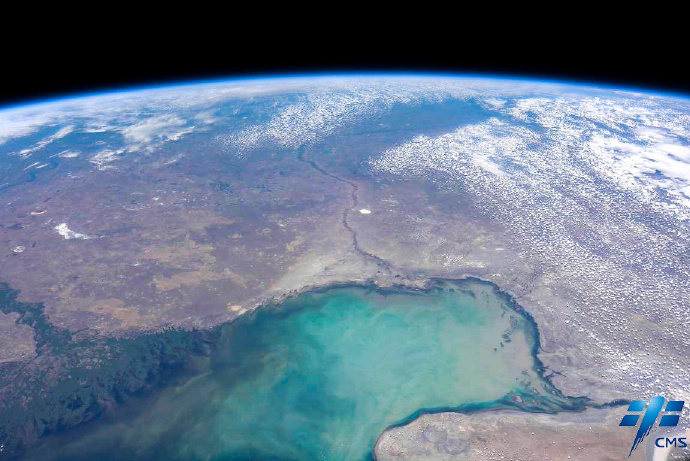
The China Manned Space Engineering Office officially released the second batch of high-definition pictures taken by the Shenzhou 12 astronauts in orbit. Among them, Figures 1-4 and 6 are taken by Shenzhou 12 Takionauts Liu Boming, and Figures 7-8 are taken by Tang Hongbo: Figure 1: The second largest saltwater lake in the world, Urumiya Lake, Iran Figure 2: Northern Xinjiang (Junggar Basin + Sailimu Lake + Tianshan) Mountains) Figure 3: Lake Balkhash and northern Xinjiang Figure 4: Lake Van in Armenia Figure 5/6: Caspian Sea (photographed by Shenjiu astronauts in Figure 5) Figure 7: South Africa Figure 8: Peruvian Plateau and Peru’s fishing grounds
Images and visuals are from Weibo also their respectives.
中国空间站On Tuesday 31st August, 2021, at Hong Kong SAR – Beijing Time morning, the Belt and Road InitiativeCNSA –China National Space Administration CSS China Space Station in which on a three month setting up a new home of the first three Shenzhou 12 crew Takionauts –Chinese Astronauts Nie Haisheng – Liu Boming – Tang Hongbo … in which on that Tuesday Official release! The Stunning photography works taken by the Shenzhou 12 Takionauts in orbit are shocking in incredible stunning photography detail through the China – The China Manned Space Engineering Office officially released the Shenzhou 12 manned mission 3 Takionauts in orbit photography shot 从空间看地球 high-definition pictures . Today, let the “Shenzhen photographers” of the Shenzhou 12 astronaut crew take you to appreciate the shocking beauty of the earth from the first perspective of the Takionauts!
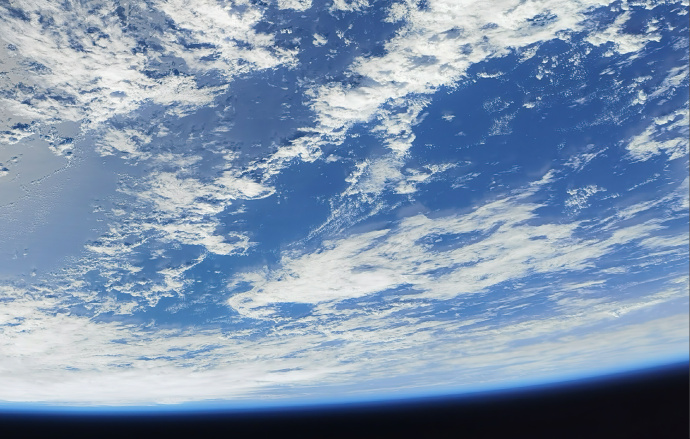
Wow, the home on earth taken by the Shenzhou 12 astronauts is so beautiful! The first 5 photos were taken by Tang Hongbo, and the last 2 photos were taken by Nie Haisheng
The course of incredible resolution definition detail of Gulf of Guinea, Ethiopia Plateau, Beijing, North Africa… These HD pictures, shot by the Taikonauts residing inside China’s space station core module, show people a beautiful star-gazing landscape under-lit by the Earthly glow. Photos are from the Takionaut Center of China….. in which most of the photography was taken over the course of the August 2021 Month..
On August 13, 2021, the weather in the Indian Ocean was still changeable. After completing the manipulator training in the cabin, Tang Hongbo and his two calf dolls waited for the great beautiful rivers and mountains of the motherland ahead….
In the sleeping area of the core cabin of the China Space Station, each of the three sleeping areas has a small porthole. This is Tang Hongbo’s sleeping area. Is this the one with his son’s photo? Photograph by Takionaut Tang Hongbo
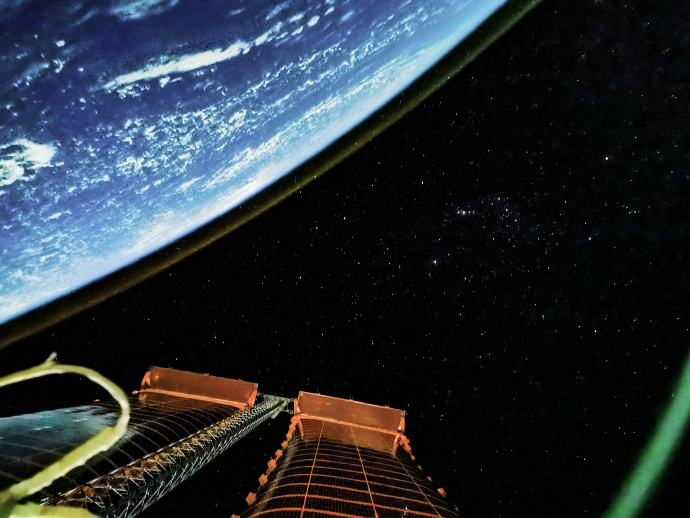
Shenzhou 12 astronaut Nie Haisheng captured the night view of Beijing from the space station The high-definition pictures of the earth and the stars taken by the Takionauts Tang Hongbo and Nie Haisheng on the space station on the Shenzhou 12 spacecraft are amazing! It’s still my own enjoyable..
During the release of the stunning Photography captured by many wondering what photography camera equipment some analysed photography deductively that it was Huawei 5G P40 series pink Smart phone series with SLR range.
Images and visuals are from Weibo also their respectives.