#CNSA #ChinaNationalSpaceAdministration #国家航天局 |#BRI #September2022 | #嫦娥五号#CLEP The #Moon #Change5 #LunarMission #MonsRumker #LunaExploration the New research achievements – Chinese scientists discover new minerals #Changesite on the moon for the first time for the #中秋節 #MidAutumnFestival 2022

More than One year ago on 24th November 2020, the Chang Zheng – Long March Five Carrier Rocket Launched away  in CNSA – China National Space Administration China Wenchang spaceport launch, Change Five  Lunar probe into orbit, opened up towards China – People’s Republic of China’s first celestial bodies sample return trip from Mons Rumker on the Lunar Surface of the moon New research achievements – Chinese scientists reveal the composition of lunar soil minerals and space wind at the landing site of Chang’e 5

Chinese scientists discover new minerals on the moon for the first time ​​The autumn 9th September 2022  today, on the eve of the traditional Chinese festival Mid-Autumn Festival,  in which duration on the 10th  towards 13th  September 2022 the CNSA-   China National Space Administration and the National Atomic Energy Agency jointly released the latest scientific achievements of Chang’e-5. Dong Baotong, deputy director of the National Atomic Energy Agency, announced at the launch event that the new mineral discovered by Chinese scientists on the moon for the first time was named “Chang’e Stone”. This is a major scientific achievement my country has made in the field of space science, and it is also a successful exploration of cross-industry and cross-professional cooperation between nuclear and aerospace.

▲The position of Chang’e stone in the sample

“Chang’e stone” is a phosphate mineral in the form of columnar crystals found in lunar basalt grains. The innovative team of CNNC Beijing Institute of Geology, through a series of high-tech means such as X-ray diffraction, isolated a single crystal particle with a particle size of about 10 microns from 140,000 lunar sample particles, and successfully deciphered it. its crystal structure. Confirmed as a new mineral by voting by the International Mineralogical Society (IMA) New Mineral Classification and Nomenclature Committee (CNMNC). This mineral is the sixth new mineral discovered by humans on the moon, and my country has become the third country in the world to discover new minerals on the moon after the United States and Russia.

▲Microscope photos of lunar samples
▲Scanning electron microscope photo of Chang’e stone and symbiotic minerals

On December 17, 2020, Chang’e 5 returned to Earth with 1,731 grams of lunar samples. The National Space Administration has completed the distribution of 152 lunar samples in four batches totaling 53,625.7 mg, and 98 applicants from 33 scientific research units have passed the application. The fifth batch of lunar samples is being reviewed and will be released according to procedures. The Chinese Academy of Sciences, the Ministry of Education, the Ministry of Natural Resources, China National Nuclear Corporation and other units have been approved to undertake lunar sample research work, and foreign scientists and students have also participated in the joint research. At present, the latest achievements have been made in magma differentiation, space weathering, helium-3 gas and bioenergy conversion, etc., which are useful for understanding the origin and evolution of the moon, exploring the effective use of lunar resources, and realizing “zero energy” extraterrestrial environment and life. The support system has important implications

▲Chang’e Stone Structure The National Space Administration and the National Atomic Energy Agency, as the competent government departments in China’s aerospace and nuclear fields, have always adhered to the principles of “innovative leadership, collaborative efficiency, peaceful development, cooperation and sharing”, adhering to the concept of peaceful use of space and peaceful use of nuclear energy , continue to be committed to the integration of aerospace technology and nuclear technology, continue to explore scientific frontiers in deep space exploration and nuclear technology applications, and make new contributions to promoting the development of science and technology, the emergence of scientific achievements and international cooperation. .

Via CNSA China Space AdministrationCLEP China Lunar Exploration project management office

#CNSA #ChinaNationalSpaceAdministration #国家航天局 |#BeltAndRoadinitiative #September2022 | #WenchangSpacecraftLaunchCenter #文昌航天發射場 | #ChinaSpaceStation #实验舱 #文天 #Wentian #Shenzhou14 crew After the #EVA #Spacewalk first Highlights ….

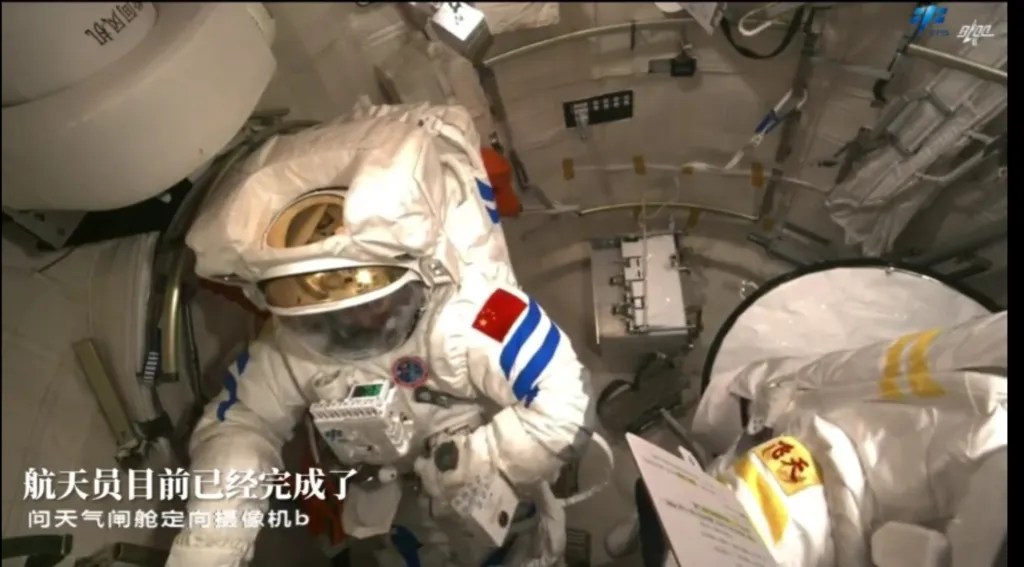
On the 1st September 2022 it is the first Shenzhou 14  EVA Spacewalk for  CNSA –China National Space Administration    China Space Tiangong Space Station .  first exiting  out  is Commander陈冬Chen Dong opened the airlock door of the airlock cabin Today on 1st September 2022 , Takionaut went out of the cabin for the first time….  At 15:48, the Takionauts closed the cabin door of the Wentian module, and then Takionauts Chen Dong and刘洋Liu Yang entered the extravehicular spacesuit successively and carried out various preparations before leaving the cabin. At 18:26, Takionauts Chen Dong opened the airlock door of the Wentian experimental cabin. In the follow-up, Chen Dong and Liu Yang worked outside the cabin, and Cai Xuzhe cooperated and supported in the core cabin, and jointly completed various predetermined tasks such as the installation of the extended pump set in the Wentian experimental cabin and the lifting of the panoramic camera in the Wentian experimental cabin……

Following seven hours least later the Shenzhou 14 Crew successfully completed the first outing EVA Spacewalk  mission At 0:33 Hours on September 2nd  2022, Beijing time, after about 6 hours of out-of-vehicle activities, Shenzhou 14 Takionaut s Chen Dong, Liu Yang, and Cai Xuzhe worked closely together , to complete all the scheduled tasks during the outboard activity, Chen Dong and Liu Yang have returned to the Wentian experimental cabin safely, and the outboard activity was a complete success. This is the first time that Takionauts have exited from the Wentian experimental cabin airlock, and the exit activities are carried out with the assistance of a small robotic arm. During the astronaut’s out-of-vehicle activities, the heaven and earth cooperated closely and the inside and outside of the cabin cooperated closely, and successively completed tasks such as the installation of the extended pump set in the Wentian cabin, the lifting of the panoramic camera in the Wentian cabin, and the verification of the autonomous emergency return outside the cabin. The whole process was smooth and successful, and the inspection the ability of the Takionauts to work together with the small robotic arm has been verified, and the functional performance of the Wentian experimental cabin airlock and related support equipment for exit activities has been verified.

Images and Visuals are from their Respectives…

#CNSA #ChinaNationalSpaceAdministration #国家航天局 |#BeltAndRoadinitiative #September2022 | #WenchangSpacecraftLaunchCenter #文昌航天發射場 | #ChinaSpaceStation #实验舱 #文天 #Wentian #Shenzhou14 crew #EVA #Spacewalk first Highlights

天宫On a Shenzhou 14 first EVA Space Walk outside of the Wentian Module in which : Sharing the beauty of the cabin with the Takionauts  “Wow, the earth is right in front of my eyes, so close, it’s coming towards me.” The Takionaut Chen Dong exclaimed How shocking and stunning is the scenery outside the cabin? From the perspective of the first astronauts of Shenzhou 14 out of the cabin, let us have an overview of the beautiful space and experience the infinite possibilities brought by science and technology!

On the 1st September 2022 it is the first Shenzhou 14  EVA Spacewalk for  CNSA –China National Space Administration    China Space Tiangong Space Station .  first exiting  out  is Commander陈冬Chen Dong opened the airlock door of the airlock cabin Today on 1st September 2022 , Takionaut went out of the cabin for the first time….  At 15:48, the Takionauts closed the cabin door of the Wentian module, and then Takionauts Chen Dong and刘洋Liu Yang entered the extravehicular spacesuit successively and carried out various preparations before leaving the cabin. At 18:26, Takionauts Chen Dong opened the airlock door of the Wentian experimental cabin. In the follow-up, Chen Dong and Liu Yang worked outside the cabin, and Cai Xuzhe cooperated and supported in the core cabin, and jointly completed various predetermined tasks such as the installation of the extended pump set in the Wentian experimental cabin and the lifting of the panoramic camera in the Wentian experimental cabin……

Following seven hours least later the Shenzhou 14 Crew successfully completed the first outing EVA Spacewalk  mission At 0:33 Hours on September 2nd  2022, Beijing time, after about 6 hours of out-of-vehicle activities, Shenzhou 14 Takionaut s Chen Dong, Liu Yang, and Cai Xuzhe worked closely together , to complete all the scheduled tasks during the outboard activity, Chen Dong and Liu Yang have returned to the Wentian experimental cabin safely, and the outboard activity was a complete success. This is the first time that Takionauts have exited from the Wentian experimental cabin airlock, and the exit activities are carried out with the assistance of a small robotic arm. During the astronaut’s out-of-vehicle activities, the heaven and earth cooperated closely and the inside and outside of the cabin cooperated closely, and successively completed tasks such as the installation of the extended pump set in the Wentian cabin, the lifting of the panoramic camera in the Wentian cabin, and the verification of the autonomous emergency return outside the cabin. The whole process was smooth and successful, and the inspection the ability of the Takionauts to work together with the small robotic arm has been verified, and the functional performance of the Wentian experimental cabin airlock and related support equipment for exit activities has been verified.

Images and Visuals are from their Respectives…

#CNSA #ChinaNationalSpaceAdministration #国家航天局 |#BRI #August2022 | #ChinaSpaceStation #TiangongSpaceStation #实验舱 #文天 #Wentian These control torque gyro “big guys” of more than 100 kilograms make the space station “sit like a bell and walk like the wind”

These “big guys” of more than 100 kilograms make the space station “sit like a bell and walk like the wind”

​​CNSA –China National Space Administration …..On July 24, China successfully launched the Wentian Experimental Module at the Wenchang Space Launch Site- Hainan Province- China, People’s Republic of China. As China’s space station is getting bigger and bigger, its attitude control difficulty is unprecedented in my China, People’s Republic of China space flight missions. The Wentian experimental module brought four “big guys” weighing more than 100 kilograms to the sky, and the attitude control of the space station is inseparable from them.


The scientific name of “big guy” is control torque gyro, which is an inertial execution component for spacecraft attitude control. It obtains angular momentum through a high-speed rotating flywheel, and outputs torque by changing the direction of angular momentum. The combined use of multiple control moment gyroscopes can make the space station of more than 100 tons “sit like a bell and walk like the wind” in space.
 

The control moment gyro used in the Chinese space station was developed by the 502 Institute of the Fifth Academy of China Aerospace Science and Technology Corporation. “Configuration. This configuration is the advanced point at the system level of the composite, which can be used together and reconfigured on demand through the overall network.

Six of them have been installed on the outer wall of the connecting cone between the large column section and the small column section of the core module of the space station. The other 6 units have been brought to Tianzhou-4 before, and 4 units have been brought to the Wentian test cabin this time. In the future, Tianzhou-5 will “pick up” another unit. These 6 units will be installed in Wentian Experimental cabin.

​If you count from the preliminary research in 1998, it will be 23 years before the first successful application of the control moment gyroscope used by the space station in orbit by 2021. The development of control torque gyroscope in my country can be described as untold hardships.

6 large control moment gyroscopes installed in the core module of the space station

Self- researched and punched “blockers”

​Thousands of miles…..The control torque gyroscope was once a “stumbling block” for Chinese astronauts. In 1991, my country began to demonstrate the space laboratory and space station projects, and the control torque gyroscope was proposed as a “heavy weapon”. “Core technology cannot be bought”, so , at the beginning of the argument, he firmly chose to be self-reliant.


The 502 Institute of the Fifth Academy of Aerospace Science and Technology Group formed a team to start the technical research and product development of the control moment gyroscope, but the difficulty is beyond everyone’s imagination. As the saying goes, “Thousands of hammers turn into sharp weapons, and every refinement turns them into pure steel”. After going through all kinds of ups and downs and suffering, the team has overcome difficulties for more than 10 years, and they finally succeeded.


China’s first control torque gyro was launched in 2011 with Tiangong-1. Its on-orbit application is a milestone in the development of China’s space electromechanical components, making China the third country in the world to master this technology .

The Takionauts of Shenzhou 14 set up control moment gyroscopes in orbit

From “stumbling blocks” to technological peaks

​Starting from Tiangong-1, the Fifth Academy of Aerospace Science and Technology Group has developed a series of control torque gyroscope products for larger and smaller spacecraft applications. However, unlike the application of control torque gyroscopes on other spacecraft, space station missions have higher requirements ——


The control torque gyroscopes of other spacecraft are installed in the cabin, and the working environment is relatively simple, while the control torque gyroscopes on the space station need to adapt to the two working environments inside and outside the cabin at the same time, which brings great challenges, especially for more than 200 degrees The temperature difference, the developers have to carry out a special thermal control design. For products in the cabin, vibration and noise reduction work has also been carried out.

​As the most complex space electromechanical product, the control torque gyroscope has a harsh working environment and long service life. In order to ensure the life and reliability of the space station, the control torque gyroscope needs to have the ability to be replaced on-orbit, so it is necessary to carry out on-orbit maintenance and ergonomic design verification work. In order to meet the requirements of long life and high reliability at the same time, it is also necessary to consider redundant backup issues in the design.


The space station mission takes the use of control moment gyroscopes on Chinese spacecraft to a new level . The stumbling block turned into a technological peak.

Product type spectrum development

In the years after Tiangong-1, the Fifth Academy of Aerospace Science and Technology Group has successively developed a full range of control torque gyroscope products to meet the attitude maneuver and attitude control requirements of various space vehicles in my country.


Compared with the first-generation products from the Sky, the newly developed control torque gyroscope has greatly improved the control accuracy. It has the advantages of high precision, fast response, long life and high reliability, and can meet the attitude control requirements of various space vehicles in China, People’s Republic of China


The application of the series of products has significantly improved the attitude maneuvering and attitude stability control capabilities of my country’s space vehicles, enabling satellites to see more accurately and widely, and one can be used more than one. The development and application of control moment gyroscopes have also promoted the rapid development of space inertial actuators in China, People’s Republic of China.

来源:中国载人航天工程办公室 航天科技集团五院 

文/薛英民 李刚

编辑/杨成 赵聪

校对/高一鸣

监制/黄希

Images and visuals are from their respectives.

#CNSA #ChinaNationalSpaceAdministration #国家航天局 |#BeltAndRoadinitiative #August2022 | #WenchangSpacecraftLaunchCenter #文昌航天發射場 | #ChinaSpaceStation #TiangongSpaceStation- Celebrating 30th anniversary of the implementation of China’s manned space project with activities … “Hand in Hand, Looking at the Heavenly Palace” youth and manned spaceflight face-to-face activity

Friends, the Takionauts are calling you to “Wangtian Palace”!

On Hainan Province –China –People’s Republic of China…. in the district area of the Wenchang – Wenchang Spacecraft launch center in which the awesome team at one of many CNSA –China National Space Administration  that China National Space Administration…………… On 24th July 2022

After Wentian experimental module entered orbit, the status setting was successfully completed. At 3:13 on July 25, 2022, Beijing time, it was successfully connected to the forward port of 天和 Tianhe Core Module. The entire rendezvous and docking process lasted about 13 hours. . This is the first time that two 20-ton spacecraft in my country- China- People’s Republic of China have achieved rendezvous and docking in orbit. …According to the mission plan, the Shenzhou 14 Takionaut crew will then enter the Wentian experimental module….. In which finally docked in early morning time of the 25th July 2022 in with CNSA –Beijing Aerospace City in which co-ordinated the docking maneuverers have achieved rendezvous and docking in orbit.…   in which the crew of the Shenzhou 14 staying for six months in construction of the stage one of the China Space station with the additional Mengtian experimental module in which will be delivered on the October 2022 Launch Schedule calendar..

Announcement on the online solicitation of the “Hand in Hand, Looking at the Heavenly Palace” youth and manned spaceflight face-to-face activity

Do you still remember the unprecedented “Heavenly Palace Painting Exhibition” on New Year’s Day this year? Remember last year’s “Youth and Stars Conversation” between children in the Midwest and Takionauts aunts and uncles? Do you still remember the “Global Shooting Heaven Palace” event that became popular on the Internet since last year? Do you want to send your own paintings into space as well? Do you want to take a photo of “Heavenly Palace” with your hometown? Do you want to send a letter to Takionauts uncles and aunts? Want to go to the launch site to watch the rocket launch? Now the opportunity is here, scan the QR code in the text or log in to the manned space engineering website (website: www.cmse.gov.cn ) , as well as the client of People’s Daily, Xinhua News Agency, and CCTV news client to participate in the “Hands-on” Let’s hold hands and look at the Heavenly Palace” face-to-face activity between young people and manned spaceflight!

2022 is the 30th anniversary of the establishment of China’s manned space project and the decisive year for the construction of China’s space station. The dream of building China’s own space station is about to become a reality. In order to fully demonstrate the historic achievements and historic leaps made by the motherland’s aerospace industry since the 18th National Congress of the Communist Party of China, and to further guide the young people to establish lofty ideals, strengthen China’s self-confidence, fortify their will to struggle, and promote the spirit of science, they will now face the The whole society carried out a face-to-face activity between young people and manned spaceflight of “Hand in Hand, Looking at the Heavenly Palace”. The event was guided by the China Manned Space Engineering News and Publicity Office, hosted by the China Aerospace Foundation, and undertaken by the No. 208 Institute of the Second Research Institute of China Aerospace Science and Industry Corporation. Online collection activities such as “Tiangong Painting Exhibition” and “Juvenile Photographing Tiangong”, continue to carry out the “Going to Heaven with Dreams” activities, and collect “a letter to Takionauts.”. The selected works of the above activities will be displayed publicly at the Chinese Space Station. The award-winning authors will have the opportunity to watch the rocket launch at the launch site and conduct dialogues and exchanges with the Takionauts.

Young people are welcome to participate actively, join hands to realize the dream, and witness the historical moment of the completion of the construction of the Chinese space station! Please refer to the attachment for the specific requirements of the event.

appendix:

1. Requirements for the second “Tiangong Painting Exhibition”

2. Requirements for the collection of works of “Juvenile Photographing the Heavenly Palace”

3. “A Letter to Astronauts” Letter Call Requirements

Source from the CNSA China National Space Administration –CMSE China Manned Space

Images and visuals are from Weibo also their respectives..