#CNSA #ChinaNationalSpaceAdministration #国家航天局 |#BeltAndRoadinitiative #July2022 | #嫦娥五号#CLEP The #Moon #Change5 #LunarMission #MonsRumker #LunaExploration the Magical Chang’e 5″ #PopularScienceDocumentary Officially Released in #Beijing…

More than One year ago on 24th November 2020, the Chang Zheng – Long March Five Carrier Rocket Launched away  in CNSA – China National Space Administration China Wenchang spaceport launch, Change Five  Lunar probe into orbit, opened up towards China – People’s Republic of China’s first celestial bodies sample return trip from Mons Rumker on the Lunar Surface of the moon in which now on the week of 12th July a new series Popular Science Documentary named the “The Magical Chang’e 5” Popular Science Documentary Officially Released in Beijing- China – People’s Republic of China…  

 .……  

On July 12th 2022, the popular science documentary “The Magical Chang’e 5” jointly produced by the National Space Administration and the China Association for Science and Technology was officially released in Beijing. Shu Wei, secretary of the Secretariat of the China Association for Science and Technology, and Dong Baotong, deputy director of the National Space Administration, attended the press conference and delivered speeches. Hu Hao, the chief designer of the third phase of the lunar exploration project, and relevant comrades from the China Association for Science and Technology, the National Space Administration, the Space Foundation, and the engineering research and development units attended the conference- press conference.

On December 17, 2020, the Chang’e 5 mission, the third phase of the lunar exploration project, obtained 1,731 grams of lunar samples and returned to Earth, realizing the millennium dream of the Chinese nation “to embrace the moon in nine days”, and promoting human lunar sample research into the “Chang’e Era”. Chang’e 5 is not only a historical achievement of scientific and technological innovation, but also has a very high value for popular science. Show the lunar exploration journey of Chang’e 5 in the way of popular science, and tell the technological breakthrough of Chang’e 5 in the language of popular science, give full play to the social efficiency of major projects, and promote the process of popularization of scientific and technological resources.

Scientific and technological innovation and scientific popularization are the two wings to realize innovation and development. The popular science documentary “The Magical Chang’e 5” focuses on the key links of the Chang’e 5 mission from launch to home. It reproduces the magical journey of Chang’e’s lunar exploration in the form of records + popular science, and uses the form of documentary + animation It describes the scientific principles of Chang’e’s lunar exploration, which is a beneficial exploration of the combination of scientific and technological innovation and scientific popularization.
 

At the press conference, three senior consultants of the lunar exploration project sent messages via video. Academician Luan Enjie, the first commander-in-chief of the lunar exploration project, said that our lunar exploration project has embarked on a lunar exploration road with Chinese characteristics. Academician Ouyang Ziyuan, chief scientist of the Chang’e-1 lunar application system, said that “The Magical Chang’e-5” is China’s first all-round, multi-dimensional and three-dimensional science popularization work based on the lunar exploration project. Academician Ye Peijian, chief designer and commander of the Chang’e-1 probe, said that the core technology can only rely on self-reliance. They believe that “The Magical Chang’e 5” will surely plant spiritual seeds in the hearts of young people and take our exploration to a deeper space.

Via CNSA China Space Administration –CLEP China Lunar Exploration project management office

#CNSA #ChinaNationalSpaceAdministration #国家航天局 |#BeltAndRoadinitiative #June2022 | #嫦娥五号#CLEP The #Moon #Change5 #LunarMission #MonsRumker #LunaExploration Announcement The new results reveal the distribution characteristics of lunar surface water in the landing area. The lunar soil contains water in the form of hydroxyl groups …

More than One year ago on 24th November 2020, the Chang Zheng – Long March Five Carrier Rocket Launched away  in CNSA – China National Space Administration China Wenchang spaceport launch, Change Five  Lunar probe into orbit, opened up towards China – People’s Republic of China’s first celestial bodies sample return trip from Mons Rumker on the Lunar Surface.……  

[The new results of Chang’e 5 reveal the distribution characteristics of lunar surface water in the landing area. The lunar soil contains water in the form of hydroxyl groups]

On June 15, “Nature Communications” published an important research result of my country’s Chang’e 5 online.
Whether there is water on the moon, how much water there is, what form of water it is, and where the water comes from is controversial, and it has always been a research hotspot in lunar science. At the beginning of the Chang’e-5 mission project demonstration, the research team proposed to extend the spectral range of the lunar mineral spectrometer on the lander to 3.2 μm, and realized the first in-situ detection of the spectral absorption characteristics of lunar surface water in the world. In order to avoid the impact of the dynamic “water” (hydroxyl OH) when the engine plume and the solar wind bombard the lunar surface on the in-situ spectral analysis, the research team carefully designed the timing of acquiring the in-situ detection spectral data. The detection timing was selected 6 hours after landing to avoid the influence of the engine plume composition when the CE-5 probe landed; The dynamic “water” of the lunar surface; the moon (landing zone) is under the protection of the earth’s magnetic field during the spectral measurement, which shields the solar wind and avoids the dynamic “water” (hydroxyl OH) factor produced by the bombardment of the solar wind. In this environment, the Chang’e-5 spectrometer can obtain a “clean” absorption spectrum of “water”. After strict correction and analysis, the research team found that the lunar soil in the Chang’e-5 landing area obviously contains “water” in the form of hydroxyl groups. But the average content is low, only about 30ppm.


At present, it is believed that there are three main sources of lunar “water”: one is (dynamic) hydroxyl substances produced by the interaction between solar wind particles and lunar surface materials; the other is water and hydroxyl-containing substances brought by comets or meteorites that hit the moon; Lunar primary (internal) water. After the lunar samples were returned to Earth, the research team conducted a systematic analysis of the returned lunar samples in the laboratory. The laboratory spectral analysis once again verified the clear existence of hydroxy water, but the research on the existence form, content and source of “water” requires detailed research. Mineral petrological analysis. The Apollo lunar sample study believes that the (impact) cemented glass in the lunar soil contains hydroxyl substances formed by the long-term injection of the solar wind, and the content of cemented glass is an important factor affecting the “water” content in the lunar sample. Laboratory analysis of the returned samples showed that the Chang’e 5 lunar sample is a type of young basalt with a very small content of cemented glass (less than 16%), which is only 1/3 of the Apollo 11 lunar sample, so it is estimated that the Chang’e 5 lunar soil sample The “water” from the solar wind injected into the cemented glass is not more than 18ppm. At the same time, the foreign impact sputters in the lunar soil samples of the Chang’e-5 landing area are very low, and their contribution to “water” can be ignored. Therefore, there must be primary water originating from the interior of the moon in the Chang’e-5 lunar soil samples. Laboratory analysis of the Chang’e-5 lunar samples found at least one hydrous mineral, hydroxyapatite, whose content was uneven, ranging from 0 ppm to 179 ppm (average about 17 ppm) in equivalent samples of hydroxy water, proving that The presence of “water” from the magma crystallization process in the Chang’e-5 lunar soil samples indicates that “water” not only existed, but also played a very important role in the late lunar magmatic activity.


The lunar in-situ detection spectral data of this research result were obtained by the Lunar Mineral Spectrum Analyzer developed by the Shanghai Institute of Technical Physics, Chinese Academy of Sciences. The operation management, data reception and processing of the scientific detection load were carried out by the National Astronomical Observatory of the Chinese Academy of Sciences (Lunar Exploration Engineering Ground Application System).

Via CNSA China Space Administration –CLEP China Lunar Exploration project management office

#CNSA #ChinaNationalSpaceAdministration #国家航天局 |#BeltAndRoadinitiative #May2022 | #WenchangSpacecraftLaunchCenter #文昌航天發射場 | #ChinaSpaceStation #ChangZheng5B Longmarch5B Carrier Rocket arrives at Wechang Space Launch Center for实验舱#Wentian #ExperimentalCabinModule ….

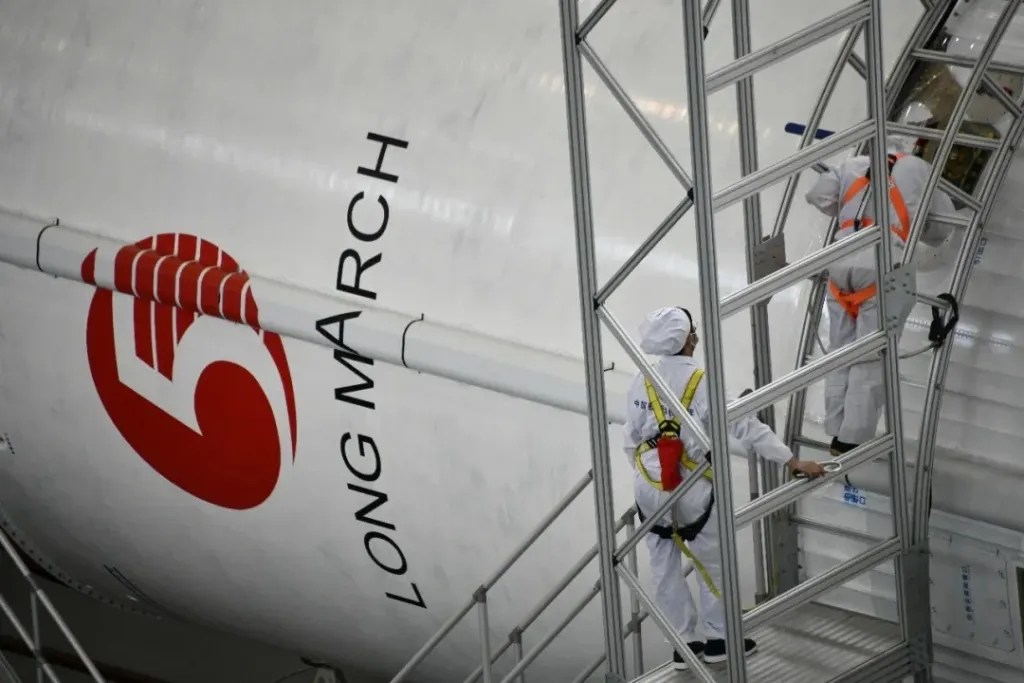
On Hainan Province –China –People’s Republic of China…. in the district area of the Wenchang – Wenchang Spacecraft launch center in which the awesome team at one of many CNSA –China National Space Administration  that China National Space Administration…………… On May 29th 2022 The Chang Zheng- Long March 5B Yao three carrier rocket arrived at Wenchang Space Launch Site safely] According to the China Manned Space Engineering Office, the Long March 5B Yaosan carrier rocket that carried out the launch mission of the Wentian experimental module has completed all the research and development work before leaving the factory.

Arrived safely at Wenchang Space Launch Site on after that, Chang Zheng- Long March 5B Yao three carrier rocket will carry out the final assembly and test work at the launch site together with the Wentian experimental module that arrived earlier. At present, each participating system in the launch site area is carrying out mission preparations as planned….  

According to the China Manned Space Engineering Office, Chang Zheng- Long March 5B Yao three carrier rocket that carried out the launch mission of the Wentian experimental module has completed all the research and development before leaving the factory.

The work will be safely delivered to Wenchang Space Launch Site on May 29, 2022. After that, the Long March 5B Yaosan carrier rocket will carry out the final assembly and test work at the launch site together with the Wentian experimental module that arrived earlier.

中国空间站 On currently on May 2022, the Belt and Road Initiative CNSA –China National Space Administration  the two extensions modules of Tiangong China Space Station are now ready and verify certified in which forms the right and left parts of the Tiangong China Space Station in which completion of the China Space Station is expected to finalised its construction in the late 2022 year.. 

On the 24th May 2022 on the Earliest Morning the components of the Chang Zheng – Long March 5B Carrier Rocket has arrived at the Wechang Qinglan Port in Hainan Province – China – People’s Republic of China.. of the Chang Zheng –Long March Carrier Rocket Cargo ship of Yuanwang 21 and Yuanwang 22… in which it was previously left from Tianjin….

It was on at about 8:00 a.m. on 19th May 2022, Beijing time, two rocket carriers, Yuanwang 21 and Yuanwang 22, set sail from Tianjin Port, targeting Hainan Wenchang Qinglan Port, and are expected to arrive on the 24th.

Chang Zheng –Long March Carrier Rocket Cargo ship Yuanwang 21 and Yuanwang 22 transporting the Long March 5B Yao 3 carrier rocket are being loaded in Tianjin Port Yuanwang 21 entered the inner berth of Tianjin Port on 14th  May  2022  to load the rocket transport container, and completed loading and evacuated on 16th  May 2022  After leaving the berth, Yuanwang 22 then entered the berth to load the remaining containers, which are expected to be fully loaded by tomorrow morning.

Previously As of May 2022 both The experimental cabin is progressing smoothly, waiting for the launch The Wentian experimental cabin to be launched in July is ready for finally and the Mengtian experimental cabin is also making corresponding preparations.

After the construction of the China Space Station is completed, the two experimental cabins will be the main working places for astronauts in orbit. In both experimental cabins, space science experiments and technical experiments in the sealed cabin and outside the sealed cabin can be carried out. Both cabins are equipped with The load test cabinet inside the cabin and the load installation platform outside the cabin also provide support and guarantee measures such as information, power supply and heat dissipation, and can carry out experiments in various fields such as space science, space materials, space medicine and space exploration.


  The Wentian experimental module is equipped with the same Taikonauts’ living facilities as the core module, including 3 sleeping areas, 1 sanitary area, kitchen and other facilities, which can guarantee the astronauts’ life. It can also work with the core module to support the life of 6 astronauts during the rotation of the two manned spacecraft; in addition, a small robotic arm is also configured, which can be used alone or in combination with the large robotic arm of the core module. , to jointly complete the tasks of Taikonauts leaving the cabin, caring for extravehicular facilities, and patrolling. In addition, the Wentian experimental cabin is also equipped with an astronaut exit airlock. After the space station is completed, the airlock of the Wentian experimental cabin will be As the main airlock cabin for astronauts to leave the cabin, the node cabin of the core cabin is used for other functions at this time, just as a backup; the Wentian experimental cabin also has a backup section for the core cabin to manage and control the assembly. That is to say, when the function of the core module platform fails, it can be switched to the Wentian experimental module to exercise the combined control and management functions, which can improve the reliability of the space station as a whole.


  The Mengtian experimental cabin is equipped with a cargo airlock and an outboard deployment test platform. In the future, the scientific test equipment that needs to be installed outside the cabin can be transported to the space station through a cargo spacecraft, and then the load will be sent to the outside of the cabin through the cargo airlock, and the robotic arm or astronaut will install it on the platform outside the cabin. Realize the continuous update of the extravehicular test project.

Images and visuals are from their respectives.

#CNSA #ChinaNationalSpaceAdministration #国家航天局 |#BeltAndRoadinitiative #May2022 | #CMS #ChinaMannedSpace #ChinaSpaceStation the awaiting extension of #TianheCoreModule #实验舱 #Mengtian #实验舱#Wentian #ExperimentalCabinModule #ChangZheng5B #LongMarch5B CarrierRocket as arrived at #WenchangSpacecraftLaunchCenter …..

中国空间站 On currently on May 2022, the Belt and Road Initiative CNSA –China National Space Administration  the two extensions modules of Tiangong China Space Station are now ready and verify certified in which forms the right and left parts of the Tiangong China Space Station in which completion of the China Space Station is expected to finalised its construction in the late 2022 year.. 

On the 24th May 2022 on the Earliest Morning the components of the Chang Zheng – Long March 5B Carrier Rocket has arrived at the Wechang Qinglan Port in Hainan Province – China – People’s Republic of China.. of the Chang Zheng –Long March Carrier Rocket Cargo ship of Yuanwang 21 and Yuanwang 22… in which it was previously left from Tianjin….

It was on at about 8:00 a.m. on 19th May 2022, Beijing time, two rocket carriers, Yuanwang 21 and Yuanwang 22, set sail from Tianjin Port, targeting Hainan Wenchang Qinglan Port, and are expected to arrive on the 24th.

Chang Zheng –Long March Carrier Rocket Cargo ship Yuanwang 21 and Yuanwang 22 transporting the Long March 5B Yao 3 carrier rocket are being loaded in Tianjin Port Yuanwang 21 entered the inner berth of Tianjin Port on 14th  May  2022  to load the rocket transport container, and completed loading and evacuated on 16th  May 2022  After leaving the berth, Yuanwang 22 then entered the berth to load the remaining containers, which are expected to be fully loaded by tomorrow morning.

As of May 2022 both The experimental cabin is progressing smoothly, waiting for the launch The Wentian experimental cabin to be launched in July is ready for finally and the Mengtian experimental cabin is also making corresponding preparations.


After the construction of the China Space Station is completed, the two experimental cabins will be the main working places for astronauts in orbit. In both experimental cabins, space science experiments and technical experiments in the sealed cabin and outside the sealed cabin can be carried out. Both cabins are equipped with The load test cabinet inside the cabin and the load installation platform outside the cabin also provide support and guarantee measures such as information, power supply and heat dissipation, and can carry out experiments in various fields such as space science, space materials, space medicine and space exploration.


  The Wentian experimental module is equipped with the same Taikonauts’ living facilities as the core module, including 3 sleeping areas, 1 sanitary area, kitchen and other facilities, which can guarantee the astronauts’ life. It can also work with the core module to support the life of 6 astronauts during the rotation of the two manned spacecraft; in addition, a small robotic arm is also configured, which can be used alone or in combination with the large robotic arm of the core module. , to jointly complete the tasks of Taikonauts leaving the cabin, caring for extravehicular facilities, and patrolling. In addition, the Wentian experimental cabin is also equipped with an astronaut exit airlock. After the space station is completed, the airlock of the Wentian experimental cabin will be As the main airlock cabin for astronauts to leave the cabin, the node cabin of the core cabin is used for other functions at this time, just as a backup; the Wentian experimental cabin also has a backup section for the core cabin to manage and control the assembly. That is to say, when the function of the core module platform fails, it can be switched to the Wentian experimental module to exercise the combined control and management functions, which can improve the reliability of the space station as a whole.

  The Mengtian experimental cabin is equipped with a cargo airlock and an outboard deployment test platform. In the future, the scientific test equipment that needs to be installed outside the cabin can be transported to the space station through a cargo spacecraft, and then the load will be sent to the outside of the cabin through the cargo airlock, and the robotic arm or astronaut will install it on the platform outside the cabin. Realize the continuous update of the extravehicular test project.

Images and visuals are from their respectives.

#CNSA #ChinaNationalSpaceAdministration #國家航天局 |#BeltAndRoadinitiative #March2021 | International Iconic #CarrierRocket #LongMarch5B #ChangZheng5B engine testing before assembly launch of the are getting ready for the #CMS #ChinaMannedSpaceflight #CSS #ChinaSpaceStation #SpaceStationConstruction…..


On 28th February 2021 Sunday on a nearby Rocket engine testing facilities nearby the VAB – Vertical Assembly building of the CNSA – China National Space Administration– Wenchang Space Craft launch Center – Hainan Province – China – People’s Republic of China…  The Long March 5B launch vehicle high thrust hydrogen oxygen engine completed a 520-second test run to further verify the optimized engine performance to ensure China the launch mission of the core module of the space station went smoothly. It is reported that this spring, my country will launch the Tianhe core module with the Long March 5B Carrier Rocket …..

This round of test runs is to further verify the optimized engine performance to ensure that the mission of the Long March 5B Yao-2 carrier rocket launching the core module of the space station is on schedule..

With the High-thrust hydrogen-oxygen engine completed 520-second long-distance test run On February 28th 2021……..  the  high-thrust hydrogen-oxygen engine completed a 520-second long-distance test run in Yungang, Beijing. This is the fifth long-distance test run of the engine successfully. The cumulative test duration of the same engine reached 2520 seconds, which greatly improved the reliability of the high-thrust hydrogen-oxygen engine.


In the future, the engine will undergo three long-distance test runs of 500 seconds, and the cumulative test run time will reach about 4000 seconds by then, further verifying the reliability of the high-thrust hydrogen-oxygen engine……

Previously on 2021 January there’s three types of Long March-Chang Zheng Carrier Rocket series in its final stages of assembly in which is undertaking one of the construction of the CNSA –China National Space Administration CMS China Manned Spaceflight Belt and Road Initiative CSS China Space Station in which will core module be launched on during this year 2021 spring launch calendar ….

In which there are three series  Long March rocket undertaking the mission of the China Space Station will debut again 中国空间站 Core module will be launched next spring China Academy of Launch Vehicle Technology is responsible for the development of the Long March 2F, Long March 7 and Long March 5B launch vehicles………  According to the plan, the Long March 2F, Long March 7 and long March 5B three-type carrier rockets will respectively undertake the launch missions of manned spacecraft, cargo spacecraft and the core cabin of the space station. During the festival, the final assembly test of the Type III rocket is being carried out in an orderly manner in Beijing and Tianjin.

The Long March 2 F Yao 13 carrier rocket is undergoing testing in the final assembly plant. The test team has established a “chief command” system to coordinate and guarantee resources to ensure close cohesion and orderly progress. This type of rocket plans to complete the final assembly test after the Spring Festival.

The Long March 7 Yaosan launch vehicle is undergoing final assembly. The model team strictly follows the requirements of refined final assembly to ensure that all operations and tests are done correctly and well at a time. At present, the rocket final assembly is progressing smoothly.

In the Tianjin General Assembly Test Plant, the Long March 5B Yao-2 launch vehicle has just completed its test, and the model team is preparing for the rocket’s work before it leaves the factory to ensure that the rocket is shipped to the launch site as planned…..

Images and visuals are from Weibo.