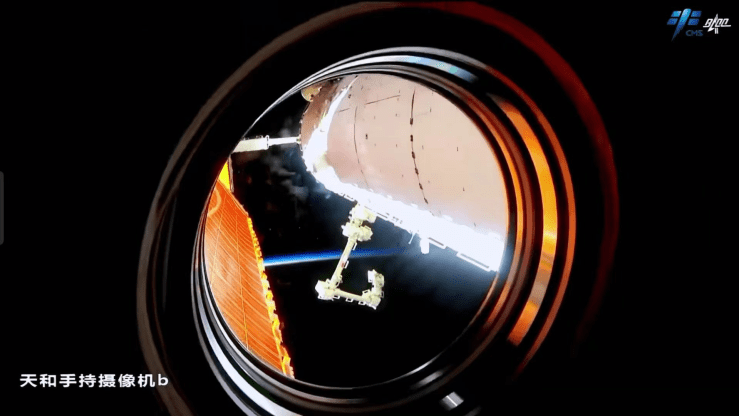
#CNSA #ChinaNationalSpaceAdministration #国家航天局 |#BRI #July2023 | #天宫 #Tiangong #ChinaSpaceStation #神舟十六号 #Shenzhou16 #Takionaut #景海鹏 #JingHaPeng will rise to the 11th place in total flight time! Preparing to leave the cabin for the first time…

On the 30th  May 2023 clear 0931 Hours Morning Hong Kong SAR- Beijing time , the Belt and Road InitiativeCNSA –China National Space Administration from Jiuquan Satellite Launch Center – Inner Mongolia –China – People’s Republic of China deployment of  the Chang Zheng – The Chang Zheng – Long March 2F Yao 16 –Shenzhou 16  carrier rocket.. On which Takionauts Jing Haipeng, Zhu Yangzhu, and Gui Haichao took to the predetermined orbit. The first manned flight mission in the application and development stage was a complete success. The three astronauts will stay in the space station and “join up” with the crew of Shenzhou 15 to carry out on-orbit handover “face-to-face” meeting in which brings the total crew of six with a handover ceremony from Shenzhou 15 towards 16..

As of 09:31 on July 16, 2023, “Shenzhou 16” Takionauts Jing Haipeng, Zhu Yangzhu, and Gui Haichao have been flying for 47 days. The total flight time ranking is undergoing a new change.

Takionaut Jing Haipeng has carried out four manned missions including “Shenzhen 7”, “Shenzhen 9”, “Shenzhen 11” and “Shenzhen 16”. long Takionaut. The “Shenzhen VII” spacecraft ignited and took off at 21:10 on September 25, 2008, and landed at 17:37 on September 28. The flight time of the astronauts Zhai Zhigang, Liu Boming and Jing Haipeng was 2 days, 20 hours and 27 minutes. From 18:37 on June 16, 2012 to 10:05 on June 29, astronauts Jing Haipeng, Liu Wang, and Liu Yang carried out the “Shenzhen Nine” mission in 12 days, 15 hours and 28 minutes. From 07:30, October 17, 2016 to 13:59, November 18, 2016, Takionauts Jing Haipeng and Chen Dong partnered to carry out the “God 11” mission, with a flight time of 32 days, 6 hours and 29 minutes. Before the “God 16” mission, the total flight time of Jing Haipeng’s first three missions was 47 days, 18 hours and 24 minutes.
As of 16:07 on July 16, 2023, Jing Haipeng’s total flight time will reach 95 days and 1 hour, surpassing Liu Boming and ranking 11th among Chinese Takionauts. Liu Boming has carried out two missions including “Shenzhen 7” and “Shenzhen 12”. The total flight time was 95 days and 35 minutes.

During the period when the “Shenzhen XVI” crew was in orbit, large-scale space science experiments were carried out on a rolling basis, and the work of space application systems such as the out-of-cabin installation of the space radiation biology exposure experiment device in the “Mengtian” experimental cabin has been completed as planned. At the same time, the “Shenzhen XVI” crew is preparing for the first out of the cabin, which will be the first out of the third batch of astronauts, who will perform it? What extravehicular work will be done?

Images and visuals are from their Respectives CMS China Manned SpaceCNSA-China National Space Administration

CNSA #ChinaNationalSpaceAdministration #國家航天局 |#BRI  #July2023 | #火星 # 天問 #天问一号#TianwenOne #MarsMission #Tianwen1 probe  #祝融号 #ZhuRong stunning Martian landscape new stunning photography during the year 2022  before Hibernation  #AGallery

天问一号飞運騎遊達达3亿CNSA – China National Space Administration – ESA – European Space agency Belt and road initiative mars mission…first Mars exploration mission, Tianwen- Martian Probe OneAs of September 15, 2022, the Tianwen-1 orbiter has been in orbit for more than 780 days, and the rover has travelled a total of 1,921 meters, completed the established scientific exploration tasks, and obtained 1,480 GB of original scientific exploration data. The scientific research team has obtained rich scientific results through the research on the first-hand scientific data obtained independently by my country. Through a comprehensive study of typical landforms such as concave cones, barrier craters, and trenches distributed in the landing area, the important connection between the formation of the above-mentioned landforms and water activities has been revealed.

朱融号  Zhurong Mars Rover The photos taken by the Mars rover before hibernation for one month (April 22), maybe this is the posthumous work…..The mosaic pictures of other scenes taken by Zhurong are all 50% of the original picture, and they were taken on January 29, March 3, March 14 and April 12, 2022.

It is worth mentioning that Figure 4 is the last batch of pictures from the navigation terrain camera of the Zhurong Mars rover currently released, and it may also be the last batch of photos from the Zhurong rover that we can see in the days to come Original..

Data source: The fourth batch of scientific exploration data of Tianwen-1 released by China Planetary Exploration Engineering Ground

On February 17, 2022, the Zhu Rong discovered an interesting-looking bunker (Figure 1). The ground around it is full of gravel, and most of it is sand here. On February 19th, the Zhurong sailed close to it to investigate it. Figure 2 is a collage of photos of the bunker taken on the side.


Source of original data: The fourth batch of scientific exploration data of Tianwen-1 released by China Planetary Exploration Engineering Ground Application System on July 3, 2023​​​​….

A selfie taken by the Zhu Rong rover on January 12, 2022, showing the back cover of the lander on the distant horizon.

Source of original data: The fourth batch of scientific exploration data of Tianwen-1 released by China Planetary Exploration Engineering Ground Application System on July 3, 2023​​​​….

Four images of the surface of Mars acquired by the Tianwen-1 orbiter’s medium-resolution camera between January and February 2022. Do these four pictures look familiar to you? A little hint: the main scenery in the four photos are Peacock Mountain (Pavonis Mons), Arsia Mountain (Arsia Mons), Matt crater (Marth crater) on the Arabian Highlands (Arabia Terra) and Mount Elysium ( Elysium Mons).

That’s right, this is the documentary “Hello! Original images of the four photos of Mars in the opening credits of each episode of Mars. With the advancement of the Mars global image mapping work in 2022, the medium-resolution camera imaging area gradually moves southward to the middle and low latitudes. We have seen more and more shocking Mars photos, and we will slowly share them with you.

Original data source: The fourth batch of scientific exploration data of Tianwen-1 released by the China Planetary Exploration Engineering Ground Application System on July 3…

Tharsis Tholus, taken by the medium-resolution camera of Tianwen-1 on January 26, 2022, is a small shield volcano at 90.69° west longitude and 13.25° north latitude on Mars. Source of original data: The fourth batch of scientific exploration data of Tianwen-1 released by China Planetary Exploration Engineering Ground Application System on July 3, 2023

Tractus Catena, long and narrow in the Arcadia region of the northern hemisphere A group of pits located between the Alba Mountains and the Asklaw Mountains, with a total length of nearly 900 kilometers.
This picture is made by mosaicing 21 orbiter medium-resolution camera (MoRIC) images, taken from February to March 2022-detection cycle 845,998, and processed using OpenCV, SKImage, and Lr. [CAS/GRAS, CNSA/PEC; export production

Noctis Labyrinthus (Noctis Labyrinthus), taken by the medium-resolution camera of the Tianwen-1 orbiter on February 21, 2022, is a complex canyon in the western section of the Grand Canyon Mariners on the surface of Mars, shaped like a maze. In fact, the Latin name Labyrinthus of this type of landform means “maze at night”, and the Chinese translation of some places is directly called “maze”. Data source: The fourth batch

of scientific exploration data of Tianwen-1, the ground application system of China Planetary Exploration Engineering

The Tianwen-1 medium-resolution camera took the wind-eroded landform on the surface of Mars at 65.4° east longitude and 5.1° north latitude on February 17, 2022 (40% original resolution). Each impact crater bears traces of wind erosion, as if meteors flew over the surface of Mars. The reason for this landform is the accumulation of wind and sand formed under the action of the prevailing wind direction. The fourth batch of scientific exploration data of Tianwen-1 released by China Planetary Exploration Engineering Ground Application System on July 3, 2023.

Images and visuals are from their respectives  CNSA China National Space AdministrationCLEP China Lunar Exploration Program.

#CNSA #ChinaNationalSpaceAdministration #国家航天局 |#BRI #July2023 | #天宫 #Tiangong #ChinaSpaceStation #CMS #ChinaMannedSpace #神舟十六号 #Shenzhou16 16 Crew working on Space science experiments are rolling…. 14th July 2023

On the 30th  May 2023 clear 0931 Hours Morning Hong Kong SAR- Beijing time , the Belt and Road InitiativeCNSA –China National Space Administration from Jiuquan Satellite Launch Center – Inner Mongolia –China – People’s Republic of China deployment of  the Chang Zheng – The Chang Zheng – Long March 2F Yao 16 –Shenzhou 16  carrier rocket.. On which Takionauts Jing Haipeng, Zhu Yangzhu, and Gui Haichao took to the predetermined orbit. The first manned flight mission in the application and development stage was a complete success. The three astronauts will stay in the space station and “join up” with the crew of Shenzhou 15 to carry out on-orbit handover “face-to-face” meeting in which brings the total crew of six with a handover ceremony  from Shenzhou 15 towards 16..

On the 14th July 2023 CNSA China National Space Administration – Tiangong – China Space Station Shenzhou 16 Crew With the completion of the construction of the third module of China’s space station in orbit and the efficient operation of the National Space Laboratory, astronauts in the space station closely cooperate with ground scientific research personnel to carry out large-scale space science on a rolling basis experiment. The Shenshiliu group has recently carried out fluid physics experiments and set up a cold atom interferometer.

Images and visuals are from their Respectives CMS China Manned SpaceCNSA-China National Space Administration

#CNSA #ChinaNationalSpaceAdministration #国家航天局 |#BRI #July2023 | #酒泉卫星发射中心#JiuquanSatelliteLaunchCenter launched on the International Icon #ChangZheng2C  #LongMarch2C  YZ-1S #CarrierRocket successfully launch China Star Network’s #TestSatellite #InternetSatellite  …

On the 9th July 2023 clear 1900 Hours Hong Kong SAR- Beijing time , the Belt and Road InitiativeCNSA –China National Space Administration launching from Jiuquan Satellite Launch Center – Inner Mongolia –China – People’s Republic of China deployed launched the Chang Zheng – The Chang Zheng – Long March 2C YZ-1S carrier rocket.. This launch is the 478st launch of the Long March series of launch vehicles. successfully launch the satellite Internet technology test satellite into space, and the satellite entered the schedule smoothly Orbit, the launch mission was a complete success.

【The number of launches of Chang Zheng- Long March 2C Carrier Rockets  this year will hit a new high】During this mission, the rocket realized the interconnection between the Beijing remote test network system and the remote auxiliary test and launch system of Jiuquan Satellite Launch Center for the first time, and it can be launched in the Beijing remote measurement and control hall Remote auxiliary support for the final assembly, testing, and launch of rockets at the launch site, reducing the time and cost of personnel traveling to and from the launch site, and improving launch efficiency.

At 19:00 on July 9, 2023, Beijing time, our country used the Long March 2C/Yuanzheng 1S launch vehicle at station 94 of the Jiuquan Satellite Launch Center , the satellite Internet technology test satellite was successfully launched into space, and the satellite successfully entered the predetermined low-earth orbit, and the launch mission was a complete success.
The satellite Internet technology test double star launched this time was developed by the General Department of Communication and Navigation Satellite of the Fifth Academy of Aerospace Science and Technology…

The upper stage of Yuanzheng-1S for this mission:
1) Adopt a new curved grid transition section, which reduces the weight by 35%, improves the rocket’s carrying capacity, reduces the section installation interface, and optimizes the final assembly operation process.


2) The measurement system adopts the space-ground-based integrated measurement and control mode for the first time, which can freely switch the space-based and ground-based measurement and control time according to the mission requirements, and has the ability to measure and control the whole process without blind spots, which greatly improves the task adaptability.


This mission is the fifth space launch of the Chang Zheng- Long March 2C Carrier Rockets  in 2023. In the second half of the year, the Chang Zheng- Long March 2C Carrier Rockets  continued to maintain a high-intensity launch situation. In 2023, the Chang Zheng- Long March 2C Carrier Rockets launches will hit a new high.

The Chang Zheng- Long March 2C/Yuanzheng 1S successfully launched China Star Network’s first test star mission badge This badge is one of the small series of space mission badges “upper level”. The outline of this series of badges is unified with the fairing The shape of this badge accurately corresponds to the shape of the fairing assembled by the Changer C rocket.

The background of the badge is selected from Jiuquan Western Han Dynasty Monument, also known as Quanhu Park, which is the only well-preserved Chinese-style garden in the Hexi Corridor
This launch mission is:
The 1st launch of China Aerospace in July 2023 (all successful)
The 5th launch of Long March 2C in 2023 (all successful)
The 12th launch of the First Aerospace Academy in 2023 (all successful) )
The 20th launch of Aerospace Science and Technology in 2023 (all successful)
The 26th launch of China Aerospace in 2023 (all successful)
The 101st global space launch in 2023 (95 successful)
The 198th launch of Jiuquan Satellite Launch Center (183 successes)
The 5th flight of the upper stage of Yuanzheng-1S (all successes)
The 70th launch of the Long March 2C carrier rocket (69 successes)
The first hospital grasped the 290th launch of the Long March rocket (276 Success)
The 478th launch of the Long March series of launch vehicles (461 successes)
The 148th consecutive successful launch of the Long March series of launch vehicles 🔺The
532nd launch of China’s launch vehicles (499 successes)

Images and visuals are from their Respectives CMS China Manned SpaceCNSA-China National Space Administration

#CNSA #ChinaNationalSpaceAdministration #国家航天局 |#BRI #July2023 #CMS #ChinaMannedSpace #Shenzhou10 #Shenzhou13 #Takionaut #王亞平 #WangYaping inspiring the youth in  the 2023 International Youth Exchange Conference….

CNSA China National Space AdmistratonCMS China Manned Space Shenzhou ten and thirteen Senior Colonel Takionaut王亞平Wang Yaping inspiring the youths , students who listened to her lectures have now become her teammates On the morning of July 7th, the 2023 International Youth Exchange Conference was held at Jinan opened, and Takionaut Wang Yaping spoke at the opening ceremony. She told the story of how a student from Tiangong classroom became her teammate. Wang Yaping said that many students who attended the class in the past devoted themselves to the aerospace industry of the motherland. , I think this is the happiest thing for me as a space teacher, and it is also the biggest motivation for me to continue to spread knowledge and inspire dreams for young people in the future.

  Images and visuals are from their respectives- CNSA –China National Space Administration respectives