On the 0813 30th December 2023 Saturday Hours Hong- Kong SAR – Beijing time CNSA –China National Space Administration , China, People’s Republic of China. Successfully launched the Chang Zheng- Long March 2C/Yuanzheng 1S Jiuquan Satellite Launch Center, Inner Mongolia, China, People’s Republic of China, and then successfully launched a new advance satellite internet technology.
The Long March 2C/Yuanzheng 1S carrier rocket ignited and took off at the Jiuquan Satellite Launch Center, and then successfully sent the satellite Internet technology test satellite into the predetermined orbit. This year, all 48 space missions of the launch vehicles developed by China Aerospace Science and Technology Corporation were a complete success. The satellite Internet technology test satellite was developed by the Fifth Academy of China Aerospace Science and Technology Corporation.
“Long March 2C” is a medium-sized two-stage room-temperature liquid launch vehicle developed by the First Academy of China Aerospace Science and Technology Corporation. Its main power uses dinitrogen tetroxide/uniform dimethylhydrazine (N2O4/UDMH) propellant. The arrow is about 42.3 meters long, with a first and second stage diameter of 3.35 meters, a take-off mass of 241 tons, and a take-off thrust of about 302 tons. Its low-Earth orbit transport capacity is 4 tons, and the maximum transport capacity in the 500-kilometer sun-synchronous orbit is 2 tons. When paired with the “expedition” In the “No. 1 S” upper stage state, the 700-kilometer sun-synchronous orbit has a transport capacity of 2.5 tons…
The “Yuanzheng-1″ commercial/”Yuanzheng-1S” (YZ-1S) upper stage was developed by the First Academy of Aerospace Science and Technology and was improved on the basis of the “Yuanzheng-1” upper stage. The upper stage has a diameter of 2.8 meters, is equipped with a YF-50D engine, uses dinitrogen tetroxide/uniform dimethyl hydrazine propellant, has 2 ignition capabilities, a vacuum thrust of about 0.66 tons, and a vacuum specific impulse of about 316 seconds. This upper stage is mainly aimed at short-term flight missions. It has system optimization and equipment streamlining based on the “Yuanzheng-1” upper stage. Its weight and cost are greatly reduced, and its working time is shorter. After being separated from the basic stage, it can immediately The ignition was accelerated and the entire flight mission was completed within one hour.
Since its successful first flight, the “Yuanzheng-1” commercial upper stage has carried out a total of 7 launch missions, all of which were carried out in conjunction with the “Chang 2-C” rocket. The “Chang 2C” rocket, paired with the “Yuanzheng-1S” upper stage, can perform various orbital launch missions such as low-Earth orbit, sun-synchronous orbit, geosynchronous transfer orbit, and earth-moon transfer orbit, and has the ability to launch multiple satellites in different orbits.
This launch is the 9th launch of the “Long March 2C” rocket in 2023, the 36th launch of the Jiuquan Satellite Launch Center, the 67th launch of China, and the 220th launch of the world. At the same time, this launch is also the final battle between China’s aerospace industry and the world’s aerospace industry this year. The total number of China’s space launches this year reached a record-breaking 67, and the total number of world space launches reached a new high of 220.
This mission is the 505th flight of the Long March series of launch vehicles.
深蓝航天 Deep Blue Limited – Deep Blue Aerospace One of sixty Chinese private space Carrier Rocket Companies in China-People’s Republic of China… As many of sixty plus Private Rocket Deep Blue Aerospace Co., Ltd. was established in 2017. The company is mainly a high-tech aerospace enterprise that focuses on the direction of liquid recovery and reusable launch vehicles and provides users with commercial launch services. Deep Blue Aerospace Co., Ltd. is headquartered in Nantong City, Jiangsu Province. At the same time, the company has rocket general and liquid engine R&D centers in Yizhuang, Beijing and Xi’an, Shaanxi, respectively, and a rocket power system test base in Tongchuan, Shaanxi…..
On December 1st 2023, the Blue Arrow Aerospace Zhuque Suzaku- 2 Yaosan liquid oxygen methane carrier rocket was successfully transferred to the launch area and is preparing to select an opportunity to carry out the launch mission in the near future. The launch is sponsored by PopMart ..
POP MART is a market-leading character-based entertainment company and a global champion of designer toy culture.
The world’s liquid oxygen methane rocket successfully entered orbit for the second time! Zhuque-2 takes the lead in entering the commercial launch stage
At 07:39 Hong Kong SAR- Beijing time on December 9th , 2023, the ” Suzaku -Zhuque-2″ Yao-3 carrier rocket carrying the three satellites “Honghu”, “Tianyi 33” and “Honghu-2” was ignited from the Jiuquan Satellite Launch Center Blue Arrow Space Launch Site Launched, the satellite was successfully placed into a sun-synchronous orbit (SSO) at an altitude of 460 kilometers.. Launching from酒泉卫星发射中心Jiuquan Satellite launch Center, Inner Mongolia, China, People’s Republic of China .
The “Honghu” satellite is a 50-kilogram-class space science experimental satellite independently developed by Tianyi Research Institute. It is mainly equipped with a comprehensive electronic load, a xenon Hall propulsion load, and a krypton Hall propulsion load. It will complete the Hall propulsion orbit control function and Performance verification, comprehensive electronic load device and switch life verification and other tasks. The “Tianyi 33” satellite is a 50-kilogram space science experimental satellite jointly developed by the Tianyi Research Institute and Hunan University of Science and Technology. It is equipped with a remote sensing camera module and a number of new technology payloads.
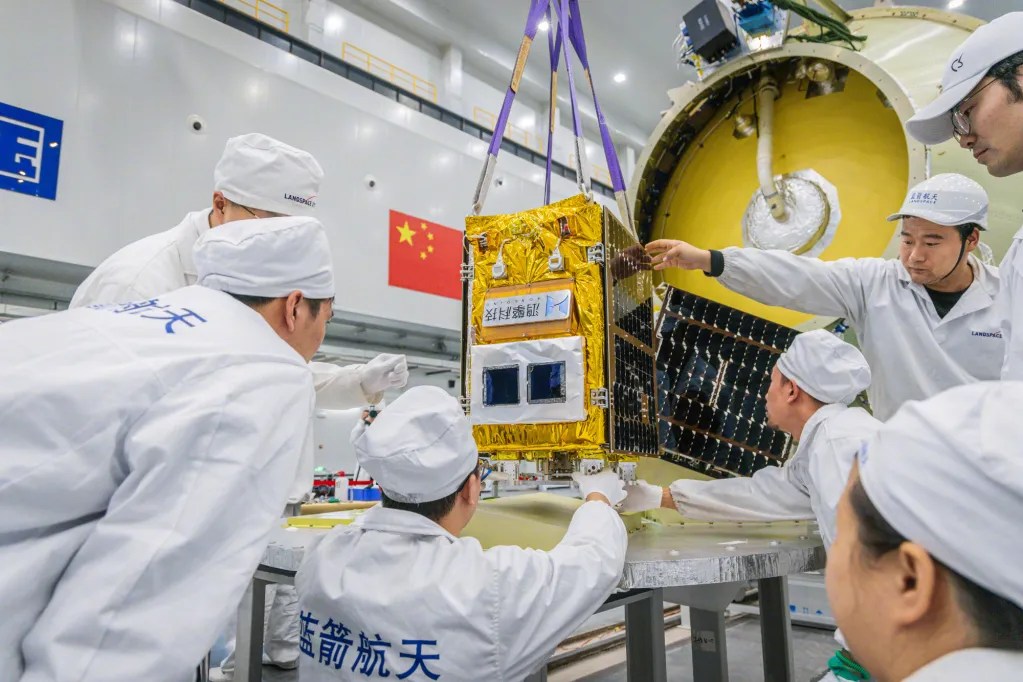
“Honghu 2” is an experimental satellite developed by Shanghai Blue Arrow Hongqing Technology Co., Ltd. for low-orbit satellite constellation networking. It is equipped with a Hall electric propulsion system (xenon and krypton), a satellite integrated electronic system, and a new solar array. Innovative technologies such as self-developed products, on-orbit verification of large-scale orbit changes of satellites, high computing power operations on satellites, and new solar technologies provide technical support for my country’s satellite constellation networking.
Honghu satellite is a 50kg space science experimental satellite independently developed by Tianyi Research Institute. The satellite is mainly equipped with a comprehensive electronic payload, a xenon Hall propulsion load, and a krypton Hall propulsion load developed by Shanghai Blue Arrow Hongqing Technology Co., Ltd. It will complete the Hall propulsion orbit control function and performance verification, comprehensive electronic payload devices and Tasks such as switch machine life verification. This launch will be the first time that my country has used xenon and krypton permanent magnet electric propulsion systems to achieve a cumulative 100-kilometer-level orbit control test. It also plans to complete nearly 3,000 hours of on-orbit ignition testing and a 10,000-time switch life of the Hall electric propulsion system. verify.
The Honghu satellite is also equipped with the “Xingcheng II” argon ion thruster developed by Xingcheng Huiyu (Beijing) Technology Co., Ltd.
The cost of this type of thruster is much lower than that of xenon and krypton. It is developed based on ion propulsion technology, with ionization and acceleration separated. The specific impulse can reach 1500s and the thrust adjustment range is large. At the same time, due to its integrated and centralized layout Designed for easier satellite installation and control. This type of thruster has high reliability and cost-effectiveness, and can be widely used in orbit control scenarios such as orbit entry, network attitude adjustment, and deorbiting of micro-satellites, which can significantly reduce the deployment cost of satellite constellations. This flight is the second on-orbit verification of this type of thruster. It mainly conducts on-orbit tests such as electromagnetic control, ignition, working and shutdown processes, and temperature measurement and control under long-term working conditions. It will provide support for the development and application of subsequent products. Provide technical support.
Tianyi 33 satellite is a 50kg space science experimental satellite jointly developed by Tianyi Research Institute and Hunan University of Science and Technology. The satellite is equipped with a remote sensing camera module and a number of new technology payloads, and for the first time adopts a number of Tianyi independent research and development platform technologies, which can provide more reliable temperature control, thermal protection and energy guarantee conditions for the normal on-orbit work of the payload. In particular, the satellite adopts newly developed thermal control technology to achieve precise temperature control of the satellite in the restricted space of space. The temperature control accuracy design value is better than 0.5°C. The temperature control energy consumption is expected to be reduced by more than 50%, and it can achieve high temperature Sensitive scientific research loads provide reliable environmental protection. At the same time, high-performance composite materials are also applied to the multiple layers of the Tianyi 33 satellite, which further improves the satellite’s radiation protection capabilities.
In terms of power supply, the Tianyi 33 satellite adopts the high-power long-term power supply technology independently developed by Tianyi for the first time, which enables the satellite to support the normal startup of high-current loads and meet the needs of uninterrupted on-orbit testing of the load. The Tianyi 33 satellite is also equipped with a scientific research load independently developed by Beijing University of Posts and Telecommunications based on the open source real-time dual-core operating system RROS as the underlying architecture and based on the Rust language. This load will complete general tasks represented by tensorflow/k8s and real-time tasks represented by real-time file system and real-time network transmission on the satellite, and ensure the normal execution of upper-layer applications and scientific research tasks, such as satellite-to-ground delay measurement, Live video broadcast, satellite-based web chat service, pseudo-ssh experiment, etc. This marks the world’s first dual-core operating system written in Rust to be officially applied in satellite scenarios. While taking into account versatility and real-time performance, RROS achieves high security and low power consumption, better adapts to satellite scenarios and supports the complex application requirements of satellite payloads, and provides operating system guarantees for the next generation of standardized and universal satellite platforms.
“ZhuQue-2” (ZhuQue-2) is a medium-sized two-stage dual-cryogenic liquid launch vehicle independently developed by Blue Arrow Aerospace Company. The first and second stages all use liquid oxygen methane engines. The rocket is equipped with four “Tianque-12” (TQ-12) engines in the first stage, with a single thrust of 658.5 kilonewtons (about 67 tons) at sea level and a sea level specific impulse of 286 seconds. The four “Tianque-12” engines are combined in parallel. The body code is “Tianque-13” (TQ-13); the secondary main engine is a “Tianque-12” (TQ-12) engine, with a vacuum thrust of 776.5 kN (about 79 tons) and a vacuum specific impulse of 350 seconds. , equipped with a swimming engine “Tianque-11”, using a four-combustion chamber design, a vacuum thrust of 80 kN (about 8.2 tons), a vacuum specific impulse of 333 seconds, a “Tianque-12” and a “Tianque-12” The Que-11 combination is codenamed “Tianque-16” (TQ-16).
TheZhuque Suzaku- 2 Yaosan liquid oxygen methane carrier rocket is 49.5 meters long, with a diameter of 3.35 meters for the first and second stages and a fairing. It has a take-off mass of 220 tons (not including payload), a take-off thrust of 268 tons, and a 500-kilometer sun-synchronous orbit (SSO) capacity of 1.5 tons. It is an improved version. The 500-kilometer sun-synchronous orbit capacity will be increased to 4 tons, which can meet the needs of satellite deployment and spacecraft launch in low-Earth orbit.
Zhuque Suzaku- 2 Yaosan liquid oxygen methane carrier rocket Yaosan is the third rocket of the first batch of “Suzaku-2”. The three test arrows fully verified the correctness and coordination of the overall and sub-system plans of the “Zhuque-2”, and accumulated flight samples and a good data basis for subsequent design improvements and reliability improvements of rocket and engine products. , laying a solid foundation for the development of the “Suzaku-3” reusable liquid oxygen methane launch vehicle. This launch is the world’s first official commercial launch of a liquid oxygen methane rocket.
This launch is the second launch of the “Suzaku-2” rocket in 2023, the 31st launch of the Jiuquan Satellite Launch Center, the 58th launch of China, and the 201st launch of the world.
On the 1210 Noon 4th December 2023 Monday Hours Hong- Kong SAR – Beijing time CNSA –China National Space Administration , China, People’s Republic of China. Successfully launched the Yonggan 33 Remote Sensing satellite with the Chang Zheng- Long March 2C Jiuquan Satellite Launch Center, Inner Mongolia, China, People’s Republic of China, and then successfully launched a new Egypt on the Egypt-2 satellite project
[The Long March 2C carrier rocket successfully launched the Egypt Satellite 2]
At 12:10 Beijing time today, my country successfully launched the Egypt Satellite 2 using the Long March 2C carrier rocket at the Jiuquan Satellite Launch Center. According to the agreement between China and Egypt on the Egypt-2 satellite project, China has developed and launched for Egypt a small optical remote sensing satellite with a resolution of 2 meters (panchromatic)/8 meters (multispectral);
Using satellites aided by the Chinese government The final assembly and integration test center conducts final assembly and testing of the satellite; after on-orbit delivery, it will serve Egypt’s land and resource utilization, water conservancy, agriculture and other fields. This launch is the 499th launch of the Long March series of launch vehicles…
Entering the predetermined orbit, the launch mission was a complete success. This mission also carried and launched the second group of Xingchi-1 satellites A and B. The Egypt-2 satellite is mainly used for Egypt’s land and resources census and meets the needs of Egyptian users in the fields of agriculture, forestry, urban construction, environment and disaster monitoring. The two satellites launched are mainly used to provide commercial remote sensing services to users.
The Egypt-2 satellite uses the CAST1000 platform independently developed by the Aerospace Dongfanghong Satellite Co., Ltd. of the Fifth Academy of Aerospace Science and Technology as the satellite platform. It strictly controls the key links to improve image quality and selects high-performance technology that has been verified in orbit. The quality-independent and reliable core detector strengthens the high-quality control of the satellite-ground integrated indicator system in the entire process of satellite design, analysis, testing, and testing.
On November 2nd , 2023, the factory review meeting of the Egypt-aided Satellite 2 was held at the China Academy of Space Technology and passed the factory review as planned. Leaders of the International Economic Cooperation Affairs Bureau of the Ministry of Commerce and leaders of the Earth Observation and Data Center of the National Space Administration, the project management unit, attended the meeting and delivered speeches.
Experts attending the meeting watched a documentary report on satellite development, listened to the “Summary Report on the Development and Quality of the Egypt-2 Satellite Aid” made by the satellite chief engineer, and conducted discussions and questions. The review expert group believed that the Egypt-aided Satellite 2 had successfully completed all development and testing work, met relevant quality supervision requirements, and agreed to pass the factory review.
The meeting pointed out that the Egypt-2 satellite project is a landmark project for pragmatic cooperation between China and Egypt, the transformation and upgrading of China-Africa cooperation, and the promotion of high-quality development of the joint construction of the “Belt and Road”. A concrete manifestation of joint action. Since the start of the project, the general contractor and the management unit have cooperated sincerely to overcome the impact of the epidemic and overcome difficulties, and the work results have been hard-won. The successful implementation of the project has achieved many “firsts” in the history of China-Egypt cooperation and is of milestone significance.
As a satellite project that adopts a foreign aid management model, the Egypt-2 satellite project has written a new chapter in international cooperation in my country’s satellite projects. As a project management unit, on the basis of strict quality management and project management, the center will continue to manage the follow-up satellite launch, on-orbit testing and delivery stages, continue to expand the breadth and depth of China-Egypt aerospace cooperation, and build a new era for the new era. The China-Egypt community with a shared future continues to contribute its space capabilities.
深蓝航天 Deep Blue Limited – Deep Blue Aerospace One of sixty Chinese private space Carrier Rocket Companies in China-People’s Republic of China… As many of sixty plus Private Rocket Deep Blue Aerospace Co., Ltd. was established in 2017. The company is mainly a high-tech aerospace enterprise that focuses on the direction of liquid recovery and reusable launch vehicles and provides users with commercial launch services. Deep Blue Aerospace Co., Ltd. is headquartered in Nantong City, Jiangsu Province. At the same time, the company has rocket general and liquid engine R&D centers in Yizhuang, Beijing and Xi’an, Shaanxi, respectively, and a rocket power system test base in Tongchuan, Shaanxi…..
On December 1st 2023, the Blue Arrow Aerospace Zhuque Suzaku- 2 Yaosan liquid oxygen methane carrier rocket was successfully transferred to the launch area and is preparing to select an opportunity to carry out the launch mission in the near future. The launch is sponsored by PopMart ..
POP MART is a market-leading character-based entertainment company and a global champion of designer toy culture.
We have set foot in more than 23 countries and regions through our network of 350+ offline stores and 2000+ Roboshops catering to a diverse audience of cultural pioneers and art fans. Some of our best-known characters include MOLLY, The Monsters, DIMOO, Skullpanda and others – each created by one of our artist friends and regular collaborators.
Through global artist development, IP operations, designer toy culture evangelism, and strategic investments, we have built an integrated platform covering the entire designer toy value chain, allowing artists to focus solely on their craft and giving stage to talent from all over the world.
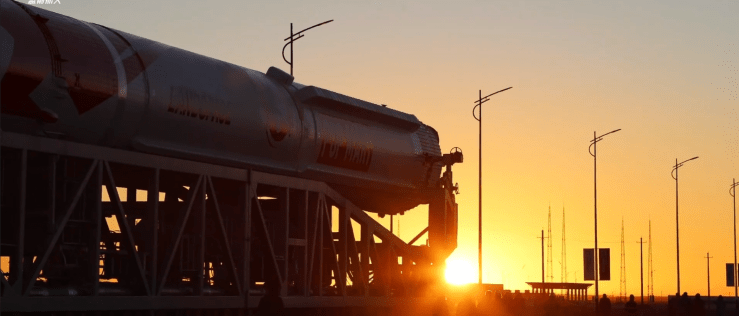
[The third rocket of Blue Arrow Aerospace Suzaku 2 has been transferred and erected and will be launched in the near future]
After the successful go-around, this launch is a key launch and is expected to officially carry commercial payloads. Therefore, it is also possible to carry out research on transportation capacity and orbit accuracy. further test.
It can be seen from the video that domestic private rockets are basically transported by road, and road transportation can easily exceed the 3.35-meter special train limit when conditions permit. It is estimated that it is more difficult for private companies to obtain special trains.
At present, the mainstream next-generation liquid launch vehicles that should be privately operated are basically aiming at a diameter of more than 4 meters, especially the 4.2-meter diameter of Interstellar, which has already passed through some launch sites.
LandSpace – Blue Arrow’s Suzaku 3 has not been officially announced, but the diameter must be more than 4 meters. I am sure that with this diameter, the entire diameter of the passage should have been passed. At present, the two are mainly Jiuquan and Wenchang. As long as they can support a diameter of more than 4 meters, this will be very advantageous for the development of my country’s rockets.
[Chinese Rockets Are Stunningly Beautiful]
Blue Arrow Aerospace has just shared photos of the Zhuque-2 Yaosan-3 rocket being tested and transferred to the launch station at the Jiuquan Satellite Launch Center.
I have to say that the desert scenery and high-tech products are really beautiful.
Blue Arrow Aerospace is a private aerospace enterprise in my country (really private, not a national team vest). Zhuque 2 is a medium-sized liquid oxygen methane rocket (fueled by natural gas), with a total length of 49.5 meters and a diameter of 3.35 meters. The design goal is to be able to carry 6 tons Objects are sent into Earth orbit.
On July 12 this year, the Zhuque-2 Yao-2 rocket was successfully launched, becoming the world’s first liquid oxygen methane rocket to enter orbit…..
On the 1155 morning 16TH November 2023 Thursday Hours Hong- Kong SAR – Beijing time CNSA –China National Space Administration , China, People’s Republic of China. Successfully launched the Yonggan 33 Remote Sensing satellite with the Chang Zheng- Long March 2C Jiuquan Satellite Launch Center, Inner Mongolia, China, People’s Republic of China, and then successfully launched a new generation of ocean water color observation satellite into the predetermined orbit, and the launch mission was completed successfully.
At 11:55 on November 16, my country successfully launched a new generation of ocean satellite at the Jiuquan Satellite Launch Center using a launch vehicle composed of the Long March 2C basic stage and the Yuanzheng 1S upper stage. Water color observation satellite Haiyang-301. The satellite’s indicators have reached the advanced level of international water color remote sensing satellites, can meet the main business needs of my country’s marine environment monitoring, and can serve major national strategic needs such as ecological civilization construction, smart ocean engineering construction, and the “One Belt, One Road” initiative.
At 11:55 on November 16, my country successfully launched the new generation ocean water color observation satellite Haiyang-301 from the Jiuquan Satellite Launch Center using a launch vehicle composed of the Long March-2C basic stage and the Yuanzheng-1S upper stage. The satellite’s indicators have reached the advanced level of international water color remote sensing satellites, can meet the main business needs of my country’s marine environment monitoring, and can serve major national strategic needs such as ecological civilization construction, smart ocean engineering construction, and the “One Belt, One Road” initiative.
The long-distance propylene rocket currently has two states: the basic type and the Yuanzheng-1S upper stage configuration. In view of the heavy weight and high orbit of the satellite, this mission uses the Long March 2C/Yuanzheng 1S configuration rocket, which has the capability of launching multiple satellites with one rocket and deploying constellations. This is the sixth launch of this configuration of rocket. This rocket optimizes a number of technologies, effectively improving the accuracy of the debris landing point and the accuracy of the entire flight time.
The new generation of ocean water color observation satellites are scientific research satellites in the national civil space infrastructure. The satellite is equipped with payloads such as an ocean water color and water temperature scanner, a medium-resolution programmable imaging spectrometer, and a coastal zone imager. It can improve the spatial resolution and spectral resolution of my country’s ocean water color observations, expand the detection spectral band, and achieve rapid coverage of global ocean water color observations. , improve the application level of my country’s ocean remote sensing satellites, and operate in orbit with the Haiyang-1 C/D satellite to promote the sustainable development of my country’s ocean water color remote sensing business. Compared with the previous generation of Haiyang-1 satellites, Haiyang-3-01 has achieved leaps and bounds in terms of ocean water color product types, product quality, and detection capabilities. The satellite has a design life of 8 years and can carry out high-precision, multi-spectral, and long-term sequence observations of global ocean waters to meet applications in natural resources, ecological environment, transportation, meteorology and other industries, help protect the marine environment, and safeguard my country’s maritime rights and interests.
The National Space Administration is responsible for the organization and management of the new generation ocean water color observation satellite project, the organization and coordination of major matters, and the approval of launch licenses; the Ministry of Natural Resources is the lead user department, and the main user departments include the Ministry of Ecology and Environment, the Ministry of Transport, the China Meteorological Administration, etc., responsible for their respective Application system construction and operation; the National Satellite Ocean Application Center of the Ministry of Natural Resources is responsible for the construction and operation of ground systems; China Academy of Space Technology of China Aerospace Science and Technology Corporation and China Academy of Launch Vehicle Technology are responsible for the overall development of satellite systems and launch vehicle systems respectively.
This mission is the 497th launch of the Long March series of launch vehicles.