#CNSA #ChinaNationalSpaceAdministration #国家航天局 |#BRI #December2023| #酒泉卫星发射中心 #JiuquanSatelliteLaunchCenter – #ChangZheng2C #LongMarch2C Yuanzheng 1S #CarrierRocket launched advance #TestSatellite #InternetSatellite …..

On the 0813 30th  December 2023 Saturday  Hours Hong- Kong SAR – Beijing time CNSA –China National Space Administration , China, People’s Republic of China. Successfully launched the Chang Zheng- Long March 2C/Yuanzheng 1S Jiuquan Satellite Launch Center, Inner Mongolia, China, People’s Republic of China, and then successfully launched a new advance satellite internet technology.

The Long March 2C/Yuanzheng 1S carrier rocket ignited and took off at the Jiuquan Satellite Launch Center, and then successfully sent the satellite Internet technology test satellite into the predetermined orbit. This year, all 48 space missions of the launch vehicles developed by China Aerospace Science and Technology Corporation were a complete success. The satellite Internet technology test satellite was developed by the Fifth Academy of China Aerospace Science and Technology Corporation.

“Long March 2C” is a medium-sized two-stage room-temperature liquid launch vehicle developed by the First Academy of China Aerospace Science and Technology Corporation. Its main power uses dinitrogen tetroxide/uniform dimethylhydrazine (N2O4/UDMH) propellant. The arrow is about 42.3 meters long, with a first and second stage diameter of 3.35 meters, a take-off mass of 241 tons, and a take-off thrust of about 302 tons. Its low-Earth orbit transport capacity is 4 tons, and the maximum transport capacity in the 500-kilometer sun-synchronous orbit is 2 tons. When paired with the “expedition” In the “No. 1 S” upper stage state, the 700-kilometer sun-synchronous orbit has a transport capacity of 2.5 tons…

The “Yuanzheng-1″ commercial/”Yuanzheng-1S” (YZ-1S) upper stage was developed by the First Academy of Aerospace Science and Technology and was improved on the basis of the “Yuanzheng-1” upper stage. The upper stage has a diameter of 2.8 meters, is equipped with a YF-50D engine, uses dinitrogen tetroxide/uniform dimethyl hydrazine propellant, has 2 ignition capabilities, a vacuum thrust of about 0.66 tons, and a vacuum specific impulse of about 316 seconds. This upper stage is mainly aimed at short-term flight missions. It has system optimization and equipment streamlining based on the “Yuanzheng-1” upper stage. Its weight and cost are greatly reduced, and its working time is shorter. After being separated from the basic stage, it can immediately The ignition was accelerated and the entire flight mission was completed within one hour.

Since its successful first flight, the “Yuanzheng-1” commercial upper stage has carried out a total of 7 launch missions, all of which were carried out in conjunction with the “Chang 2-C” rocket. The “Chang 2C” rocket, paired with the “Yuanzheng-1S” upper stage, can perform various orbital launch missions such as low-Earth orbit, sun-synchronous orbit, geosynchronous transfer orbit, and earth-moon transfer orbit, and has the ability to launch multiple satellites in different orbits.

This launch is the 9th launch of the “Long March 2C” rocket in 2023, the 36th launch of the Jiuquan Satellite Launch Center, the 67th launch of China, and the 220th launch of the world. At the same time, this launch is also the final battle between China’s aerospace industry and the world’s aerospace industry this year. The total number of China’s space launches this year reached a record-breaking 67, and the total number of world space launches reached a new high of 220.

This mission is the 505th flight of the Long March series of launch vehicles.

Images and visuals are from their Respectives CMS China Manned SpaceCNSA-China National Space Administration

#CNSA #ChinaNationalSpaceAdministration #国家航天局 |#BRI #Decemberr2023 | China’s Manned Space Engineering | Chasing Dreams of the Universe and Asking the Sky—China’s Manned Space Engineering Achievement Exhibition” officially opened in #上海 # Shanghai- Shanghai New International Expo Center. Featuring #Shenzhou 10/13 #Takionaut #王亞平#WangYaping

[“Chasing Dreams of the Universe and Asking the Sky—China’s Manned Space Engineering Achievement Exhibition” officially opened in Shanghai]

On the morning of December 29, 2023, “Chasing Dreams of the Universe and Asking the Sky—China’s Manned Space Engineering Achievements Exhibition Shanghai Station” opened The ceremony was held at the Shanghai New International Expo Center. This exhibition is co-sponsored by the China Manned Space Engineering Office and the Shanghai Municipal People’s Government, organized by the Shanghai National Defense Science and Technology Industry Office, the Shanghai Pudong New Area People’s Government, and the Shanghai Institute of Aerospace Technology, with support from the China Space Foundation. Xiao Guiyu, Vice Chairman of the Shanghai Municipal Committee of the Chinese People’s Political Consultative Conference and Deputy Secretary of the Party Leadership Group, Zhou Jianping, Academician of the Chinese Academy of Engineering and Chief Designer of China’s Manned Space Program, Ji Qiming, Assistant Director of the China Manned Space Program Office, Vice Chairman (concurrently) of the All-China Women’s Federation and Super Astronaut Wang Yaping, and About 150 representatives from various sectors in Shanghai attended the opening ceremony.

The Shanghai Station of the China Manned Space Engineering Achievements Exhibition is open to the public free of charge. The main exhibits include a 1:1 model of the space station Tianhe core module, a 1:4 model of the space station assembly, Long March 2F, Long March 7, and Long March 5B. , Long March 10 launch vehicle and other models, as well as physical objects such as extravehicular space suits, Shenzhou 14 return capsules, environmental control and life support equipment, as well as new-generation manned spacecraft and lunar landers and other important components for future manned lunar landings. Aircraft product model. It is worth mentioning that this exhibition specially displays the space station Mengtian experimental module model developed by Shanghai, flexible solar wings, Shenzhou 12 manned spacecraft voice processing equipment, Shenzhou 7 accompanying satellite and other exhibits, showing the Public display of Shanghai’s power in manned spaceflight projects. It is understood that the Shanghai Institute of Aerospace Technology is also responsible for participating in the development of other space station modules, manned spacecraft, cargo spacecraft and Long March 5B launch vehicle and other flight products in the manned space project.

Shanghai New International Expo Center.China, Shanghai, Pudong, 龙阳路2345号邮政编码: 201204, China, People’s Republic of China.


In 1992, China’s manned space project was officially launched. In 2022, the “three-step” strategic mission will be successfully completed and the Chinese space station will be fully completed. It has now officially entered the space station application and development stage. After more than 30 years of continuous struggle of several generations of astronauts, the Chinese nation has historically realized the millennium dream of flying into space, successfully mastered a series of key core technologies, created a brilliant record of 30 battles and 30 victories in major flight missions, and built The important weapon of a great power, whose lifeline is completely in the hands of the Chinese people, has embarked on a manned space development path that is in line with China’s national conditions, has given birth to the great manned space spirit that is included in the spiritual pedigree of the Chinese Communists, and has the ability to develop alongside the world’s aerospace powers. Confidence and ability have added another “milestone” that will shine in the annals of history on the journey of building a powerful aerospace nation and climbing the peak of science and technology, and written a magnificent chapter in the vast universe of using the aerospace dream to support the Chinese dream.


The achievement exhibition is divided into glorious history, brilliant achievements, future prospects and other sections. It comprehensively and systematically reviews the glorious history of self-confidence and self-improvement and struggle to realize dreams over the past thirty years across the entire project. It focuses on displaying the achievements of the Party with Comrade Xi Jinping as the core since the 18th National Congress of the Communist Party of China. The leap-forward development and historic achievements of China’s aerospace industry under the strong leadership of the central government highlight the great political advantages and practical power of adhering to the party’s leadership, adhering to the new national system, and adhering to the development path with Chinese characteristics, and vividly demonstrate the vast number of aerospace personnel. A high-spirited spirit that is especially able to endure hardship, fight, tackle problems, and contribute.

The exhibition is free and open to the public and lasts for 50 days. The main exhibits include a 1:1 model of the space station Tianhe core module, a 1:4 model of the space station assembly, Long March 2F, Long March 7, Long March 5B, and Long March 10. There are also models of launch vehicles, as well as physical objects such as extravehicular space suits, Shenzhou 14 return capsules, environmental control and life support equipment, as well as product models of major future manned lunar landing vehicles such as new-generation manned spacecraft and lunar landers. It is worth mentioning that this exhibition specially displays the space station Mengtian experimental module model developed by Shanghai, flexible solar wings, Shenzhou 12 manned spacecraft voice processing equipment, Shenzhou 7 accompanying satellite and other exhibits, to the Public display of Shanghai’s power in manned spaceflight projects. It is understood that the Shanghai Institute of Aerospace Technology is also responsible for participating in the development of other space station modules, manned spacecraft, cargo spacecraft and Long March 5B launch vehicle and other flight products in the manned space project.

The purpose of holding this exhibition is to better display the achievements of aerospace development, promote the spirit of patriotism, and popularize aerospace science and technology knowledge. During the exhibition period, a number of aerospace science education activities and aerospace culture dissemination activities will also be held to allow the public to further understand manned spaceflight. Participate in supporting manned spaceflight and inspire the public, especially young people, to advocate science, explore the unknown, and pursue their dreams.

Images and visuals are from their Respectives CMS China Manned SpaceCNSA-China National Space Administration

#CNSA #ChinaNationalSpaceAdministration #国家航天局 |#WenchangSpacecraftLaunchCenter #文昌航天發射場 #BRI #December2023 |#天宫#Tiangong #ChinaSpaceStation #Shenzhou15 Advance #天舟七号 #CargoSpaceCraft #Tianzhou7  #ChangZheng7 #LongMarch7 Yao 8  #CarrierRocket arrives ..

On the 21st December 2023 Hour Hong- Kong SAR – Beijing time CNSA –China National Space Administration   On May 10th 2023 , the combination of the  Chang Zheng Long March 7 Yao 8 carrier rocket has safely arrived at the Wenchang Space Launch Site…… According to the China Manned Space Engineering Office, the Long March-7 Yao-8 carrier rocket that will carry out the Tianzhou-7 launch mission has completed all development work before leaving the factory and will be launched in 2023.

 It was safely transported to the Wenchang Space Launch Site on December 21, 2023. After that, the Long March 7 Yao 8 launch vehicle will carry out final assembly and testing at the launch site together with the Tianzhou 7 cargo spacecraft that has arrived in advance. At present, all participating systems in the launch site area are steadily preparing for missions as planned….

Images and visuals are from their Respectives CMS China Manned SpaceCNSA-China National Space Administration  

#MadeInChina #中國製造| #ISpace #星际荣耀#InterstellarGlory #December2023 | #ChinesePrivateSpaceCompany –#CarrierRocket #JiuquanSatelliteLaunchCenter  #Hyperbola 1  Successfully Deploys the  #迪迩一号卫星 #Dier1 #TestSatellite #Satellite ….

In which iSpace- Interstellar Glory in which it is the first Chinese Private Space Company to do so successfully commercially first out from sixty known private space companies in China People’s Republic of China…  Founded in Beijing 2016 located in Beijing Economic and Technological Development Zone or known for short as E-Town in Capital of China – People’s Republic of China …

Beijing Interstellar Glory Space Technology Co., Ltd. (referred to as “Interstellar Glory”) was established in October 2016, with Peng Xiaobo as the legal representative. The company is committed to developing excellent commercial launch vehicles and providing systematic launch solutions, providing global commercial aerospace customers with more efficient, higher-quality, and more cost-effective launch services, so as to greatly improve the ability of human beings to freely enter and exit space.

The company focuses on the research and development of intelligent launch vehicles, and provides integrated commercial launch services for global satellite and constellation customers.

At 15th  December Sunday 1500  Hong Kong SAR- Beijing Time,  iSpace -Beijing Interstellar Glory Space Technology Co., Ltd.’s Hyperbolic 1 Carrier Rocket 1 launch vehicle. This launch is the 209th space launch in the world in 2023, the 62nd for China, the 8th this month, the 2nd for Interstellar Glory, and the 2nd for the Hyperbolic 1 launch vehicle.

successfully sending the Dier-1 satellite into space. The planned orbit was achieved….

According to Ziwei Technology’s official account: Recently, Beijing Ziwei Yutong Technology Co., Ltd. (abbreviation: Ziwei Technology The Dier-1 satellite developed by AZSPACE has arrived at the Jiuquan Satellite Launch Center in China. At present, the satellite has completed the technical area test and satellite-rocket docking, and will be launched by the Hyperbola-1 Y7 launch vehicle of Beijing Interstellar Glory Space Technology Co., Ltd. in the near future.


Based on Ziwei Technology’s previous push and the unique shape in the photo, there is a high probability that the satellite will verify commercial spacecraft related technologies

The Dier-1 Liangxi satellite is developed by Beijing Ziwei Yutong Technology Co., Ltd. (abbreviation: Ziwei Technology AZSPACE). The satellite in orbit mainly carries out technical verification of small unmanned spacecraft platforms, and carries optical observation payloads and life science payloads. This mission will accumulate experience for the design, development and flight of the subsequent B300 series of small unmanned spacecraft.

Images-visuals are from their respectives..

#MadeInChina #中國製造 #中國 | #东方空间 #OrienSpace #December2023 | Developing Assembling  to launch the adorable cute #引力一号 #GravityOne Yao 1 Carrier Rocket planned for marine first sea flight in #December2023 taking shape..

东方空间 OrienSpace is one of sixty plus Carrier Rocket Companies in Made In China, People’s Republic of China.. Located in headquartered in Beijing, B3, Digital Manor, No. 1 Disheng West Road, Yizhuang Economic and Technological Development Zone, Daxing District, Beijing………Shandong Address: No. 30, Nanjing Street, Economic Development Zone, Haiyang City, Yantai City, Shandong Province………Shaanxi Address: 4th Floor, Northwest Building, Eleven Science and Technology, National Civil Aerospace Industry Base, Xi’an, Shaanxi Province…….Hainan Address: Room 125, 1st Floor, Building 20, No. 169, Wenwei Road, Wencheng Town, Wenchang City, Hainan Province…

Established in 2020, Dongfang Space is mainly engaged in space transportation. It is a design and manufacturing service company for launch vehicles and new aerospace vehicles. Through the research and development of the “Gravity” series of launch vehicles, the company has created serialized, diversified, and flight-based aerospace transportation products such as one-time use, recyclable reuse, and manned flight, and quickly formed low-cost, large-scale, and convenient launches. Service capability, committed to becoming the world’s most respected provider of commercial aerospace products and launch services, so that everyone can realize the dream of spaceflight…….

[Are the destinations of private Carrier rockets all turtle version of Falcon 9]

Oriental Space’s “Gravity 2” recyclable Reusable liquid launch vehicle plans to fly for the first time in 2025. According to news on November 27, the 2023 China (Wenchang) Commercial Aerospace Summit Forum was held in Wenchang Hosted, Oriental Space and Hainan Wenchang International Space City officially signed a launch vehicle launch and recovery Hainan base project to conduct in-depth cooperation around the launch and recovery of the “Gravity 2” recyclable liquid launch vehicle to serve large-scale constellation networking and high-orbit rocket launches need.

Eastern Space will launch its all-solid Gravity-1 rocket next month, but its subsequent destination will still be a liquid rocket.

Gravity 2 has a take-off weight of 927 tons, a take-off thrust of 1,420 tons, a low-Earth orbit carrying capacity of 25.6 tons, a 500-kilometer sun-synchronous orbit carrying capacity of 19.1 tons, and a geosynchronous transfer orbit of 7.7 tons. It is planned to make its first flight in 2025.


The “Gravity-2” recyclable liquid launch vehicle is scheduled to fly for the first time in 2025. Gravity-2 is positioned to meet the needs of large-scale networking of medium and large satellites and commercial high-orbit launches. It is characterized by ultimate cost-effectiveness/high-orbit launch/core-stage recovery. of medium and large launch vehicles.


The rocket adopts a two-stage and a half configuration of liquid core stage + solid boost. The first stage of the core uses 9 units of Oriental Space’s self-developed Force-85 liquid oxygen and kerosene engines, and the second stage of the core uses 1 unit of the Force-85 liquid oxygen and kerosene vacuum version. The engine and booster inherit the Gravity-1 boost technology

[The first all-solid private rocket with four boosters is about to be launched] Oriental Space’s first launch vehicle “Gravity-1” is scheduled to be launched from Haiyang Oriental Space Port in Shandong Province in December 2023. of the first launch.

“Gravity One” is an innovative model in the world’s launch vehicle field. It is the world’s first medium-sized all-solid strap-on launch vehicle. It will become the world’s solid launch vehicle with the largest take-off capacity and the most powerful capacity. Officials have now released actual shots of the appearance of the “Gravity-1” Yaoyi rocket.


It adopts a three-stage and a half configuration, consisting of a core first stage, a core second stage, a core third stage and four boosters bundled around the core first stage, all using solid propellant.

“Gravity One” meets the needs of large-scale networking of small and medium-sized satellites in low orbit, and supports the launch needs of multiple satellites in one rocket. For a constellation satellite with a single weight of 200 kilograms, the rocket can support the multi-satellite launch of 18 to 24 satellites in one rocket. In the Yaoyi mission, the rocket will be equipped with a fairing with a diameter of 4.2 meters, the largest of Chinese commercial rockets, waiting for the solid giant rocket to rise from the east.
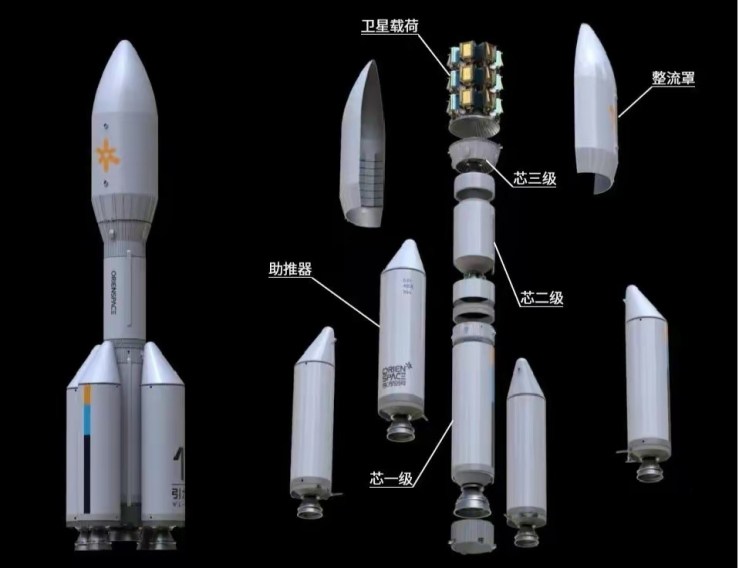
The arrow core has a first-stage diameter of 2.65 meters and is equipped with an SR-2500 solid rocket motor with a thrust of 255 tons and a maximum nozzle diameter of 2.4 meters, leading the country in comprehensive performance. The booster has a diameter of 2.65 meters and a height of more than 10 meters. It is equipped with a solid engine with a thrust of more than 150 tons; the secondary core diameter is 2.65 meters; the third core diameter is 1.4 meters. It is equipped with a solid main engine. The final attitude control power system has a total of 4 50 N and 12 The 700-N solid motor is used for attitude control such as pitch, yaw, and roll and terminal speed correction during part of the rocket’s flight phase, and is used for final stage deorbit and reentry.


The “Gravity One” rocket is 31.4 meters long, has a take-off mass of 405 tons, a take-off thrust of more than 600 tons (the core first stage does not ignite during take-off), a thrust-to-weight ratio of more than 1.48, and optional fairings with diameters of 3.35 meters, 3.8 meters and 4.2 meters. The 4.2-meter-diameter fairing has a load space of 100 cubic meters. Its low-Earth orbit (LEO) carrying capacity is 6.5 tons, and the carrying factor is about 1.60%. The 500-kilometer sun-synchronous orbit (SSO) carrying capacity is 4.2 tons, and the carrying factor is about 1.04%. 700 The kilometer SSO has a carrying capacity of 3.7 tons and a carrying coefficient of approximately 0.91%.

For comparison, the world’s most powerful solid rocket is currently the European Space Agency’s “Vega-C”, which has a take-off mass of 210 tons, a take-off thrust of about 459 tons, and a 700-kilometer polar orbit (PO) transport capacity of 2.3 tons (700-kilometer SSO). The transport capacity is close to 2.3 tons) and the load factor is 1.10%.

In comparison, the take-off mass of “Gravity One” is 190 tons higher, and the 700-kilometer SSO transport capacity is nearly 1.4 tons higher.

Images and visuals are from their respectives also 东方空间 OrienSpace