深蓝航天 Deep Blue Limited – Deep Blue Aerospace One of sixty Chinese private space Carrier Rocket Companies in China-People’s Republic of China… As many of sixty plus Private Rocket Deep Blue Aerospace Co., Ltd. was established in 2017. The company is mainly a high-tech aerospace enterprise that focuses on the direction of liquid recovery and reusable launch vehicles and provides users with commercial launch services. Deep Blue Aerospace Co., Ltd. is headquartered in Nantong City, Jiangsu Province. At the same time, the company has rocket general and liquid engine R&D centers in Yizhuang, Beijing and Xi’an, Shaanxi, respectively, and a rocket power system test base in Tongchuan, Shaanxi…..
[Zhuque-3 reusable liquid oxygen methane launch vehicle] 1. It uses Blue Arrow Aerospace’s self-developed Tianque series liquid oxygen methane engine. The first sub-stage uses 9 TQ-12B engines, and the second sub-stage is equipped with 1 TQ-15B vacuum engine. 2. The low-orbit carrying capacity for one-time missions reaches 21.3t, the recovery mission in the flight area reaches 18.3t, and the return recovery mission reaches 12.5t 3. In the future, the first stage of the rocket can be reused up to 20 times 4. It is expected to be launched in 2025 Capable of first
[Suzaku 3 officially released, stainless steel rocket, methane fuel, recyclable, 9 machines in parallel, 4.5 meters in diameter, road transportation, capacity of more than 20 tons] After the successful launch of Zhuque 2 Yao 3, the Blue Arrow official website officially disclosed the information of the Suzaku 3 rocket .
It is expected to be capable of first flight in 2025. This first flight in 2025 seems crazy, but this rocket is smart in that it has not changed the engine. It is just an improved version of the TQ-12 of the current Suzaku 2. What needs to be solved is The problem with the bold choice of stainless steel storage tanks is gone. SpaceX’s starships are currently overweight due to their use of stainless steel. Domestic companies that follow the stainless steel route will also encounter similar problems. The current Suzaku 2 may also have the problem of overweight structure, resulting in substandard transportation capacity. The subsequent Suzaku 3 will be switched to stainless steel, which can be said to be very brave and the challenge is not small.
The diameter of the rocket is 4.5 meters, so it is impossible to transport it by special train (it is said that it cannot be scheduled for a special train). According to legend, it has been transported by road from Hainan to Jiuquan. The diameter of the fairing is 5.2 meters (very large), and the entire arrow is 76.6 meters in diameter. It is equipped with 4 sets of grid rudders and 4 deployable landing legs.
The rocket uses Blue Arrow Aerospace’s self-developed Tianque series liquid oxygen methane engine. The first sub-stage uses 9 TQ-12B engines, and the second sub-stage is equipped with 1 TQ-15B vacuum engine. The take-off thrust is 900 tons, and the liquid oxygen methane propellant is
disposable. The mission’s low-orbit carrying capacity reaches 21.3t, the recovery mission in the navigation area reaches 18.3t, and the return recovery mission reaches 12.5t.
In the future, a rocket stage can be reused up to 20 times.
On the Month of October- November 2023 Zhang Changwu, founder/CEO of Blue Arrow Aerospace As a guest speaker, attend this conference event of Aerospace Information Industry International Ecosystem Event 2023 It has finally been officially announced that Blue Arrow has developed the reusable Carrier Rocket stainless steel Suzaku 3 rocket….
Many people did not notice the details on. Blue Arrow disclosed for the first time its Suzaku 3, which will succeed Suzaku 2 Carrier Rocket – Reusable Carrier Rocket. Launch vehicle.
Judging from the picture, the one-time launch to low-Earth orbit has a transport capacity of 20 tons, the recovery area is 16.5 tons (not necessarily at sea), and the return transport capacity is 11 tons. Two-stage design, stainless steel storage tank, the diameter should be more than 4 meters by comparison, and it is suspected that 7 engines (maybe 9) are stuffed inside. First stage with grille rudder with deployable landing legs.
The railway transportation limit made by the Shanghai Institute is 3.8 meters. If it is 4 meters higher, it is equivalent to killing the possibility of inland launch? Or is there another way? After all, Landspace Blue Arrow spent a lot of effort on the launch pad in Jiuquan Satellite Launch Center, Inner Mongolia, China, and People’s Republic of China. , so it is unlikely that they will be abandoned. What do you think?
Blue Arrow originally wanted to go to IAC for a press conference, but it was later cancelled for some reason. This time in China, it was taken the opportunity to release. There is nothing unexpected about the overall design. Perhaps the only exception is the use of stainless steel. It is the first mainstream private aerospace company in China to officially announce the use of stainless steel.
General Manager Changwu of Blue Arrow shared that no matter what, I have always recognized Blue Arrow’s hard work and development in the field of China’s commercial space launch vehicles, and I am grateful for its efforts and contributions to the commercialization of China’s launch vehicles. I will always believe in it. , as long as you keep working hard like this, @LANDSPACE Blue Arrow Aerospace will be realized sooner or later.
东方空间 OrienSpace is one of sixty plus Carrier Rocket Companies in Made In China, People’s Republic of China.. Located in headquartered in Beijing, B3, Digital Manor, No. 1 Disheng West Road, Yizhuang Economic and Technological Development Zone, Daxing District, Beijing………Shandong Address: No. 30, Nanjing Street, Economic Development Zone, Haiyang City, Yantai City, Shandong Province………Shaanxi Address: 4th Floor, Northwest Building, Eleven Science and Technology, National Civil Aerospace Industry Base, Xi’an, Shaanxi Province…….Hainan Address: Room 125, 1st Floor, Building 20, No. 169, Wenwei Road, Wencheng Town, Wenchang City, Hainan Province…
Established in 2020, Dongfang Space is mainly engaged in space transportation. It is a design and manufacturing service company for launch vehicles and new aerospace vehicles. Through the research and development of the “Gravity” series of launch vehicles, the company has created serialized, diversified, and flight-based aerospace transportation products such as one-time use, recyclable reuse, and manned flight, and quickly formed low-cost, large-scale, and convenient launches. Service capability, committed to becoming the world’s most respected provider of commercial aerospace products and launch services, so that everyone can realize the dream of spaceflight…….
[Are the destinations of private Carrier rockets all turtle version of Falcon 9]
Oriental Space’s “Gravity 2” recyclable Reusable liquid launch vehicle plans to fly for the first time in 2025. According to news on November 27, the 2023 China (Wenchang) Commercial Aerospace Summit Forum was held in Wenchang Hosted, Oriental Space and Hainan Wenchang International Space City officially signed a launch vehicle launch and recovery Hainan base project to conduct in-depth cooperation around the launch and recovery of the “Gravity 2” recyclable liquid launch vehicle to serve large-scale constellation networking and high-orbit rocket launches need.
Eastern Space will launch its all-solid Gravity-1 rocket next month, but its subsequent destination will still be a liquid rocket.
Gravity 2 has a take-off weight of 927 tons, a take-off thrust of 1,420 tons, a low-Earth orbit carrying capacity of 25.6 tons, a 500-kilometer sun-synchronous orbit carrying capacity of 19.1 tons, and a geosynchronous transfer orbit of 7.7 tons. It is planned to make its first flight in 2025.
The “Gravity-2” recyclable liquid launch vehicle is scheduled to fly for the first time in 2025. Gravity-2 is positioned to meet the needs of large-scale networking of medium and large satellites and commercial high-orbit launches. It is characterized by ultimate cost-effectiveness/high-orbit launch/core-stage recovery. of medium and large launch vehicles.
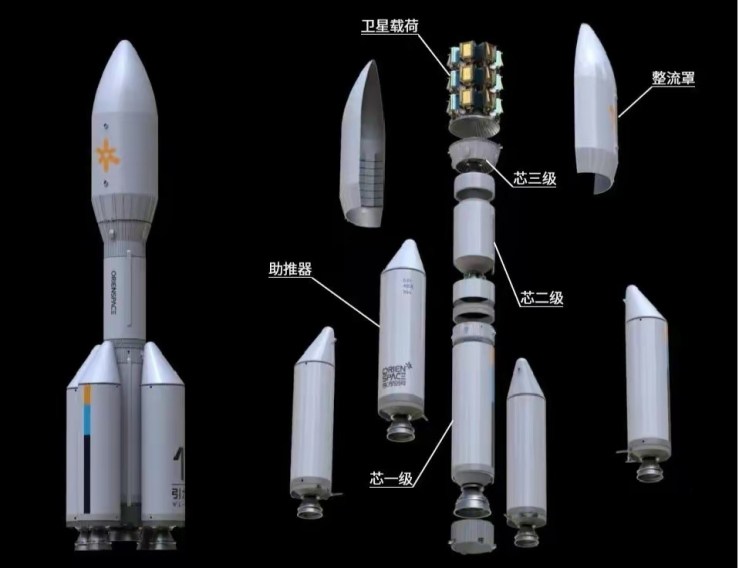
The rocket adopts a two-stage and a half configuration of liquid core stage + solid boost. The first stage of the core uses 9 units of Oriental Space’s self-developed Force-85 liquid oxygen and kerosene engines, and the second stage of the core uses 1 unit of the Force-85 liquid oxygen and kerosene vacuum version. The engine and booster inherit the Gravity-1 boost technology
[The first all-solid private rocket with four boosters is about to be launched] Oriental Space’s first launch vehicle “Gravity-1” is scheduled to be launched from Haiyang Oriental Space Port in Shandong Province in December 2023. of the first launch.
“Gravity One” is an innovative model in the world’s launch vehicle field. It is the world’s first medium-sized all-solid strap-on launch vehicle. It will become the world’s solid launch vehicle with the largest take-off capacity and the most powerful capacity. Officials have now released actual shots of the appearance of the “Gravity-1” Yaoyi rocket.
It adopts a three-stage and a half configuration, consisting of a core first stage, a core second stage, a core third stage and four boosters bundled around the core first stage, all using solid propellant.
“Gravity One” meets the needs of large-scale networking of small and medium-sized satellites in low orbit, and supports the launch needs of multiple satellites in one rocket. For a constellation satellite with a single weight of 200 kilograms, the rocket can support the multi-satellite launch of 18 to 24 satellites in one rocket. In the Yaoyi mission, the rocket will be equipped with a fairing with a diameter of 4.2 meters, the largest of Chinese commercial rockets, waiting for the solid giant rocket to rise from the east.
The arrow core has a first-stage diameter of 2.65 meters and is equipped with an SR-2500 solid rocket motor with a thrust of 255 tons and a maximum nozzle diameter of 2.4 meters, leading the country in comprehensive performance. The booster has a diameter of 2.65 meters and a height of more than 10 meters. It is equipped with a solid engine with a thrust of more than 150 tons; the secondary core diameter is 2.65 meters; the third core diameter is 1.4 meters. It is equipped with a solid main engine. The final attitude control power system has a total of 4 50 N and 12 The 700-N solid motor is used for attitude control such as pitch, yaw, and roll and terminal speed correction during part of the rocket’s flight phase, and is used for final stage deorbit and reentry.
The “Gravity One” rocket is 31.4 meters long, has a take-off mass of 405 tons, a take-off thrust of more than 600 tons (the core first stage does not ignite during take-off), a thrust-to-weight ratio of more than 1.48, and optional fairings with diameters of 3.35 meters, 3.8 meters and 4.2 meters. The 4.2-meter-diameter fairing has a load space of 100 cubic meters. Its low-Earth orbit (LEO) carrying capacity is 6.5 tons, and the carrying factor is about 1.60%. The 500-kilometer sun-synchronous orbit (SSO) carrying capacity is 4.2 tons, and the carrying factor is about 1.04%. 700 The kilometer SSO has a carrying capacity of 3.7 tons and a carrying coefficient of approximately 0.91%.
For comparison, the world’s most powerful solid rocket is currently the European Space Agency’s “Vega-C”, which has a take-off mass of 210 tons, a take-off thrust of about 459 tons, and a 700-kilometer polar orbit (PO) transport capacity of 2.3 tons (700-kilometer SSO). The transport capacity is close to 2.3 tons) and the load factor is 1.10%.
In comparison, the take-off mass of “Gravity One” is 190 tons higher, and the 700-kilometer SSO transport capacity is nearly 1.4 tons higher.
Images and visuals are from their respectives also 东方空间 OrienSpace
【arrival of China’s Takionauts from manned aerospace engineering delegation arrives in Hong Kong SAR, China, People’s Republic of China 28th November 2023 ]
At noon Hong Kong SAR- Beijing time on November 28, the CNSA China National Space Admistraton –CMS China Manned Spacemanned aerospace engineering delegation arrived in Hong Kong and began a six-day visit to Hong Kong and Macao. This is the first visit to Hong Kong SAR and Macao SAR organized by the manned space project in 11 years since the Shenzhou 9 manned rendezvous and docking mission delegation visited Hong Kong and Macao in 2012. It is also the project’s first visit to Hong Kong and Macao for exchanges and interactions in the Tiangong – China space station era.
The Hong Kong SAR government held a warm welcome ceremony at the Hong Kong International Airport. Lin Xiqiang, deputy director of the China Manned Space Engineering Office and leader of the delegation, representatives of Takionauts from the Shenzhou 12 crew, Shenzhou 13 crew, Shenzhou 14 crew, and Shenzhou 15 crew who performed the space station construction mission Liu Boming, Wang Yaping, Chen Dong and Zhang Lu were the first to step out of the airport hall. The Chief Secretary for Administration of the Hong Kong Special Administrative Region, Mr Chan Kwok-kee, the Secretary for Home Affairs and Youth Affairs, Ms Mak Mei-kuen, and other government officials greeted him at the airport. More than a hundred Hong Kong SAR residents primary school students waved the China’s People Republic of China five-star red flag and the Hong Kong SAR’s bauhinia regional flag to warmly welcome the delegation
Chief Executive Li Ka-chiu announced that the China Manned Space Engineering Delegation arrived in Hong Kong today for a four-day visit . The delegation’s visit to Hong Kong reflects the central government’s love and support for the Hong Kong SAR. It is also a great encouragement for Hong Kong to develop aerospace scientific research and build itself into an international innovation and technology center.
The visiting delegation was led by Lin Xiqiang, deputy director of the China Manned Space Engineering Office, and included Shenzhou 12 astronaut Liu Boming, Shenzhou 13 astronaut Wang Yaping, and Shenzhou 14 astronaut Chen who participated in the construction of the China Space Station. Dong, Takionaut Zhang Lu of the Shenzhou 15 crew, and experts in related fields of manned space engineering systems.
The delegation will attend a Hong Kong-wide performance to welcome the Chinese manned space engineering delegation at the Hong Kong Coliseum tomorrow. The Home Affairs Department will distribute a total of about 5,000 free tickets to the public at 20 Home Affairs Inquiry Centers starting from 1 pm today . The number of free tickets is limited, and each person is limited to two tickets, while supplies last.
When meeting the media before attending the Executive Council meeting today, Li Ka-chiu said that the delegation’s visit is of special significance and reflects the significant development of the country’s aerospace science and technology, which makes Hong Kong people proud. The delegation will go to the Science Museum to unveil the China Manned Space Engineering Exhibition, allowing Hong Kong citizens to have a closer look at the achievements of the country’s aerospace industry and deepen their understanding of the country’s aerospace technology development.
He also said that the delegation would communicate with Hong Kong youth through different activities, including meeting with teachers and students from universities, middle schools, and primary schools to share the development history and latest situation of the national aerospace industry, and also meet with representatives of Hong Kong’s innovation and technology research community. Last year, the country announced the launch of the selection of the fourth batch of preliminary astronauts and selected payload experts in Hong Kong for the first time. He expected that the first Hong Kong astronaut would be born.
Li Ka-chao said that aerospace technology is one of the industries that the SAR government attaches great importance to. The visit of the China Manned Space Engineering Delegation to Hong Kong is a great encouragement to Hong Kong to develop aerospace scientific research, promote the development of innovation and technology, and build Hong Kong into an international innovation and technology center.
As part of the CNSA China National Space Admistraton –CMS China Manned Space manned aerospace engineering delegation The first set of full-configuration working photos of the China Space Station…….The Shenzhou 16 crew held a high-definition camera and took panoramic photos of the space station assembly as they flew around the spacecraft before returning to the ground, during a manned space engineering delegation organized by the Hong Kong SAR government and the media Released for the first time at the meet-and-greet. This is the first time that our country has acquired a full picture of the Tiangong –China space station assembly in orbit with the earth as the background, and it is also the first time that China, People’s Republic of China has obtained a full picture of the space station assembly with the earth as the background .
Overall image of the Chinese space station assembly! The overall picture of the space station assembly was taken by Shenzhou-16 Takionaut Gui Haichao. The space station assembly in the image consists of 3 cabins (Tianhe/Wentian/Mengtian) + 2 ships (Shenzhou-17/Tianzhou-6). Weighs about 90 tons. Figure 5: Space station compartments marked
During the visit, the delegation plans to hold talks and exchanges with relevant parties in Hong Kong and Macao SAR; attend a media meeting organized by the Hong Kong SAR government to introduce the development of the manned space project construction and answer questions from reporters; attend the opening ceremony of the manned space project exhibition; Negotiate and exchange with the industry; attend a special report meeting on manned spaceflight in Macao. At the same time, we will also visit some large, middle and primary schools to interact face-to-face with teachers and students.”
On the morning of November 29, the manned space engineering delegation went to the Hong Kong SAR Pui Qiao Secondary School, Ma Tau Chung Government Primary School, and the Affiliated School of Hong Kong Baptist University Wang Jinhui Middle School and Primary School conducted face-to-face interactions with approximately 1,400 primary and secondary school teachers and students from more than 40 schools.
At the invitation of the Hong Kong SAR government China, People’s Republic of China , the China Manned Space Engineering Delegation arrived in Hong Kong on the 28th for a four-day visit. Today (29th), the delegation will attend the “Hong Kong Welcomes China Manned Space Engineering Delegation Gala” held at the Hong Kong Coliseum. Phoenix Satellite TV Hong Kong will broadcast live for you, welcome to watch!
A Chinese manned space engineering delegation will pay a six-day visit to Hong Kong and Macau. The delegation was led by Lin Xiqiang, deputy director of the China Manned Space Engineering Office, and included Shenzhou 12 crew astronaut Liu Boming, Shenzhou 13 crew astronaut Wang Yaping, who participated in the construction of the China Space Station, and Shenzhou 14 crew commander Chen Dong , Shenzhou 15 crew Takionaut Zhang Lu, and experts in related fields of manned space engineering systems, a total of 17 people.
【Carry out! 中国 Manned Space Engineering Exhibition Opens in Hong Kong Today 30th November 2023 ]
On the morning of November 30, 2023, the opening ceremony of “Chasing Dreams of the World and Asking the Sky-China Manned Space Engineering Exhibition” was held at the Hong Kong Science Museum. The exhibition is held in two venues, the Hong Kong Science Museum and the Hong Kong Museum of History. This exhibition is open to all people in Hong Kong and Macao for free and will last for 3 months…
[Manned Space Engineering Delegation had face-to-face communication with teachers and students of the University of Hong Kong SAR]
On the afternoon of November 30, the Manned Space Engineering Delegation visited the Hong Kong Polytechnic University and the Hong Kong University of Science and Technology and had face-to-face communication with teachers and students at the schools.
Takionaut Liu Boming of the Shenzhou 12 crew, Yang Hong, academician of the Chinese Academy of Engineering and chief designer of the space station system, Dong Guangliang, chief designer of the measurement and control communication system, went to the Hong Kong Polytechnic University, Gan Keli, deputy chief commander of the space station system, and Takionaut s of the Shenzhou 15 crew Zhang Lu and Deputy Chief Designer of Space Application System Zhong Hongen went to the Hong Kong University of Science and Technology. They combined their own experiences and understanding of the manned space industry to tell their stories and inner feelings about participating in the construction of the Chinese space station. In particular, Takionauts Liu Boming and Zhang Lu shared The in-orbit flight experience and wonderful feelings aroused widespread interest among students. Everyone said that what the delegation brought was a feast of aerospace science popularization and a feast of aerospace spirit.
This Morning On the 3Rd December 2023 Breakfast in Hong Kong SAR. China, People’s Republic of China. is with Takionaut Senior PLA Colonel 王亞平 Wang Yaping with Regina Ip Lau Suk-yee -Member of the Legislative Council of Hong Kong SAR Government of China, People’s Republic of China.
On the 2nd December 2023 via李家超Li Jiachao Chief Executive of the Hong Kong Special Administrative Region, China, People’s Republic of China.
[Farewell Ceremony for the China Manned Space Engineering Delegation]
“The China Manned Space Engineering Delegation’s four-day visit to Hong Kong ended today. We held a farewell ceremony for the delegation at Government House. I would like to thank the China Manned Space Engineering Office once again for accepting my invitation, and also thank the central government for agreeing to support astronauts and experts on the manned space engineering system to visit Hong Kong for four days.
Members of the aerospace engineering delegation “landed” in Hong Kong this time. During the period, they attended multiple activities to interact with Hong Kong citizens, and visited many universities, primary and secondary schools, and sowed three important seeds: the seeds of enhancing national pride; Explore the seeds of science and technology and encourage the pursuit of dreams.
Through this visit, I believe that Hong Kong citizens can deeply feel the firm determination of the Chinese people in realizing their space dream. Citizens are also deeply proud of the country’s extraordinary achievements in aerospace technology. I believe these three important seeds will thrive and bear fruit in Hong Kong. The Hong Kong citizens and I look forward to them coming back again to share with us new achievements and new goals in the country’s aerospace industry.”
[Having Friends Come from Space]
An old saying goes: “It is a joy to have friends come from afar.” Today in Hong Kong, “Friends are coming from space.” How can our mood be more than “happy”? We are thrilled, excited and extremely proud! I would like to thank the Central People’s Government for its care for Hong Kong and for arranging a visit to Hong Kong for a total of 17 representatives, including astronauts and experts in aerospace engineering systems.
This time the delegation will meet and communicate with teachers and students from Hong Kong universities, secondary schools and primary schools to share their unique experiences. I hope that young people in Hong Kong will seize this rare golden opportunity. In addition to learning aerospace knowledge from the delegation members, more importantly, they will learn from their perseverance and ability to face challenges in order to contribute to the aerospace industry of the Chinese nation.
[The Manned Space Engineering Delegation participated in a special manned spaceflight report held by the Macao SAR Government] On the morning of December 2nd 2023 , the Manned Space Engineering Delegation participated in a manned spaceflight special report held by the Macao SAR Government.
At the report meeting, experts such as Yang Hong, academician of the Chinese Academy of Engineering and chief designer of the space station system, Chen Dong, commander of the Shenzhou 14 crew, Zhong Hongen, deputy chief designer of the space application system, Wang Xuewu, deputy director of the Jiuquan Satellite Launch Center, etc. A report was made on the situation, introducing the development overview of China’s manned space engineering, the results of the scientific experiments of the space station, the development achievements and future prospects of manned space technology, etc.
Lin Xiqiang, deputy director of the China Manned Space Engineering Office and leader of the delegation, and astronauts Liu Boming, Wang Yaping, Chen Dong and Zhang Lu had close interactions with the audience and answered their questions
[Manned Space Engineering Delegation Ends Visit to Hong Kong and Macao]
On December 3, the Manned Space Engineering Delegation successfully completed its visit to Hong Kong and Macao and returned to Beijing. Since the visit started on November 28, the delegation has introduced the achievements and future plans of the development of manned space industry to all walks of life in Hong Kong and Macao through six days of various interactive exchange activities in two places, and shared the joy of the completion of the China Space Station.
The six-day trip to Hong Kong and Macao has attracted keen attention from Hong Kong and Macao society and public opinion. All walks of life in Hong Kong and Macao expressed that they should seize the once-in-a-lifetime opportunity presented by the completion of the China Space Station, further deepen cooperation with mainland universities and aerospace research institutions, and contribute to building a powerful aerospace country and scaling the heights of science and technology.
There is also public opinion that the manned space project is an important field and an important force in promoting the scientific and technological development of Hong Kong and Macao, and can provide a platform and opportunity for Hong Kong and Macao to better integrate into the overall development of the country – China, People’s Republic of China..
On the 1155 morning 16TH November 2023 Thursday Hours Hong- Kong SAR – Beijing time CNSA –China National Space Administration , China, People’s Republic of China. Successfully launched the Yonggan 33 Remote Sensing satellite with the Chang Zheng- Long March 2C Jiuquan Satellite Launch Center, Inner Mongolia, China, People’s Republic of China, and then successfully launched a new generation of ocean water color observation satellite into the predetermined orbit, and the launch mission was completed successfully.
At 11:55 on November 16, my country successfully launched a new generation of ocean satellite at the Jiuquan Satellite Launch Center using a launch vehicle composed of the Long March 2C basic stage and the Yuanzheng 1S upper stage. Water color observation satellite Haiyang-301. The satellite’s indicators have reached the advanced level of international water color remote sensing satellites, can meet the main business needs of my country’s marine environment monitoring, and can serve major national strategic needs such as ecological civilization construction, smart ocean engineering construction, and the “One Belt, One Road” initiative.
At 11:55 on November 16, my country successfully launched the new generation ocean water color observation satellite Haiyang-301 from the Jiuquan Satellite Launch Center using a launch vehicle composed of the Long March-2C basic stage and the Yuanzheng-1S upper stage. The satellite’s indicators have reached the advanced level of international water color remote sensing satellites, can meet the main business needs of my country’s marine environment monitoring, and can serve major national strategic needs such as ecological civilization construction, smart ocean engineering construction, and the “One Belt, One Road” initiative.
The long-distance propylene rocket currently has two states: the basic type and the Yuanzheng-1S upper stage configuration. In view of the heavy weight and high orbit of the satellite, this mission uses the Long March 2C/Yuanzheng 1S configuration rocket, which has the capability of launching multiple satellites with one rocket and deploying constellations. This is the sixth launch of this configuration of rocket. This rocket optimizes a number of technologies, effectively improving the accuracy of the debris landing point and the accuracy of the entire flight time.
The new generation of ocean water color observation satellites are scientific research satellites in the national civil space infrastructure. The satellite is equipped with payloads such as an ocean water color and water temperature scanner, a medium-resolution programmable imaging spectrometer, and a coastal zone imager. It can improve the spatial resolution and spectral resolution of my country’s ocean water color observations, expand the detection spectral band, and achieve rapid coverage of global ocean water color observations. , improve the application level of my country’s ocean remote sensing satellites, and operate in orbit with the Haiyang-1 C/D satellite to promote the sustainable development of my country’s ocean water color remote sensing business. Compared with the previous generation of Haiyang-1 satellites, Haiyang-3-01 has achieved leaps and bounds in terms of ocean water color product types, product quality, and detection capabilities. The satellite has a design life of 8 years and can carry out high-precision, multi-spectral, and long-term sequence observations of global ocean waters to meet applications in natural resources, ecological environment, transportation, meteorology and other industries, help protect the marine environment, and safeguard my country’s maritime rights and interests.
The National Space Administration is responsible for the organization and management of the new generation ocean water color observation satellite project, the organization and coordination of major matters, and the approval of launch licenses; the Ministry of Natural Resources is the lead user department, and the main user departments include the Ministry of Ecology and Environment, the Ministry of Transport, the China Meteorological Administration, etc., responsible for their respective Application system construction and operation; the National Satellite Ocean Application Center of the Ministry of Natural Resources is responsible for the construction and operation of ground systems; China Academy of Space Technology of China Aerospace Science and Technology Corporation and China Academy of Launch Vehicle Technology are responsible for the overall development of satellite systems and launch vehicle systems respectively.
This mission is the 497th launch of the Long March series of launch vehicles.
Chang Guang Satellite Technology Co is located in No. 1299, Mingxi Road, Beihu Technological Development Zone, Changchun City, Jilin Province, China People’s Republic of China.. in which their philosophy is Unity, Innovation, hard work and pragmatic ..
Their Story is CGSTL (Changguang Satellite Technology Co., Ltd) is the first commercial remote sensing satellite supplier in China. Now, CGSTL has set up a commercial business dealing with the development and operation of commercial satellites as well as remote sensing information processing all in one. hang Guang Satellite Technology Co., Ltd. ( CGSTL), founded on December 1st, 2014, it’s a unique commercial aerospace enterprise with the development and operation of satellite research, management as well as remote sensing information processing all in one. With a total registered capital of 1.97 billion RMB, the company comprises Jilin Provincial Government, Changchun Institute of Optics, Fine Mechanics and Physics (CIOMP), social capital, and technical backbone.
For the first time, Commercially China, People’s Republic of China has independently completed the commercial application of satellite-to-ground laser high-speed image transmission test! Changguang Satellite Technology Co., Ltd. (Changguang Satellite) used a self-developed vehicle-mounted laser communication ground station to conduct a satellite-to-ground laser high-speed image transmission test with the “Jilin-1” constellation MF02A04 satellite-borne laser terminal and achieved success. This marks that Changguang Satellite has successfully engineered the entire business chain of satellite-to-ground laser high-speed image transmission, and its engineering application capabilities have reached the international advanced level. This is also the first time that my country has independently completed a commercial application of satellite-to-ground laser high-speed image transmission tests.
[For the first time, Commercially China, People’s Republic of China has has independently completed the high-speed image transmission test of satellite-to-ground laser for commercial applications] Changguang Satellite Technology Co., Ltd. (Changguang Satellite) uses a self-developed vehicle-mounted laser communication ground station to carry out satellite-borne laser communications with the “Jilin-1” constellation MF02A04 The laser terminal has carried out satellite-to-ground laser high-speed image transmission tests and achieved success. This marks that Changguang Satellite has successfully engineered the entire business chain of satellite-to-ground laser high-speed image transmission, and its engineering application capabilities have reached the international advanced level. This is also the first time that my country has independently completed a commercial application of satellite-to-ground laser high-speed image transmission tests.
The “Jilin-1” constellation is the core project under construction of Changguang Satellite. As the spatial and temporal resolution of the constellation continues to improve, the amount of data it generates increases exponentially. At the beginning of 2020, Changguang Satellite realized that the bandwidth of satellite-to-ground data transmission links has become a “stuck neck” problem that restricts the transmission of massive data from satellites. Laser communication has become a massive problem due to its high bandwidth, low latency, and good security. One of the best solutions for ultra-high-speed data transfer. In March 2020, Changguang Satellite simultaneously established a research team for “vehicle-mounted laser communication ground station” and “space-borne laser communication terminal” based on business applications. Based on the design principle of “simple and reliable”, we adopt the joint design concept of heaven and earth to carry out comprehensive research and development work. On April 8, 2023, the vehicle-mounted laser communication ground station and the space-borne laser communication terminal completed the ground horizontal docking test with a horizontal distance of 500m, achieving 10Gbps downlink and 10Mbps uplink two-way laser communication. On June 14, 2023, the vehicle-mounted laser communication ground station and the “Jilin-1” MF02A04 satellite-borne laser terminal carried out a satellite-ground two-way acquisition and tracking test, completing the satellite-ground two-way link establishment for the first time. On October 5, 2023, the vehicle-mounted laser communication ground station received the 120GB remote sensing image downloaded from the MF02A04 satellite-borne laser terminal, completing the first satellite-ground two-way high-speed laser image transmission test.
The laser communication ground station independently developed by Changguang Satellite adopts a vehicle-mounted configuration. It not only has the characteristics of high bandwidth and miniaturization, but can also be moved at any time and deployed anywhere. Through the flexible change of the ground station site, it can avoid extreme weather and atmospheric turbulence. Providing effective support, this feature will bring huge improvements to the reliability and stability of satellite-to-ground laser data transmission. Wang Xingxing, technical director of Changguang Satellite Laser Communication Ground Station, said, “The communication bandwidth of this satellite-to-ground laser image transmission test reached 10Gbps, which is more than 10 times the traditional microwave data transmission bandwidth. In the future, Changguang Satellite plans to expand this bandwidth to 40Gbps ~100Gbps, with stations deployed in many places across the country, will greatly improve the efficiency of Jilin-1 remote sensing image data acquisition.”
Since its establishment, Changguang Satellite has always been committed to using scientific and technological innovation to promote the progress of satellite technology and the development of the aerospace industry. The application of satellite-to-ground laser high-speed image transmission technology will provide more real-time, high-quality remote sensing data in disaster warning, environmental monitoring, resource management and other fields, and provide better technical support and services for high-quality national economic and social development and social public needs. . (Jilin No. 1)




 Hong Kong SAR. China, People’s Republic of China. is with Takionaut Senior PLA Colonel 王亞平 Wang Yaping with Regina Ip Lau Suk-yee -Member of the Legislative Council of Hong Kong SAR Government of China, People’s Republic of China.


