#MadeInChina #中國製造 |#深蓝航天#DeepBlueLimitedCompany  #January2024| Deep Blue Aerospace #ReusableCarrierRocket #ReusableCarrierRocketEngine Development Progress -The first long-distance test run of Deep Blue Aerospace’s #3DPrinted  #ThunderR1 #Flight preparation engine rocking test run was a complete success….

深蓝航天  Deep Blue Limited – Deep Blue Aerospace One of sixty Chinese private space Carrier Rocket Companies in China-People’s Republic of China…  As many of sixty plus Private Rocket Deep Blue Aerospace Co., Ltd. was established in 2017. The company is mainly a high-tech aerospace enterprise that focuses on the direction of liquid recovery and reusable launch vehicles and provides users with commercial launch services. Deep Blue Aerospace Co., Ltd. is headquartered in Nantong City, Jiangsu Province. At the same time, the company has rocket general and liquid engine R&D centers in Yizhuang, Beijing and Xi’an, Shaanxi, respectively, and a rocket power system test base in Tongchuan, Shaanxi…..

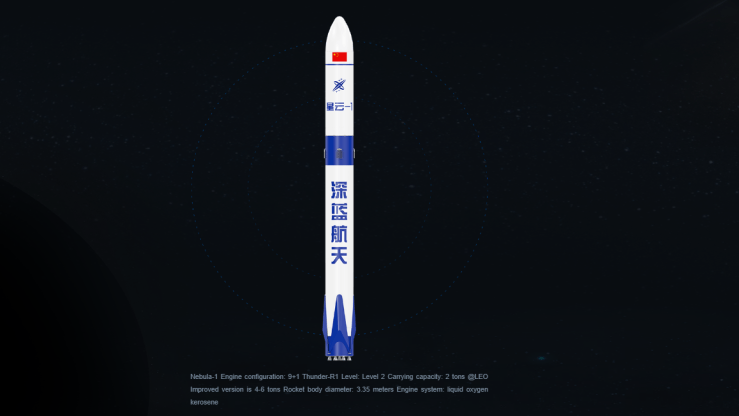
Recently on the 5th January 2024, DeepBlue Aerospace’s “Thunder-R1” engine rocking test run was a complete success. This test run included sine wave swing, square wave position, frequency sweep and triangle wave swing tests, covering the control requirements for subsequent flight missions and verifying the engine Compatibility with servo system operation. This engine test has accumulated a large amount of data and valuable experience for the power system test. It also laid the foundation for the high-altitude VTVL recovery test of the first sub-stage of the “Nebula-1” rocket that Deep Blue Aerospace will conduct this year, as well as the first flight of the “Nebula-1” rocket. Solid foundation…..

Recently, DeepBlue Aerospace’s “Thunder-R1” engine rocking test run was a complete success. This test run included sine wave swing, square wave position, frequency sweep and triangle wave swing tests, covering the control requirements for subsequent flight missions and verifying the engine Compatibility with servo system operation.

This test run achieved the following results:

1. Feasibility of the plan

The “Thunder-R1” engine adopts a pump backswing solution, which has a small weight in the swing part, greatly reduces the power demand on the servo mechanism, and improves the response characteristics of the small engine control loop; the pump backswing technology can achieve the same swing angle. Significantly reducing the swing envelope is a key technology to achieve a parallel layout of multiple rockets in a limited space. This test run verified the feasibility of this solution;

2 Reliability of flexible links

The maximum swing angle of the engine during the test was ±7°, which verified the reliability of the high-pressure swing hose;

3. Stability of electrical system

Through multiple complete machine tests of the “Thunder-R1” engine, the working stability and reliability of the engine’s electrical system have been fully verified.

This test run fully assessed the relevant performance indicators of the engine controller, servo system, battery, measurement system, ignition system and other parts to meet the overall requirements for the delivery of the rocket. In addition, the engine servo is the most important execution link of the rocket control system, and its working performance, stability and reliability were fully assessed and verified during this engine test run. The engine servo operates according to regulations and completes unidirectional swing and omnidirectional swing of various swing angles at multiple frequency points, with a maximum swing angle of 7 degrees. The engine servo is working normally and all performance indicators meet the requirements of the rocket control system.

This engine test has accumulated a large amount of data and valuable experience for the power system test. It also laid the foundation for the high-altitude VTVL recovery test of the first sub-stage of the “Nebula-1” rocket that Deep Blue Aerospace will conduct this year, as well as the first flight of the “Nebula-1” rocket. Solid foundation.

Knowledge Posts

The “Thunder-R1” engine thrust vector control adopts a pump backswing technical solution. As the name suggests, a swingable high-pressure hose is set between the engine’s thrust chamber and the turbine pump. When the engine is performing vector control during operation, the turbine The pump is stationary and the thrust chamber is oscillated by the servo actuator. The name pump backswing engine actually comes from the perspective of the overall engine layout. This layout is based on the engine frame, and the frame and the thrust chamber are connected through a gimbal. Since only the thrust chamber swings, the swing mass and inertia are small, and the power requirements for the servo actuator are lower; since the turbopump does not swing, the engine swing profile is more compact, and the saved space provides the possibility to connect more rocket engines in parallel. 

Images and visuals are from their Respectives.

#MadeInChina #中國製造| #ISpace #星际荣耀#InterstellarGlory #December2023 | #ChinesePrivateSpaceCompany –#ReusableCarrierRocket #CarrierRocket #JiuquanSatelliteLaunchCenter  #Hyperbola 2 Successfully vertical take-off and landing test verification of rocket recovery and reusability of 343 meters ….

[Hyperbolic 2 completed its second flight test flight to an altitude of 343 meters First time in the country! Reusable technology verifies successful rocket reuse flight!]

At 17:07 on December 10th Sunday 2023 Hong Kong SAR- Beijing Time,  iSpace -Beijing Interstellar Glory Space Technology Co., Ltd.’s Hyperbolic 2 reusable liquid oxygen methane verification rocket (code-named SQX-2Y) was launched on the Jiuquan satellite launch center, Inner Mongolia, China , People’s Republic of China,  The center carried out its second flight test mission. This test flight altitude was 343.12m, the flight time was 63.15s, the target lateral displacement was 50m, the landing position accuracy was about 0.295m, the landing speed was 1.1m/s, the landing attitude angle was about 1.18°, and the roll The angle was about 4.4°, the rocket landed smoothly and accurately, and the state was safely restored. The flight test mission was a complete success.


The rocket successfully completed its first vertical take-off and landing flight test on November 2, 2023. After the first flight, Interstellar Glory completed the rocket’s reuse maintenance and inspection work in only twenty days, and moved to another site to perform repeated operations. The flight mission was a complete success. This flight further obtained flight data samples of each system, provided technical accumulation for more and more efficient reusable flights of the reusable launch vehicle, and provided a basis for the company’s ongoing The development of the large-scale reusable launch vehicle Hyperbola-3 provides key technology verification.

This flight further obtained flight data samples of each system, provided technical accumulation for more and more efficient reuse flights of the reusable launch vehicle, and provided information for the ongoing development of the medium and large reusable launch vehicle Hyperbola-3. The research and development work provided key technical verification….

Images-visuals are from their respectives..

#MadeInChina #中國製造 |#深蓝航天 #LANDSPACE #DeepBlueLimitedCompany #December2023| Deep Blue Aerospace #ReusableCarrierRocket # Zhuque-3 #Suzaku-3″ #CarrierRocket stainless steel launch vehicle announcement ….Ready by 2025…

深蓝航天  Deep Blue Limited – Deep Blue Aerospace One of sixty Chinese private space Carrier Rocket Companies in China-People’s Republic of China…  As many of sixty plus Private Rocket Deep Blue Aerospace Co., Ltd. was established in 2017. The company is mainly a high-tech aerospace enterprise that focuses on the direction of liquid recovery and reusable launch vehicles and provides users with commercial launch services. Deep Blue Aerospace Co., Ltd. is headquartered in Nantong City, Jiangsu Province. At the same time, the company has rocket general and liquid engine R&D centers in Yizhuang, Beijing and Xi’an, Shaanxi, respectively, and a rocket power system test base in Tongchuan, Shaanxi…..

[Zhuque-3 reusable liquid oxygen methane launch vehicle]
1. It uses Blue Arrow Aerospace’s self-developed Tianque series liquid oxygen methane engine. The first sub-stage uses 9 TQ-12B engines, and the second sub-stage is equipped with 1 TQ-15B vacuum engine.
2. The low-orbit carrying capacity for one-time missions reaches 21.3t, the recovery mission in the flight area reaches 18.3t, and the return recovery mission reaches 12.5t
3. In the future, the first stage of the rocket can be reused up to 20 times
4. It is expected to be launched in 2025 Capable of first

[Suzaku 3 officially released, stainless steel rocket, methane fuel, recyclable, 9 machines in parallel, 4.5 meters in diameter, road transportation, capacity of more than 20 tons] After the successful launch of Zhuque 2 Yao 3, the Blue Arrow official website officially disclosed the information of the Suzaku 3 rocket .


It is expected to be capable of first flight in 2025. This first flight in 2025 seems crazy, but this rocket is smart in that it has not changed the engine. It is just an improved version of the TQ-12 of the current Suzaku 2. What needs to be solved is The problem with the bold choice of stainless steel storage tanks is gone. SpaceX’s starships are currently overweight due to their use of stainless steel. Domestic companies that follow the stainless steel route will also encounter similar problems. The current Suzaku 2 may also have the problem of overweight structure, resulting in substandard transportation capacity. The subsequent Suzaku 3 will be switched to stainless steel, which can be said to be very brave and the challenge is not small.


The diameter of the rocket is 4.5 meters, so it is impossible to transport it by special train (it is said that it cannot be scheduled for a special train). According to legend, it has been transported by road from Hainan to Jiuquan. The diameter of the fairing is 5.2 meters (very large), and the entire arrow is 76.6 meters in diameter. It is equipped with 4 sets of grid rudders and 4 deployable landing legs.

The rocket uses Blue Arrow Aerospace’s self-developed Tianque series liquid oxygen methane engine. The first sub-stage uses 9 TQ-12B engines, and the second sub-stage is equipped with 1 TQ-15B vacuum engine. The take-off thrust is 900 tons, and the liquid oxygen methane propellant is

disposable. The mission’s low-orbit carrying capacity reaches 21.3t, the recovery mission in the navigation area reaches 18.3t, and the return recovery mission reaches 12.5t.

In the future, a rocket stage can be reused up to 20 times.

On the Month of October- November 2023  Zhang Changwu, founder/CEO of Blue Arrow Aerospace As a guest speaker, attend this conference event of Aerospace Information Industry International Ecosystem Event 2023 It has finally been officially announced that Blue Arrow has developed the reusable Carrier Rocket  stainless steel Suzaku 3 rocket….  

Many people did not notice the details on. Blue Arrow disclosed for the first time its Suzaku 3, which will succeed Suzaku 2 Carrier Rocket – Reusable Carrier Rocket. Launch vehicle.

Judging from the picture, the one-time launch to low-Earth orbit has a transport capacity of 20 tons, the recovery area is 16.5 tons (not necessarily at sea), and the return transport capacity is 11 tons. Two-stage design, stainless steel storage tank, the diameter should be more than 4 meters by comparison, and it is suspected that 7 engines (maybe 9) are stuffed inside. First stage with grille rudder with deployable landing legs.

The railway transportation limit made by the Shanghai Institute is 3.8 meters. If it is 4 meters higher, it is equivalent to killing the possibility of inland launch? Or is there another way? After all, Landspace Blue Arrow spent a lot of effort on the launch pad in Jiuquan Satellite Launch Center, Inner Mongolia, China, and People’s Republic of China. , so it is unlikely that they will be abandoned. What do you think?

Blue Arrow originally wanted to go to IAC for a press conference, but it was later cancelled for some reason. This time in China, it was taken the opportunity to release. There is nothing unexpected about the overall design. Perhaps the only exception is the use of stainless steel. It is the first mainstream private aerospace company in China to officially announce the use of stainless steel.

General Manager Changwu of Blue Arrow shared that no matter what, I have always recognized Blue Arrow’s hard work and development in the field of China’s commercial space launch vehicles, and I am grateful for its efforts and contributions to the commercialization of China’s launch vehicles. I will always believe in it. , as long as you keep working hard like this, @LANDSPACE Blue Arrow Aerospace will be realized sooner or later.

Images and visuals are from their Respectives.

#MadeInChina #中國製造 #中國 | #东方空间 #OrienSpace #December2023 | Developing Assembling  to launch the adorable cute #引力一号 #GravityOne Yao 1 Carrier Rocket planned for marine first sea flight in #December2023 taking shape..

东方空间 OrienSpace is one of sixty plus Carrier Rocket Companies in Made In China, People’s Republic of China.. Located in headquartered in Beijing, B3, Digital Manor, No. 1 Disheng West Road, Yizhuang Economic and Technological Development Zone, Daxing District, Beijing………Shandong Address: No. 30, Nanjing Street, Economic Development Zone, Haiyang City, Yantai City, Shandong Province………Shaanxi Address: 4th Floor, Northwest Building, Eleven Science and Technology, National Civil Aerospace Industry Base, Xi’an, Shaanxi Province…….Hainan Address: Room 125, 1st Floor, Building 20, No. 169, Wenwei Road, Wencheng Town, Wenchang City, Hainan Province…

Established in 2020, Dongfang Space is mainly engaged in space transportation. It is a design and manufacturing service company for launch vehicles and new aerospace vehicles. Through the research and development of the “Gravity” series of launch vehicles, the company has created serialized, diversified, and flight-based aerospace transportation products such as one-time use, recyclable reuse, and manned flight, and quickly formed low-cost, large-scale, and convenient launches. Service capability, committed to becoming the world’s most respected provider of commercial aerospace products and launch services, so that everyone can realize the dream of spaceflight…….

[Are the destinations of private Carrier rockets all turtle version of Falcon 9]

Oriental Space’s “Gravity 2” recyclable Reusable liquid launch vehicle plans to fly for the first time in 2025. According to news on November 27, the 2023 China (Wenchang) Commercial Aerospace Summit Forum was held in Wenchang Hosted, Oriental Space and Hainan Wenchang International Space City officially signed a launch vehicle launch and recovery Hainan base project to conduct in-depth cooperation around the launch and recovery of the “Gravity 2” recyclable liquid launch vehicle to serve large-scale constellation networking and high-orbit rocket launches need.

Eastern Space will launch its all-solid Gravity-1 rocket next month, but its subsequent destination will still be a liquid rocket.

Gravity 2 has a take-off weight of 927 tons, a take-off thrust of 1,420 tons, a low-Earth orbit carrying capacity of 25.6 tons, a 500-kilometer sun-synchronous orbit carrying capacity of 19.1 tons, and a geosynchronous transfer orbit of 7.7 tons. It is planned to make its first flight in 2025.


The “Gravity-2” recyclable liquid launch vehicle is scheduled to fly for the first time in 2025. Gravity-2 is positioned to meet the needs of large-scale networking of medium and large satellites and commercial high-orbit launches. It is characterized by ultimate cost-effectiveness/high-orbit launch/core-stage recovery. of medium and large launch vehicles.


The rocket adopts a two-stage and a half configuration of liquid core stage + solid boost. The first stage of the core uses 9 units of Oriental Space’s self-developed Force-85 liquid oxygen and kerosene engines, and the second stage of the core uses 1 unit of the Force-85 liquid oxygen and kerosene vacuum version. The engine and booster inherit the Gravity-1 boost technology

[The first all-solid private rocket with four boosters is about to be launched] Oriental Space’s first launch vehicle “Gravity-1” is scheduled to be launched from Haiyang Oriental Space Port in Shandong Province in December 2023. of the first launch.

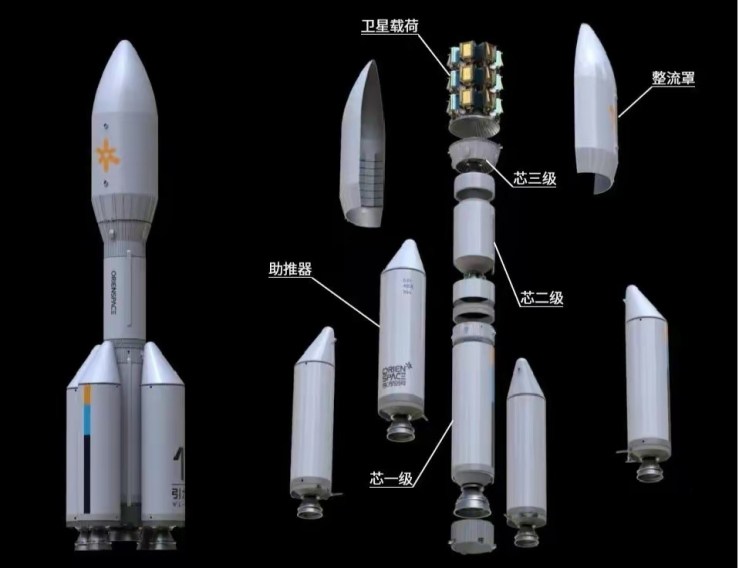
“Gravity One” is an innovative model in the world’s launch vehicle field. It is the world’s first medium-sized all-solid strap-on launch vehicle. It will become the world’s solid launch vehicle with the largest take-off capacity and the most powerful capacity. Officials have now released actual shots of the appearance of the “Gravity-1” Yaoyi rocket.


It adopts a three-stage and a half configuration, consisting of a core first stage, a core second stage, a core third stage and four boosters bundled around the core first stage, all using solid propellant.

“Gravity One” meets the needs of large-scale networking of small and medium-sized satellites in low orbit, and supports the launch needs of multiple satellites in one rocket. For a constellation satellite with a single weight of 200 kilograms, the rocket can support the multi-satellite launch of 18 to 24 satellites in one rocket. In the Yaoyi mission, the rocket will be equipped with a fairing with a diameter of 4.2 meters, the largest of Chinese commercial rockets, waiting for the solid giant rocket to rise from the east.

The arrow core has a first-stage diameter of 2.65 meters and is equipped with an SR-2500 solid rocket motor with a thrust of 255 tons and a maximum nozzle diameter of 2.4 meters, leading the country in comprehensive performance. The booster has a diameter of 2.65 meters and a height of more than 10 meters. It is equipped with a solid engine with a thrust of more than 150 tons; the secondary core diameter is 2.65 meters; the third core diameter is 1.4 meters. It is equipped with a solid main engine. The final attitude control power system has a total of 4 50 N and 12 The 700-N solid motor is used for attitude control such as pitch, yaw, and roll and terminal speed correction during part of the rocket’s flight phase, and is used for final stage deorbit and reentry.


The “Gravity One” rocket is 31.4 meters long, has a take-off mass of 405 tons, a take-off thrust of more than 600 tons (the core first stage does not ignite during take-off), a thrust-to-weight ratio of more than 1.48, and optional fairings with diameters of 3.35 meters, 3.8 meters and 4.2 meters. The 4.2-meter-diameter fairing has a load space of 100 cubic meters. Its low-Earth orbit (LEO) carrying capacity is 6.5 tons, and the carrying factor is about 1.60%. The 500-kilometer sun-synchronous orbit (SSO) carrying capacity is 4.2 tons, and the carrying factor is about 1.04%. 700 The kilometer SSO has a carrying capacity of 3.7 tons and a carrying coefficient of approximately 0.91%.

For comparison, the world’s most powerful solid rocket is currently the European Space Agency’s “Vega-C”, which has a take-off mass of 210 tons, a take-off thrust of about 459 tons, and a 700-kilometer polar orbit (PO) transport capacity of 2.3 tons (700-kilometer SSO). The transport capacity is close to 2.3 tons) and the load factor is 1.10%.

In comparison, the take-off mass of “Gravity One” is 190 tons higher, and the 700-kilometer SSO transport capacity is nearly 1.4 tons higher.

Images and visuals are from their respectives also 东方空间 OrienSpace

#MadeInChina #中國製造 |#深蓝航天 #LANDSPACE #DeepBlueLimitedCompany #November2023| Deep Blue Aerospace #ReusableCarrierRocket # Zhuque-3 #Suzaku-3″ #CarrierRocket stainless steel launch vehicle announcement at Aerospace Information Industry International Ecosystem Event 2023.

深蓝航天  Deep Blue Limited – Deep Blue Aerospace One of sixty Chinese private space Carrier Rocket Companies in China-People’s Republic of China…  As many of sixty plus Private Rocket Deep Blue Aerospace Co., Ltd. was established in 2017. The company is mainly a high-tech aerospace enterprise that focuses on the direction of liquid recovery and reusable launch vehicles and provides users with commercial launch services. Deep Blue Aerospace Co., Ltd. is headquartered in Nantong City, Jiangsu Province. At the same time, the company has rocket general and liquid engine R&D centers in Yizhuang, Beijing and Xi’an, Shaanxi, respectively, and a rocket power system test base in Tongchuan, Shaanxi…..

On the Month of October- November 2023  Zhang Changwu, founder/CEO of Blue Arrow Aerospace As a guest speaker, attend this conference event of Aerospace Information Industry International Ecosystem Event 2023 It has finally been officially announced that Blue Arrow has developed the reusable Carrier Rocket  stainless steel Suzaku 3 rocket….  

Many people did not notice the details on. Blue Arrow disclosed for the first time its Suzaku 3, which will succeed Suzaku 2 Carrier Rocket – Reusable Carrier Rocket. Launch vehicle.


Judging from the picture, the one-time launch to low-Earth orbit has a transport capacity of 20 tons, the recovery area is 16.5 tons (not necessarily at sea), and the return transport capacity is 11 tons. Two-stage design, stainless steel storage tank, the diameter should be more than 4 meters by comparison, and it is suspected that 7 engines (maybe 9) are stuffed inside. First stage with grille rudder with deployable landing legs.


The railway transportation limit made by the Shanghai Institute is 3.8 meters. If it is 4 meters higher, it is equivalent to killing the possibility of inland launch? Or is there another way? After all, Landspace Blue Arrow spent a lot of effort on the launch pad in Jiuquan Satellite Launch Center, Inner Mongolia, China, and People’s Republic of China. , so it is unlikely that they will be abandoned. What do you think?


Blue Arrow originally wanted to go to IAC for a press conference, but it was later cancelled for some reason. This time in China, it was taken the opportunity to release. There is nothing unexpected about the overall design. Perhaps the only exception is the use of stainless steel. It is the first mainstream private aerospace company in China to officially announce the use of stainless steel.

General Manager Changwu of Blue Arrow shared that no matter what, I have always recognized Blue Arrow’s hard work and development in the field of China’s commercial space launch vehicles, and I am grateful for its efforts and contributions to the commercialization of China’s launch vehicles. I will always believe in it. , as long as you keep working hard like this, @LANDSPACE Blue Arrow Aerospace will be realized sooner or later.

Images and visuals are from their Respectives.