#CNSA #ChinaNationalSpaceAdministration #国家航天局 |#BeltAndRoadinitiative #June2021|#酒泉衛星發射中心 #JiuquanSatelliteLaunchCenter Launch of the International Iconic #LongMarch2F #ChangZheng2F #神舟十二号#CarrierRocket deploying #Shenzhou12 docking with #CSS #ChinaSpaceStation #TianheCoreModule…. #AGallery

On 17th  June 2021 Friday 9:22 a summery clear morning Hong Kong SAR- Beijing Time-  CNSA –China National Space Administration  on which from Jiuquan Satellite launch Center – Inner Mongolia- China-People’s Republic of China… It  was the  it was the first time in half decade  that the first three Takionaut –Chinese Astronaut to be launched on the 17th June 2021 Friday….Shenzhou 12 manned spacecraft launched successfully…… According to the China Manned Space Engineering Office, at 9:22 on June 17, 2021, Beijing time, the Long March 2 F Yao 12 carrying the Shenzhou 12 manned spacecraft The carrier rocket was ignited and launched on time at the Jiuquan Satellite Launch Center. About 573 seconds later, the Shenzhou 12 manned spacecraft successfully separated from the rocket and entered a predetermined orbit. The three astronauts Nie Haisheng, Liu Boming, and Tang Hongbo were successfully sent into space for flight. The crew was in good condition and the launch was a complete success

 神舟十二号开始圆满成功…….This is the 19th mission since the establishment and implementation of China’s manned space project, and it is also the first manned mission in the space station stage. After the spacecraft enters orbit, it will carry out autonomous and rapid rendezvous and docking with the core cabin of Tianhe in accordance with the predetermined procedure. During the flight of the composite body, the astronauts will be stationed in the space and core module, complete a three-month in-orbit residency, carry out manipulator operations, exit activities, etc., and verify the astronauts’ long-term residency in orbit, regenerative life support, also various items more Key technology.


At present, the combination of Tianhe core module and Tianzhou-2 is operating in a near-circular docking orbit of about 390km, and is in good condition, meeting the mission requirements for rendezvous and docking with 神舟十二号 and astronauts stationing conditions….

Space Science: What’s the use of the small box held by the astronauts] At all the astronauts’ expedition ceremonies, the astronauts will be seen carrying a small box in their hands, and this morning’s 神舟十二号 astronauts’ expedition ceremonies are not exception. According to experts, the spacesuit needs to be ventilated before the astronaut wears the spacesuit and prepares to enter the cabin. The small square box carried by the astronaut is a hand-held small portable ventilation device with a power supply and a fan to provide a certain amount of ventilation for the spacesuit. Ensure the thermal comfort of the human body.

The astronauts will leave the cabin twice and mainly complete four tasks…. According to the overall arrangement of the Shenzhou 12 manned mission, the three astronauts will mainly complete four aspects of work during the orbit. Carry out two out-of-cabin activities and out-of-cabin operations.
These four main tasks:


One is to carry out the daily management of the core cabin assembly. Including Tianhe core cabin on-orbit test, regenerative life support system verification, manipulator test and operation training, and material and waste management. The
second is to carry out two out-of-cabin activities and out-of-cabin operations. Including the on-orbit transfer, assembly, and testing of extravehicular suits, the assembly of extravehicular toolboxes, the elevation of panoramic cameras, and the installation of extended pump sets….

On 17th June 2021 Friday at averagely 1630 hours Hong Kong SAR- Beijing time the Shenzhou 12 module have docked successfully with the Tainhe Core module of the CNSA -CSS -China National Space Admistraton – China Manned Space Agency -China Space Station .

The third is to carry out space science experiments and technical tests. Carry out the assembly and testing of experimental equipment for space application missions, and carry out experiments (tests) in the fields of space applications and aerospace medicine according to procedures, as well as related science education activities; the
fourth is to carry out the health management of the astronauts themselves. Carry out daily life care and physical exercises as planned, and regularly monitor, maintain and evaluate their own health status.


According to the plan, after the Shenzhou XII spacecraft enters orbit, it will use an autonomous rapid rendezvous and docking mode to connect to the forward port of the Tianhe core cabin and form a combination with the Tianhe core cabin and the Tianzhou-2 cargo spacecraft. The astronauts stationed in the core module, implemented the synchronized work and rest system of heaven and earth for work and life. After staying for about 3 months, they took the spacecraft return module to return to the Dongfeng landing site.


At present, the Tianhe core module and the Tianzhou-2 combination are in a stable state, all equipment is working normally, and it has the conditions for rendezvous and docking and astronauts stationed. The systems for performing the Shenzhou 12 mission have completed comprehensive exercises, the astronauts flight crew are in good condition, and all preparations are basically in place before launch.

The core module of the space station and the ground training modules of the two experimental modules Out-of- on hands training on  Shenzhou spacecraft control panel…vehicle training spacesuit …

Images and visuals are from Weibo..

#CNSA #ChinaNationalSpaceAdministration #國家航天局 |#BeltAndRoadinitiative #June2021 |#火星 # 天問 #天问一号#TianwenOne #MarsMission #Marslander #MarsRover #Tianwen1 probe #祝融号 #ZhuRong Exploring celebrating sending #DragonBoatfestival wishers from the #RedPlanet #Mars ….

On the Rustic half diameter planet size Red planet Mars  on Hong Kong SAR- Beijing  Earth Friday  time On June 11th  2021 , at the unveiling ceremony of the first batch of scientific image maps of the Tianwen-1 rover landing on Mars in Beijing, the panoramic view of the landing site, the topography of Mars, the “Chinese imprint” and the image taken by the “Zhurong” rover were announced. “Photographs with the tour” and other image maps. The release of the first batch of scientific image maps marked the complete success of my country’s first Mars exploration mission.

The Dragon Boat Festival, also known as the Dragon Boat Festival, the Dragon Boat Festival, and the Tianzhong Festival, was originally a festival originated  by ancient ancestors to worship the dragon ancestors, pray for blessings and ward off evil spirits. In the midsummer Dragon Boat Festival, the Canglong Qi Su soared in the middle of the sky in the south, and was in the most “center” position in the whole year, that is, as the line of the fifth line of “The Book of Changes•Qian Gua”: “Flying Dragon is in the Sky”. The Dragon Boat Festival is due to legend that Qu Yuan, a poet of Chu State during the Warring States Period, committed suicide by jumping on the Miluo River on May 5. Later, people also took the Dragon Boat Festival as a festival to commemorate Qu Yuan. The fragrance of dumplings and dragon boats became one of the four traditional festivals in China.

The two most primitive beliefs of the Chinese people: one is belief in heaven and earth, and the other is belief in ancestors. Most of the ancient festivals were formed when the ancients chose auspicious days to make sacrifices to thank the gods and ancestors. The early festival culture reflected the humanistic spirit of the ancients such as natural worship and consolidating the roots. Sacrificial activities contain profound cultural connotations of respectful virtue, ritual and music civilization. The word “Dragon Boat Festival” first appeared in “Feng Tu Ji” of the Jin Dynasty. The original meaning of the word “duan” is “zheng”, and “wu” is “zhong”. “Dragon Boat Festival”, “Zhengzhong” also. The ancients used the heavenly stems and earthly branches to record the years, the heavenly stems carried the way of the sky, and the earth supported the way of carrying the earth. The heavenly stems and the earth’s branches were set up to coordinate the luck of the heavens and the earth. On the midsummer noon day, the Canglong Seven Suspension is in the middle of the south of the sky, which is the most “centered” position for daily operations throughout the year, and it is a sign of good fortune.

Qu Yuan was not an emperor or a general, but a poet. Few people can understand his poems, but for more than two thousand years, Chinese children have expressed their memory of him on the Dragon Boat Festival. This is not only in China, but there is no second example in the history of the world. Different from the “The Great Avenue is in my heart” of the philosophers, what Qu Yuan wants to present is the interaction between heaven and man. At the same time, he feels that he has many doubts that he can’t answer, “Sun and the moon, Lie Xing, Chen?”, “圜 is nine layers, who is the camp?”. More than two thousand years ago, Qu Yuan issued more than 170 questions, asking about the circulation of stars, studying the Taoist school of heaven and earth, exploring the evolution of all things, and seeking the principles of the world. Although he could not fully understand, Qu Yuan also expressed his attitude: “The road is long and long, and I will search up and down”, “I am more than good at heart, even if I die nine times, I still have no regrets.” This is China The simple expression of the ancients exploring the unknown and pursuing the truth.

This year’s Dragon Boat Festival has added a different kind of feelings. The name of China’s first Mars exploration mission, Tianwen-1, is derived from Qu Yuan’s long poem “Tianwen”. This year, China’s first Mars exploration mission was a complete success, and Tianwen-1 left a Chinese mark on the surface of Mars for the first time. The mission of the Chinese astronauts is to turn romantic myths into materialized reality, and to provide scientific answers to the millennial doubts. Tianwen-1’s journey to Mars will also be a question and answer to the ancients of China over a thousand years of time and space.

In addition, the commemoration of Qu Yuan also reflects the feelings of family and country and national characteristics in traditional Chinese culture. As we all know, the main civilization of the Chinese originated from the farming civilization, and the Chinese solar terms are mostly related to the farming time. Farming civilization is different from nomadic civilization and marine civilization. For nomadic civilization, horseback is home, tent is home, living by water and grass, and migrating with the seasons. Ocean civilization is always looking forward to the other shore, and where the other shore is may never be known, or it may never come back. China’s farming civilization advocates “intensive farming”, spring ploughing and autumn harvesting, which are stable and peaceful. Looking back at China’s aerospace industry from the perspective of civilization and history, it can be said that China’s aerospace industry is deeply rooted in the development sequence of the Chinese nation’s civilization and serves the sustainable progress of human civilization and the well-being of people’s lives. The development of China’s aerospace industry is shouldered The development of the mission is the development of open cooperation and the development of peace and win-win. It will also make more and greater contributions to building a community with a shared future for mankind.

Tianwen No.1 carries Zhurong No.1, I wish you all a good Dragon Boat Festival, Happiness goes well..

Images and visuals are from Weibo of CNSA – China National Space Administration – CLEP –China Lunar Exploration Program

#CNSA #ChinaNationalSpaceAdministration #國家航天局 |#BeltAndRoadinitiative #June2021 |#火星 # 天問 #天问一号#TianwenOne #MarsMission #Marslander #MarsRover #Tianwen1 probe #祝融号 #ZhuRong Exploring the #RedPlanet #Mars #UtopiaPlanitia released high-resolution images of the landing area exploration mission #Tianwen1

天问一号飞運騎遊達达3亿 …….As of 7th June 2021 Monday CNSA – China National Space Administration – ESA – European Space agency Belt and road initiative mars mission…first Mars exploration mission, Tianwen- Martian Probe One …….”祝融号Zhu Rong” Mars Lander – Mars rover successfully sent back telemetry towards China National Space Administration released a high-resolution image of the landing area of ​China- People’s Republic of China’s first Mars exploration Tianwen-1 mission. The image of the Zhongtianwen-1 landing platform, the “Zhurong” rover and the surrounding area are clearly visible.

The image was taken at 18:00 on June 2 by the high-resolution camera of Tianwen-1 surround. After landing, there are two obvious bright spots in the upper right corner of the image. The upper bright spot is composed of two bright spots. The larger bright spot is the Tianwen-1 landing platform, and the smaller bright spot is the “Zhurong” rover. With the bright spot of the landing platform as the center, the surrounding area is darker. According to analysis, it may be caused by the engine plume during the landing. There are symmetrical jet-like bright stripes in the north-south direction of the landing platform, which may be formed by blowing off fine dust when the landing platform is passivated after landing. The bright spot in the middle of the image is the combination of the back cover and the parachute thrown away during the landing on Mars, in which the back cover is a round bright spot, and the parachute is a long strip of bright spot. In the lower left direction of the image, there is another obvious bright spot, which is a heat-proof outsole thrown away during the landing.

As of today, the “Zhu Rong” rover has been working on the surface of Mars for 24 Martian days, carrying out environmental perception, fire surface movement, and scientific exploration. All scientific load equipment has been activated to obtain scientific data. The orbiter runs in a relay orbit with a period of 8.2 hours and provides relay communication for the scientific exploration of the Mars rover.

国家航天局发布我国首次火星探测任务天问一号着陆区域高分影像图

2021年6月7日,国家航天局发布我国首次火星探测天问一号任务着陆区域高分影像图。图像中天问一号着陆平台、“祝融号”火星车及周边区域情况清晰可见。 

影像图由天问一号环绕器高分辨率相机于6月2日18时拍摄。着陆后图像右上角有两处明显亮斑,靠上的亮斑由两个亮点组成,较大亮点为天问一号着陆平台,较小亮点为“祝融号”火星车。以着陆平台亮点为中心,周围区域颜色较暗,据分析,可能是降落过程中受到发动机羽流影响造成。着陆平台南北方向,存在对称的喷射状亮条纹,可能是着陆后着陆平台钝化时吹除了较细的尘埃形成。图像中部亮斑为降落火星过程中抛离的背罩及降落伞组合体,其中背罩为圆形亮点,降落伞为长条状亮点。图像左下方向,存在另外一处明显的亮斑,为降落过程中抛离的防热大底。 

截至今天,“祝融号”火星车在火星表面已工作24个火星日,开展环境感知、火面移动、科学探测,所有科学载荷设备均已开机工作,获取科学数据。环绕器运行在周期8.2小时的中继轨道,为火星车科学探测提供中继通信。

Images and visuals are from Weibo of CNSA – China National Space Administration – CLEP –China Lunar Exploration Program

#CNSA #ChinaNationalSpaceAdministration #国家航天局 |#BeltAndRoadinitiative #May2021 | #WenchangSpacecraftLaunchCenter #文昌航天發射場The newly advance variant #LongMarch7 #ChangZheng7 #CarrierRocket successfully launched and deployed the #CargoShip #Tianzhou2 Docked with the #CSS #ChinaSpaceStation #AGallery….

On the 29th May 2021 Saturday Wenchang Spacecraft launch Center –Hainan Province –China – People’s Republic of China..  It was the successful launch of CNSA – China National Space Administration–  China’s Tianzhou-2 cargo spacecraft in which was successfully launched on using a Long March- Chang Zheng 7 Medium Heavy Carrier Rocket..  in which the During this month of  16th May 2021  on a beautifully clear summery day  it is the transfer of the advance Long March- Chang Zheng 7 Medium Heavy Carrier Rocket from Wenchang Spacecraft Launch Centre in Hainan Province – China – People’s Republic of China in which the Collaborative CNSA –China National Space Administration Belt and Road Initiative in which will be robotically assembled to form the China Space Station in which is a collaborative in between ESA- European Space Agency,  ROSCOMMOS – UNOSA – United Nations for Office of Outer Space Affairs..

China launched the Tianzhou-2 cargo spacecraft at around 2055 hours Hong Kong -Beijing Time Saturday from Wenchang, southern China’s Hainan Province. The spacecraft, loaded with fuel, equipment and life supplies to sustain the Tiangong Space Station, is carried by the Long March-7 Y3 carrier rocket. As CGTN provide a special coverage gives you more details about Tianzhou-2 and China’s space station project…..

During the Docking procedures Space station and cargo spacecraft can be connected to the grid for power generation…According to the Eighth Academy of Aerospace Science and Technology, after the core cabin is successfully docked with the cargo spacecraft, in the combined flight mode, in order to ensure the power generation capacity of each cabin and the cargo spacecraft, the core cabin and the cargo spacecraft The cargo spacecraft will be connected to the grid for power supply. At that time, the core cabin can provide up to 2,000 watts of power to the cargo spacecraft. Although compared with the “big family” of the core cabin, the cargo spacecraft has only one third of the power supply capacity of the core cabin, but at critical moments, the cargo spacecraft can also provide about 1,000 watts of power to the core cabin.


“The core cabin supplies power to the cargo spacecraft, mainly considering that the cargo spacecraft is installed at the stern of the core cabin, and the cargo spacecraft’s solar battery wings are small in size and are easily blocked by other combinations of the space station. The cargo spacecraft supplies power to the core cabin for the purpose of Responding to the very few special situations that may occur in the future space station, this also demonstrates the flexibility and reliability of the power supply of the entire space station assembly.” Wang Zhenxu, chief designer of the power supply subsystem of the cargo spacecraft, introduced.
In order to receive the 2000 watts of power gift from the core cabin, the cargo spacecraft itself needs to undergo a high-voltage grid-connected adaptation process. In response to the above problems, the developers of the Eighth Academy of Aerospace Science and Technology conducted a series of verification experiments to ensure that the normal operation requirements of the cargo spacecraft are met.


When the cargo spacecraft is connected to the core cabin for power supply, how to deal with the excess electricity? Developers have their own methods. Wang Zhenxu introduced that in the Tianzhou No. 2 cabin, a shunt regulator is installed, through which the excess electricity of the solar battery wing can be shunted. In the future, there will be the challenge of joint power supply of multiple combinations, but the power sub-system can always adapt. This is the intelligent management of the power sub-system in the space station era.

The newly advance variant of the Long March –Chang Zheng 7 Carrier Rocket has more than 130 improvements to make its performance better] This mission is the third launch of the Long March 7 carrier rocket. 4 years have passed since the Long March 7 Yao-2 launches. During this period, the model team Carried out a large number of optimized and improved designs, which not only realized the technological leap from “zero window” to “narrow window” launch, but also through more than 130 improvements such as simplifying and optimizing the on-board measurement system, and optimizing the tank pressurization design. The rocket has better performance and is more conducive to batch production and high-density launch.


Simplify and optimize the design of the on-arrow measurement system. The measurement parameters used for research have been deleted. The number of measuring points on the arrow has been reduced by about one-third, and the number of stand-alone measurement systems has been reduced by nearly half. This not only saves costs, but also helps to improve the sampling accuracy of some key parameters. In addition, this rocket also uses a high-rate Ka-band space-based measurement system. Compared with the S-band measurement system used by the Long March 7 Yao-2 launch vehicle, the transmission code rate has been increased by more than 20 times, realizing the full range of rocket flight telemetry. No blind spots.


Optimize the design of pressurization of the tank on the arrow. Combining the analysis of the results of the previous two flight tests, the booster reduces one tank booster gas cylinder without affecting normal use, and optimizes the boost pressure control bands of each module tank to increase the boost pressure. Utilization of gas. The rocket boost, the first-stage tail end and the first-stage transition section are changed from composite coating to ordinary coating. After the improvement, the construction process is simplified and the production cycle is shortened. Taking the first-level post-transition section as an example, the improved production cycle has been shortened from about 18 days to 13 days, laying the foundation for subsequent mass production.
Focusing on zero-window launch, focusing on flight success or failure, sorting out one detail by one detail, fully identifying the weaknesses in the design and making improvements, in addition, drawing inferences about other rocket quality issues from the mechanism to ensure the complete success of this launch mission….

Previously on the 16th May 2021 it’s was Transferring from the final complete advance Long March- Chang Zheng 7 Medium Heavy Carrier Rocket from the vertical assembly building in which has been transferred launch complex.. …. According to the China Manned Space Engineering Office, on May 16, the combination of the Tianzhou-2 cargo spacecraft and the Long March-7 carrier rocket was transferred to the launch area. At present, the facilities and equipment at the launch site are in good condition, and various functional inspections and joint tests before launch will be carried out as planned.

On the morning of May 16, the ship-and-arrow combination of the Tianzhou-2 cargo spacecraft and the Long March 7 Yaosan carrier rocket was launched at the event Driven by the platform, it was successfully transferred from the 502 vertical assembly test plant to station 201 in the launch area. At present, the facilities and equipment at the launch site are in good condition, and various functional inspections and joint tests before launch will be carried out as planned…. On which it was a family and media day for the staff that worked for Wenchang Spacecraft launch complex ….

 One of the many foods menus that been onboard is Fish-flavoured pork shreds and Gongbao chicken in space Tianzhou-2 will carry 3 people and 3 months astronaut consumables, 2 sets of extravehicular space suits and platform materials, and dock with the core module; During its docking at the space station, a number of in-orbit tests will be carried out as planned.
According to the space station construction plan, my country will launch the Shenzhou 12 manned spacecraft next month, and three astronauts will take the spacecraft to the core module. The three astronauts have to work and live in the core module for about three months. Therefore, they must prepare a variety of materials to facilitate their “clothing, food, shelter, transportation” and work in space. There are various daily necessities in the “express” sent by the number.
The food on the space station can be described as a must-see in space, making people salivate from the sky. China’s aerospace food has many traditional Chinese dishes, with obvious Chinese characteristics. The food is not only divided into main and side dishes, but also pays attention to the combination of meat and vegetables, but also has unique flavours. Even the well-known shredded pork and kung pao chicken… all appear on the astronaut’s food list

Transfer of the Tianzhou-2 cargo spacecraft ship-arrow assembly to the launch area] According to the China Manned Space Engineering Office, on May 16th, the Tianzhou-2 cargo spacecraft and the Long March 7 Yaosan carrier rocket assembly was completed Transfer to the launch area. At present, the launch facility is in good condition, and various functional inspections and joint tests will be carried out before launching as planned….

Images and visuals is from Weibo

#CNSA #ChinaNationalSpaceAdministration #國家航天局 |#BeltAndRoadinitiative #May2021 |#火星 # 天問 #天问一号#TianwenOne #MarsMission #Marslander #MarsRover #Tianwen1 probe finally #祝融号 #ZhuRong Started Rover exploring #Planet #Mars #UtopiaPlanitia #MartainSurface …….

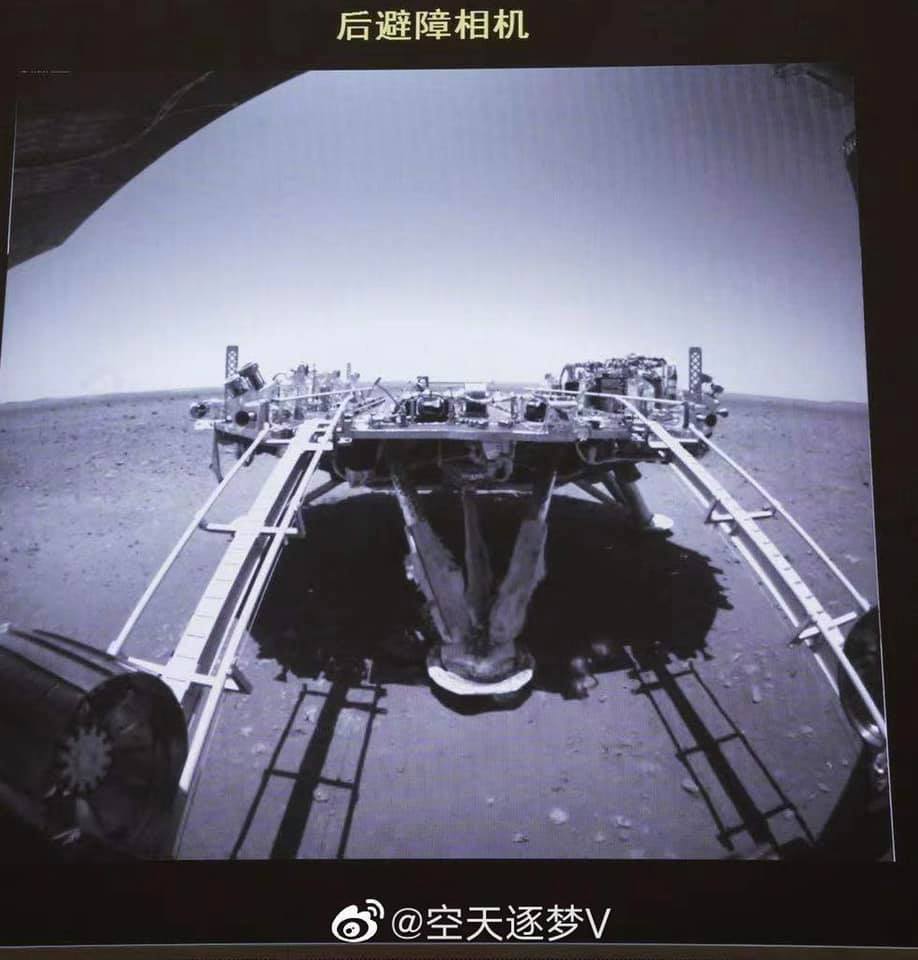
天问一号飞運騎遊達达3亿 …….As of 22nd  May 2021 CNSA – China National Space Administration– ESA – European Space agency Belt and road initiative mars mission…first Mars exploration mission, Tianwen- Martian Probe One …….”祝融号Zhu Rong” Mars Lander – Mars rover successfully sent back telemetry signals and landed on Mars with a complete success in which confirmed it’s now left the Mars Lander Platform National Space Administration that according to the telemetry data, at 10:40 on May 22, the “Zhu Rong” rover safely left the landing platform, reached the surface of Mars, and began to patrol and explore…….

The scientific goal of the Tianwen-1 mission is to study the morphology and geological structure characteristics of Mars, the characteristics of the soil on the surface of Mars and the distribution of water ice, the composition of the surface material on Mars, the ionosphere of Mars and the characteristics of the surface climate and environment, the physical field and internal structure of Mars… also any other scientifically explorations..

Since the probe was launched on July 23, 2020, during the ground-fire transfer flight and the ring-fire orbit operation, the orbiter is equipped with a medium-resolution camera, a high-resolution camera, a mineral spectrum Analyzer, a magnetometer and other 7 scientific instruments. The payload was started to detect and obtain scientific data. During the fire surface work, the rover will carry out environmental perception, fire surface movement and scientific detection in the patrol area as planned. Through the configuration of the terrain camera, multi-spectral camera, subsurface detection radar, surface composition detector and other 6 payloads, the inspection area Carry out detailed detection. At the same time, the orbiter will operate in the relay orbit to provide stable relay communication for the Mars rover patrol and detection, and take into account the development of surround detection.​​​​

At During  7:18 Hong Kong SAR – Beijing Time  on May 15th 2021 , the scientific research team confirmed according to the telemetry signal sent by the “Zhurong” Mars rover that the Tianwen 1 Landing Patrol successfully landed in the pre-selected landing zone in the southern Utopia Plain of Mars, and my country’s first Mars exploration mission landing on Mars was achieved. A complete success…..

At about 1 am, the Tianwen-1 probe was de-orbited in its parked orbit, maneuvering to Mars and entering orbit. At about 4 o’clock, the landing patrol was separated from the orbiter. After about 3 hours of flight, it entered the Martian atmosphere. After about 9 minutes of deceleration, hovering, obstacle avoidance and buffering, it successfully landed on the pre-selected landing zone. About 30 minutes after the two devices are separated; the orbiter will ascend and return to the parking orbit to provide relay communication for the landing patrol device. In the follow-up, the “Zhurong” rover will successively carry out global imaging of the landing site, self-check, leave the landing platform and carry out inspections.

images and visuals are from Weibo