#CNSA #ChinaNationalSpaceAdministration #国家航天局 |#BRI #February2023 #Tiangong #ChinaSpaceStation #CMS #ChinaMannedSpace #Shenzhou15 Crew #天宫The First #EVA #Spacewalk  for the #YearOftheRabbit ….

On the week of coming on the 10th February 2023 CMS China Manned SpaceCNSA-China National Space Administration  the crew of the Shenzhou 15 of the Tiangong-China Space Station is first spacewalk, EVA for the year of the Rabbit, in which The Takionaut crew of Shenzhou 15 to perform the first out-of-vehicle activity.

At 00:16 on February 10th, 2023, Hong Kong SAR Beijing time, after about 7 hours of extravehicular activities, Shenzhou 15 Takionauts Fei Junlong, Deng Qingming, and Zhang Lu worked closely together to successfully complete the mission. Complete all the scheduled tasks for the out-of-vehicle activities. At present, astronaut Fei Junlong and astronaut Zhang Lu have safely returned to the Wentian experimental module, and the out-of-cabin activity has been a complete success.


During the Takionauts ‘ out-of-vehicle activities, tasks such as the installation of the Mengtian extra-cabin expansion pump set were completed, and the whole process went smoothly and successfully. This is the first time for Takionauts to go out of the cabin after the completion of the Chinese space station. Takionauts Fei Junlong and Takionauts Zhang Lu walked in space for the first time, and once again successfully realized their dreams. According to the plan, in the future, the astronaut crew will carry out several out-of-cabin activities.


After About 7 hours of out-of-vehicle activities, 神州十五 Takionauts Fei Junlong, Deng Qingming, and Zhang Lu worked closely together to successfully complete all the scheduled tasks for the out-of-vehicle activities. At present, astronaut Fei Junlong (wearing a red striped extravehicular suit) and Takionauts Zhang Lu (wearing a blue striped extravehicular suit (have safely returned to the Wentian experimental cabin, and the extravehicular activity has been a complete success, during the extravehicular….


In addition, the space station cargo out-of-cabin installation task has also been carried out in the early stage. At present, loads such as energy particle detectors and plasma in-situ imaging detectors have been installed out of the cabin, and the installation process of the loads outside the cabin and the functional performance of the cargo airlock and transfer mechanism of the space station have been fully verified.


According to reports, the space station’s cargo out-of-cabin installation task is coordinated by the load transfer mechanism, cargo airlock, inner and outer hatches, and robotic arms. Through on-orbit astronauts or ground operations, the cargo that needs to be out of the cabin will be sent out of the cabin. The goods outside the cabin can also be sent into the cabin. Breakthroughs and mastery of this key technology can greatly improve the efficiency of cargo exchange inside and outside the cabin, and reduce the number of astronauts leaving the cabin and workload. According to the plan, the installation of cargo out of the cabin will continue in the future.

Images and visuals are from their Respectives CMS China Manned SpaceCNSA-China National Space Administration

#CNSA #ChinaNationalSpaceAdministration #国家航天局 |#BRI #January2023 #Tiangong #ChinaSpaceStation – #中国国家博物馆; #NationalMuseumofChina #Beijing featuring new Aerospace Space exhibits of China space developments.  Featuring the China Space Station Sky Survey Space Telescope (CSST)

The National Museum of China中国国家博物馆; flanks the eastern side of Tiananmen Square in Beijing, China. The museum’s mission is to educate about the arts and history of China. It is directed by the Ministry of Culture and Tourism of the People’s Republic of China. 16 E Chang’an St, 前门 Dongcheng, China, 100051…. China, People’s Republic of China.

On the week of 20th January 2023 just before the Chinese Lunar New Year eve of the Year of the Rabbit The hall of the National Museum has recently exhibited a lot of aerospace exhibits. In addition to the Chang Zheng Long March 10 and the Sky Survey Telescope, there are also models of the Chinese space station assembly, the return capsule of the Shenzhou spacecraft and the actual parachute, the escape tower of the Chang-2 F, the Chang-2 F/Chang 7/Chang 5 B model, YF-20/100/77 engine, etc. These exhibits may not be permanent. Friends who are interested in Beijing or other places must seize the opportunity!

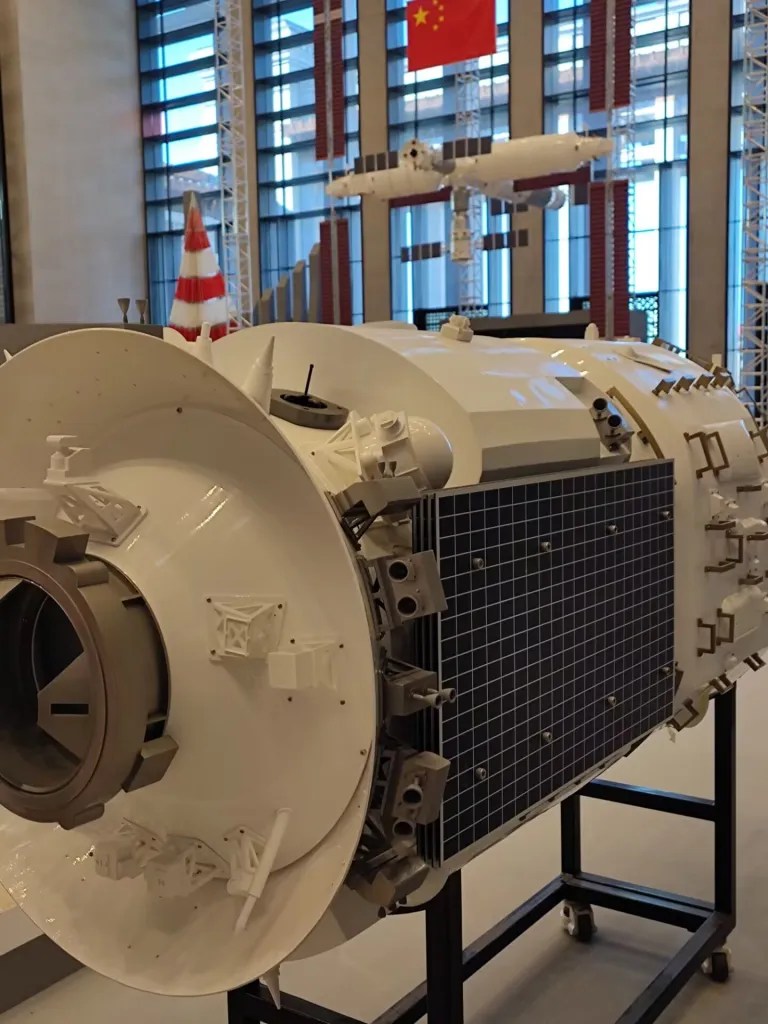
The China Space Station Sky Survey Space Telescope (CSST) model exhibited by the National Museum is quite high-precision, and its overall structural layout is clear at a glance. It is mainly composed of two parts: the optical cabin and the service cabin. The overall outer diameter is about 4.2 meters, and the diameter of the main mirror is about 2 meters. .
In terms of the external structure of the cabin, it can be seen that there are a pair of solar wings on both sides of the service cabin, 5 control moment gyroscopes, a relay communication antenna, a mechanical arm docking port on the top, and a space station docking port and related equipment for rendezvous and docking at the rear; the optical cabin It is covered with handles for astronauts to go out of the cabin, and 4 star sensors.


In addition, CSST has a total of 3 types of 48 attitude control engines installed, including 16 forward 150N, reverse 4 150N, rotation 12 10N, pitch 8 25N, yaw 8 25N, visual judgment is not guaranteed to be completely correct

Images and visuals are of their Respectives – Photographed by 深蓝之日DBS

#CNSA #ChinaNationalSpaceAdministration #国家航天局 |#BRI #January2023 #Tiangong #ChinaSpaceStation #CMS #ChinaMannedSpace #Shenzhou15 Crew  #天宫 Celebrates #ChineseLunarNewYear #YearOftheRabbit Celebrating with Stunning #EarthVideography ..

On the week of coming on the 22nd January 2023 CMS China Manned SpaceCNSA-China National Space Administration  the crew of the Shenzhou 15 of the Tiangong-China Space Station celebrating the Festive Chinese Lunar New Year in writing New Year good luck blessings in Chinese Traditional Couplets in Traditional Chinese calligraphy wondering what the crew of the Shenzhou 15….?

Spring Festival Evening Blessings on a spring festival gala of year of the rabbit in wishing… , I wish you good luck in 2023 ….The Chinese New Year is approaching, and the crew of Shenzhou 15 will spend the Chinese New Year in space. Takionaut Zhang Lu wrote the word “Fu” by hand, and presented a pair of Spring Festival couplets to the folks. This “blessing” from space

Watching the New Year’s Fireworks with You The earth under the sunshine, exudes holy beauty, let the Chinese space station show you that the mountains and rivers are safe, and send you an invitation for 2023: the old one A page is quietly turned, the year of the lucky rabbit, China’s manned spaceflight will go to the mountains and seas with you.

Images and visuals are from their Respectives CMS China Manned SpaceCNSA-China National Space Administration

#CNSA #ChinaNationalSpaceAdministration #国家航天局 |#BRI #January2023 #Tiangong #ChinaSpaceStation #CMS #ChinaMannedSpace #Shenzhou15  #天宫TV四季  welcomes Amazing stunning #EarthViews #EarthPhotography of the Blue Planet from the perspective of a small robotic arm…..

On the week of 13th December 2022 wondering what the crew of the Shenzhou 15 are doing in which finalisation of the completion of the Tiangong – China Space Station the Takionaut Crew start with a productive new week taking the Dream crew working soothingly after entering orbit? In which how is life in orbit, in which they’re the second crew besides comrades Shenzhou 14 crew living in T Shape China Space Station…. Having a brief moment of watching the crew..

On the Week of 16th January 2023..  Counting down towards the Year of the Rabbit on the 20th January 2023, the Crew of Shenzhou 15 has been Busy throughout the New Year, also towards the Chinese Lunar New Year, as the Shenzhou 15 Crew Celebrates for the first time. As the Tiangong –China Space Station orbits the Planet Earth it always constantly have a view of the Motherland China, People’s Republic of China. Viewing from the Chinese Space Station from the perspective of a small Five meter length robotic arm… that Design with multiple functions ……   When the sun slowly paints the space station golden, when the small robotic arm quietly watches the Chinese space station and the blue planet 400 kilometers away, the space station Year after year, day after day, it surrounds the earth as a witness to our future…..

Images and visuals are from their Respectives CMS China Manned SpaceCNSA-China National Space Administration

#MadeInChina #中國製造| #中科宇航 #ZhongkeAerospace #CASSPace #January 2023 ||#酒泉衛星發射中心 #JiuquanSatelliteLaunchCenter  the #ChinesePrivateSpaceCompany #Lijian1 #ZK1A Yao Two #CarrierRocket undergoing final assembly..  for the Launch calendar of #May2023  

On January 2023 Beijing Zhongke Aerospace Exploration Technology Co., Ltd. Lijian-1 and Yao-2 carrier rockets are undergoing final assembly and testing at the China Science and Technology Aerospace Industrialization Base, and are scheduled to launch in Jiuquan in May 2023! At the beginning of the new year, Lijian-1 Yao-2 (Zhongke-1-A) carrier rocket carried out final assembly and testing work as planned at the China Science and Technology Aerospace Flight Technology Industrialization Base, and plans to launch at the Jiuquan Satellite Launch Center in May 2023 . The mission load of the launch vehicle is Changsha Tianyi Space Technology Co., Ltd. Fucheng 1, TY26 and other satellites, with a total weight of 1 ton. As a lean, digital and intelligent launch vehicle industrial base built by Zhongke Aerospace, the Zhongke Aerospace Flight Science and Technology Industrialization Base is running smoothly, and will have an annual production capacity of 30 launch vehicles in the future.


The final assembly and testing of the Lijian-1 Yao-2 launch vehicle fully verified the rocket power system, structural system, flight control system, avionics system, launch support system, etc., marking the largest solid launch vehicle in China—” “Lijian No. 1” is making great strides towards standardization and mass production.

The final assembly site of the Lijian-1 carrier rocket is a domestic first-class and internationally advanced aerospace industrialization base built by China Science and Technology Aerospace. It is located in Nansha District, Guangzhou City, and is located in the geometric center of the Guangdong-Hong Kong-Macao Greater Bay Area. Mu, which is mainly used to carry out the development, production, test, final assembly and testing of serialized solid and liquid launch vehicles, and based on this, it will attract upstream and downstream related aerospace companies to land, and create an integrated “industry-university-research-government-finance” international The first-class aerospace industry cluster forms the first commercial aerospace industrial park in China.

Beijing Zhongke Aerospace Exploration Technology Co., Ltd. is the first domestic aerospace enterprise with mixed ownership, and it is also the target enterprise that Oriental Aerospace Port focuses on introducing. Relying on the scientific research strength and resource advantages of the Institute of Mechanics of the Chinese Academy of Sciences and the Aerospace Flight Technology Center of the Chinese Academy of Sciences, China Aerospace Science and Technology has been committed to the research and development and integration of space technology and aerospace vehicles as a platform for the transformation of major national scientific research projects, as well as the transformation and provision of technological achievements. Aerospace launch service. The Lijian-1 rocket project also adds a brand-new name card to the Oriental Space Port, which will surely promote the construction of the Oriental Space Port to take a solid step forward.

Images and visuals are from Weibo and their respectives