On the 30th May 2023 clear 0931 Hours Morning Hong Kong SAR- Beijing time , the Belt and Road InitiativeCNSA –China National Space Administration from Jiuquan Satellite Launch Center – Inner Mongolia –China – People’s Republic of China deployment of the Chang Zheng – The Chang Zheng – Long March 2F Yao 16 –Shenzhou 16 carrier rocket.. On which Takionauts Jing Haipeng, Zhu Yangzhu, and Gui Haichao took to the predetermined orbit. The first manned flight mission in the application and development stage was a complete success. The three astronauts will stay in the space station and “join up” with the crew of Shenzhou 15 to carry out on-orbit handover “face-to-face” meeting in which brings the total crew of six with a handover ceremony from Shenzhou 15 towards 16..
[How would a Takionaut choose between posting beginning of autumn and exercising? 】
Today is the beginning of autumn, which means that autumn is coming, and it is also the national fitness day. In this season of “sticking autumn fat”, come and meet the Takionauts for the first exercise in autumn. In this passionate autumn, look at the energetic “dopamine” outfits of the Takionauts.
Today 立秋Liqiu looking from afar, autumn is condensing in the depths of the clouds. Tue, 8th August 2023 – Wed, 23rd August 2023,The traditional Chinese calendar divides a year into 24 solar terms. is the 13th solar term. It begins when the Sun reaches the celestial longitude of 135° and ends when it reaches the longitude of 150°.
长征十号 At 22nd 23rd July 2023 Hong Kong SAR- Beijing time , China- People’s Republic of China- CNSA –China National Space Administration Successfully Carrier Rocket engine tested for the New Next Generation Chang Zheng – Long March 10 Manned Lunar mission landing Carrier rocket freighter The main engine of China’s manned lunar landing rocket Long March 10 completed another ignition test run yesterday, which verified all the requirements of the rocket mission for the engine, and provided strong support for the solidification of the engine’s technical status, the establishment of product technology baselines, and the improvement of reliability.
The engine used in this test run uses advanced liquid oxygen kerosene as fuel, which is improved and iterated from the high-thrust liquid oxygen kerosene engine used by the new generation of launch vehicles such as the active Long March 5, with a thrust of 130 tons. (The Sixth Academy of Aerospace Science and Technology Group)
Created with GIMP
The reporter learned from China Aerospace Science and Technology Group Co., Ltd. on July 23 that the main engine of my country’s manned moon landing rocket was tested in the Fengzhou Test Area of the Sixth Academy of Aerospace Science and Technology Corporation, and achieved continuous success. This test run verified the engine flight mission profile, and provided strong support for the solidification of the engine technical state, the establishment of the product technical baseline, and the improvement of reliability.
The engine is the power source of the rocket, and its development process is very complicated. Test run is an important link in the engine development process, and there are dozens of types. In layman’s terms, engine test run is the process of igniting the engine and verifying the rationality of its design scheme and process reliability. This is an indispensable and important part of the development and delivery of a type 1 engine. It will run through all stages before and after engine development. Each stage of test run has different meanings, and the ignition time varies from a few seconds to hundreds of seconds.
It is reported that the engine used in this test run uses advanced liquid oxygen kerosene as fuel, which is improved and iterated from the high-thrust liquid oxygen kerosene engine used by the new generation of launch vehicles such as the Long March 5. The thrust reaches 130 tons. The R&D team of the Sixth Academy of Aerospace Science and Technology Group adheres to the concept of digital design, and has successively overcome key technical problems such as engine start-up and shutdown sequence, engine wide-range continuously variable thrust, and engine long life and high reliability.
In addition, the continuous success of the test run has fully verified the reliability of a number of new carrying process technologies. The engine production of this test run adopts the concept of intelligent manufacturing, and actively applies new materials, new processes, and new technologies. The inner wall of the thrust chamber of the core component adopts a new protective coating, key assemblies adopt automatic welding technology, and a large number of components adopt 3D printing technology.
During the preparation of the engine test run, the participants in the research and test conducted tests and verifications on each subsystem of the test through comprehensive means such as digital modelling, simulation calculation, and system debugging. The successful test run shows that the test area has greatly improved the multi-station parallel test run capability and test efficiency by optimizing the workflow.
On the 30th May 2023 clear 0931 Hours Morning Hong Kong SAR- Beijing time , the Belt and Road InitiativeCNSA –China National Space Administration from Jiuquan Satellite Launch Center – Inner Mongolia –China – People’s Republic of China deployment of the Chang Zheng – The Chang Zheng – Long March 2F Yao 16 –Shenzhou 16 carrier rocket.. On which Takionauts Jing Haipeng, Zhu Yangzhu, and Gui Haichao took to the predetermined orbit. The first manned flight mission in the application and development stage was a complete success. The three astronauts will stay in the space station and “join up” with the crew of Shenzhou 15 to carry out on-orbit handover “face-to-face” meeting in which brings the total crew of six with a handover ceremony from Shenzhou 15 towards 16..
At 21:40 on July 20, 2023, Shenzhou 16 Takionauts Jing Haipeng, Zhu Yangzhu, and Gui Haichao worked closely together to successfully complete all the scheduled tasks for the out-of-vehicle activities. The three astronauts interacted frequently during the whole process of leaving the cabin, and easily completed the work of raising the three panoramic cameras outside the cabin.
[The crew of Shenzhou 16 Takionauts successfully completed all the scheduled tasks for the out-of-vehicle activities]
According to the CNSA – China National Space Administration – China Manned Space Engineering Office, at 21:40 on July 20, 2023, Hong Kong SAR Beijing time, after about 8 hours of out-of-vehicle activities, Shenzhou 16 Takionauts Jing Haipeng, Zhu Yangzhu, and Gui Haichao worked closely together, and with the support of the space station’s robotic arm, they successfully completed all the scheduled tasks for extravehicular activities. Takionauts Jing Haipeng and Zhu Yangzhu have safely returned to the space station. The experiment cabin and out-of-cabin activities were a complete success.
During the Takionauts ‘ out-of-vehicle activities, the installation and lifting of the in-orbit support for the panoramic camera B of the core module, and the unlocking and lifting of the panoramic cameras A and B of the dream capsule were completed. The whole process went smoothly and successfully. Takionauts Jing Haipeng, who has flown for four times, cooperated with the out-of-vehicle activity from the cabin of Shenzhou-7. With 15 years of perseverance, he realized the dream of “spacewalking”; astronaut Zhu Yangzhu became my country’s first out-of-vehicle activity Active Spaceflight Engineer.
According to the plan, in the future, the Takionauts crew will also carry out a large number of space science experiments (tests), and participate in the completion of multiple application load out-of-cabin installation tasks…
Shenzhou 16 Takionauts Jing Haipeng, Zhu Yangzhu, and Gui Haichao worked closely together, and with the support of the space station’s robotic arm, they successfully completed all the scheduled tasks for the out-of-vehicle activities. Astronauts Jing Haipeng and Zhu Yangzhu have safely returned to the Wentian experimental module of the space station. During the Takionauts ‘ out-of-vehicle activities, the installation and lifting of the in-orbit support for the panoramic camera B of the core module, and the unlocking and lifting of the panoramic cameras A and B of the dream capsule were completed. The whole process went smoothly and successfully.Takionauts Jing Haipeng, who has flown four times, cooperated from the Shenzhou 7 capsule to this extravehicular activity. With 15 years of perseverance, he realized the dream of “spacewalking”. According to the plan, in the future, the astronaut crew will also carry out a large number of space science experiments (tests), and participate in the completion of multiple application load out-of-cabin installation tasks…..
The activity area of this extravehicular activity covers multiple quadrants of the third cabin of the space station. The panoramic camera of the Tianhe cabin is different from the two experimental cabins. The panoramic camera of the experimental cabin has been optimized to simplify the lifting steps and save effort; the panoramic camera of the Tianhe cabin needs more steps to complete the lifting (for details, please refer to God The four out-of-vehicle activities of Twelve and God Thirteen, the process of raising the panoramic camera is introduced).
The long path between the operating areas and many quadrants involved also means that the Takionauts need to spend more time for transfer, which may be one of the reasons why the time spent on this extravehicular activity is close to the critical value of the extravehicular suit.
On the 30th May 2023 clear 0931 Hours Morning Hong Kong SAR- Beijing time , the Belt and Road InitiativeCNSA –China National Space Administration from Jiuquan Satellite Launch Center – Inner Mongolia –China – People’s Republic of China deployment of the Chang Zheng – The Chang Zheng – Long March 2F Yao 16 –Shenzhou 16 carrier rocket.. On which Takionauts Jing Haipeng, Zhu Yangzhu, and Gui Haichao took to the predetermined orbit. The first manned flight mission in the application and development stage was a complete success. The three astronauts will stay in the space station and “join up” with the crew of Shenzhou 15 to carry out on-orbit handover “face-to-face” meeting in which brings the total crew of six with a handover ceremony from Shenzhou 15 towards 16..
[Shenzhou 16 crew will choose an opportunity to launch out-of-cabin activities in the near future]
On the 20th July 2023 The latest news from the China Manned Space Office; since it successfully entered the space station complex on May 30, 2023, Beijing time, the crew of Shenzhou-16 astronauts have been working in orbit for 51 days, and nearly one-third of the five-month space scientific research journey has been completed. At present, the Shenzhou 16 astronaut crew is in good condition, the space station assembly is running stably, and has the conditions to carry out extravehicular activities….
On July 12, 2023, the Ninth China (International) Commercial Aerospace Summit Forum opened in Wuhan. This forum is jointly directed by China National Space Administration, China Meteorological Administration, China Manned Space Engineering Office, Hubei Provincial People’s Government, Wuhan Municipal People’s Government, China Aerospace Science and Industry Corporation, China Aerospace Science and Technology Corporation, China Electronics Technology Co., Ltd. It is co-sponsored by Group Co., Ltd., China Aerospace Foundation and Chinese Society of Astronautics. Ji Qiming, Assistant Director of China Manned Space Engineering Office, Zhang Hailian, Deputy Chief Designer of China Manned Space Engineering and other leaders attended the forum.
Ji Qiming, assistant director of the China Manned Space Engineering Office, said in his opening speech that commercial aerospace is a new force in my country’s aerospace field and has become an indispensable force in my country’s aerospace industry. The Commercial Aerospace Summit Forum strives to bring together experts, scholars and relevant superior resources in the aerospace field at home and abroad, and actively builds a well-known platform for exchanges, cooperation and achievements in the industry. It is an important witness, companion and promoter of my country’s commercial aerospace development. All along, China’s manned space program has attached great importance to the cultivation, development and application of commercial space power.
Speech by Assistant Director Ji Qiming
Previously, the China Manned Space Engineering Office issued an announcement to the public on the solicitation of low-cost cargo transportation plans for the space station, and received many proposals from commercial aerospace companies. At present, the China Manned Space Engineering Office is soliciting from the whole society the manned lunar rover development plan and the space station space science and application project. In the future, the China Manned Space Engineering Office will continue to create more space for commercial aerospace forces to play a role in scientific payload carrying, on-orbit maintenance, space travel, and flight product development in accordance with the principles of openness, fairness and justice. Accumulate experience and lay the foundation for promoting the formation of a unified development pattern of manned spaceflight…commercialization with unified national management, active social participation, smooth transformation of achievements, and continuous improvement of benefits..
Deputy chief designer Zhang Hailian made a keynote speech
Zhang Hailian, deputy chief designer of China’s manned spaceflight project, made a keynote report on “Overall Considerations on the Development of my country’s Manned Lunar Exploration” in the main forum. The development steps of lunar exploration, expounding the preliminary flight plan of my country’s manned lunar exploration, and the main functions and performances of flight products such as a new generation of manned launch vehicles, a new generation of manned spacecraft, lunar landers, lunar rovers, and lunar landing suits. The main key technologies faced in the lunar scientific research and development stage, put forward the preliminary consideration of promoting the high-quality and high-efficiency development of the manned lunar exploration project with the help of commercial aerospace and social forces.
In addition, the crew of Shenzhou 16 Takionauts sent a video speech from the China Space Station, wishing the forum a complete success.
[Preliminary plan for manned moon landing announced]
Zhang Hailian, deputy chief engineer of the China Manned Space Engineering Office, disclosed at the Ninth China (International) Commercial Space Summit Forum held in Wuhan that morning that my country plans to realize manned landing on the moon by 2030 Carry out scientific exploration, and then explore the construction of a lunar scientific research and experiment station, and carry out systematic and continuous lunar exploration and related technology test verification. At present, China’s preliminary plan for manned moon landing is:
🔷Use two carrier rockets to send the lunar lander and the manned spacecraft to the lunar orbit for rendezvous and docking in orbit, and the astronauts enter the lunar lander from the spacecraft. 🔷Afterwards, the lunar lander will descend and land on the predetermined area of the lunar surface alone, and the astronauts will land on the moon to carry out scientific investigation and sample collection.
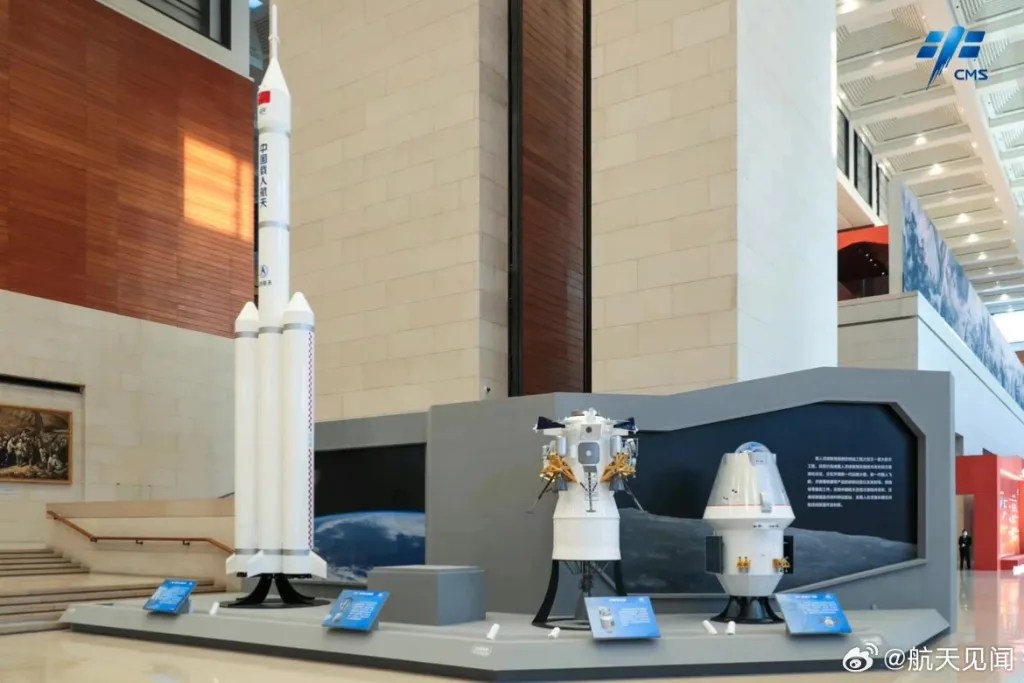
🔷After completing the scheduled tasks, the astronauts will take the lander to ascend to the orbit around the moon to rendezvous and dock with the spacecraft, and carry samples back to Earth on the spacecraft. To accomplish this task, Chinese scientific researchers are developing equipment such as the Long March 10 carrier rocket, a new generation of manned spacecraft, a lunar lander, and a manned lunar rover..
China plans to realize manned landing on the moon to carry out scientific exploration before 2030, and then will explore the construction of a lunar scientific research and experimental station to carry out systematic and continuous lunar exploration and related technical test verification.
At present, China’s preliminary plan for manned landing on the moon is:
use two carrier rockets to send the lunar lander and the manned spacecraft to the lunar orbit for on-orbit rendezvous and docking, and the astronauts enter the lunar lander from the spacecraft.
Afterwards, the lunar lander will descend and land on the predetermined area of the lunar surface alone, and the astronauts will land on the moon to carry out scientific investigation and sample collection.
To accomplish this task, Chinese scientific researchers are developing equipment such as the Long March 10 carrier rocket, a new generation of manned spacecraft, a lunar lander, and a manned lunar rover. (China Manned Spaceflight Office🇨🇳The latest CG concept map of my country’s future manned lunar landing rover, lunar lander, and lunar scientific research and test station…
China Takionauts will land on the moon in this way
Zhang Hailian, deputy chief engineer of the China Manned Space Engineering Office, disclosed at the Ninth China (International) Commercial Aerospace Summit Forum held in Wuhan this morning that our country plans to Before 2030, realize manned landing on the moon to carry out scientific exploration, and then explore and build a lunar scientific research and test station to carry out systematic and continuous lunar exploration and related technology test verification.
At present, China, People’s Republic of China, preliminary plan for manned landing on the moon is: use two carrier rockets to send the lunar lander and the manned spacecraft to the Earth-Moon transfer orbit, the spacecraft and the lander will rendezvous and dock in the orbit around the moon, and the astronauts will enter from the spacecraft. Lunar lander. Afterwards, the lunar lander will descend and land on the predetermined area of the lunar surface, and the astronauts will land on the moon to carry out scientific investigation and sample collection. After completing the scheduled tasks, the astronauts will take the lander to ascend to orbit around the moon to rendezvous and dock with the spacecraft, and return to Earth with the spacecraft. To accomplish this task, Chinese researchers are developing equipment such as the Long March 10 carrier rocket, a new generation of manned spacecraft, a lunar lander, a lunar suit, and a manned lunar rover
Zhang Hailian, deputy chief engineer of the China Manned Space Engineering Office, disclosed at the Ninth China (International) Commercial Space Summit Forum held in Wuhan this morning that my country plans to realize manned landing on the moon to carry out scientific exploration before 2030, and then to explore and construct The Lunar Scientific Research and Experimental Station conducts systematic and continuous lunar exploration and related technology test verification.