CNSA #ChinaNationalSpaceAdministration #國家航天局 |#BeltAndRoadinitiative #June2022 | #火星 # 天問 #天问一号#TianwenOne #MarsMission #Tianwen1 probe  #祝融号 #ZhuRong #Tianwen1 completes the established scientific exploration mission…

Tianwen-1 completes the established scientific exploration mission

天问一号飞運騎遊達达3亿CNSA – China National Space Administration – ESA – European Space agency Belt and road initiative mars mission…first Mars exploration mission, Tianwen- Martian Probe One ​​​As of June 29, 2022, the Tianwen-1 mission orbiter has been flying normally for 706 days, and has acquired medium-resolution image data covering the entire world of Mars. All scientific payloads have achieved global exploration of Mars. Both the Tianwen-1 mission orbiter and the Mars rover have completed the established scientific exploration missions.

The Tianwen-1 mission was approved by the Party Central Committee in January 2016, and was successfully launched on July 23, 2020. After a deep space flight of 475 million kilometers for 202 days, the probe will rendezvous with Mars on February 10, 2021, and successfully implemented the capture and braking to enter the orbit around Mars. After 3 months of detailed inspection of the pre-selected landing area, the Mars landing was successfully carried out on May 15, 2021. On May 22, the “Zhurong” rover successfully landed on the surface of Mars and began to patrol and explore.

On August 15, 2021, the “Zhurong” rover successfully completed the 90 Martian scientific exploration missions, and continued to carry out extended exploration missions. It has traveled 1,921.5 meters on the surface of Mars. Affected by the severe winter cold and dusty weather in the landing area, the rover will enter the winter dormancy mode on May 18, 2022 as designed. Around December 2022, the “Zhurong” landing area will enter the early spring season. will resume normal work.

The orbiter has circled Mars 1,344 times, achieving global coverage and is currently in normal condition. In the follow-up, it will continue to carry out global remote sensing detection, and choose an opportunity to carry out expansion technology experiments to carry out preliminary technical verification for related tasks.

After nearly two years of flight and exploration for the Tianwen-1 mission, the 13 scientific payloads deployed by the rover and orbiter have obtained a total of about 1040GB of raw scientific data. After receiving and processing on the ground, the standard scientific data products formed are submitted to the rover on a monthly basis. A team of scientists has conducted analysis and interpretation, and relevant scientific results have been published in well-known academic journals at home and abroad. These scientific data will be open to scientists around the world at an appropriate time. Scientists around the world are welcome to actively apply for research and jointly promote the cause of human exploration of the universe.

In the spirit of open and shared cooperation, the National Space Administration actively promotes cooperation with the space agencies and scientific communities of various countries, and shares the orbital data of its Mars orbiter with the National Aeronautics and Space Administration (NASA) and the European Space Agency (ESA) to carry out collision warning. Cooperation; the “Zhurong” Mars rover and the European Space Agency’s “Mars Express” orbiter carry out data relay communication experiments to realize China-Europe Mars scientific data relay cooperation; Observatory stations in other countries use the Tianwen-1 orbiter and the “Mars Express” orbiter to jointly carry out occultation observations of the sun and conduct scientific research such as solar wind. These cooperation have achieved good results, enriched human knowledge, and made positive contributions to the construction of a community with a shared future for mankind in the scientific field.
 

Below is a recent image of Mars taken by Tianwen-1. 

Figure 1 The image of Mount Askela taken by the center camera, with a diameter of 456 kilometers and a height of 18 kilometers , shows the characteristics of the crater on the top of Mount Askela, and there are multiple crater collapse events.
Figure 2 An image of the Antarctic ice sheet taken by the center camera. The image shows the polar cap of the Martian South Pole. The study believes that the long-term and permanent polar cap of the Martian poles is mainly composed of dry ice (solid carbon dioxide) and water ice.

Figure 3 The central point camera captures the western landform image of the Sailor Grand Canyon. The Sailor Grand Canyon extends over 4,000 kilometers from east to west, 150 kilometers to 700 kilometers from north to south , and the deepest can reach 7 kilometers .
Figure 4. The image of the Arabian Highlands impact crater taken by the camera in the middle point. The image shows the geomorphological features of dozens of impact craters distributed in the area.

Figure 5 The image of the edge of the Mond ring crater captured by a high-resolution camera with a spatial resolution of about 0.5 meters and a diameter of about 91 kilometers . The image shows the geomorphological features of the edge of the Mond ring crater. The lower left part of the picture is the inside of the ring crater. The edge of the pit can be seen clearly collapsing into the pit.
Figure 6 The image of the inspection area taken by Zhurong. The image was taken before the rover entered the winter dormancy state, showing the local characteristics of a dune landform in the inspection area.

Images and visuals are from CNSA- China National Space Administration also from there respectives- CLEP –China Lunar Exploration Project..

#CNSA #ChinaNationalSpaceAdministration #国家航天局 |#BeltAndRoadinitiative #June2022 | #嫦娥五号#CLEP The #Moon #Change5 #LunarMission #MonsRumker #LunaExploration Announcement The new results reveal the distribution characteristics of lunar surface water in the landing area. The lunar soil contains water in the form of hydroxyl groups …

More than One year ago on 24th November 2020, the Chang Zheng – Long March Five Carrier Rocket Launched away  in CNSA – China National Space Administration China Wenchang spaceport launch, Change Five  Lunar probe into orbit, opened up towards China – People’s Republic of China’s first celestial bodies sample return trip from Mons Rumker on the Lunar Surface.……  

[The new results of Chang’e 5 reveal the distribution characteristics of lunar surface water in the landing area. The lunar soil contains water in the form of hydroxyl groups]

On June 15, “Nature Communications” published an important research result of my country’s Chang’e 5 online.
Whether there is water on the moon, how much water there is, what form of water it is, and where the water comes from is controversial, and it has always been a research hotspot in lunar science. At the beginning of the Chang’e-5 mission project demonstration, the research team proposed to extend the spectral range of the lunar mineral spectrometer on the lander to 3.2 μm, and realized the first in-situ detection of the spectral absorption characteristics of lunar surface water in the world. In order to avoid the impact of the dynamic “water” (hydroxyl OH) when the engine plume and the solar wind bombard the lunar surface on the in-situ spectral analysis, the research team carefully designed the timing of acquiring the in-situ detection spectral data. The detection timing was selected 6 hours after landing to avoid the influence of the engine plume composition when the CE-5 probe landed; The dynamic “water” of the lunar surface; the moon (landing zone) is under the protection of the earth’s magnetic field during the spectral measurement, which shields the solar wind and avoids the dynamic “water” (hydroxyl OH) factor produced by the bombardment of the solar wind. In this environment, the Chang’e-5 spectrometer can obtain a “clean” absorption spectrum of “water”. After strict correction and analysis, the research team found that the lunar soil in the Chang’e-5 landing area obviously contains “water” in the form of hydroxyl groups. But the average content is low, only about 30ppm.


At present, it is believed that there are three main sources of lunar “water”: one is (dynamic) hydroxyl substances produced by the interaction between solar wind particles and lunar surface materials; the other is water and hydroxyl-containing substances brought by comets or meteorites that hit the moon; Lunar primary (internal) water. After the lunar samples were returned to Earth, the research team conducted a systematic analysis of the returned lunar samples in the laboratory. The laboratory spectral analysis once again verified the clear existence of hydroxy water, but the research on the existence form, content and source of “water” requires detailed research. Mineral petrological analysis. The Apollo lunar sample study believes that the (impact) cemented glass in the lunar soil contains hydroxyl substances formed by the long-term injection of the solar wind, and the content of cemented glass is an important factor affecting the “water” content in the lunar sample. Laboratory analysis of the returned samples showed that the Chang’e 5 lunar sample is a type of young basalt with a very small content of cemented glass (less than 16%), which is only 1/3 of the Apollo 11 lunar sample, so it is estimated that the Chang’e 5 lunar soil sample The “water” from the solar wind injected into the cemented glass is not more than 18ppm. At the same time, the foreign impact sputters in the lunar soil samples of the Chang’e-5 landing area are very low, and their contribution to “water” can be ignored. Therefore, there must be primary water originating from the interior of the moon in the Chang’e-5 lunar soil samples. Laboratory analysis of the Chang’e-5 lunar samples found at least one hydrous mineral, hydroxyapatite, whose content was uneven, ranging from 0 ppm to 179 ppm (average about 17 ppm) in equivalent samples of hydroxy water, proving that The presence of “water” from the magma crystallization process in the Chang’e-5 lunar soil samples indicates that “water” not only existed, but also played a very important role in the late lunar magmatic activity.


The lunar in-situ detection spectral data of this research result were obtained by the Lunar Mineral Spectrum Analyzer developed by the Shanghai Institute of Technical Physics, Chinese Academy of Sciences. The operation management, data reception and processing of the scientific detection load were carried out by the National Astronomical Observatory of the Chinese Academy of Sciences (Lunar Exploration Engineering Ground Application System).

Via CNSA China Space Administration –CLEP China Lunar Exploration project management office

#CNSA #ChinaNationalSpaceAdministration #国家航天局 |#BeltAndRoadinitiative #May2022 | #WenchangSpacecraftLaunchCenter #文昌航天發射場 | #ChinaSpaceStation #ChangZheng5B Longmarch5B Carrier Rocket arrives at Wechang Space Launch Center for实验舱#Wentian #ExperimentalCabinModule ….

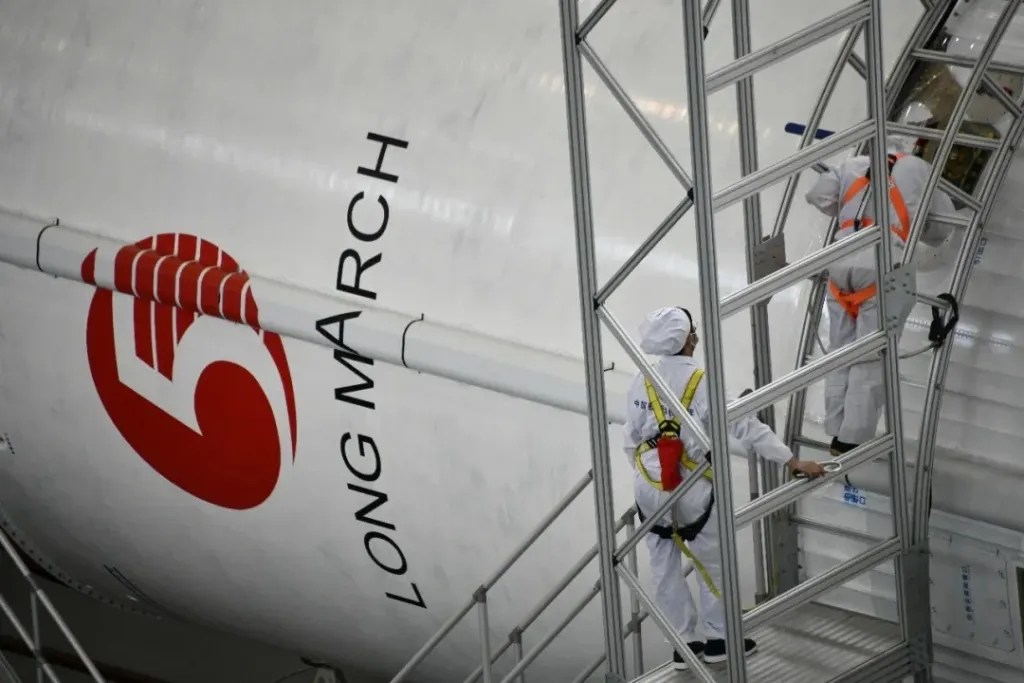
On Hainan Province –China –People’s Republic of China…. in the district area of the Wenchang – Wenchang Spacecraft launch center in which the awesome team at one of many CNSA –China National Space Administration  that China National Space Administration…………… On May 29th 2022 The Chang Zheng- Long March 5B Yao three carrier rocket arrived at Wenchang Space Launch Site safely] According to the China Manned Space Engineering Office, the Long March 5B Yaosan carrier rocket that carried out the launch mission of the Wentian experimental module has completed all the research and development work before leaving the factory.

Arrived safely at Wenchang Space Launch Site on after that, Chang Zheng- Long March 5B Yao three carrier rocket will carry out the final assembly and test work at the launch site together with the Wentian experimental module that arrived earlier. At present, each participating system in the launch site area is carrying out mission preparations as planned….  

According to the China Manned Space Engineering Office, Chang Zheng- Long March 5B Yao three carrier rocket that carried out the launch mission of the Wentian experimental module has completed all the research and development before leaving the factory.

The work will be safely delivered to Wenchang Space Launch Site on May 29, 2022. After that, the Long March 5B Yaosan carrier rocket will carry out the final assembly and test work at the launch site together with the Wentian experimental module that arrived earlier.

中国空间站 On currently on May 2022, the Belt and Road Initiative CNSA –China National Space Administration  the two extensions modules of Tiangong China Space Station are now ready and verify certified in which forms the right and left parts of the Tiangong China Space Station in which completion of the China Space Station is expected to finalised its construction in the late 2022 year.. 

On the 24th May 2022 on the Earliest Morning the components of the Chang Zheng – Long March 5B Carrier Rocket has arrived at the Wechang Qinglan Port in Hainan Province – China – People’s Republic of China.. of the Chang Zheng –Long March Carrier Rocket Cargo ship of Yuanwang 21 and Yuanwang 22… in which it was previously left from Tianjin….

It was on at about 8:00 a.m. on 19th May 2022, Beijing time, two rocket carriers, Yuanwang 21 and Yuanwang 22, set sail from Tianjin Port, targeting Hainan Wenchang Qinglan Port, and are expected to arrive on the 24th.

Chang Zheng –Long March Carrier Rocket Cargo ship Yuanwang 21 and Yuanwang 22 transporting the Long March 5B Yao 3 carrier rocket are being loaded in Tianjin Port Yuanwang 21 entered the inner berth of Tianjin Port on 14th  May  2022  to load the rocket transport container, and completed loading and evacuated on 16th  May 2022  After leaving the berth, Yuanwang 22 then entered the berth to load the remaining containers, which are expected to be fully loaded by tomorrow morning.

Previously As of May 2022 both The experimental cabin is progressing smoothly, waiting for the launch The Wentian experimental cabin to be launched in July is ready for finally and the Mengtian experimental cabin is also making corresponding preparations.

After the construction of the China Space Station is completed, the two experimental cabins will be the main working places for astronauts in orbit. In both experimental cabins, space science experiments and technical experiments in the sealed cabin and outside the sealed cabin can be carried out. Both cabins are equipped with The load test cabinet inside the cabin and the load installation platform outside the cabin also provide support and guarantee measures such as information, power supply and heat dissipation, and can carry out experiments in various fields such as space science, space materials, space medicine and space exploration.


  The Wentian experimental module is equipped with the same Taikonauts’ living facilities as the core module, including 3 sleeping areas, 1 sanitary area, kitchen and other facilities, which can guarantee the astronauts’ life. It can also work with the core module to support the life of 6 astronauts during the rotation of the two manned spacecraft; in addition, a small robotic arm is also configured, which can be used alone or in combination with the large robotic arm of the core module. , to jointly complete the tasks of Taikonauts leaving the cabin, caring for extravehicular facilities, and patrolling. In addition, the Wentian experimental cabin is also equipped with an astronaut exit airlock. After the space station is completed, the airlock of the Wentian experimental cabin will be As the main airlock cabin for astronauts to leave the cabin, the node cabin of the core cabin is used for other functions at this time, just as a backup; the Wentian experimental cabin also has a backup section for the core cabin to manage and control the assembly. That is to say, when the function of the core module platform fails, it can be switched to the Wentian experimental module to exercise the combined control and management functions, which can improve the reliability of the space station as a whole.


  The Mengtian experimental cabin is equipped with a cargo airlock and an outboard deployment test platform. In the future, the scientific test equipment that needs to be installed outside the cabin can be transported to the space station through a cargo spacecraft, and then the load will be sent to the outside of the cabin through the cargo airlock, and the robotic arm or astronaut will install it on the platform outside the cabin. Realize the continuous update of the extravehicular test project.

Images and visuals are from their respectives.

#CNSA #ChinaNationalSpaceAdministration #国家航天局 |#BeltAndRoadinitiative #May2022 | #CMS #ChinaMannedSpace #ChinaSpaceStation the awaiting extension of #TianheCoreModule #实验舱 #Mengtian #实验舱#Wentian #ExperimentalCabinModule #ChangZheng5B #LongMarch5B CarrierRocket as arrived at #WenchangSpacecraftLaunchCenter …..

中国空间站 On currently on May 2022, the Belt and Road Initiative CNSA –China National Space Administration  the two extensions modules of Tiangong China Space Station are now ready and verify certified in which forms the right and left parts of the Tiangong China Space Station in which completion of the China Space Station is expected to finalised its construction in the late 2022 year.. 

On the 24th May 2022 on the Earliest Morning the components of the Chang Zheng – Long March 5B Carrier Rocket has arrived at the Wechang Qinglan Port in Hainan Province – China – People’s Republic of China.. of the Chang Zheng –Long March Carrier Rocket Cargo ship of Yuanwang 21 and Yuanwang 22… in which it was previously left from Tianjin….

It was on at about 8:00 a.m. on 19th May 2022, Beijing time, two rocket carriers, Yuanwang 21 and Yuanwang 22, set sail from Tianjin Port, targeting Hainan Wenchang Qinglan Port, and are expected to arrive on the 24th.

Chang Zheng –Long March Carrier Rocket Cargo ship Yuanwang 21 and Yuanwang 22 transporting the Long March 5B Yao 3 carrier rocket are being loaded in Tianjin Port Yuanwang 21 entered the inner berth of Tianjin Port on 14th  May  2022  to load the rocket transport container, and completed loading and evacuated on 16th  May 2022  After leaving the berth, Yuanwang 22 then entered the berth to load the remaining containers, which are expected to be fully loaded by tomorrow morning.

As of May 2022 both The experimental cabin is progressing smoothly, waiting for the launch The Wentian experimental cabin to be launched in July is ready for finally and the Mengtian experimental cabin is also making corresponding preparations.


After the construction of the China Space Station is completed, the two experimental cabins will be the main working places for astronauts in orbit. In both experimental cabins, space science experiments and technical experiments in the sealed cabin and outside the sealed cabin can be carried out. Both cabins are equipped with The load test cabinet inside the cabin and the load installation platform outside the cabin also provide support and guarantee measures such as information, power supply and heat dissipation, and can carry out experiments in various fields such as space science, space materials, space medicine and space exploration.


  The Wentian experimental module is equipped with the same Taikonauts’ living facilities as the core module, including 3 sleeping areas, 1 sanitary area, kitchen and other facilities, which can guarantee the astronauts’ life. It can also work with the core module to support the life of 6 astronauts during the rotation of the two manned spacecraft; in addition, a small robotic arm is also configured, which can be used alone or in combination with the large robotic arm of the core module. , to jointly complete the tasks of Taikonauts leaving the cabin, caring for extravehicular facilities, and patrolling. In addition, the Wentian experimental cabin is also equipped with an astronaut exit airlock. After the space station is completed, the airlock of the Wentian experimental cabin will be As the main airlock cabin for astronauts to leave the cabin, the node cabin of the core cabin is used for other functions at this time, just as a backup; the Wentian experimental cabin also has a backup section for the core cabin to manage and control the assembly. That is to say, when the function of the core module platform fails, it can be switched to the Wentian experimental module to exercise the combined control and management functions, which can improve the reliability of the space station as a whole.

  The Mengtian experimental cabin is equipped with a cargo airlock and an outboard deployment test platform. In the future, the scientific test equipment that needs to be installed outside the cabin can be transported to the space station through a cargo spacecraft, and then the load will be sent to the outside of the cabin through the cargo airlock, and the robotic arm or astronaut will install it on the platform outside the cabin. Realize the continuous update of the extravehicular test project.

Images and visuals are from their respectives.

#CNSA #ChinaNationalSpaceAdministration #国家航天局 |#Vivo #XNote #April2022 | #WenchangSpacecraftLaunchCenter #文昌航天發射場 | the inspiration behind of the design of ultra-postmodern sleekness #Smartphone with Vivo X Note is the #ChangZheng5 #LongMarch5 #CarrierRocket ..

On a very 14th  April 2022 in Hainan Province –China –People’s Republic of China…. Clear Day  in the district area of the Wenchang – Wenchang Spacecraft launch center in which the awesome team at one of many CNSA –China National Space Administration in which the CNSA Chang Zheng – Long March five Heavy Carrier Rocket has international always attracted so much attention that’s is driven . Driven by aerospace, the development of the technology industry has become more and more mature.

That inspired the design of the Vivo X Note is a typical case…. . The 7-inch wide-screen design refers to the research and development ideas of launch vehicles, making the overall structure light, thin and sturdy. Special consideration is also given to the grip feeling during use, breaking through industry traditions and finding a new golden ratio. It is expected that aerospace technology can bring more inspiration to the technology industry……. With the inspiration of the Chang Zheng- Long March Five it’s big of its of 56.97 meters in height  In scientific and technological research and development, we have the same pursuit as China Aerospace: “To the vast and subtle” 中国 Aerospace Creation . We hope that through the ultimate control of every detail, ordinary people can truly appreciate the convenience brought by technological development…

The big-screen business flagship Vivo X Note pays tribute to every dedicated you. 7-inch wide screen, 5000mAh large battery, long-distance power system, 8.37mm thin and light hand feel, Snapdragon 8 SPU custom flagship chip with vivo self-developed chip V1, 3D large-area ultrasonic fingerprint, full-focus Zeiss four cameras, smart office Pro, thousand mirrors Security Architecture. On the big screen, it will give you a very different business experience.

Vivo X Note color matching] vivo X Note also adopts a square and round sky-level design, with a total of three color matching. Qingshan blue is artistic and attractive, with special embossed textures on both sides of the fuselage, making the vision more three-dimensional; earth gray, calm, pure and restrained, and stress-free for business commuting; bright night black, using low-light AG technology, under the light It flashes on and off, and the customized strings on both sides are designed with a full sense of design…

Images and visuals are from their respectives.