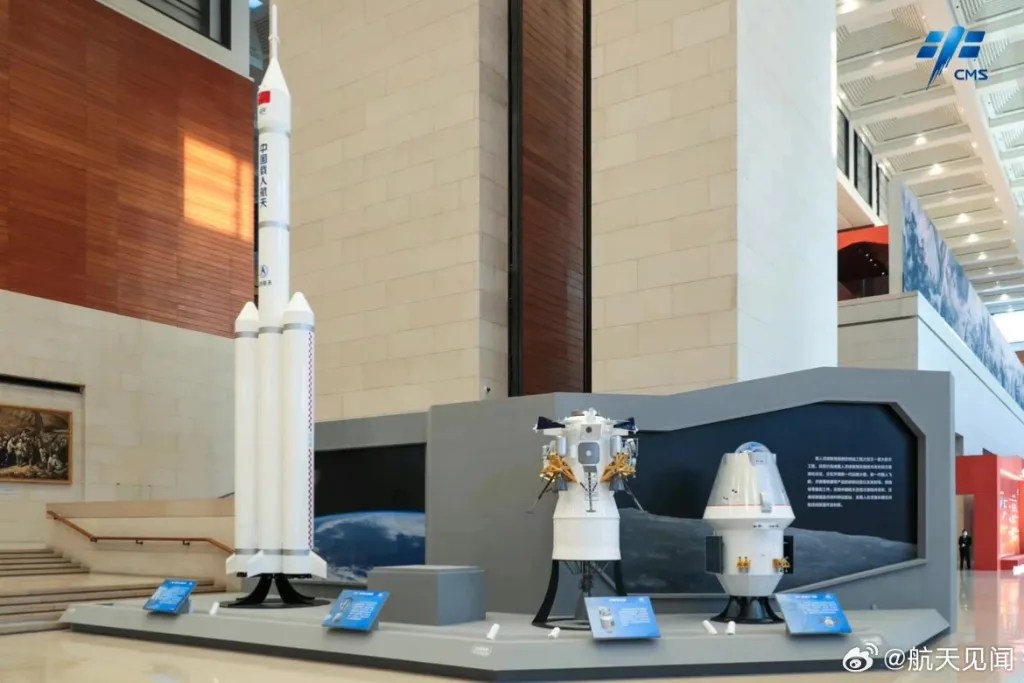
DURING MAY 2024 CNSA _China National Space Administration – Assisting manned lunar landing Recently, Asia’s largest Carrier Rocket space engine high-altitude simulation test International benchmark was completed and put into use in Tongchuan, Shaanxi province, China, People’s Republic of China, marking a major breakthrough in the key technology of high-altitude simulation test of the main reduction engine of China’s manned lunar landing project, which will effectively guarantee and support the smooth implementation of the manned lunar exploration project. What is a space engine test bench? Why is it the “ultimate test site” for Carrier Rocket spacecraft engines?

1. What is a space engine test bench?
There is a consensus in the aerospace field: “To develop aerospace, power comes first .” In space exploration, space engines provide power for launch vehicles and other spacecraft to fly into space. If the engine is regarded as the “heart” of the rocket, then the space engine test bench is like the monitor of the rocket’s “heart”. It is a ground test facility specially used to test the performance of rocket engines . It is usually composed of a test workshop, a load-bearing pier, a guide trough, a measurement and control center, a measurement and control system, a test frame, etc. It can simulate the working environment of the engine to verify and evaluate the performance, function, strength, reliability and other aspects of the rocket engine, and ensure that the engine can work stably and reliably in actual flight.

2. Why build a space engine test bench?
The development of space engines is a complex and delicate project, which requires not only a deep theoretical foundation and advanced computational simulation technology, but also actual ignition tests to verify the accuracy and reliability of the design. Therefore, in the process of engine development, the combination of theory and practice is indispensable. The engine test bench is equipped with various high-precision sensors, which are the “senses” of engine testing and can monitor the key parameters of the engine in real time during the ignition test. Through these precise measurements, researchers can intuitively observe the performance of the engine in actual work, so as to have a comprehensive and in-depth understanding of the engine’s performance. These test parameters not only provide researchers with various indicators of the engine’s working status, but also serve as an important basis for evaluating engine performance. By comparing the test results with the design expectations, researchers can find deficiencies in the design and make necessary improvements and optimizations to the engine.

3. Why do different engines require “tailor-made” test benches?
From the perspective of type , since each type of engine has its own unique design and performance parameters, it determines the specific environment and conditions required for testing. This means that one test bench cannot solve the “package” engine test work. Different types of test benches need to be built according to different types of engines to make the test environment and the actual working environment of the engine as consistent as possible. For this reason, test benches can also be classified. For example , according to the scale of the test bench , the test bench structure, the propellant tank capacity, and the measurement and control equipment, it can be divided into large test benches and small and medium-sized test benches; according to the type of engine propellant, it can be divided into liquid oxygen and liquid hydrogen engine test benches, liquid oxygen and kerosene engine test benches, and room temperature storable engine test benches; according to the length of the engine thrust test, it can be divided into two types of test benches: steady-state test and dynamic test. The former mainly tests the engine’s steady-state thrust and pressure performance indicators, and verifies the quality of engine design and manufacturing through long-term stable work, while the latter focuses on the study of the thrust and pressure rise transition process and the aftereffect impulse change characteristics of the descending stage; according to the installation posture during the engine test, it can be divided into horizontal test benches and vertical test benches. The horizontal test bench has a wide range of uses, and the change of engine mass during operation has little effect on thrust measurement, but at the same time, this test bench is less sensitive to lateral forces. Vertical test benches are divided into upright and inverted types.
From a safety perspective , the test bench must ensure safety during the test process. Different engines will generate different thrust and heat flow when ignited, so special guide grooves and cooling systems are needed to deal with it.
From a measurement perspective , in order to obtain accurate test data, the sensors and measurement equipment on the test bench need to match the specific parameters of the engine. For example, the thrust measurement system must be able to accurately measure thrust within a specific range.
From the perspective of the simulation environment , the test bench is designed to simulate various conditions that the engine may encounter in actual flight, including high-altitude simulation, vibration environment, etc. The flight conditions of different engines may be different, so a specific simulation environment is required.
From a cost-effectiveness perspective, designing and building dedicated test rigs for different engines can improve the efficiency and accuracy of testing, saving time and resources in the long run.
From the perspective of technological development , the advancement of space engine development technology will be accompanied by new testing requirements. The construction of a dedicated test bench can provide the necessary testing support for new engines.

4. Why has the high-altitude simulation test bench become a development trend?
When launching, the engines of spacecraft such as the upper stage of a launch vehicle are in a state of low pressure at an altitude of more than 80 kilometers, and their high-altitude performance is very different from that on the ground. Since the aerodynamic and thermal loads that affect the structural strength of the engine cannot be simulated when it is stationary on the ground, a high- altitude simulation test bench is needed to create high-altitude conditions . Usually, a low-pressure environment of 30-40 kilometers is formed by vacuuming to simulate high-altitude flight conditions. The high-altitude simulation test bench is mainly used to assess the nozzle structure and performance of the engine in a low-pressure and vacuum environment to ensure the reliability of high-altitude operation. Through high-altitude simulated hot tests , the safety of the test can be improved , faults can be discovered and eliminated in a timely manner , and key support can be provided for the development of advanced engines .
With the continuous construction and improvement of the space engine test bench, it will provide a more advanced and reliable platform for the development and testing of various types of spacecraft engines.
Images and visuals are from their Respectives CMS China Manned SpaceCNSA-China National Space Administration