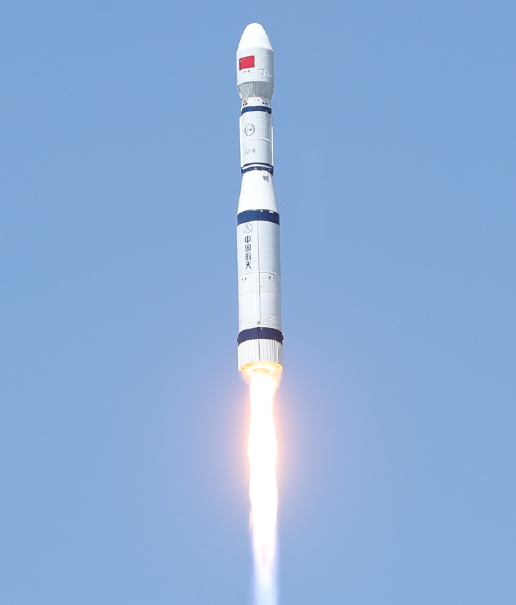
#CNSA #ChinaNationalSpaceAdministration #国家航天局 |#BRI #July2023 | #CASC #ChinaAcademyOfSpaceTechnology #长征六号#ChangZheng6C #LongMarch6C China’s first space “carpooling” rocket auction soon……

长征六号On the 13th July 2023 it is the first Auction of China, People’s Republic of China’s First Carpooling on the CNSA –China National Space Administration Chang Zheng – Long March 6 Carrier Rocket and international Icon Launch Vehicle Piggbacking Opportunities also auction activity.. “carpooling” rocket auction will start at 3:00 pm on July 13. The rocket participating in this auction is the Long March 6 developed by the CASC – China Academy of Space Technology- Eighth Academy of Aerospace Science and Technology Group C carrier rocket is expected to be launched by the end of this year of 2023, and the starting price is 80,000 yuan per kilogram. ​​​

Long March 6 carrier rocket (English: Long March 6, abbreviation: CZ-6) is a new generation of non-toxic and non-polluting small liquid carrier rocket developed by the Shanghai Academy of Aerospace Technology of the People’s Republic of China ( the Eighth Research Institute of China Aerospace Science and Technology Corporation ) .

The Chang Zheng Long March 6C 43 meters tall three-stage rocket with a carrying capacity of 500 kilograms in a sun-synchronous orbit at an altitude of 700 kilometers . The rocket has the advantages of low cost, high reliability, strong adaptability, and good safety. Many new technologies are applied for the first time in China, and the development is very difficult . The Long March-6 launch vehicle was officially approved by the state in the year  2009,

Design Principle’s

LOW COST-  Cost reduction is an important condition for improving the competitiveness of launch vehicles in the domestic and foreign satellite launch markets. The key to the development of small launch vehicles is to reduce costs. On the one hand, make full use of the basic technology of the new generation of launch vehicles to reduce the cost of development. During the design process, the idea of ​​low-cost design should always be implemented, and the system configuration should be simplified as much as possible while ensuring reliability; launch operations should be simplified to reduce launch costs. Using kerosene/liquid oxygen engine, the light fuel cost saves millions of yuan compared with before.

High reliability is the lifeblood of a rocket. Follow the reliability design principle of “simple is reliable”, and strive for simplicity in stand-alone or system design; through strict quality assurance system and quality management system, control product design and production quality. The design reliability is 95%. After further optimization, the reliability of the first flight has been increased to 98%, which is 1% higher than that of the most secure Long March 2 F-type.

Adaptable- To meet the diverse needs of users, it can not only adapt to the launch of small satellites in various orbits, but also launch double or multiple satellites; it can adapt to new launch sites or launch at existing launch sites. During its maiden flight, the Long March-6 completed 20 satellites in one rocket, setting a new record for Chinese satellite launches.

Short cycle -The technology of the basic type of new-generation carrier rocket is fully applied, the development cycle is short, the launch method is simplified, the launch cycle is shortened, and the requirements for rapid launch are met. The launch preparation time for the first flight only takes one week

Images and visuals are from their Respectives CMS China Manned SpaceCNSA-China National Space Administration

#CNSA #ChinaNationalSpaceAdministration #国家航天局 |#BRI #July2023 | #酒泉卫星发射中心#JiuquanSatelliteLaunchCenter launched on the International Icon #ChangZheng2C  #LongMarch2C  YZ-1S #CarrierRocket successfully launch China Star Network’s #TestSatellite #InternetSatellite  …

On the 9th July 2023 clear 1900 Hours Hong Kong SAR- Beijing time , the Belt and Road InitiativeCNSA –China National Space Administration launching from Jiuquan Satellite Launch Center – Inner Mongolia –China – People’s Republic of China deployed launched the Chang Zheng – The Chang Zheng – Long March 2C YZ-1S carrier rocket.. This launch is the 478st launch of the Long March series of launch vehicles. successfully launch the satellite Internet technology test satellite into space, and the satellite entered the schedule smoothly Orbit, the launch mission was a complete success.

【The number of launches of Chang Zheng- Long March 2C Carrier Rockets  this year will hit a new high】During this mission, the rocket realized the interconnection between the Beijing remote test network system and the remote auxiliary test and launch system of Jiuquan Satellite Launch Center for the first time, and it can be launched in the Beijing remote measurement and control hall Remote auxiliary support for the final assembly, testing, and launch of rockets at the launch site, reducing the time and cost of personnel traveling to and from the launch site, and improving launch efficiency.

At 19:00 on July 9, 2023, Beijing time, our country used the Long March 2C/Yuanzheng 1S launch vehicle at station 94 of the Jiuquan Satellite Launch Center , the satellite Internet technology test satellite was successfully launched into space, and the satellite successfully entered the predetermined low-earth orbit, and the launch mission was a complete success.
The satellite Internet technology test double star launched this time was developed by the General Department of Communication and Navigation Satellite of the Fifth Academy of Aerospace Science and Technology…

The upper stage of Yuanzheng-1S for this mission:
1) Adopt a new curved grid transition section, which reduces the weight by 35%, improves the rocket’s carrying capacity, reduces the section installation interface, and optimizes the final assembly operation process.


2) The measurement system adopts the space-ground-based integrated measurement and control mode for the first time, which can freely switch the space-based and ground-based measurement and control time according to the mission requirements, and has the ability to measure and control the whole process without blind spots, which greatly improves the task adaptability.


This mission is the fifth space launch of the Chang Zheng- Long March 2C Carrier Rockets  in 2023. In the second half of the year, the Chang Zheng- Long March 2C Carrier Rockets  continued to maintain a high-intensity launch situation. In 2023, the Chang Zheng- Long March 2C Carrier Rockets launches will hit a new high.

The Chang Zheng- Long March 2C/Yuanzheng 1S successfully launched China Star Network’s first test star mission badge This badge is one of the small series of space mission badges “upper level”. The outline of this series of badges is unified with the fairing The shape of this badge accurately corresponds to the shape of the fairing assembled by the Changer C rocket.

The background of the badge is selected from Jiuquan Western Han Dynasty Monument, also known as Quanhu Park, which is the only well-preserved Chinese-style garden in the Hexi Corridor
This launch mission is:
The 1st launch of China Aerospace in July 2023 (all successful)
The 5th launch of Long March 2C in 2023 (all successful)
The 12th launch of the First Aerospace Academy in 2023 (all successful) )
The 20th launch of Aerospace Science and Technology in 2023 (all successful)
The 26th launch of China Aerospace in 2023 (all successful)
The 101st global space launch in 2023 (95 successful)
The 198th launch of Jiuquan Satellite Launch Center (183 successes)
The 5th flight of the upper stage of Yuanzheng-1S (all successes)
The 70th launch of the Long March 2C carrier rocket (69 successes)
The first hospital grasped the 290th launch of the Long March rocket (276 Success)
The 478th launch of the Long March series of launch vehicles (461 successes)
The 148th consecutive successful launch of the Long March series of launch vehicles 🔺The
532nd launch of China’s launch vehicles (499 successes)

Images and visuals are from their Respectives CMS China Manned SpaceCNSA-China National Space Administration

#CNSA #ChinaNationalSpaceAdministration #国家航天局 |#BRI #July2023 | #天宫#Tiangong #ChinaSpaceStation #CMS #ChinaMannedSpace #神舟十六号 #Shenzhou16 16 Crew Sends Blessings to the 35th Summer Class of International Space University

On the 30th  May 2023 clear 0931 Hours Morning Hong Kong SAR- Beijing time , the Belt and Road InitiativeCNSA –China National Space Administration from Jiuquan Satellite Launch Center – Inner Mongolia –China – People’s Republic of China deployment of  the Chang Zheng – The Chang Zheng – Long March 2F Yao 16 –Shenzhou 16  carrier rocket.. On which Takionauts Jing Haipeng, Zhu Yangzhu, and Gui Haichao took to the predetermined orbit. The first manned flight mission in the application and development stage was a complete success. The three astronauts will stay in the space station and “join up” with the crew of Shenzhou 15 to carry out on-orbit handover “face-to-face” meeting in which brings the total crew of six with a handover ceremony  from Shenzhou 15 towards 16..

On the 5th July  2023 CNSA China National Space Administration – Tiangong – China Space Station Shenzhou 16 Crew Sends Blessings to 35th International Space University Summer Class On the morning of July 5 local time evening  of the conference on  Six Hour Morning Beijing time  , the 35th Summer Class of International Space University opened in San Jose, Brazil. The crew of Shenzhou 16 Takionauts Jing Haipeng, Zhu Yangzhu and Gui Haichao specially recorded a video on the China Space Station to send blessings for the smooth holding of the summer…..  

Images and visuals are from their Respectives CMS China Manned SpaceCNSA-China National Space Administration

#MadeInChina #中國製造 |#深蓝航天#DeepBlueLimitedCompany #July2023| Deep Blue Aerospace Xingyun-1  #ReusableCarrierRocket Development Progress – completed the first domestic rectification using a non-pyrotechnic connection unlocking faring mechanism…

深蓝航天  Deep Blue Limited – Deep Blue Aerospace One of sixty Chinese private space Carrier Rocket Companies in China-People’s Republic of China…  As many of sixty plus Private Rocket Deep Blue Aerospace Co., Ltd. was established in 2017. The company is mainly a high-tech aerospace enterprise that focuses on the direction of liquid recovery and reusable launch vehicles and provides users with commercial launch services. Deep Blue Aerospace Co., Ltd. is headquartered in Nantong City, Jiangsu Province. At the same time, the company has rocket general and liquid engine R&D centers in Yizhuang, Beijing and Xi’an, Shaanxi, respectively, and a rocket power system test base in Tongchuan, Shaanxi…..

Recently this month of June July 2023 , the separation test of the fairing of the “Xingyun-1” liquid recyclable and reusable launch vehicle of Shenlan Aerospace was a complete success. This is the first test in China to use a non-pyrotechnic connection unlocking mechanism to separate the fairing. In order to fully verify the separation state of the fairing under different deviations, Deep Blue Aerospace has conducted many experiments on this round, all of which use the self-developed non-pyrotechnic connection unlocking mechanism. The separation timing of the test is correct, which is basically consistent with the simulation results. No damage occurred in

This round of separation tests was completed in the Deep Blue Aerospace Nantong rocket assembly base, and the fairing was completely recovered after multiple tests. ​The main technical indicators of this round of fairing separation test have been completed:

This round of tests used the same set of connection and unlocking mechanisms to complete multiple separation tests within three days, verifying the reusability and rapid response capabilities of the self-developed non-pyrotechnic connection and unlocking mechanism, which is the first time in domestic fairing separation tests. ​

This round of fairing separation test is one of the phase tests before the first flight of the “Xingyun-1” liquid reusable launch vehicle. The success of this round of tests will pave the way for the first flight of the “Xingyun-1” rocket in 2024 established a solid foundation.

Why did the rocket separate the fairing? ​ ​The launch vehicle will encounter harsh environments during flight. The fairing protects the satellite load from aerodynamic force and aerodynamic heat, and also reduces the aerodynamic resistance of the launch vehicle during flight. After leaving the atmosphere, the launch vehicle is no longer affected by aerodynamics, and throwing away the fairing helps to increase the rocket’s carrying capacity. 

Images and visuals are from their Respectives.

#CNSA #ChinaNationalSpaceAdministration #国家航天局 |#BRI #July2023 #CMS #ChinaMannedSpace #Shenzhou10 #Shenzhou13 #Takionaut #王亞平 #WangYaping inspiring the youth in  the 2023 International Youth Exchange Conference….

CNSA China National Space AdmistratonCMS China Manned Space Shenzhou ten and thirteen Senior Colonel Takionaut王亞平Wang Yaping inspiring the youths , students who listened to her lectures have now become her teammates On the morning of July 7th, the 2023 International Youth Exchange Conference was held at Jinan opened, and Takionaut Wang Yaping spoke at the opening ceremony. She told the story of how a student from Tiangong classroom became her teammate. Wang Yaping said that many students who attended the class in the past devoted themselves to the aerospace industry of the motherland. , I think this is the happiest thing for me as a space teacher, and it is also the biggest motivation for me to continue to spread knowledge and inspire dreams for young people in the future.

  Images and visuals are from their respectives- CNSA –China National Space Administration respectives