On the 25th November 2022 Hours Hong Kong SAR – Beijing timeCNSA –China National Space Administrationthe Tiangong –China Space Station Crew of Shenzhou 14 crew announces soon to be next Tiangong – China Space Station Tiangong Classroom of Space Teaching with your Favourite Teachers from Shenzhou 10, Shenzhou 13 towards Shenzhou 14. Takionauts Chen Dong, Liu Yang, and Cai Xuzhe introduced at the Chinese space station: the first time they greeted and entered Wentian in orbit capsule, dream capsule; the first time to leave the capsule from the airlock of the Wentian capsule; the first time to conduct a “space lecture” in the Wentian capsule; and soon, the next “space lecture” will be on orbit for the first time. The arrival of the Takionauts trip trio… They also sent a message to the students: “Looking forward to you who have spaceflight dreams, join us to collect the light of the galaxy, depict the outline of the sun and the moon, and go to a more exciting sea of stars! China Space Station, etc. You are here on a Space mission trip!”
CNSA –China National Space Administration…………… After Wentian experimental module entered orbit, the status setting was successfully completed. At 3:13 on July 25, 2022, Beijing time, it was successfully connected to the forward port of 天和 Tianhe Core Module. The entire rendezvous and docking process lasted about 13 hours. . This is the first time that two 20-ton spacecraft in my country- China- People’s Republic of China have achieved rendezvous and docking in orbit. …According to the mission plan, the Shenzhou 14 Takionaut crew will then enter the Wentian experimental module….. In which finally docked in early morning time of the 25th July 2022 in with CNSA –Beijing Aerospace City in which co-ordinated the docking maneuverers have achieved rendezvous and docking in orbit.… in which the crew of the Shenzhou 14 staying for six months in construction of the stage one of the China Space station with the additional Mengtianexperimental module in which will be delivered on the October 2022 Launch Schedule calendar..
At present, the Wentian experimental module is running stably in orbit, and the astronauts have completed the unlocking and installation of the scientific experimental cabinet in the Wentian capsule. In addition to the scientific experiment cabinet, the Wentian capsule is also equipped with two extravehicular detectors: a plasma in-situ imaging detector and an energetic particle detector , which will be installed on the extravehicular exposure platform as planned . Among them, the plasma in-situ imaging detector is the first scientific payload for space environment detection outside the space station in China . Today, the eighth chapter of “Ask the Sky” uses three questions to give you an in-depth understanding of the plasma in-situ imaging detector.
Its main functions include in -situ measurement of plasma electronic parameters, plasma ion parameters and the surface potential of the space station cabin, and 3D imaging detection of ions. Detect and measure the composition, density, temperature, velocity and surface potential of the space station orbital plasma, as well as the three-dimensional spatial distribution of the space station orbital plasma velocity and density.
Its main scientific and applied goals include:
ONE – Carry out orbital plasma in-situ detection and three-dimensional imaging detection of the space station, and accumulate scientific detection data.
TWO- Provide plasma monitoring data support for space station operation and application and test (experimental) missions, research on disturbance characteristics and evolution mechanism of the ionosphere in the middle and low latitudes, and improvement of the orbital ionosphere model of the space station.
THREE – Through the in-situ detection of plasma and the accumulation of long-term charging data, it provides data support for studying the charging effect of plasma on the space station, promoting the establishment of a charging evaluation system for the space station, and supporting the decision-making of the space station mission.
Q: What is the value? Scientific research value of plasma in situ imaging detector
A: The space station is my country’s long-term in-orbit space infrastructure and an important platform for my country to conduct various space science experiments (experiments). The space station has a 340~450km near-circular orbit with an orbital inclination of 42°~43°. Monitoring the space environment of the orbit of the space station is one of the important tasks to ensure the safety of manned spaceflight projects. At the same time, the long-term on-orbit detection of space environment elements can provide an important basis for studying the mechanism of the harm caused by the space environment to the space station and Takionauts, and can also provide necessary space environment parameters for the scientific experimental loads on the space station .
The main components of the plasma in situ imaging detector
The operating orbit of the space station is located in the peak height region of the ionospheric F2 layer, and the ionospheric plasma environment is the basic environment for the operation of the space station. This area has the highest plasma density, is the most concentrated area of various ionospheric physical phenomena and their effects, and also has the greatest impact on navigation and positioning signals. The space station is an ideal platform for in-situ detection and research of the Earth’s ionospheric plasma. It is also an ideal platform to study the interaction between plasma and space station .
A major advantage of monitoring the plasma environment in space station orbit is the long on-orbit time . The lifespan of ordinary satellites at the orbital altitude of the space station is short, which is not conducive to long-term monitoring of the ionospheric environment. Using the platform of the space station to conduct long-term in-situ detection of ionospheric plasma in the middle and low latitudes can be used to study the origin and evolution mechanism of the irregular structure of the ionosphere in the middle and low latitudes, so as to improve the accuracy of the ionospheric model and improve the reliability of the ionospheric model. Accuracy of navigation/positioning .
In addition, the space station is immersed in space plasma, which will interact with the plasma in various ways, causing charging of the space station, contamination and damage of surface materials, etc. Long-term in-situ detection and charging monitoring of on-orbit ionospheric plasma environment at the space station provides an important opportunity to study the interaction mechanism between the plasma environment and the space station and its impact on astronauts and the space station . one of the important jobs .
Therefore, the plasma in-situ imaging detector monitors the ionospheric plasma environment of the orbit of the space station, which can be used to study the mechanism and evolution process of the irregular structure of the ionosphere in the middle and low latitudes, improve the accuracy of the ionosphere model and the navigation/positioning accuracy, and also guarantee the carrier It is one of the important tasks for the safety of human aerospace engineering technology systems in orbit and the safety of astronauts’ extravehicular activities. The long-term monitoring of the elements of the ionospheric plasma environment also provides important data for the study of the mechanism of the effect of the ionospheric plasma environment on the space station and astronauts.
Q: How to apply? Extended application of plasma in situ imaging detector
Answer: The ion imager of the plasma in-situ imaging detector is the first application in China’s space field. It can image ions in the energy range of 0.1eV to 204eV in a 360°×94° annular field of view, and the imaging time resolution can be Up to 45ms, which is at the international advanced level . The ion imager of the plasma in-situ imaging detector can be applied to plasma detection in interplanetary space and deep space in the future .
The Langmuir probe and blocking potential analyzer of the plasma in-situ imaging detector, the Langmuir probe and blocking potential analyzer on my country’s Zhangheng-1 satellite and the Langmuir probe on Lutan-1 satellite It can carry out joint detection in orbit. The altitude of China’s space station is 340~450km, the orbital altitude of Zhangheng-1 satellite is about 500km, and the orbital altitude of Lutan-1 satellite is about 600km. Joint detection will enable more comprehensive detection of the global ionosphere.
In the future, astronauts will assemble and test the external interface of the plasma in-situ imaging detector in the cabin, and install it on the exposure platform outside the cabin. Let’s look forward to the “two blooms” inside and outside the on-orbit scientific experiment of Tiangong Space Station!
一個空間 One Space -Chongqing Zero One Space Aerospace Technology Co., Ltd. One Space Technology Group Co., Ltd. (One Space), a pioneering enterprise in China’s commercial aerospace industry, has formed a technology platform centered on the launch vehicle business… is one of many sixty plus commercial private space Carrier Rocket companies in China- People’s Republic of China in which they’re founded in Beijing – Chongqing- Xi’an – in which currently they’re development to full commercialisation of in between light to medium heavy launch carrier vehicles …. was established in Beijing Zhongguancun Science and Technology Park. It is a leading rocket technology company in China, committed to building informatization, intelligence, and combat The modernized “Rocket+” industrial service platform now has 3 research institutes and 2 research centers……..It has developed three technology platforms of Zero One Rocket, Zero One Electronics, and Zero One Power. At the same time, it is committed to exploring the application of new technologies and new mechanisms in the fields of aerospace and national defense and military industry to become a world-class commercial aerospace group.
As a leading rocket technology company in China, OneSpace has always adhered to the vertical integration of rocket technology, and continued to invest in research and development in five aspects: rocket overall technology, control system technology, telemetry system technology, launch support system technology, and power system technology.
In order to further enhance the company’s rocket products with quick response, high maneuverability and multi-platform characteristics, the Wangshu series container launch platform was specially developed. The platform completed the plan review in July last year. After overcoming the difficulties of the epidemic, it has officially entered the production and assembly stage.
Wangshu series container launch platform
The launch support system is an important part of the rocket launch. The platform integrates the rocket launch system and can realize rocket body transportation, storage, launch and other related functions. It can not only meet the launch needs of private commercial rockets, but also provide services for emergency launches . Through the adjustment of the internal components of the platform, the launch platform can be applied to most launch vehicles with a diameter of less than or equal to 1.4m in the current market. Taking advantage of this platform, OneSpace’s latest self-developed Linglong-1 series of solid launch vehicles will further enhance the launch speed and maneuverability advantages.
It is expected that the launch platform will complete the factory review in June, so stay tuned!
深蓝航天 Deep Blue Limited – Deep Blue Aerospace One of sixty Chinese private space Carrier Rocket Companies in China-People’s Republic of China… As many of sixty plus Private Rocket Deep Blue Aerospace Co., Ltd. was established in 2017. The company is mainly a high-tech aerospace enterprise that focuses on the direction of liquid recovery and reusable launch vehicles and provides users with commercial launch services. Deep Blue Aerospace Co., Ltd. is headquartered in Nantong City, Jiangsu Province. At the same time, the company has rocket general and liquid engine R&D centers in Yizhuang, Beijing and Xi’an, Shaanxi, respectively, and a rocket power system test base in Tongchuan, Shaanxi…..
On May 6, 2022, the “Nebula-M” test rocket independently developed by DeepBlue Aerospace completed a 1-kilometer vertical take-off and landing flight test. It has climbed to a new height and is a solid step closer to the successful realization of orbit and recovery
Deep Blue Aerospace’s third-hand “Nebula-M” rocket completes the flight recovery mission On May 6, 2022, the “Nebula-M” No. 1 test rocket independently developed by DeepBlue Aerospace completed a 1-kilometer vertical take-off and landing (VTVL) flight test, and the rocket moved laterally during the process of climbing and falling. , and finally landed to a point less than 0.5 meters from the “bull’s eye” position of the landing site, and the “Nebula-M” test arrow was successfully recovered.
The arrow body used in this Kilometer-level test is still the “Nebula-M” No. 1 test arrow, which has performed 3 flight missions and 7 ground static ignitions, truly realizing the recyclability and reuse of liquid launch vehicles ; its The equipped “Thunder-5” engine is the first needle-bolt-type liquid oxygen kerosene engine to be manufactured using 3D printing technology in China. The completion of this mission announced that Deep Blue Aerospace has climbed to a new height in the history of China’s reusable and reusable rockets, and has taken a solid step towards the successful realization of orbit and recovery.
Pictured: “Nebula-M” kilometer-level VTVL vertical recovery flight test
From July to October 2021, the “Nebula-M” test rocket has successively completed the 10-meter and 100-meter VTVL vertical recovery flight tests, achieving two zero breakthroughs in domestic liquid oxygen and kerosene rockets. In May 2022, the same rocket once again refreshed a new test height. Deep Blue Aerospace has become the fastest Chinese commercial aerospace company in the world outside the United States to develop and recycle rockets.
Pictured: “Nebula-M” kilometer-level VTVL vertical recovery flight test
This kilometer-level VTVL vertical recovery flight test marks that Deep Blue Aerospace achieved the same level of test results achieved in 2012-2013 with 8 launch tests in more than a year in only 10 months and 3 launch tests. Deep Blue Aerospace has become the second company in the world to complete all low-altitude engineering tests for vertical recovery and reuse of liquid oxygen and kerosene rockets (the first being SpaceX in the United States).
Kilometer -level VTVL vertical recovery flight test broke many domestic records…
The “Nebula-M” kilometer-level VTVL vertical recovery flight test has four technical highlights:
Significant reduction in flight test costs
Under the premise of realizing the vertical recovery of the full arrow, the cost of re-flying the mission is only about 1% of the cost of the production and manufacturing of the arrow body, including the replacement of some wear and tear parts, the test and maintenance cost of the whole arrow, and the propellant cost;
Longer working time for a single ignition
Compared with the 100-meter-level test, the kilometer-level VTVL vertical recovery flight test has greatly improved the working time of a single ignition of the engine, which is closer to the working time of a single-stage engine of an orbiting rocket. Different from the state of the ground test, this time the stability of the large-scale thrust change and long-range work of the engine is assessed in the real flight environment, which has more authenticity and practical significance in engineering development;
Application of Lateral Guidance Algorithm
In this kilometer-level test, during the vertical takeoff-vertical landing flight process, a lateral guidance algorithm was added, the coordinates of the target point were pre-booked, and the computer on the rocket carried out calculation and planning, issued lateral guidance commands, and guided the rocket to the target coordinates. Transverse, carry out the verification of the rocket’s off-site return and recovery technology, and carry out preliminary technical verification for the off-site return and reuse of the rockets entering orbit, and intercontinental travel, etc.;
Breakthroughs in multiple coefficients of the kilometer-level VTVL vertical recovery flight test
In this kilometer-level VTVL vertical recovery flight test, the flight speed reached 0.2Ma and the flight altitude reached 1 km. This is the vertical recovery flight test with the highest flight altitude, fastest flight speed and longest flight time in China.
Through this flight test, the aerodynamic problems of the rocket body in the vertical recovery process of the rocket, as well as the long-term mechanical heat and vibration environment adaptability, the engine’s long-term and large-scale thrust change ability, and the reusable arrow are further verified. Key core technologies such as body structure and landing buffer device, lateral guidance and attitude control capabilities have laid a solid foundation for the subsequent 10-kilometer-level vertical recovery and orbit-level recovery.
Huo Liang, CEO of Deep Blue
The success of Deep Blue Aerospace’s “Nebula-M” rocket kilometer-level VTVL vertical recovery flight test also announced that the low-altitude recovery stage has come to a successful end, and the “Nebula-M” 1 test rocket has successfully completed its historical mission. In the next stage, Deep Blue Aerospace will use the same full-scale test rocket as the orbiting rocket to continue the high-altitude recovery test stage (similar to the recovery test carried out by SpaceX’s second stage using the full-scale prototype “Falcon 9 R”), It will make rapid breakthroughs towards the height of 10km and 100km, and finally realize the controllable recovery and reuse of the first sub-stage of the orbiting rocket.
Pictured: “Nebula-M” kilometer-level VTVL vertical recovery flight test
In 2021, the Permanent Mission of China to the United Nations (Vienna) submitted a note verbale to the Secretary-General of the United Nations and released information that the satellites launched by the US Starlink plan had approached the Chinese space station twice, and this behavior had a negative impact on the life and health of the astronauts built by the Chinese space station. threaten. For safety reasons, the Chinese space station complex has implemented two “emergency collision avoidance” measures against the relevant US satellites. However, the key to these problems is that the number of satellite launches planned by Starlink far exceeds that of China. As of March 2022, Starlink plans to launch more than 2,000 satellites, and the only way to achieve such a large number of satellite launches is to reduce the launch cost of rockets and increase the frequency of launches to be realized.
Low-cost recyclable rockets have become the only way to develop future launch vehicles. With rapid overhaul, relaunch, successful recovery, and rapid iteration, SpaceX’s Falcon 9 ranks among the world’s rocket echelons. Up to now, SpaceX’s flight data: 95 rocket reuse flights, 118 rocket landings, and the take-off stage of a single carrier rocket can be reused up to 12 times.
On April 16, 2022 From the construction of space infrastructure to the completion and opening of the Beidou global satellite navigation system, from the successful conclusion of the “three-step” lunar exploration project to the “Tianwen-1” crossing the Earth-Moon system to start the Mars exploration journey… Countless brilliant achievements are in It continues to prove that China is making progress towards becoming a “space power”.
As a commercial aerospace enterprise, Deep Blue Aerospace actively responded to the country’s strategic deployment of the aerospace industry, anchored the goal of rocket recycling and reuse, and never wavered or changed the direction of research and development.
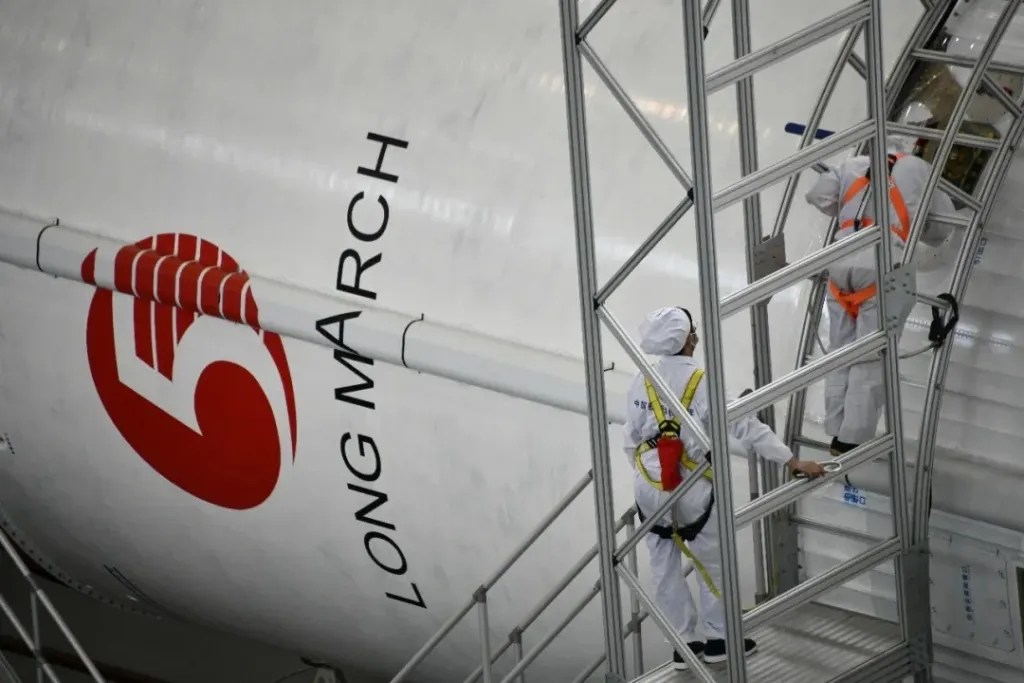
On a very 14th April 2022 in Hainan Province –China –People’s Republic of China…. Clear Day in the district area of the Wenchang – Wenchang Spacecraft launch center in which the awesome team at one of many CNSA –China National Space Administration in which the CNSA Chang Zheng – Long March five Heavy Carrier Rocket has international always attracted so much attention that’s is driven . Driven by aerospace, the development of the technology industry has become more and more mature.
That inspired the design of the Vivo X Note is a typical case…. . The 7-inch wide-screen design refers to the research and development ideas of launch vehicles, making the overall structure light, thin and sturdy. Special consideration is also given to the grip feeling during use, breaking through industry traditions and finding a new golden ratio. It is expected that aerospace technology can bring more inspiration to the technology industry……. With the inspiration of the Chang Zheng- Long March Five it’s big of its of 56.97 meters in height In scientific and technological research and development, we have the same pursuit as China Aerospace: “To the vast and subtle” 中国 Aerospace Creation . We hope that through the ultimate control of every detail, ordinary people can truly appreciate the convenience brought by technological development…
The big-screen business flagship Vivo X Note pays tribute to every dedicated you. 7-inch wide screen, 5000mAh large battery, long-distance power system, 8.37mm thin and light hand feel, Snapdragon 8 SPU custom flagship chip with vivo self-developed chip V1, 3D large-area ultrasonic fingerprint, full-focus Zeiss four cameras, smart office Pro, thousand mirrors Security Architecture. On the big screen, it will give you a very different business experience.
Vivo X Note color matching] vivo X Note also adopts a square and round sky-level design, with a total of three color matching. Qingshan blue is artistic and attractive, with special embossed textures on both sides of the fuselage, making the vision more three-dimensional; earth gray, calm, pure and restrained, and stress-free for business commuting; bright night black, using low-light AG technology, under the light It flashes on and off, and the customized strings on both sides are designed with a full sense of design…