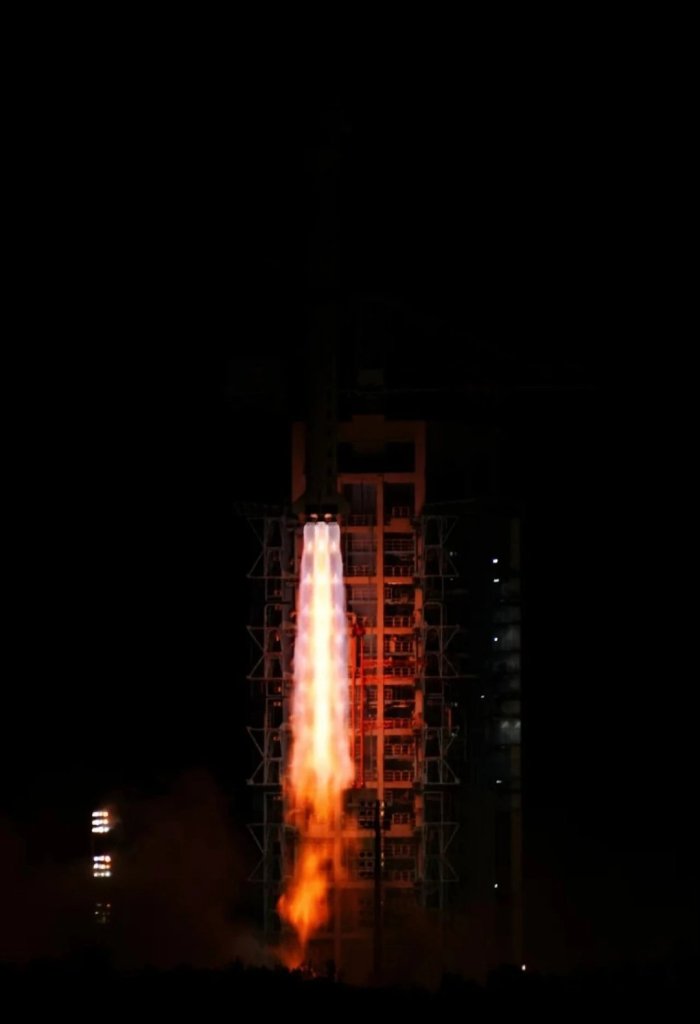
#CNSA #ChinaNationalSpaceAdministration #国家航天局 |#BRI #October2023| || #酒泉卫星发射中心 #JiuquanSatelliteLaunchCenter #Tiangong #ChinaSpaceStation #CMS #ChinaMannedSpace, #神舟十七号#Shenzhou17 #ChangZheng2F #LongMarch2F Yao 17 #MannedCarrierRocket Launching is about to be unveiled!

The Shenzhou 17 mission Chang Zheng- Long March 2F Yao 17 manned Carrier Rocket is about to be unveiled at the on the 19th October 2023 Thursday Hours Hong- Kong SAR – Beijing time CNSA –China National Space Administration …..

It is expected that on the morning of October 26, 2023, the “Shenzhou 17” manned spacecraft carrying three astronauts will be launched from the 921 station of the Jiuquan launch site by the “Long March 2F” Yao 17 carrier rocket. After separation, the spacecraft will use the rapid rendezvous and docking mode to ascend to the forward port of the “Tianhe” core module of the Chinese Space Station to carry out the third astronaut crew rotation mission of China’s manned space program.

It is expected that about a week before the launch, the “Long March 2F” Yao 17 carrier rocket. spacecraft and the “Chang 2F” Yao 17 rocket assembly will be vertically transferred from the 9001 vertical assembly test plant to the 921 launch station on the movable launch platform, and the launch mission will be transferred to the refuelling station. launch phase. During the launch station, the “Shenzhou 17” mission will organize joint training work such as full-system launch drills at the launch site and joint drills in the entire region to fully prepare for the launch work.

The “Shenzhou 17” manned spacecraft was developed by the Fifth Academy of China Aerospace Science and Technology Corporation. It adopts a three-cabin configuration in series, with the propulsion module, return module and orbital module in sequence from bottom to top. The total length of the spacecraft is 9 meters, the maximum diameter of the cabin section is 2.8 meters, and the take-off mass is no more than 8130 kilograms. The spacecraft can carry three astronauts to and from space, and can dock at the space station and fly for 6 months. At the same time, the spacecraft has the cargo capacity of 300 kilograms in the upward direction and 50 kilograms in the downward direction.

At present, the development and production of the “Shenzhou” manned spacecraft has entered the second batch of mass production. This batch plans to develop and produce 6 spacecraft from “Shenzhou 16” to “Shenzhou 21”, and “Shenzhou 17” It is the second spacecraft in this batch. Compared with the previous batch, the new batch of spacecraft has mainly been improved in two aspects. On the one hand, it continues to promote the domestic replacement of parts and components and further enhances its independent controllability; on the other hand, it has improved the human-machine interaction interface of the return capsule. Modernized and upgraded, more convenient and friendly.

The “Chang-2F” launch vehicle was developed by the First Academy of China Aerospace Science and Technology Corporation. It is a medium-sized two-stage semi-normal temperature liquid launch vehicle. It consists of a core first stage, a core second stage, and four boosters tied around the core first stage. , the main power of the entire arrow is dinitrogen tetroxide/uniform dimethylhydrazine propellant. The rocket currently in use is the “Chang 2F” improved version (CZ-2F/G), with a total length of about 58 meters, a take-off mass of about 496.82 tons, and a low-Earth orbit carrying capacity of not less than 8,130 kilograms.

By continuously eliminating weak links and optimizing the technical status, the reliability and safety of the “Chang-2F” rocket have been steadily improved year by year. By the time of the “ Long March 2F” Yao 17 carrier rocket., the rocket’s reliability evaluation results had increased to 0.9896, and the safety evaluation results had reached 0.99996. Safety 0.9896 means that there will only be 1.04 failures per 100 flights. Safety 0.99996 means that the rocket escape system will only have a 4/100,000 probability of failure when responding to failures.

“Shenzhou 17” is my country’s 17th “Shenzhou” spacecraft launch mission and the 12th manned launch mission. As usual, the astronauts will settle in Wentian Pavilion of Dongfeng Space City one week before the launch, and will participate in the joint inspection and testing of people, ships, rockets, and ground in the full-system launch drill organized by the launch site system, and “test drive” The “Shenzhou Seventeen” spacecraft. The day before the launch, the three astronauts of the “Shenzhou 17” crew will make their official debut.

Images and visuals are from their Respectives CMS China Manned SpaceCNSA-China National Space Administration

#CNSA #ChinaNationalSpaceAdministration #国家航天局 |#BRI #October2023 |#西昌衛星發射中心 #XichangSatelliteLaunchCenter the advance iconic #ChangZheng2D #LongMarch2D Yao 84 launches #Yaogan 39 03  #RemoteSensing 39 #Satellite ….

On the 5th October 2023 in  CNSA _China National Space Administration -China – People’s Republic of China 0824 hours Hong Kong –Beijing Time China- People’s Republic of China launch the Chang Zheng – Long march 2D  Yao 84  Carrier Rocket launching from station form Xichang Satellite Launch Center Sichuan Province…..

At 08:24 on October 5, 2023, the ” Chang Zheng- Long March 2D” Ya84 carrier rocket carrying the “Yaogan 39” 03 satellites was launched from Station 3 of the Xichang Launch Site, accurately delivering the satellite to into a predetermined orbit.

The 03 satellites of this mission, “Yaogan 39”, were developed by the Fifth Academy and the Eighth Academy of China Aerospace Science and Technology Corporation.

“Long March 2D” is a medium-sized two-stage normal-temperature liquid launch vehicle developed by the Eighth Academy of Sciences. The main power of the entire rocket is dinitrogen tetroxide/uniform dimethyl hydrazine propellant. The arrow is 41 meters long, with a diameter of 3.35 meters for both the first and second levels, a take-off mass of 250 tons, a take-off thrust of 302 tons, a low-Earth orbit (LEO) transport capacity of 4.0 tons, a 500-kilometer sun-synchronous orbit (SSO) transport capacity of 1.5 tons, and 700 The SSO transport capacity per Kilometer is 1.3 tons. This rocket uses an extended fairing with a diameter of 3.35 meters, which significantly increases the arrow length.

From its successful first flight to this launch, the “Long March 2D” rocket has achieved 81 consecutive victories, continuing to set a record for consecutive victories for a single launch vehicle in my country. At the same time, this launch is the 490th launch of the “Long March” series of launch vehicles. Since the successful first flight of “Long March 5B” on May 5, 2020 (the 331st launch of the Long March rocket), the “Long March” rocket has achieved 160 Winning streak, winning streak record continues to hit new highs.

 This launch is the 9th launch of the “Long March 2D” rocket in 2023, the 10th launch at the Xichang Launch Site, the 46th launch in China, and the 160th launch in the world.

The Long March Rockets achieved 160 consecutive victories!

Images and visuals are from their Respectives CMS China Manned SpaceCNSA-China National Space Administration

#CNSA #ChinaNationalSpaceAdministration #国家航天局 |#BRI #October2023 | #嫦娥五号#CLEP the #Moon #Change5 Team won the highest team honour of the International Academy of Astronautics….  On China’s National Day..

More than One year ago on 24th November 2020, the Chang Zheng – Long March Five Carrier Rocket Launched away  in CNSA – China National Space Administration China Wenchang spaceport launch, Change Five  Lunar probe into orbit, opened up towards China – People’s Republic of China’s first celestial bodies sample return trip from Mons Rumker on the Lunar Surface of the moon New research achievements – Chinese scientists reveal the composition of lunar soil minerals and space wind at the landing site of Chang’e 5

Chang’e-5 team On October 1st 2023 on China’s  National Day of the Founding of People’s Republic of China….  During the 74th International Astronautical Congress (IAC) opened in Baku, Azerbaijan. Scientists such as Schumacher, President of the International Academy of Astronautics, awarded the “Chang’e-5 team” to the Chinese Chang’e-5 team. Lawrence Team Award”. Chang’e-5 chief designer Hu Hao and others attended the award ceremony as team representatives and announced that Chang’e-5 lunar scientific research samples will soon be open to international applications. Scientists from all countries are welcome to jointly research and share results.

Chang’e-5 was China’s first unmanned lunar sample return mission. It was China’s most complex aerospace system project with the largest technical span at that time. It made breakthroughs in lunar surface sampling, lunar surface take-off and ascent, lunar orbit rendezvous and docking, sample transfer, and jump-type missions. Using key technologies such as re-entry and return, after an interlocking flight process, it brought back 1,731 grams of lunar samples, becoming the world’s largest unmanned lunar sampling mission with the largest single sampling volume. The Chang’e-5 mission is a vivid practice for my country to achieve high-level scientific and technological self-reliance. It has laid the foundation for subsequent unmanned lunar scientific research stations and manned lunar landings. It is another important milestone in my country’s aerospace development.

The “Lawrence Team Award” was established in 2001. It is one of the two major awards issued annually by the International Academy of Astronautics (IAA). It is the highest team honor of the International Academy of Astronautics and aims to recognize aerospace project teams that have made outstanding achievements in the field of aerospace. Chang’e-5’s outstanding achievements in technological innovation, scientific discovery, and international cooperation have won high recognition from international peers.

Imagines and visuals are from their respectives CNSA China Space Administration CLEP China Lunar Exploration project management office

#CNSA #ChinaNationalSpaceAdministration #国家航天局 |#BRI #September2023 | #嫦娥五号#CLEP #中秋節 #MidAutumnFestival- The #Moon #嫦娥六号; #Change6 #SouthPole-#AitkenBasin #LunarSample return mission from the #Darkside #OtherSide of the #Moon Announcement   —–

On the 29th September 2023 the嫦娥六号; Change 6 Lunar Sample Return Mission onboard the  Chang Zheng – Long March Five Carrier Rocket modified announcement by CNSA – China National Space Administration China Wenchang spaceport launch, Change lunar series  Lunar probes… The National Space Administration announced today that the development of the lunar exploration project Chang’e-6 mission is currently underway as planned and is planned to be launched around 2024. At the same time, our country is accelerating the scientific project of the International Lunar Research Station, and hopes that more international partners will join in to jointly expand the boundaries of human cognition, contribute to the peaceful use of space, and promote the construction of a community with a shared future for mankind.

嫦娥六号; Change 6  planned to be launched around 2024  Queqiao 2 is planned to be launched in the first half of 2024  The China National Space Administration reported on the 29th September 2023 that currently, the development work of the lunar exploration project Chang’e-6 mission is being carried out as planned, and the plan It will be launched around 2024.


  According to arrangements, the Chang’e-6 mission will carry out sample returns from the far side of the moon. The 10 lunar sampling returns that humans have carried out so far are all located on the front side of the moon. The far side of the moon is generally older than the front side of the moon, and there is the Aitken Basin, one of the three major lunar terrestrial bodies, which has important scientific research value. The pre-selected landing area for the Chang’e-6 mission is located in the South Pole-Aitken Basin on the far side of the moon, with a view to discovering and collecting lunar samples from different regions and ages to enhance human understanding of the moon.
  

According to arrangements, the Chang’e-6 mission will carry out sample returns from the far side of the moon. The 10 lunar sampling returns that humans have carried out so far are all located on the front side of the moon. The far side of the moon is generally older than the front side of the moon, and there is the Aitken Basin, one of the three major lunar terrestrial bodies, which has important scientific research value. The pre-selected landing area for the Chang’e-6 mission is located in the South Pole-Aitken Basin on the far side of the moon, with a view to discovering and collecting lunar samples from different regions and ages to enhance human understanding of the moon.


It is reported that in order to successfully complete the communication between the spacecraft on the far side of the moon and the earth, China, People’s Republic of China newly developed Queqiao-2 relay communication satellite is planned to be launched in the first half of 2024.

In terms of international cooperation, the Chang’e-6 mission carried payloads and satellite projects from four countries, including France’s radon detector, ESA’s negative ion detector, Italy’s laser angle reflector, and Pakistan’s CubeSat. At the same time, our country is accelerating the scientific project of the International Lunar Research Station, and hopes that more international partners will join in to jointly expand the boundaries of human cognition, contribute to the peaceful use of space, and promote the construction of a community with a shared future for mankind..

About a month ago, on August 31, the China Manned Space Engineering Office announced that the moon landing phase of China’s manned lunar exploration project has been fully launched! According to the plan, our country will achieve the first Chinese landing on the moon before 2030, and carry out lunar scientific expeditions and related technology tests. The Chinese moon landing is just around the corner!

Via CNSA China National Space AdministrationCLEP China Lunar Exploration project management office ….

#CNSA #ChinaNationalSpaceAdministration #国家航天局 |#BRI #September2023 || #酒泉卫星发射中心 #JiuquanSatelliteLaunchCenter #长征四号  #ChangZheng4C #LongMarch4C   successful launched deployed #Yoagan33 04  #RemoteSensing #Satellite

On the 0415 early morning 27th September 2023 Wednesday Hours Hong- Kong SAR – Beijing time CNSA –China National Space Administration , China, People’s Republic of China. Successfully launched the Yonggan 33 Remote Sensing satellite with the Chang Zheng- Long March 4C Jiuquan Satellite Launch Center, Inner Mongolia, China, People’s Republic of China, and then successfully sent the Remote Sensing No. 33 04 satellite into the predetermined orbit, and the launch mission was completed successfully.


The Remote Sensing 33-04 satellite was developed by the Eighth Academy of China Aerospace Science and Technology Corporation. It is mainly used in scientific experimental research, marine and land resource census, agricultural product production estimation, disaster prevention and reduction and other fields.


This launch is the 489th launch of the Long March series of launch vehicles.

Images and visuals are from their Respectives CMS China Manned SpaceCNSA-China National Space Administration