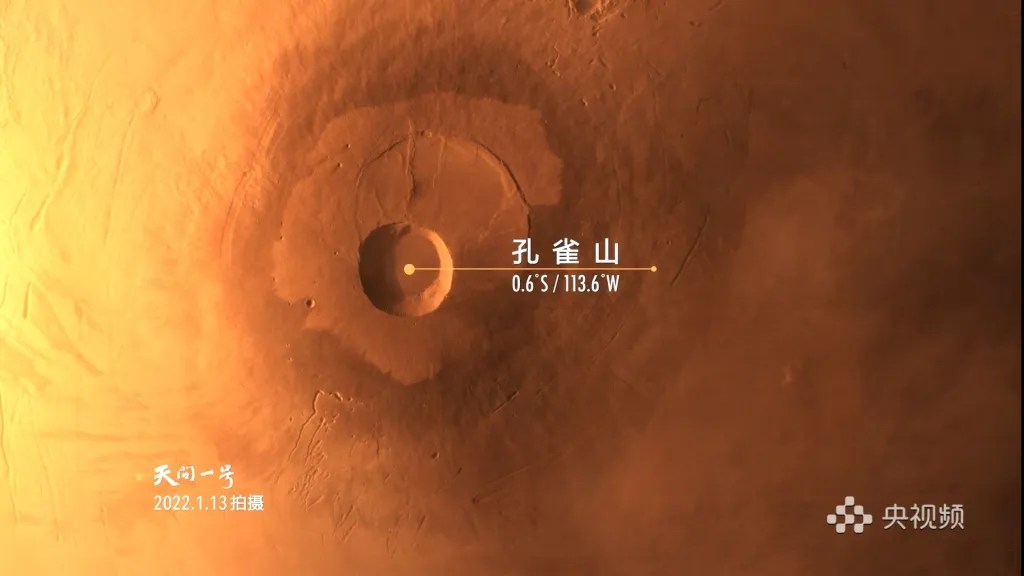
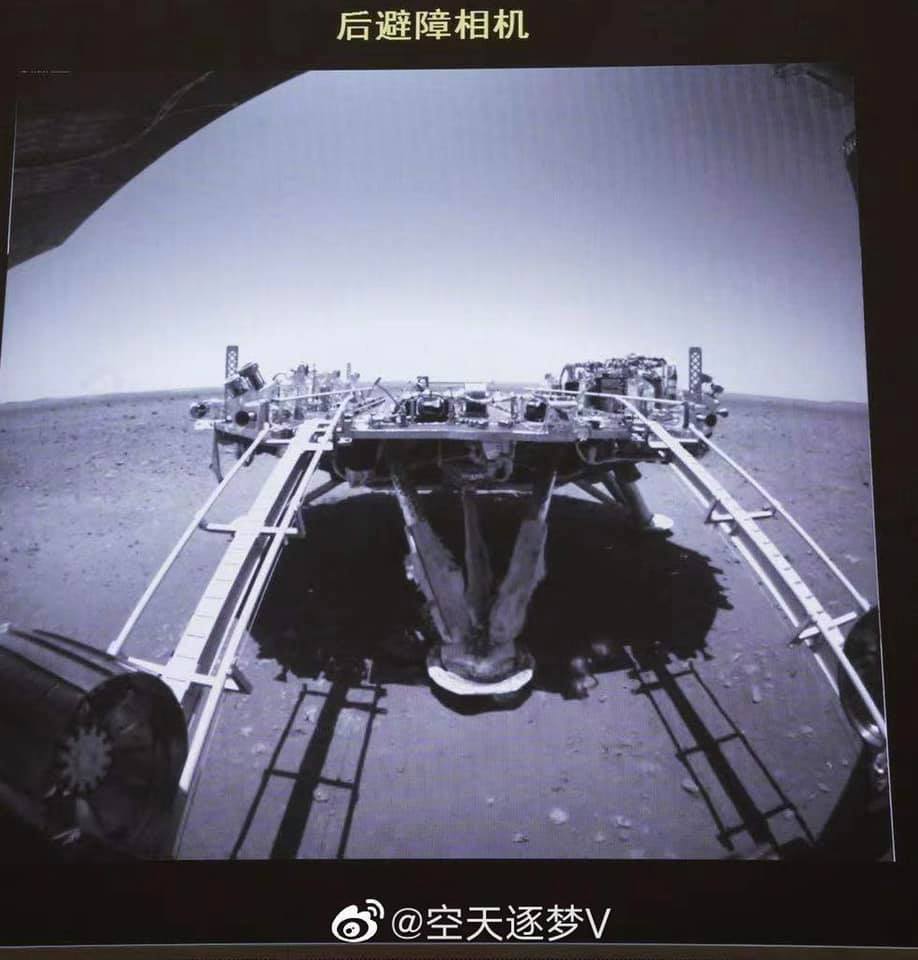
On September 16, 2022, the first seminar on scientific research achievements of Mars exploration missions was held in Beijing in a combination of online and offline methods, aiming to strengthen the exchange of scientific research results of Tianwen-1.
Figure 1. Landform map of impact craters, concave cones, grooves and ridges in the Zhurong landing area
天问一号飞運騎遊達达3亿CNSA – China National Space Administration – ESA – European Space agency Belt and road initiative mars mission…first Mars exploration mission, Tianwen- Martian Probe OneAs of September 15, 2022, the Tianwen-1 orbiter has been in orbit for more than 780 days, and the rover has travelled a total of 1,921 meters, completed the established scientific exploration tasks, and obtained 1,480 GB of original scientific exploration data. The scientific research team has obtained rich scientific results through the research on the first-hand scientific data obtained independently by my country. Through a comprehensive study of typical landforms such as concave cones, barrier craters, and trenches distributed in the landing area, the important connection between the formation of the above-mentioned landforms and water activities has been revealed.
Fig. 2 Schematic diagram of the plate-like hard-shell rock rich in water-bearing minerals found in the landing area by Zhurong and its formation process under the action of groundwater
Through camera images and spectral data, hydrous minerals were found in plate-like hard-shell rocks near the landing area, proving that there has been a large amount of liquid water activity in the landing area since 1 billion years ago (late Amazonian period).
Combined with camera images and rover moving ruts and other information, it is found that the soil in the landing area has strong compressive strength and low friction parameters, which are related to water activity and experience sand erosion.
Fig. 4 Analysis results of Martian soil mechanical parameters in the landing area of Zhurong
These new results reveal the impact of Martian sandstorm and water activities on geological evolution and environmental changes, provide strong support for the conjecture that there was an ocean in the Martian Utopian Plain, and enrich human scientific understanding of Martian geological evolution and environmental changes. The relevant results have been published in authoritative academic journals at home and abroad such as “Nature Astronomy”, “Nature Geoscience”, “Science Advances”, “Science of China” and so on.
In addition, the scientific research team also used the detection data of Tianwen-1 to obtain a batch of data on the relationship between the density of rocks on the surface of Mars and the degree of surface erosion, the distribution of ions and neutral particles in the near-fire space environment, and the gravitational field of Mars. Excellent scientific results.
At present, the Tianwen-1 orbiter continues to carry out scientific exploration in the orbit of the remote sensing mission, continues to accumulate first-hand scientific data, and makes China’s contribution to mankind’s in-depth understanding of Mars.
This month of August 2022武漢Wuhan University People’s Hospital – Wuhan, China People’s Republic of China this month Announcement of The world’s first medical remote sensing satellite is scheduled to be launched in 2023 to serve the fields of infectious disease traceability and other fields …..
The world’s first medical remote sensing satellite will be launched in 2023 According to Wuhan University People’s Hospital, the world’s first dedicated remote sensing satellite for health research – “Wuhan University People’s Hospital Health” medical remote sensing satellite (Luojia No. 4 01 satellite) It will launch in August 2023. The designed payload of the satellite is about 50kg, equipped with visible light hyperspectral cameras, ultraviolet cameras, etc., focusing on China, taking into account neighbouring countries, and detecting environmental factors that affect human health.
In the vast space, a new satellite will be added next year, which will also be the world’s first medical remote sensing satellite. On August 16, the reporter learned from the press conference of Wuhan University People’s Hospital that the world’s first dedicated remote sensing satellite in the field of health research “Wuhan University People’s Hospital Health” medical remote sensing satellite (Luojia No. 4 01) will be launched in 2023. It was launched into space on the occasion of the centennial anniversary of the hospital. The satellite will empower environmental health and smart medical research with remote sensing technology, and help healthy China with integrated innovation
The world’s first medical remote sensing satellite is a strategic cooperation between the Wuhan University People’s Hospital (Hubei Provincial People’s Hospital) and the State Key Laboratory of Surveying, Mapping and Remote Sensing Information Engineering of Wuhan University and the Institute of Astronautical Science and Technology in April this year to jointly establish the world’s first satellite. After the Medical Remote Sensing Information Research Institute “Wuhan University People’s Hospital Medical Remote Sensing Information Research Institute”, “Remote Sensing + Medicine” launched the first major integrated technological innovation.
Gong Jianya, academician of the Chinese Academy of Sciences, dean of the Institute of Aerospace Science and Technology of Wuhan University, and dean of the Institute of Medical Remote Sensing Information of the People’s Hospital of Wuhan University, attended the press conference. He introduced that among the nine major social services (health, disasters, forests, energy, water, climate, agriculture, ecology, and oceans) formulated by the Earth Observation Organization GEO released the “GEOSS Global Earth Observation System”, the only one missing is the health field. The dedicated remote sensing monitoring satellites, which limit the further cross-integration of medical and remote sensing information fields at the data source.
According to Academician Gong Jianya, the medical remote sensing satellite “Hunan University People’s Hospital Health” (Luojia 4 01) is the world’s first dedicated “remote sensing + health” satellite. The designed payload of the satellite is about 50kg. It is equipped with visible light hyperspectral cameras, ultraviolet cameras, etc., and has multiple modes such as hyperspectral, low-light, and ultraviolet. It has the advantages of integrated design, wide imaging range, multiple working modes, and fast image acquisition. Focusing on China, taking into account neighboring countries, and detecting environmental factors that affect human health.
It is reported that the R&D team of the medical remote sensing satellite (Luojia No. 4 01 satellite) of the “Hunan University People’s Hospital Health” has the full-link capability of “development, testing, scheduling, and processing” and the international leading multi-mode optical system development capability. The development will be completed within 12 months, and it is expected to leave the factory in August 2023 and launch before October.
Academician Gong Jianya introduced that for the national needs and the frontiers of disciplines in environmental health remote sensing monitoring, the establishment of the “Wuhan University People’s Hospital Health Number Multi-source Remote Sensing Micro-nano Satellite” system for environmental health monitoring, and the development of a multi-sensor payload satellite platform will target the impact of human beings. A healthy “water-soil-air” environmental element detection design load and selection of bands, breaking through the key technologies of hyperspectral environmental remote sensing intelligent high-precision inversion monitoring, improving remote sensing monitoring capabilities in the field of global health research, and linking health, population and environmental data , to evaluate and quantify the relationship between health-related variables and environmental risk factors at different geographic scales, and to carry out demonstrations of medical remote sensing applications to protect people’s health.
Wan Honghui, Secretary of the Party Committee of the People’s Hospital of Wuhan University, introduced that the Institute of Medical Remote Sensing Information has established a preliminary blueprint for the development of “remote sensing information + modern medicine”, spatiotemporal big data is used to build a digital twin smart hospital, environmental remote sensing and health GIS big data analysis Other related research and practice have already begun. As an important symbol of the integrated, innovative and high-quality development of Wuhan University People’s Hospital and an important part of the centennial celebration activities, the “Wuhan University People’s Hospital Health Number” medical remote sensing satellite will fuel a healthy China.
Wang Gaohua, Dean of the People’s Hospital of Wuhan University, introduced that, based on the integration requirements of medical treatment and remote sensing, in vivo microspace modeling and lesion identification, in vivo microspace medical equipment positioning, health GIS (geographic information system), medical image intelligent interpretation and other cutting-edge fields, It is the leading direction of the Institute of Medical Remote Sensing Information. “Wuhan University People’s Hospital Health Number” medical remote sensing satellite will be used to detect environmental factors that affect human health, and serve medical science such as infectious disease traceability, endemic disease analysis, health and longevity factor monitoring, post-disaster epidemic prevention and control, and public disease transmission and prevention. In the field of remote sensing applications, it also deeply integrates the frontiers of remote sensing observation, information mining, medical diagnosis, disease prevention and control, and spatiotemporal analysis to explore new ways to serve people’s health.
Li Deren, academician of the Chinese Academy of Sciences, academician of the Chinese Academy of Engineering, and honorary dean of the Institute of Medical Remote Sensing Information of Wuhan University People’s Hospital, said that remote sensing information technology has great potential in the medical field. “Remote sensing uses scientific methods to diagnose surface features, while medicine uses scientific methods to diagnose organs and body surface features. The two are closely related.” Remote sensing technology combined with computer information technology can upgrade the human eye with limited visual resolution for doctors to “golden eyes” And “clairvoyance”, many medical operation techniques such as cardiac interventional surgery can be successfully completed with the help of remote sensing three-dimensional positioning system. For doctors, the “blessing” of remote sensing information technology can avoid accidental injury and serious complications to nerves and blood vessels during surgery, and achieve clearer, more accurate, and more efficient individual diagnosis and treatment. For the prevention and control of infectious diseases, it can accurately assist epidemic prevention and control and epidemiological investigations, find out the impact of environmental factors on health, and effectively improve the level of disease prevention and diagnosis. Medicine and remote sensing work hand in hand and combine powerful forces to produce world-class integrated innovations that are expected to solve more “stuck neck” life and health problems.
Wuhan University People’s Hospital was founded in 1923 by Chen Yucang, an early Communist Party member and a medical doctor. It is the first government-run public hospital in Hubei. It is the first batch of third-class first-class hospitals in the country, a key window hospital built by the Hubei Provincial People’s Government, a national civilized unit, a national advanced unit for spiritual civilization construction, a national May 1st labor award group, and a national advanced group for fighting against the new crown pneumonia epidemic. In 2020, it ranks 11th in the country in the comprehensive ranking of Chinese hospitals’ influence. In 2020, China’s science and technology value ranks among the top 20 in the country, and science and technology output ranks 3rd among national hospitals.
In the new journey to welcome the centennial anniversary in 2023, Wuhan University People’s Hospital focuses on the “four aspects”, thoroughly implements the national innovation-driven development strategy and the strategic deployment of healthy China, and attaches great importance to promoting the development of people’s health through scientific and technological innovation. A series of heavy “combination punches” of reform and innovation: held a symposium for outstanding innovation contributions with the highest standards, and the 12 million yuan award encouraged the hospital innovation team to continuously forge ahead and forge ahead in key areas facing people’s lives and health; through “internal reforms” , established five “hospitals and hospitals”, including cardiovascular hospital, neuropsychiatric hospital, eye, ear, nose and throat hospital, digestive hospital, and urology and nephrology hospital. Accurate and convenient health care services; through “opening to the outside world”, close exchanges and cooperation with relevant colleges of Wuhan University, the establishment of the Institute of Medicine and Physics, the Institute of Molecular Medicine, the Institute of Public Health, the Institute of Medical Remote Sensing Information, and the Research of Medical Artificial Intelligence Cross-integration innovation platforms such as hospitals, medical-industrial integration research institutes, etc., promote the integration of disciplines, and use the advantages of high-end talent and technology to tackle clinical problems that urgently need to be solved.
The press conference also released the centennial logo of the People’s Hospital of Wuhan University. The logo integrates the hospital’s century-old red genes and a century of struggle. At the same time, the phoenix totem in Chu culture indicates that the People’s Hospital is in a new historical journey of high-quality development. The whole logo is atmospheric and agile, implying that the cadres and workers of the People’s Hospital are an important historical node in the century of construction of the hospital, further integrating interdisciplinary talents and resources, oriented by clinical needs, using cross-integration as the method, and promoting health as the purpose, With the goal of being world-class, the hospital innovation team is encouraged to forge ahead and forge ahead in the key areas facing people’s life and health, to forge ahead towards the goal of building a world-class hospital, to be a practitioner and leader of a healthy China, and to be a better life for the people creator and guardian.
At the same time, the reporter learned from the press conference that from now on, Wuhan University People’s Hospital will also carry out the activities of “Welcome the Centennial Celebration • Going down to the grass-roots level to observe the people’s feelings, solve the people’s worries and warm the people’s hearts”, including hundreds of red medical teams going to the grass-roots level, Hundreds of party members helped to monitor the people’s sentiments, 100 high-quality medical and nursing services warmed the hearts of the people, and 100 experts cloud-based diagnosis and treatment solved the people’s worries, etc. The activity focuses on public welfare and health services, and at the same time highlights the unique cultural characteristics of Wuhan University People’s Hospital (Hubei Provincial People’s Hospital), as a century-old red hospital and the first public hospital in Hubei, leading high-quality development with high-quality party building.
Currently中国空间站 Previously On 18th July 2022, the Belt and Road InitiativeCNSA –China National Space AdministrationTiangong Space Station CSS China Space Station in which on a six months setting up a new home of the first three Shenzhou 14 in which now readying for the newest module to be installed is the Wentian Experimental Module launching from a Chang Zheng – Long March 5B-Y3 Carrier Rocket at Wenchang Space Craft launch Center –Hainan Province – China – People’s Republic of China..
Currently one of the latest installations towards the Tiangong China Space Station – the latest is the Sky Survey Space Telescope stands up to 3 stories high……. China’s Sky Survey Space Telescope is in the initial stage of development. The telescope will be launched after the completion of the China Space Station. It is expected to be put into scientific operation around 2024 and will become a flagship space astronomy facility for exploring the sea of stars. It is about the size of a bus and stands 3 stories high, just like a mobile space observatory, which will fly independently with the space station in co-orbit….
The latest news of the Sky Survey Space Telescope, which is in the preliminary development stage……With the construction of the Chinese space station, the development of the Sky Survey Space Telescope for co-orbit flight with it is also progressing in an orderly manner. The reporter learned from the Changchun Institute of Optics, Fine Mechanics and Physics of the Chinese Academy of Sciences that at present, new progress has been made in the development of the first prototype of the sky survey optical facility. The telescope is expected to be launched after the completion of the Chinese space station, and will become a flagship space astronomy facility for exploring the sea of stars.
As the optical module of the Chinese space station, the Sky Survey Space Telescope will be equipped with an optical system with a diameter of 2 meters and a series of state-of-the-art detectors. The size of the telescope is equivalent to a bus, standing three stories high and weighing more than ten tons.
On the Sky Survey Space Telescope, the first-generation instrument contains a total of 5 observation equipment, including a sky survey module, a terahertz module, a multi-channel imager, an integral field of view spectrometer, and an exoplanet imaging coronagraph. Among them, the most important observation time is the sky survey module, which is a camera with an extremely wide field of view.
Xu Shuyan, researcher at the Changchun Institute of Optics and Mechanics, Chinese Academy of Sciences, chief designer of the sky survey optical facility: We are currently in the initial prototype development stage. At present, all subsystems, components and units of the identified product have been basically developed and are ready for integration testing and testing. After the completion of these tasks , we will move to the prototype development stage, carry out the development of flying parts, carry out joint tests with the integration of the sky survey platform, carry out the launch site test, and then launch at the right time.
Zhan Hu, researcher of the National Astronomical Observatory of the Chinese Academy of Sciences, responsible scientist of the Sky Survey Optical Facility: It co-orbits away from the space station during normal observation. They are in the same orbital plane. When it needs to be replenished or repaired and upgraded, the Sky Survey Space Telescope will actively dock with the space station , and then resupply, or through the operation of the astronauts, the rear-end instruments and some components of the front main optical system can be replaced and upgraded, or some of them can be transported to the experimental cabin for maintenance. According to China’s manned spaceflight project plan, the Sky Survey Space Telescope is expected to be put into scientific operation around 2024. The planned mission life is 10 years, and the life can be continuously extended through maintenance.
China’s Sky Survey Space Telescope The Sky Survey Space Telescope will operate in a low-Earth orbit at a height of about 400 kilometers, with a primary mirror diameter of 2 meters. Xu Shuyan, a researcher at the Changchun Institute of Optics and Mechanics of the Chinese Academy of Sciences, the chief designer of the survey optics facility: The characteristics of this space survey telescope are that it can see deeply, see widely, and see finely. On the basis of the same depth and precision, it is more than 300 times wider than the Hubble telescope. Under the same conditions, Hubble can see 1 star, and our space survey telescope can see 300 stars. According to reports, the detectors of the Hubble Telescope Camera are the size of a palm, while the main focal plane of the China Space Station Telescope Sky Survey Module is made up of 30 detectors, each of which is larger than the Hubble detector. Among them, 18 detectors are equipped with different filters, which can obtain color images of cosmic objects in different wavelength bands; the other 12 detectors are used for seamless spectral observation, and on average, at least thousands of celestial objects can be obtained per exposure. Spectral…
The Sky Survey Space Telescope (CSST) is expected to launch no earlier than the end of 2024, and is likely to be delayed until 2025.
Figure 1: CSST Optical Facilities Structure HD Rendering v1.1
Figure 2: Schematic diagram of CSST main optical system
Figure 4: Schematic diagram of CSST in Chang 5 B fairing
Figure 6: The overall structural model of the CSST sky survey module
“Hello! Mars Episode 1 How should a spacecraft get to Mars? Demystifying every step of Tianwen-1’s departure to Mars Hello Mars”
On the months week of 19th May 2022 天问一号飞運騎遊達达3亿CNSA – China National Space Administration – ESA – European Space agency Belt and road initiative mars mission…first Mars exploration mission, Tianwen- Martian Probe One sent back stunning images of the Half Earth Mass size of the Rustic Planet Mars in which show stunning Martian landscape with its iconic polar caps of either southern or northern … With its timeless Stunning Mars Photography. Tianwen-1″ returned high-resolution images of the Mars inspection area The “Zhurong” rover is preparing for winter, and the orbiter continues to carry out orbital exploration….. in which one year ago it was it’s first landing on Utopia Planitia region on the planet Mars .. in celebrating a CCTV five part Episode was produced..
《你好!火星》Hello Mars Episode One The content of this issue: Among the stars, there is a unique red planet, which is the nearest neighbour of the earth – Mars. Mars will oppose the sun on October 14, 2020, and Mars is less than 63 million kilometers away from the earth. The opposition of Mars is not only the best moment to observe Mars, but also the moment when Mars is relatively close to the earth. In July 2020, the launch window for flying to Mars will come again, and China’s first Mars probe, Tianwen-1, is about to set off for a planetary exploration journey.
Hello everyone, I would like to tell you some good news about the documentary “Hello!” about China’s first Mars exploration mission. “Mars” is finally on the air, friends who want to know more about Mars can stay in front of the TV tonight
“Hello! “Mars” is a large-scale scientific documentary jointly produced by the National Space Administration and China Central Radio and Television to commemorate the first anniversary of the Tianwen-1 Mars probe’s successful landing on Mars. It took three years to complete the filming and is divided into “Departure” and “Journey” “Surrounding”, “Landing” and “Patrol” have 5 episodes, each of which is 30 minutes long. They focus on the important stages of the Tianwen-1 mission, and describe a large number of astronomy, astrophysics, space applications, aerospace engineering and other disciplines in a simple way. Knowledge, in-depth analysis of Chinese wisdom and Chinese solutions in Mars exploration. Since May 2020, the co-production team has continued to track the key nodes of the Tianwen-1 mission, filmed many wonderful moments, and obtained a large number of first-hand precious materials. Many of the contents of the documentary were made public for the first time and were released authoritatively.
Broadcasting plan CCTV-1 CCTV integrated channel every night at 22:36, five days of continuous broadcast from May 18th to 22nd; CCTV-10 CCTV science and education channel every night at 20:10, from May 19th to 23rd five days of continuous broadcast
On the months week of 19th May 2022 天问一号飞運騎遊達达3亿CNSA – China National Space Administration – ESA – European Space agency Belt and road initiative mars mission…first Mars exploration mission, Tianwen- Martian Probe One sent back stunning images of the Half Earth Mass size of the Rustic Planet Mars in which show stunning Martian landscape with its iconic polar caps of either southern or northern … With its timeless Stunning Mars Photography. Tianwen-1″ returned high-resolution images of the Mars inspection area The “Zhurong” rover is preparing for winter, and the orbiter continues to carry out orbital exploration….. in which one year ago it was it’s first landing on Utopia Planitia region on the planet Mars .. in celebrating a CCTV five part Episode was produced..
Hello everyone, I would like to tell you some good news about the documentary “Hello!” about China’s first Mars exploration mission. “Mars” is finally on the air, friends who want to know more about Mars can stay in front of the TV tonight
“Hello! “Mars” is a large-scale scientific documentary jointly produced by the National Space Administration and China Central Radio and Television to commemorate the first anniversary of the Tianwen-1 Mars probe’s successful landing on Mars. It took three years to complete the filming and is divided into “Departure” and “Journey” “Surrounding”, “Landing” and “Patrol” have 5 episodes, each of which is 30 minutes long. They focus on the important stages of the Tianwen-1 mission, and describe a large number of astronomy, astrophysics, space applications, aerospace engineering and other disciplines in a simple way. Knowledge, in-depth analysis of Chinese wisdom and Chinese solutions in Mars exploration. Since May 2020, the co-production team has continued to track the key nodes of the Tianwen-1 mission, filmed many wonderful moments, and obtained a large number of first-hand precious materials. Many of the contents of the documentary were made public for the first time and were released authoritatively.
Broadcasting plan CCTV-1 CCTV integrated channel every night at 22:36, five days of continuous broadcast from May 18th to 22nd; CCTV-10 CCTV science and education channel every night at 20:10, from May 19th to 23rd five days of continuous broadcast