On the 30th May 2023 clear 0931 Hours Morning Hong Kong SAR- Beijing time , the Belt and Road InitiativeCNSA –China National Space Administration from Jiuquan Satellite Launch Center – Inner Mongolia –China – People’s Republic of China deployment of the Chang Zheng – The Chang Zheng – Long March 2F Yao 16 –Shenzhou 16 carrier rocket.. On which Takionauts Jing Haipeng, Zhu Yangzhu, and Gui Haichao took to the predetermined orbit. The first manned flight mission in the application and development stage was a complete success. The three astronauts will stay in the space station and “join up” with the crew of Shenzhou 15 to carry out on-orbit handover “face-to-face” meeting in which brings the total crew of six with a handover ceremony from Shenzhou 15 towards 16..
On the 1st September 2023 it is the first semester of Beginning of the School Calendar in which ….开学第一课#Shenzhou 16 Takionaut Crew Sends “Three Gifts” for the Beginning of School.. At the beginning of the new semester, the Shenzhou 16 Takionaut Crew brought “three gifts” to elementary and middle school students across the country: A self-motivated, curious and original heart. I hope that the students will start the new semester with their blessings and step into the ocean of knowledge with confidence! Towards primary and secondary school students across the country: A motivated spirit, a curiosity and an original intention. I hope that the students will start the new semester with their blessings and march towards the ocean of knowledge with determination!
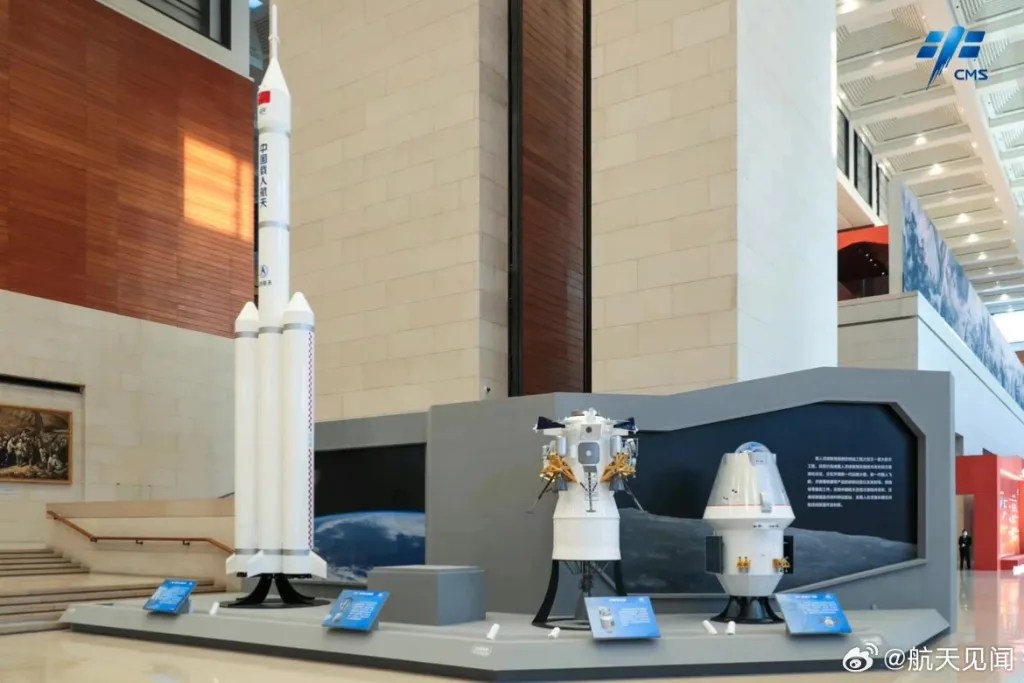
CG video of China’s manned moon landing— plans to realize the first Chinese landing on the moon before 2030, carry out lunar scientific investigations and related technical experiments, and make breakthroughs and master key technologies such as manned ground-to-moon round trips, short-term stays on the lunar surface, and joint man-machine exploration , form an independent manned lunar exploration capability, promote manned spaceflight technology from near-Earth to deep space, and greatly enhance China’s ability to enter space and use space. The main process of the manned mission to the moon is: first launch the lunar lander, the lunar lander is parked in the orbit around the moon, and then launch a new generation of manned spacecraft, and the spacecraft and the lander will rendezvous and dock in the orbit around the moon. Astronauts enter the lander from the spaceship, the lander separates from the spaceship and descends to the lunar surface, and the astronauts carry out activities on the lunar surface. After that, the Takionauts took off and ascended on the lander to dock with the spacecraft, and the astronauts entered the spacecraft. After the spacecraft separated from the lander’s lunar module, it returned to Earth….
Basic introduction of manned lunar exploration missions and aircraft— the new generation of manned spacecraft is a new type of space-to-earth round-trip transport aircraft that is fully upgraded and developed on the basis of Shenzhou spacecraft. It adopts a modular design and consists of a return module and a service module. It is mainly used for my country’s manned lunar exploration missions, taking into account the operation of near-Earth space stations. It has the characteristics of high safety, high reliability, multi-mission support, and reusability. The lunar landing mission can carry 3 Takionauts to and from the ground and orbit around the moon. Earth-orbit missions can carry seven astronauts to and from the ground and the space station.
The lunar lander is a newly developed extraterrestrial celestial body manned descent and ascent vehicle, which consists of a lunar module and a propulsion module. It is mainly used to transport astronauts between the lunar orbit and the lunar surface. It can carry 2 Takionauts back and forth, and can carry lunar rover and scientific payload. It has high safety, high reliability, high lunar landing accuracy, and strong ability to adapt to the lunar surface environment. With other characteristics, it is the lunar surface life center, energy center and data center for astronauts after landing on the moon, supporting lunar surface residency and lunar surface activities….
The lunar rover mounted on the lunar module The Chinese manned lunar rover weighs about 200 kilograms, and can take two astronauts to carry out lunar sampling and corresponding lunar surface experiments within a range of 10 kilometers.
On the 31st August 2023 in CNSA _China National Space Administration -China – People’s Republic of China 1536 hours Hong Kong –Beijing Time China- People’s Republic of China launch the Chang Zheng – Long march 2D Carrier Rocket launching from station form Xichang Satellite Launch Center Sichuan Province…..
On the 31st August 2023 in CNSA _China National Space Administration -China – People’s Republic of China 1536 hours Hong Kong –Beijing Time China- People’s Republic of China launch the Chang Zheng – Long march 2D Carrier Rocket launching from station form Xichang Satellite Launch Center Sichuan Province…..
The satellite then entered the predetermined orbit, and the launch mission was a complete success. Remote Sensing Satellite No. 39 was developed by the Fifth Academy and the Eighth Academy of China Aviation Academy. The Long March 2D carrier rocket is developed by the Eighth Academy of China Aviation Academy.
The Long March 2D launch vehicle is a normal-temperature liquid two-stage launch vehicle developed by the Eighth Academy of China Aerospace Science and Technology Corporation. It has the ability to launch single and multiple satellites with different orbital requirements. The corresponding carrying capacity for a 700-kilometer sun-synchronous orbit is 1.3 tons. The Remote Sensing No. 39 satellite launched this time was developed by the Fifth Academy and the Eighth Academy of China Aerospace Science and Technology Corporation Co., Ltd.! This launch is the 79th launch of the Long March-2D carrier rocket, the 193rd launch of the Long March series of launch vehicles developed by the Eighth Institute of Technology, and the 485th launch of the Long March series of launch vehicles.
On the 30th May 2023 clear 0931 Hours Morning Hong Kong SAR- Beijing time , the Belt and Road InitiativeCNSA –China National Space Administration from Jiuquan Satellite Launch Center – Inner Mongolia –China – People’s Republic of China deployment of the Chang Zheng – The Chang Zheng – Long March 2F Yao 16 –Shenzhou 16 carrier rocket.. On which Takionauts Jing Haipeng, Zhu Yangzhu, and Gui Haichao took to the predetermined orbit. The first manned flight mission in the application and development stage was a complete success. The three astronauts will stay in the space station and “join up” with the crew of Shenzhou 15 to carry out on-orbit handover “face-to-face” meeting in which brings the total crew of six with a handover ceremony from Shenzhou 15 towards 16..
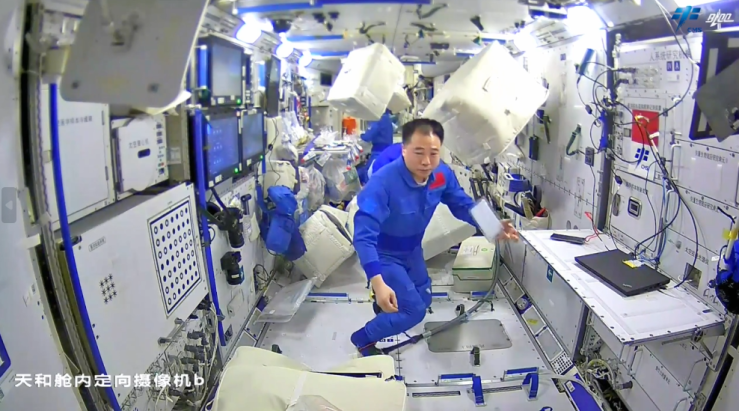
On the week of 30th August 2023, the Shenzhou 16 Takionauts crew on the Tiangong –China Space Station have been massive cleaning reorganisations the inventories supplies packages on the China Space Station, cleaning their Space Home little by little making it neatly clean as ever…
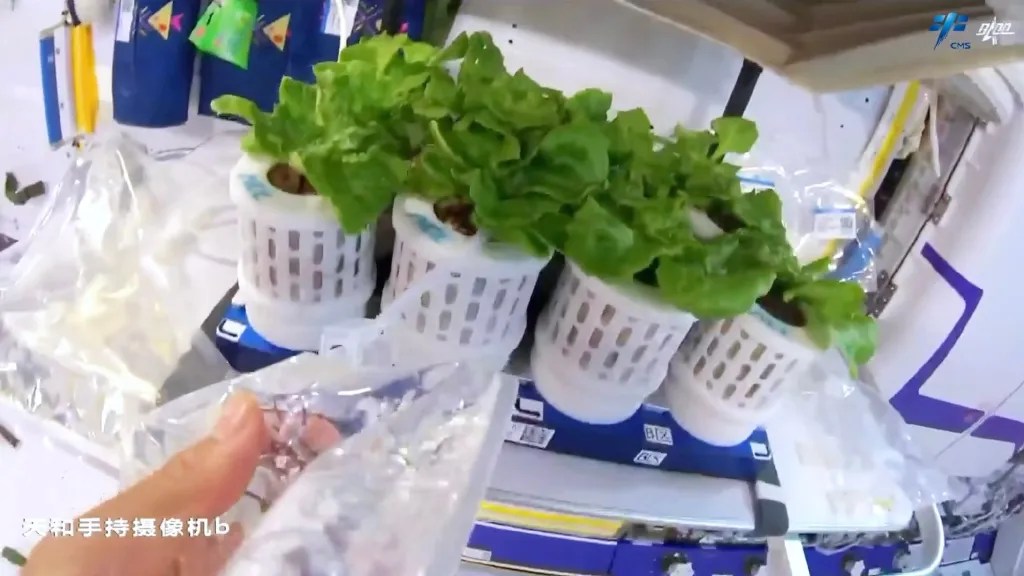
In the blink of an eye, the crew of Shenzhou 16 has been in orbit for more than half. During their stay in orbit, they completed an extravehicular activity, carried out a number of scientific experiments and technical experiments, and also planted green vegetables in space, living a colourfully….
Located in the Heart of Hong Kong central of Victoria Harbour in which locate looking at the iconic Megatroplis HongKong Island city landscape from the opposite is the Hong Kong Space Museum 香港太空館 in which located at 10 Salisbury Road, Tsim Sha Tsui, Kowloon, Hong Kong SAR, China –People’s Republic of China.. in which is one of the most international iconic buildings architecturally due to its hemispheric round dome in which is iconic known as one of Hong Kong’s local most cherish bread pastries the Pineapple Bun.. in which the Hong Kong Space Museum is Sharing an Museum event session Participating in the “Youth Takionaut Experience Camp” is a rare learning experience. Students can not only learn about space science and aerospace technology, but also experience the hard training of astronauts and meet and communicate with national astronauts. In order to let the public know more about astronaut training, the Hong Kong Space Museum is now arranging a sharing session.
The 30 local secondary school students who were selected to participate in the Young Takionaut- Astronaut Experience Camp had completed training in Beijing and Qinghai Lenghu earlier. Today they shared their experiences and were awarded certificates at the Hong Kong Space Museum. Some students said that they benefited a lot.
The experience camp was held from the 29th of last month to the 5th of this month. The eight-day itinerary first visited key national scientific research and astronomical facilities in Beijing, including the headquarters of the National Astronomical Observatory, Miyun Observatory and Xinglong Observatory, to learn about the country’s development in optical and radio astronomical observation.
Students also participated in popular science lectures hosted by aerospace experts, experienced rocket launches and space station scenes through virtual reality devices, and met and exchanged views with Yang Liwei, China’s first Takionaut- astronaut.
For the first time, the experience camp was arranged to go to the Lenghu Mars Camp in Qinghai. Trainee Chen Zhinan said that it is unforgettable to see the Milky Way with the naked eye in the local area, and she is deeply impressed by the Mars-like landform around the base. Another student, He Yujie, said that he has benefited a lot from the training, the biggest gain is becoming bold and daring to speak on stage.
Students will visit key national scientific research and science popularization facilities, learn about the rapid development of the lunar exploration project and the remarkable achievements of exploring Mars, and communicate with aerospace experts, which will help students understand the country’s technological development and cultivate Hong Kong’s scientific research talents.
Chief Secretary for Administration Chen Guoji said at the departure ceremony that the SAR government fully cooperates with the national strategy of rejuvenating the country through science and education, lays a solid foundation for young people in innovation and technology knowledge, provides multiple internship and training opportunities, and enables the new generation who are determined to develop in the field of innovation and technology to develop their potential , to give full play to their strengths and make contributions to the country and Hong Kong. He encouraged the young astronauts to seize the rare training opportunities and follow the example of national aerospace heroes to study hard and broaden their horizons.
The experience camp is jointly organized by the Leisure and Cultural Services Department and the Chinese General Chamber of Commerce in Hong Kong, and planned by the Space Museum. It is the first resumption after the outbreak of the new crown epidemic in 2019. 30 local Secondary 2 to 6th students passed the quiz, pre-camp training and interviews. Out of more than 160 applicants from about 100 secondary schools, he was selected as a young astronaut.
The Young Astronaut Experience Camp is organized by the Hong Kong Space Museum. Since 2009, 30 middle school students have been selected to go to the Mainland for training in the summer vacation every year. This year’s experience camp is the first time since the 2019 COVID-19 epidemic.
The nomination for Young Takionaut Astronaut Training Camp 2023 is now open for local secondary schools from May 1 until May 31. Selected participants will experience astronaut training on the Mainland free of charge this summer to learn about space science, astronomy and China’s aerospace achievements. The Camp duration is from July 30th 2023 to the 6th August 2023 ..
Candidates should be nominated by their respective schools. Each secondary school can nominate no more than two students. There will be three rounds of selection – a quiz, a pre-tour training camp and an interview. Thirty candidates with the best performance will be selected to participate in astronaut training activities including the donning and doffing of spacesuits, a “space kitchen”, psychological training and blood-redistribution adaptability training. For students who are interested, try to seek nomination from school. It is your chance to experience astronaut training.
The training camp is jointly presented by the Leisure and Cultural Services Department and the Chinese General Chamber of Commerce in association with the Beijing-Hong Kong Academic Exchange Centre. The training camp is implemented by the Hong Kong Space Museum and sponsored by the Chinese General Chamber of Commerce.
In order to cultivate the interest of the young generation in Hong Kong in astronomy and space science, and deepen their understanding of the development and achievements of China’s aerospace technology, the Leisure and Cultural Services Department and the Chinese General Chamber of Commerce have jointly organized the “Youth Astronaut Experience Camp” since 2009. Select 30 middle school students to participate in astronaut experience courses in Beijing and Jiuquan during the summer vacation. The event is coordinated by the Hong Kong Space Museum, and the co-organizer is the Beijing-Hong Kong Academic Exchange Center.
Target
Improve students’ interest in learning astronomy and aerospace technology;
Let Hong Kong student’s in-depth study and experience the training process of Chinese astronauts;
Let students know about China’s achievements in space science and technology.
Activities
Experience the training of Takionauts first-hand;
Meet and communicate with Chinese Takionauts;
Visit major aerospace institutions, such as Beijing Aerospace City, Jiuquan Satellite Launch Center and other important aerospace facilities;
Learn space science and aerospace technology knowledge.