#MadeInChina #中國製造 #ExPace | #November2021|#酒泉衛星發射中心#JiuquanSatelliteLaunchCenter #CASIC Rocket Technology Company #Expace #PrivateChineseSpaceCompany #Wuhan #CarrierRocketCompany #CarrierRocket #Kuaizhou 1A #KX1A Launches successfully to deploy of the a #Satellite …the two year anniversary …

During today on 13th November 2021 it is the 13th November 2019  two year anniversary Hong Kong SAR – Beijing time at one of many CNSA China National Space Administration launch complexes酒泉衛星發射中心 Jiuquan Satellite Launch Center in Dongfeng Aerospace City – inner Mongolia –China – People’s Republic of China on中國製造 Expace Technology Corporation, 2019, the Kuaizhou No. 1A solid carrier rocket ignited and lifted off at the Jiuquan Satellite Launch Center. Successfully launched and deployed mode, satellite was sent into the scheduled orbit, and the launch mission was a complete success.


Xiaotai the Kuaizhou-1A Carrier Rocket named “Our Spacecraft” was successfully launched. We became the first company to name the rocket. New media. Since then, we will celebrate every successful launch of China Aerospace.

The Kuaizhou-1A rocket was named “Kuaizhou Since its first commercial launch mission on January 9, 2017, the Kuaizhou-1A rocket has successfully completed 11 launches and fulfilled its contract. The satellite successfully entered the scheduled orbit and the launch mission was a complete success. This mission is the 13th flight of the Kuaizhou-1A carrier rocket

Currently at the moment中國製造 Expace Technology Corporation- a CASIC -China aerospace science and industry corporation has been very busy in building a New Carrier Rocket Factory in Wuhan National Aerospace Industrial Base in which the base will be in operations in May 2020   Kuaizhou Rocket Industrial Park that forms the manufacturing of twenty plus more Kuaizhou Rockets also its other sister larger carrier rockets in process of The assembly test capability of 20 solid launch vehicles……

Images and visuals are from Weibo also from their respectives ..

#CNSA #ChinaNationalSpaceAdministration #国家航天局 |#BeltAndRoadinitiative #November2021| #CMS #ChinaMannedSpace The International Iconic #CSS #ChinaSpaceStation #TianheCoreModule #Shenzhou12 crew #Takionaut Nie Hainsheng of #EarthPhotography with timeless stunning #Earth Orbiting #Astrophotography  through his bedroom porthole window

中国空间站 Today On 13th November 2021 in which during On 9th September, 2021, at Hong Kong SAR – Beijing Time  morning, the Belt and Road Initiative CNSA –China National Space Administration  CSS China Space Station in which on a three month setting up a new home of the first three Shenzhou 12 crew Takionauts –Chinese Astronauts Nie Haisheng – Liu Boming – Tang Hongbo …  in which on that Thursday Official release! The Stunning photography works taken by the Shenzhou 12 Takionauts in orbit are stunning timeless in incredible stunning photography detail through the China – The China Manned Space Engineering Office officially released the Shenzhou 12 manned mission 3 Takionauts in orbit photography shot 从空间看地球 high-definition pictures…..   The Shenzhou 12 astronaut crew take you to appreciate the shocking beauty of the earth from the first perspective of the Takionauts though their time during the three months in Earth’s orbit in which last week of November 2021 all three of Shenzhou 12 crew are doing fine as their recovery into readaptivness of   Earth’s environment also out from quarantine are back to work and with their families.

During that time of Shenzhou 12 crew Commander Nie Haisheng photography shot through the day and the core pillars cabin portholes Chinese section of the space station robotic arm large video.. Many have wondering where was his bedroom in which where was his Space Station porthole window of The case is solved…! It was taken by Nie Haisheng!  : And it should be taken through the portholes of the large column of the core cabin. Compared with the portholes in the sleeping area, its angle of view is more suitable for space station photography!  He used a special camera to shoot outside through the porthole; the effect is different from the surveillance camera in which gives a different perspectives on resolution and definition..

Looking through the large column portholes when Tianhe Robotic Arm ……Shenzhou 12 enters the Tiangong space station, there are more three portholes in the living area of ​​the small column section of the Tianhe core cabin, and these three portholes are only facing the second and fourth quadrants. Quadrant, the viewing field is limited.

Indeed, the Tianhe core cabin is equipped with multiple panoramic outside high-definition cameras, plus the wrist binocular camera of the Tianhe robotic arm, which can achieve all-round imaging without blind spots.


However, relying solely on electronic equipment is not a fool proof option, and visual portholes have the advantage of reliability.

For example, the three portholes in the residential area can directly visually observe the outer surfaces of the Wentian experimental cabin and the Mengtian experimental cabin in the future.

In fact, in addition to the portholes in the residential area, there is also a porthole at the second quadrant of the front cone of the large column section. There is a robotic arm adapter near the porthole, and the Tianhe robotic arm is parked here.

On the one hand, the porthole can directly observe the sky and the robotic arm, and it can also visually observe the radially docked Shenzhou spacecraft. After the Tiangong space station enters the operational phase, it can also record the radial docking of the Shenzhou spacecraft in high definition from here.

Images and visuals are from Weibo also their respectives.

#CNSA #ChinaNationalSpaceAdministration #国家航天局 |#BeltAndRoadinitiative #November2021| #CMS #ChinaMannedSpace the crew #Shenzhou13 #Takionaut crew First  #Spacewalk #CSS #ChinaSpaceStation #TianheCoreModule l #WangYaping #ZhaiZhigang #YeGuangfu …. Without mentioning “feeling good”, just ask how difficult it is to get out of the cabin?

中国空间站 On 8th  November 2021 Hong Kong SAR – Beijing Time  morning, the Belt and Road Initiative CNSA –China National Space Administration  CSS China Space Station in which on a three to six months setting up a new home of the first three Shenzhou 13 in which spending up to on for the further construction and verifications of the systems of the CSS –China Space Station 2021 launch calendar in which currently the three Takionauts current Shenzhou 13 ……  Preparations for the six months of extension of the China Space Station  In which the currently it remains awaiting for the crew of setting up home in conducting fun scientifically onboard中国空间站.. the China Space station

According to the China Manned Space Engineering Office, at 1:16 on November 8th, Hong Kong SAR-  Beijing time, after about 6.5 hours of outing activities, 神舟十一号 The crew of the astronauts worked closely together to successfully complete all the scheduled missions for the exit activity. Takionaut Zhai Zhigang and Takionaut Wang Yaping returned to the 中国空间站 Tianhe core module safely , and the exit activity was a complete success…

“Warmly congratulated the successful completion of 02 Chinese female Takionaut’s first out-of-cabin activity” “Proud of you” “Congratulations 01 walks in space again after getting out of the cabin for the first time in 2008 ” “03 We look forward to your next trip out of the cabin” ” Like your close cooperation and perfect performance “

November 8th 2021 at 1:16 Hong Kong SAR- Beijing Time The first out of the cabin of the Shenzhou 13 crew was a complete success Departure is a high-risk activity Takionauts face severe space environment Any failure may lead to the failure of the exit activity It even threatens the health and life safety of Takionauts How difficult is it to get out of the cabin?

Difficulty 1: Heaven and Earth Collaboration During the astronaut’s exit activity The ground must be able to detect and quickly deal with hidden dangers in time When the 01 Takionaut Zhai Zhigang lifted the weight lightly When you say the phrase “I am out of the cabin and feel good” again Chief Engineer Huang Weifen and ground researchers in the flight control hall Applaud excitedly…..

Behind the perfect appearance of the astronauts its countless nervous hearts guarding on the remote ground at all times.  They communicated with the astronauts and TV images always understand the operation process of the Takionauts and provide necessary guidance So as to achieve great synergy between heaven and earth

Difficulty 2: Cooperate inside and outside the cabin Takionaut No. 03 Ye Guangfu “Next Time Out” Cooperate and support two astronauts to carry out extravehicular operations in the cabin He stared at the screen in the cabin Pay close attention to the actions of Zhai Zhigang and Wang Yaping outside the cabin Simultaneously perform robotic arm operations accurately and calmly Make sure to transport them to the correct location The three-person crew in space is the strongest backing for each other Every tacit understanding of full marks is the result of thousands of meticulous exercises

Difficulty 3: Working with the robotic arm This is a mechanical arm that requires a lot of hard work. Like a dragon hovering above the space station Takionauts need to fully master the ability to “control” it Work closely with it to complete all work outside the cabin…..

As an extremely important auxiliary tool for extravehicular work, the robotic arm can grasp and operate at any angle near itself and “crawl” freely on the surface of the space station. This also requires Takionauts to have excellent psychological quality to achieve “human arms” under weightless conditions. Unity” allows the five-star red flag on the body to
stand firmly on the top of the sky

Difficulty 4: Accurate operation is foolproof . Every movement performed by Takionauts in the sky is a contest of technology and courage. If you want to smoothly execute various movements outside the cabin, you need to experience “devil-style training” on the ground. This is where every Takionaut enters. The only way to go before space is out of the capsule

Training through a variety of equipment such as virtual reality trainers, Takionauts can be familiar with the principles of extravehicular work and be proficient in the operation skills of related equipment to ensure the smooth implementation of exit activities

Difficulty 5: After personal safety protection leaves the space station and enters space,
an extravehicular space suit and some exit support equipment have become a short-term “safe haven” for Takionauts Faced with a series of tests such as space radiation with a temperature difference of more than 200 degrees Celsius, Takionauts overcome the weight of the outer space suit and carry out activities. At the same time, the outer suit also helps the astronauts withstand harsh conditions and provide them with missions in extremely harsh environments. Full of security.

During the Takionaut’s exit activity, the space and the earth were in strong coordination, the close cooperation inside and outside the cabin, with the full support of multiple parties, successfully completed the set tasks, and further tested the functional performance of the new generation of extravehicular spacesuits. Reliability and safety of supporting equipment related to out-of-cabin activities

Behind the “feel good”

From countless astronauts

“Overcome difficulties” and “Never give up”

Achieved another success of our country’s outing activities

May the astronauts enjoy the flight

Let more exciting “Chinese voices” resound through the sky

Source: China’s Manned Spaceflight​​​​

Images and visuals are from Weibo also their respectives.

#CNSA #ChinaNationalSpaceAdministration #国家航天局 |#BeltAndRoadinitiative #酒泉衛星發射中心 #JiuquanSatelliteLaunchCenter  #November2021| #CMS #ChinaMannedSpace  the crew  #Shenzhou13 #Takionaut crew #CSS #ChinaSpaceStation #TianheCoreModule performing their #HomeCleaning after a great #Meal #WangYaping #ZhaiZhigang #YeGuangfu ….

中国空间站 On 11th November 2021 Hong Kong SAR – Beijing Time  morning, the Belt and Road Initiative CNSA –China National Space Administration  CSS China Space Station in which on a three to six months setting up a new home of the first three Shenzhou 13 in which spending up to on for the further construction and verifications of the systems of the CSS –China Space Station 2021 launch calendar in which currently the three Takionauts current Shenzhou 13 ……  Preparations for the six months of extension of the China Space Station  In which the currently it remains awaiting for the crew of setting up home in conducting fun scientifically onboard中国空间站.. the China Space station

This is  fourth episode of the second season of Tiangong China Space Station Clean the Space House Cleaning after a great meal , After watching the food story of the Shenzhou 13 Taikonauts in space, how to clean the space house after a meal, come and see Ye Guangfu’s small theatre “Wipe the Air”! And you can never think of how to gargle in space. In which also clean the tableware after eating in space? What should I do if the drink is spilled? Sort the garbage? Information center manned spacecraft office….

 Images and visuals are from Weibo also their respectives.

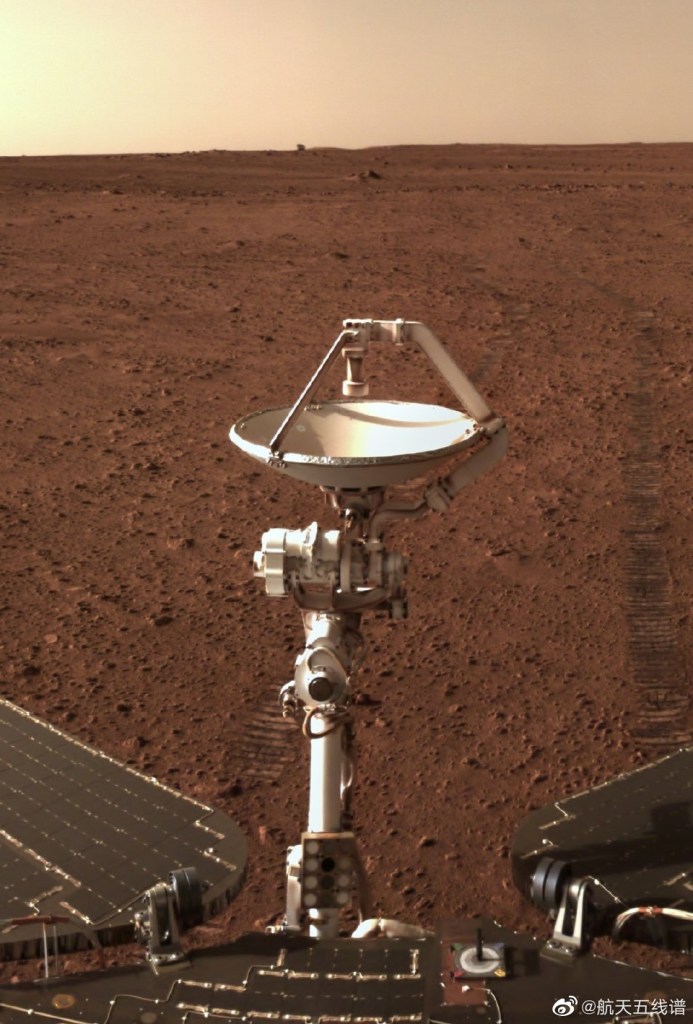
#CNSA #ChinaNationalSpaceAdministration #國家航天局 |#BeltAndRoadinitiative #November2021 |#火星 # 天問 #天问一号#TianwenOne #MarsMission #Marslander #MarsRover #Tianwen1 probe  #祝融号 #ZhuRong Tianwen No.1 probe orbiter enters remote sensing mission orbit on the #RedPlanet #Mars#天问一号探测器进入日凌阶段…

On the  8TH November 2021 Friday 天问一号飞運騎遊達达3亿CNSA – China National Space Administration – ESA – European Space agency Belt and road initiative mars mission…first Mars exploration mission, Tianwen- Martian Probe One …….祝融号Zhu Rong”  also have been exploration Roamingly1,253 meterson the Rustic half diameter planet size Red planet Mars… During that time Tianwen-1 orbiter enters remote sensing mission orbit…


November 8, 2021, “Heaven” successfully implemented around the fifth brake near the fire, into the exact orbit remote sensing mission, the Mars Global to carry out remote sensing. In the early stage, the “Zhurong” Mars rover has successfully completed the established inspection mission objectives, and is in good condition, and continues to carry out the detection mission. Considering the global remote sensing detection of the orbiter and the relay communication requirements of the Mars rover, the engineering development team optimized the orbit design and determined a remote sensing orbit plan with a near fire point of about 265 kilometers, a far fire point of about 10,700 kilometers, and a period of about 7.08 hours. While ensuring the development of orbiting scientific exploration, it will provide more relay communication support for the Mars rover to improve the efficiency of mission development.

n the remote sensing orbit, seven scientific payloads including mid-resolution cameras, high-resolution cameras, subsurface detection radars, mineral spectrum analyzers, magnetometers, ion and neutral particle analyzers, and energy particle analyzers will be acquired Scientific data such as fire star morphology and geological structure, surface material composition and soil type distribution, atmospheric ionosphere, Martian space environment, etc., focusing on typical landforms and geological units such as craters, volcanoes, canyons, and dry river beds, and implement high-resolution detection.

Up to now, the orbiter has been in orbit for 473 days, the ground fire distance is 384 million kilometers, and the light travel time is 21 minutes and 20 seconds; the rover has worked on the surface of Mars for 174 Mars days and travelled 1,253 meters in total. The two devices are in good condition. The working condition is normal. 

​2021年11月8日,“天问一号”环绕器成功实施第五次近火制动,准确进入遥感使命轨道,开展火星全球遥感探测。前期,“祝融号”火星车已圆满完成既定巡视探测任务目标,各项状态良好,继续开展探测任务。综合考虑环绕器全球遥感探测和火星车中继通信需求,工程研制团队优化了轨道设计,确定了近火点约265千米、远火点约1.07万千米、周期约7.08小时的遥感轨道方案,在保证开展环绕科学探测的同时,为火星车提供更多的中继通信支持,提升任务开展的效率…


在遥感轨道,环绕器中分辨率相机、高分辨率相机、次表层探测雷达、矿物光谱分析仪、磁强计、离子与中性粒子分析仪、能量粒子分析仪等7台科学载荷,将获取火星形貌与地质构造、表面物质成分与土壤类型分布、大气电离层、火星空间环境等科学数据,重点关注陨石坑、火山、峡谷、干涸河床等典型地貌和地质单元,实施高分辨率探测。

截至目前,环绕器在轨运行473天,地火距离3.84亿千米,光行时21分20秒;火星车在火星表面工作174个火星日,累计行驶1253米,两器状态良好,各系统工况正常。  


Images and visuals are from CNSA- China National Space Administration also from there respectives..

Author: Geng Yan Chen Gang