中国空间站 On currently on December 2021, the Belt and Road InitiativeCNSA –China National Space Administration CSS China Space Station in which on a three to six months setting up a new home of the first three Shenzhou 13 in which spending up to on for the further construction and verifications of the systems of the CSS –China Space Station 2021 launch calendar in which currently the three Takionauts current Shenzhou 13 …… Preparations for the six months of extension of the China Space Station In which the currently it remains awaiting for the crew of setting up home in conducting fun scientifically onboard中国空间站.. China Space station …..
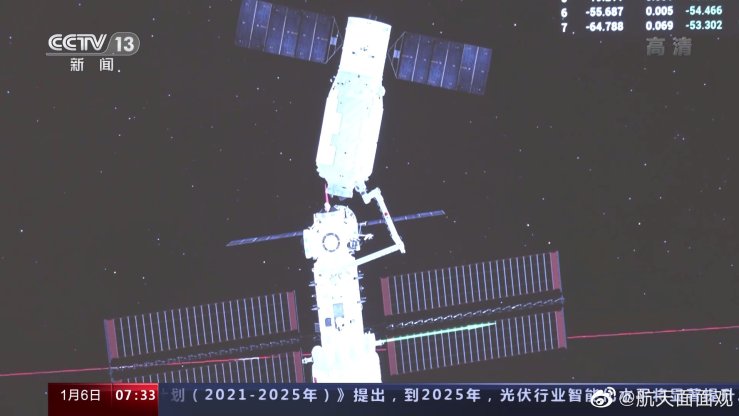
On At 06:59 Morning Hong Kong SAR- Beijing Time on January 6th Thursday, 2022, CSS China Space Station manipulator arm transposition cargo spacecraft test was a complete success. This is China- People’s republic of China’s first use of the China space station manipulator arm to operate a large on-orbit aircraft for transposition test. The test preliminarily tested the feasibility and effectiveness of using the robotic arm to manipulate the transposition of the space station section, and verified the space station section transposition technology and the robotic arm large-load control technology…..
The relocation Tianzhou-2 cargo spacecraft will cooperate with the Takionauts to complete the manual teleportation test in the next step…… After the Tianzhou-2 cargo spacecraft has completed today’s transposition test, the next step will be to cooperate with the astronauts to complete the manual teleportation test. After all the missions are over, they will choose an opportunity to re-enter the atmosphere.
Yang Sheng, the overall chief designer of the Tianzhou-2 cargo system of the Fifth Academy of Aerospace Science and Technology Group: It is the Takionauts who control the cargo spacecraft in the core compartment, and then carry out manual remote control evacuation and docking experiments. Now there are two modes of cargo ship rendezvous and docking. Normally, it is automatic rendezvous and docking. If there is an abnormal situation, we also have a manual remote operation backup method. This is actually an on-track verification of the backup method. According to Yang Sheng, after completing all tasks, Tianzhou-2 will leave the core cabin of the space station at an opportunity. Before it departs, it will pack up the waste and burn it in the atmosphere. This is also one of the key technologies for the construction of the space station.
Yang Sheng, the overall chief designer of the Tianzhou-2 cargo system of the Fifth Academy of Aerospace Science and Technology Group: After these tasks are completed, the waste will be brought back into the atmosphere and burned according to its overall consumption and lifespan. Therefore Tianzhou two cargo spacecraft. It should be up to the task, the most difficult; time will be relatively long stop of a cargo ship…..
On the 29th May 2021 Saturday Wenchang Spacecraft launch Center –Hainan Province –China – People’s Republic of China.. It was the successful launch of CNSA – China National Space Administration– China’s Tianzhou-2 cargo spacecraft in which was successfully launched on using a Long March- Chang Zheng 7 Medium Heavy Carrier Rocket.. in which the During this month of 16th May 2021 on a beautifully clear summery day it is the transfer of the advance Long March- Chang Zheng 7 Medium Heavy Carrier Rocket from Wenchang Spacecraft Launch Centre in Hainan Province – China – People’s Republic of China in which the Collaborative CNSA –China National Space Administration Belt and Road Initiative in which will be robotically assembled to form the China Space Station in which is a collaborative in between ESA- European Space Agency, ROSCOMMOS – UNOSA – United Nations for Office of Outer Space Affairs..
China launched the Tianzhou-2 cargo spacecraft at around 2055 hours Hong Kong -Beijing Time Saturday from Wenchang, southern China’s Hainan Province. The spacecraft, loaded with fuel, equipment and life supplies to sustain the Tiangong Space Station, is carried by the Long March-7 Y3 carrier rocket. As CGTN provide a special coverage gives you more details about Tianzhou-2 and China’s space station project…..
During the Docking procedures Space station and cargo spacecraft can be connected to the grid for power generation…According to the Eighth Academy of Aerospace Science and Technology, after the core cabin is successfully docked with the cargo spacecraft, in the combined flight mode, in order to ensure the power generation capacity of each cabin and the cargo spacecraft, the core cabin and the cargo spacecraft The cargo spacecraft will be connected to the grid for power supply. At that time, the core cabin can provide up to 2,000 watts of power to the cargo spacecraft. Although compared with the “big family” of the core cabin, the cargo spacecraft has only one third of the power supply capacity of the core cabin, but at critical moments, the cargo spacecraft can also provide about 1,000 watts of power to the core cabin.
“The core cabin supplies power to the cargo spacecraft, mainly considering that the cargo spacecraft is installed at the stern of the core cabin, and the cargo spacecraft’s solar battery wings are small in size and are easily blocked by other combinations of the space station. The cargo spacecraft supplies power to the core cabin for the purpose of Responding to the very few special situations that may occur in the future space station, this also demonstrates the flexibility and reliability of the power supply of the entire space station assembly.” Wang Zhenxu, chief designer of the power supply subsystem of the cargo spacecraft, introduced. In order to receive the 2000 watts of power gift from the core cabin, the cargo spacecraft itself needs to undergo a high-voltage grid-connected adaptation process. In response to the above problems, the developers of the Eighth Academy of Aerospace Science and Technology conducted a series of verification experiments to ensure that the normal operation requirements of the cargo spacecraft are met.
When the cargo spacecraft is connected to the core cabin for power supply, how to deal with the excess electricity? Developers have their own methods. Wang Zhenxu introduced that in the Tianzhou No. 2 cabin, a shunt regulator is installed, through which the excess electricity of the solar battery wing can be shunted. In the future, there will be the challenge of joint power supply of multiple combinations, but the power sub-system can always adapt. This is the intelligent management of the power sub-system in the space station era.
The newly advance variant of the Long March –Chang Zheng 7 Carrier Rocket has more than 130 improvements to make its performance better] This mission is the third launch of the Long March 7 carrier rocket. 4 years have passed since the Long March 7 Yao-2 launches. During this period, the model team Carried out a large number of optimized and improved designs, which not only realized the technological leap from “zero window” to “narrow window” launch, but also through more than 130 improvements such as simplifying and optimizing the on-board measurement system, and optimizing the tank pressurization design. The rocket has better performance and is more conducive to batch production and high-density launch.
Simplify and optimize the design of the on-arrow measurement system. The measurement parameters used for research have been deleted. The number of measuring points on the arrow has been reduced by about one-third, and the number of stand-alone measurement systems has been reduced by nearly half. This not only saves costs, but also helps to improve the sampling accuracy of some key parameters. In addition, this rocket also uses a high-rate Ka-band space-based measurement system. Compared with the S-band measurement system used by the Long March 7 Yao-2 launch vehicle, the transmission code rate has been increased by more than 20 times, realizing the full range of rocket flight telemetry. No blind spots.
Optimize the design of pressurization of the tank on the arrow. Combining the analysis of the results of the previous two flight tests, the booster reduces one tank booster gas cylinder without affecting normal use, and optimizes the boost pressure control bands of each module tank to increase the boost pressure. Utilization of gas. The rocket boost, the first-stage tail end and the first-stage transition section are changed from composite coating to ordinary coating. After the improvement, the construction process is simplified and the production cycle is shortened. Taking the first-level post-transition section as an example, the improved production cycle has been shortened from about 18 days to 13 days, laying the foundation for subsequent mass production. Focusing on zero-window launch, focusing on flight success or failure, sorting out one detail by one detail, fully identifying the weaknesses in the design and making improvements, in addition, drawing inferences about other rocket quality issues from the mechanism to ensure the complete success of this launch mission….
Previously on the 16th May 2021 it’s was Transferring from the final complete advance Long March- Chang Zheng 7 Medium Heavy Carrier Rocket from the vertical assembly building in which has been transferred launch complex.. …. According to the China Manned Space Engineering Office, on May 16, the combination of the Tianzhou-2 cargo spacecraft and the Long March-7 carrier rocket was transferred to the launch area. At present, the facilities and equipment at the launch site are in good condition, and various functional inspections and joint tests before launch will be carried out as planned.
On the morning of May 16, the ship-and-arrow combination of the Tianzhou-2 cargo spacecraft and the Long March 7 Yaosan carrier rocket was launched at the event Driven by the platform, it was successfully transferred from the 502 vertical assembly test plant to station 201 in the launch area. At present, the facilities and equipment at the launch site are in good condition, and various functional inspections and joint tests before launch will be carried out as planned…. On which it was a family and media day for the staff that worked for Wenchang Spacecraft launch complex ….
One of the many foods menus that been onboard is Fish-flavoured pork shreds and Gongbao chicken in space Tianzhou-2 will carry 3 people and 3 months astronaut consumables, 2 sets of extravehicular space suits and platform materials, and dock with the core module; During its docking at the space station, a number of in-orbit tests will be carried out as planned. According to the space station construction plan, my country will launch the Shenzhou 12 manned spacecraft next month, and three astronauts will take the spacecraft to the core module. The three astronauts have to work and live in the core module for about three months. Therefore, they must prepare a variety of materials to facilitate their “clothing, food, shelter, transportation” and work in space. There are various daily necessities in the “express” sent by the number. The food on the space station can be described as a must-see in space, making people salivate from the sky. China’s aerospace food has many traditional Chinese dishes, with obvious Chinese characteristics. The food is not only divided into main and side dishes, but also pays attention to the combination of meat and vegetables, but also has unique flavours. Even the well-known shredded pork and kung pao chicken… all appear on the astronaut’s food list
Transfer of the Tianzhou-2 cargo spacecraft ship-arrow assembly to the launch area] According to the China Manned Space Engineering Office, on May 16th, the Tianzhou-2 cargo spacecraft and the Long March 7 Yaosan carrier rocket assembly was completed Transfer to the launch area. At present, the launch facility is in good condition, and various functional inspections and joint tests will be carried out before launching as planned….
During this month of 16th May 2021 on a beautifully clear summery day it is the transfer of the advance Long March- Chang Zheng 7 Medium Heavy Carrier Rocket from Wenchang Spacecraft Launch Centre in Hainan Province – China – People’s Republic of China in which the Collaborative CNSA –China National Space Administration Belt and Road Initiative in which will be robotically assembled to form the China Space Station in which is a collaborative in between ESA- European Space Agency, ROSCOMMOS – UNOSA – United Nations for Office of Outer Space Affairs..
Beijing TV footage of the Transfer of long March -Chang Zheng seven carrier rocket – Wechang Spacecraft Launch Center -Hainan Province – China – People’s Republic of China
Today it’s the Transferring from the final complete advance Long March- Chang Zheng 7 Medium Heavy Carrier Rocket from the vertical assembly building in which has been transferred launch complex.. …. According to the China Manned Space Engineering Office, on May 16, the combination of the Tianzhou-2 cargo spacecraft and the Long March-7 carrier rocket was transferred to the launch area. At present, the facilities and equipment at the launch site are in good condition, and various functional inspections and joint tests before launch will be carried out as planned.
On the morning of May 16, the ship-and-arrow combination of the Tianzhou-2 cargo spacecraft and the Long March 7 Yaosan carrier rocket was launched at the event Driven by the platform, it was successfully transferred from the vertical assembly test plant to station in the launch area. At present, the facilities and equipment at the launch site are in good condition, and various functional inspections and joint tests before launch will be carried out as planned…. On which it was a family and media day for the staff that worked for Wenchang Spacecraft launch complex ….