Chang Guang Satellite Technology Co is located in No. 1299, Mingxi Road, Beihu Technological Development Zone, Changchun City, Jilin Province, China People’s Republic of China.. in which their philosophy is Unity, Innovation, hard work and pragmatic ..
Their Story is CGSTL (Changguang Satellite Technology Co., Ltd) is the first commercial remote sensing satellite supplier in China. Now, CGSTL has set up a commercial business dealing with the development and operation of commercial satellites as well as remote sensing information processing all in one. hang Guang Satellite Technology Co., Ltd. ( CGSTL), founded on December 1st, 2014, it’s a unique commercial aerospace enterprise with the development and operation of satellite research, management as well as remote sensing information processing all in one. With a total registered capital of 1.97 billion RMB, the company comprises Jilin Provincial Government, Changchun Institute of Optics, Fine Mechanics and Physics (CIOMP), social capital, and technical backbone.
In the “China Unicorn Enterprise Research Report 2021” released by Great Wall strategic consulting, CGSTL became the only Unicorn enterprise in Northeast China and ranked first in the field of commercial aerospace.
COMPANY VALUE CGSTL strictly adheres to the spirit of “unity, innovation, hard-work, and pragmatic”, adopting the development concept of “mass development, broad innovation “, with the mission of “serving 7 billion people on the globe with the remote sensing information product integrating sky, space and ground”, aiming for “building internet-based remote sensing information platform, and constantly introduce innovative products”, the company goes all out to promote the industrial transformation and upgrading of Jilin Province, to drive the revitalization of the old industrial base in northeast China, and to strive to compose the brilliant chapter of the Chinese commercial remote sensing satellite.
Who is JL1- changguang Jilin 1 satellite constellation is the core project under construction by CGSTL. The first phase of the project consists of 138 high-performance optical remote sensing satellites covering video, high resolution, wide band, infrared, multispectral and other series. At present, CGSTL has sent 73 Jilin-1 satellite constellation networking remote sensing satellites into the designated orbit through 19 launches (of which, SP04 has been retired on August 31, 2022). Up to now, Jilin-1 satellite constellation has 72 in orbit remote sensing satellites, and has built the world’s largest sub meter commercial remote sensing satellite constellation.
At 1330 Hours Hong Kong SAR- Beijing Time 15th June 2023 , China- People’s Republic of China- CNSA –China National Space Administration Successfully launched the New Next Generation Long March – Chang Zheng2D carrier rocket at the Taiyuan Satellite Launch Center Shanxi Province.. launch 41- forty one Satellites in which the Chang Zheng – Long March 2D Carrier Rocket is in preparing readiness to launch in which dates back to On May 22, a total of 41 satellites set off in the Changchun Aerospace Information Industry Park, among them, “Jilin No. 1” Gaofen 03D19-26 satellites, Gaofen 06A series satellites, platform 02A01-02 The 36 satellites including Si-1 are the “Jilin-1” satellites.
The Chang Zheng- Long March 2 D yao 88 carrier rocket at the No. 9 station of the Taiyuan Satellite Launch Center, with the method of “one Carrier Rocket 41 satellites “, 41 optical remote sensing satellites of Jilin No. It entered the predetermined sun-synchronous orbit, and the launch mission was a complete success.
In response to the launch mission requirements of “one arrow with 41 satellites”, the Changerding rocket development team took a series of effective measures to ensure the safe and accurate orbiting of 41 satellites by rationally arranging in the limited fairing space and selecting the optimal separation scheme. .
[Chang Zheng – Long March 2D yao 88 /Jilin-1 “One Carrier Rocket 41 Satellites” adopts the satellite layout of wall-mounted*38+sidewall*3】
One arrow launches 41 satellites, setting a new record for the largest number of satellites launched in one time in my country. But to safely and smoothly send so many satellites into orbit at one time, the first thing to solve is the layout of the satellites in the fairing, not only to ensure “sit down”, but also “sit comfortably”. To this end, the development team of Eight Director Erding fully sorted out the structure and mission requirements of the satellites, fully tapped the potential, optimized the layout design, adopted the layout method of 38 satellites on the wall + 3 satellites on the side wall, and successfully found 41 satellites. Safe and comfortable location.
In order to allow 41 ” satellite passengers” to enjoy a comfortable flight experience, the model team effectively used the space in the fairing to move the “feet” of the “passengers” under the adapter, and opened up 3 “special seats” on the support cabin , Successfully let 41 satellites “board” smoothly. Although the form of the “seat” is relatively new, but a closer look shows that they are all high-quality parts that have been sent to the “passengers” before, which effectively guarantees the safety and reliability of this mission.
In addition, in order to avoid crowded collisions when “getting off the car”, the research and development team of the Eighth Academy ingeniously designed the “drop-off plan” to allow the satellites to separate in an orderly manner. The overall design team divided the 38 satellites on the cylindrical multi-satellite adapter into one group of “passengers” on each floor, a total of 6 groups; the 3 “passengers” on the lower support cabin were taken as the seventh group, and the satellites were carried out in sequence according to the group separate. In addition, this rocket is also equipped with 10 reverse thrust rockets. By turning on the reverse thrust rockets, the distance between each group of satellites is widened to ensure the safety of separation from each other
At 15th June 2023 , China- People’s Republic of China- CNSA –China National Space Administration Successfully launched the New Next Generation Long March – Chang Zheng2D carrier rocket at the Taiyuan Satellite Launch Center Shanxi Province.. Is set to launch 41- forty one Satellites in which the Chang Zheng – Long March 2D Carrier Rocket is in preparing readiness to launch in which dates back to On May 22, a total of 41 satellites set off in the Changchun Aerospace Information Industry Park, among them, “Jilin No. 1” Gaofen 03D19-26 satellites, Gaofen 06A series satellites, platform 02A01-02 The 36 satellites including Si-1 are the “Jilin-1” satellites.
The Chang Zheng -Long March 2D “One Carrier Rocket 41 Satellites” will be launched on the next day on expected on 16th June 2023 …. The latest batch of Jilin-1 satellites launched in the form of “One Carrier Rocket 41 Satellites” involves 3 large software systems and 4 satellite models, 41 satellites, and 50 sets of antenna equipment.
At present, the launch of “One Carrier Rocket 41 Satellites” has officially entered the countdown! It is planned to be launched from the Taiyuan Satellite Launch Center in the near future. This will create the record for the largest number of satellites launched in a single spaceflight in China
[The countdown to launch has entered! Uncover how “one Carrier Rocket 41 satellites ” is achieved? 】
How did “41 satellites with one arrow” come true this time? What’s the point? Li Feng, director of the satellite operation and management technology research office of Chang Guang Satellite Technology Co., Ltd., gave the answer in an exclusive interview with China Jilin Net!
“The launch of ‘One Carrier Rocket 41 Satellites’ poses a huge challenge to the transportation and management system. In the past, a maximum of 16 satellites were launched at one time, but this time the number has reached nearly three times that of the maximum one, and it involves multiple satellite models. For measurement and control , data transmission resources, software system development, and personnel requirements are all higher. In order to do a good job in the operation and management of 41 satellites, the colleagues in the Satellite Operation and Management Technology Research Office started the preparation work at the end of last year, and the internal and external coordination of the company , docking, and recently successfully completed the system development and the joint test of the three-wheel operation and management system, involving 3 large software systems, 4 satellite models, 41 satellites, and 50 sets of antenna equipment, and confirmed the functions, performance and interfaces of each system Matching situation. The 41 satellites launched this time include 8 Jilin-1 Gaofen 03D satellites and 30 Gaofen 06A series satellites. Among them, the weight of the Gaofen 06A single satellite has been successfully reduced to 20kg, and its performance indicators are still very advanced.
Li Feng said, “During the satellite-rocket separation stage, the 41 satellites were separated seven times successively. The separation time of each group of satellites lasted for three to five seconds. . This launch has put forward higher requirements for both satellites and rockets, including separation timing and control of satellite force and torque, so as to ensure that each satellite can enter the predetermined orbit smoothly and safely. “
After the 41 satellites launched this time (including 36 “Jilin-1” satellite constellation networking remote sensing satellites) are in orbit, they will form a network with the 72 “Jilin-1” satellites in orbit. So far, “Jilin-1” “The number of satellites in orbit has increased to 108, marking that the “Jilin-1” satellite constellation network project has successfully achieved the phased goal of “Hundred Stars Flying into the Sky”
On the 31st March 2023 clear 1427 Hours Hong Kong SAR- Beijing time , the Belt and Road InitiativeCNSA –China National Space Administration launching from Jiuquan Satellite Launch Center – Inner Mongolia –China – People’s Republic of China deployed launched the Chang Zheng – Long March 11 carrier rocket …. The Chang Zheng – Long March 4C Y49 carrier rocket..
Launched The four satellites of Yaogan 34 was launched, and the satellite successfully entered the predetermined low-earth orbit (1095km×63.41º), and the launch mission was a complete success.
Remote Sensing No. 34 04 Satellite was developed by the 509 Institute of the Eighth Academy of Aerospace Science and Technology, and will form a network operation status with the already in-orbit Remote Sensing No. 34 Satellite 01, 02 and 03. It is mainly used for national land census, urban planning, land In fields such as right confirmation, road network design, crop yield estimation, disaster prevention and mitigation, etc., it meets the needs of rapid revisiting of earth observation.
The launch missions are: ◆The 14th launch of China’s spaceflight in 2023 (complete victory) ◆The 52nd launch of global spaceflight in 2023 (48 successes) ◆The 49th launch of Long March 4C (47 successes) ◆Long March 4 The 98th launch of the No. 1 rocket series (95 successes) The 185th launch of the carrier rocket developed by the Eighth Academy of Aerospace Science and Technology The 189th launch of the Jiuquan Satellite Launch Center (174 successes) The 470th launch of the Long March series rockets (454 successes) Times) ◆ The 520th launch of China’s carrier rocket (487 successes)
The Chang Zheng – Long March 4C Y49 carrier rocket is equipped with space-based relay measurement and control system In order to meet the mission requirements, this rocket adopts a Φ4000mm Von Karman satellite fairing, and is equipped with a relay user terminal and an image measurement system. Compared with the traditional ground-based measurement and control method, the relay measurement and control, as a useful supplement to the ground measurement and control station, prolongs the receiving period of the rocket signal.
The 04-star R&D team of Remote Sensing 34 optimizes and adjusts the AIT process under the multi-line parallel, efficient and streamlined mode, and completes the development tasks of the whole star’s mechanical test, electrical aging, and operation and control application docking in one month, and successfully completes the four -satellites before leaving the factory. All final assembly test tasks. After entering the base, the model youth commando planned the work carefully, carried forward the tenacious style, and carried out the unloading task in the low temperature environment of minus ten degrees. Achieved a 100% unpacking pass rate of products and equipment.
At 1850 Hours Hong Kong SAR- Beijing Time on Spring 30th March 2023 , China- People’s Republic of China- CNSA –China National Space Administration Successfully launched the New Next Generation Long March – Chang Zheng2D carrier rocket at the Taiyuan Satellite Launch Center Shanxi Province.. successfully launched Hongtu-1 Group 01 satellites
Successfully launched Hongtu-1 Group 01 satellites into space using the Long March 2D carrier rocket at the Taiyuan Satellite Launch Center, and the satellites went smoothly Entering the predetermined orbit, the launch mission was a complete success. This group of satellites is mainly used to provide commercial remote sensing data services. This mission is the 469th flight of the Long March series of launch vehicles.
Hongtu No. 1 satellite group 01: the world’s first four-star wheel-type formation flight X-InSAR constellation! Hongtu-1 Group 01 consists of four satellites, consisting of a main star and three auxiliary satellites. It is the first X-band interferometric synthetic aperture radar (InSAR) ground imaging system flying in four-star formation in the world. This group of satellites is in orbit It constitutes the world’s first wheel-type satellite formation, in which the main star weighs about 320 kg, and the auxiliary star weighs about 270 kg.
As the first wheel-type satellite formation in the world, the four satellites are like wheels flying in space. The main star is located in the middle of the wheel, and the three auxiliary satellites are evenly distributed on the hub of the wheel. Inter-satellite communication links and phase synchronization links are used. When the distance between the auxiliary satellite and the main satellite is only a few hundred meters, the stability and space security of the satellite formation on-orbit configuration are guaranteed through precise orbit control. Compared with the traditional interference satellite system, the wheel formation has a relatively It has the advantages of stability, many interference baselines, and high mapping efficiency.
It is understood that this group of satellites has the ability to survey and map the non-polar regions of the world at a scale of 1:50,000, which can quickly and efficiently conduct high-precision surveying and mapping of global land; it has the ability to monitor deformation at the millimeter level, and can be used for the investigation of disasters such as land subsidence, subsidence, and landslides. It provides data support for prevention and control, and is a “sharp tool” for early identification of major geological hazards in complex areas; it has sub-meter-level high-resolution wide-format imaging capabilities, and can conduct high-quality imaging observations of the ground around the clock, and the overall technology has reached the international leading level. .
For the small-batch development of civil SAR satellites, Yinhe Aerospace has greatly improved the development efficiency through digital simulation, automated testing, and process optimization in the stages of satellite scheme design, whole-satellite integration, and launch site testing, and shortened the development time compared with conventional ones. more than 60%.
Through the batch development of four SAR satellites this time, Yinhe Aerospace has verified the company’s ability in the vertical integration of the industrial chain. The new commercial aerospace industry ecology accelerates the construction of space infrastructure.
On the 17th March 2023 in CNSA _China National Space Administration -China – People’s Republic of China At 1633 hours Hong Kong –Beijing Time China- People’s Republic of China launch the Chang Zheng – Long march 3B Carrier Rocket launching from station form Xichang Satellite Launch Center Sichuan Province…..Deploying the Gaofen 13-02 Earth Sciences Environmental satellite….
Long March 3B successfully launched the Gaofen 13-02 satellite successfully launch the Gaofen 13-02 satellite into space, and the satellite went smoothly Entering the predetermined orbit, the launch mission was a complete success. The satellite is mainly used in the fields of land census, crop yield estimation, environmental governance, weather early warning and forecasting, and comprehensive disaster prevention and mitigation. This mission is the 468th flight of the Long March series of launch vehicles!
The 02 satellite is a high-orbit optical remote sensing satellite, which is mainly used in emergency disaster reduction, land census, ocean observation, environmental governance, meteorological observation and other fields, and can provide information services for national economic construction.
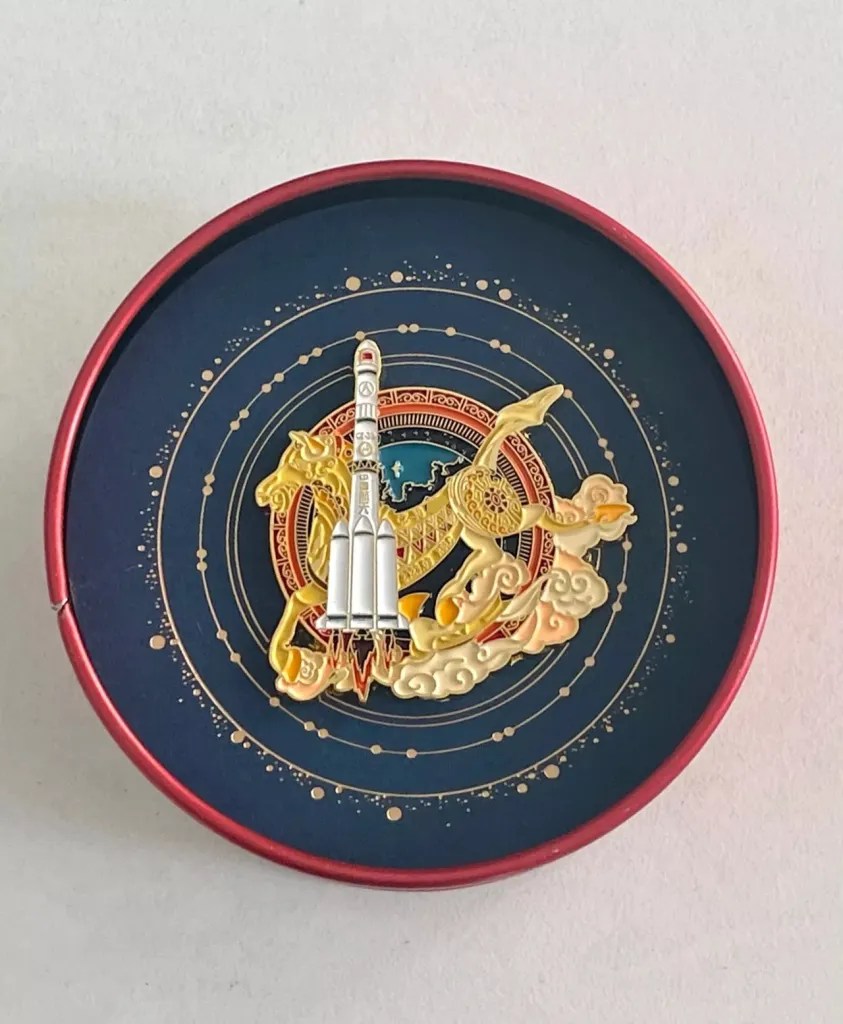
Chang Zheng – Long march 3B Carrier Rocket yao 90 launches high score 13th No. 02 satellite mission badge: This badge is inspired by the historical allusion of a horse stepping on a flying swallow. Ma Ta Feiyan is a magical and rare treasure in the history of ancient sculpture art in my country. It is a landmark building in Xichang. As an emblem element, it implies the rapid development of China’s aerospace industry and the tenacious and indomitable spirit of astronauts. The main body of the emblem is the Chang Zheng – Long march rocket, the earth is in the center of the picture, auspicious clouds surround the main body, and the stars mark the launch site, which means that one arrow and one star will be launched from here, and go forward bravely, just like astronauts bravely climbing the peak of science and technology, to write China’s aerospace industry The new chapter dares to overcome all difficulties and obstacles…..